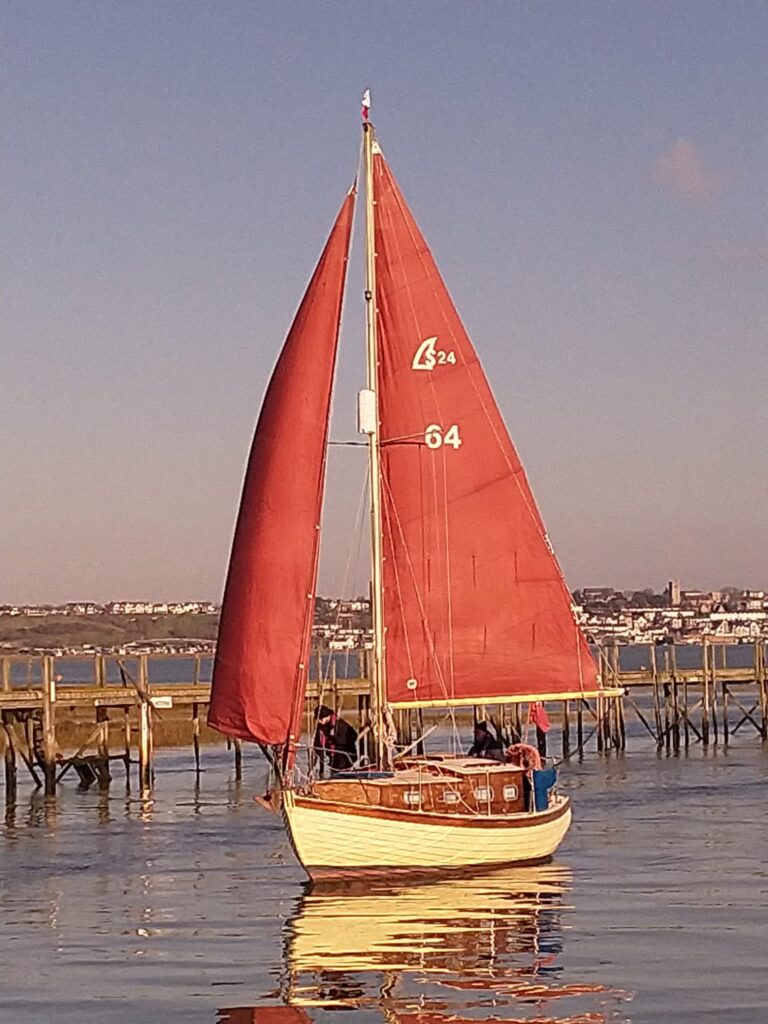
Of course, Leigh Ray a pen name and it is widely thought to be the lead author of ‘Swin, Swale & Swatchway’, Herbert Lewis Jones, actually co-written with Charles Barrett Lockwood.
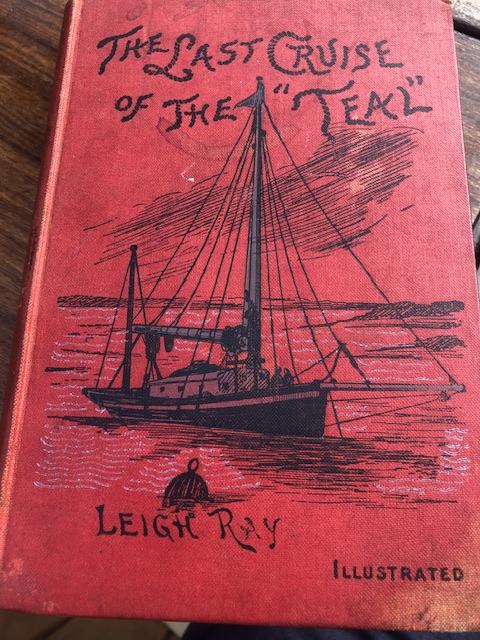
The book’s aged cover.
Ray Leigh, as many old sailing hands will know, often wrote articles for early issues of Yachting Monthly magazine.
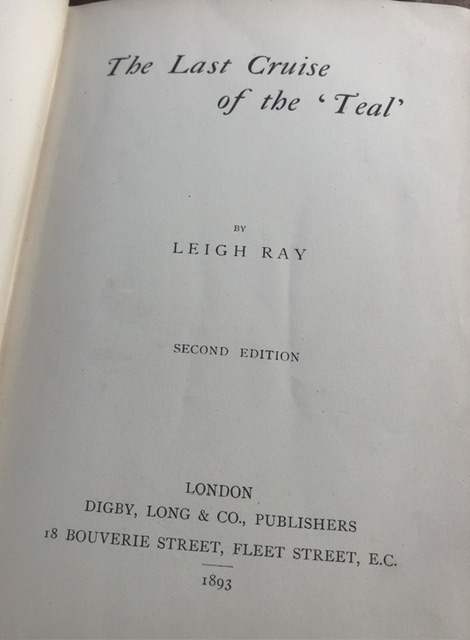
Second edition from before 1900.
Interestingly if one does a search of the two men, their medical biographies pop up but little else. In Jones’s case, sailing is mentioned as a hobby having been brought u o the banks of the River Medway. Lockwood’s biog n the other hand contains absolutely no mention of sailing… Both were doctors of some repute and died during the early years of the 1st World War.
The book was recommended by a sailing friend and I added it to a list which the mate uses for those yearly special days, and yes, it was in my birthday bag during June!
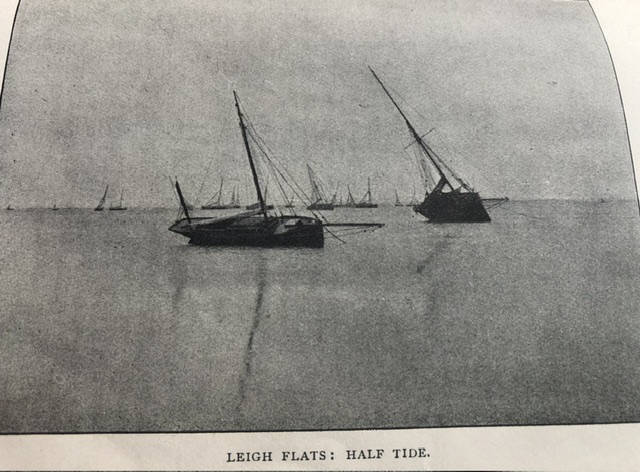
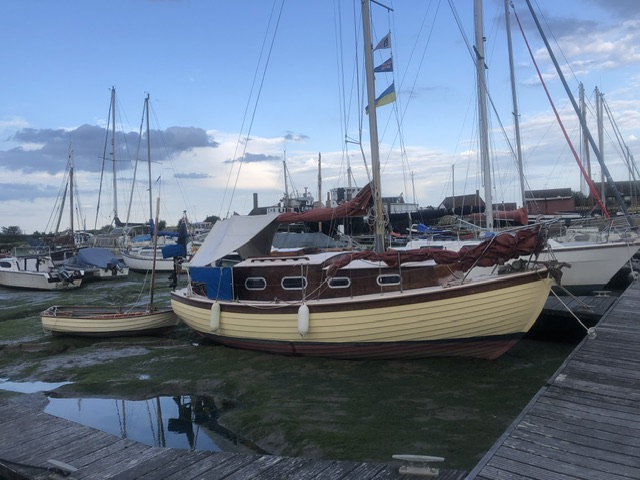
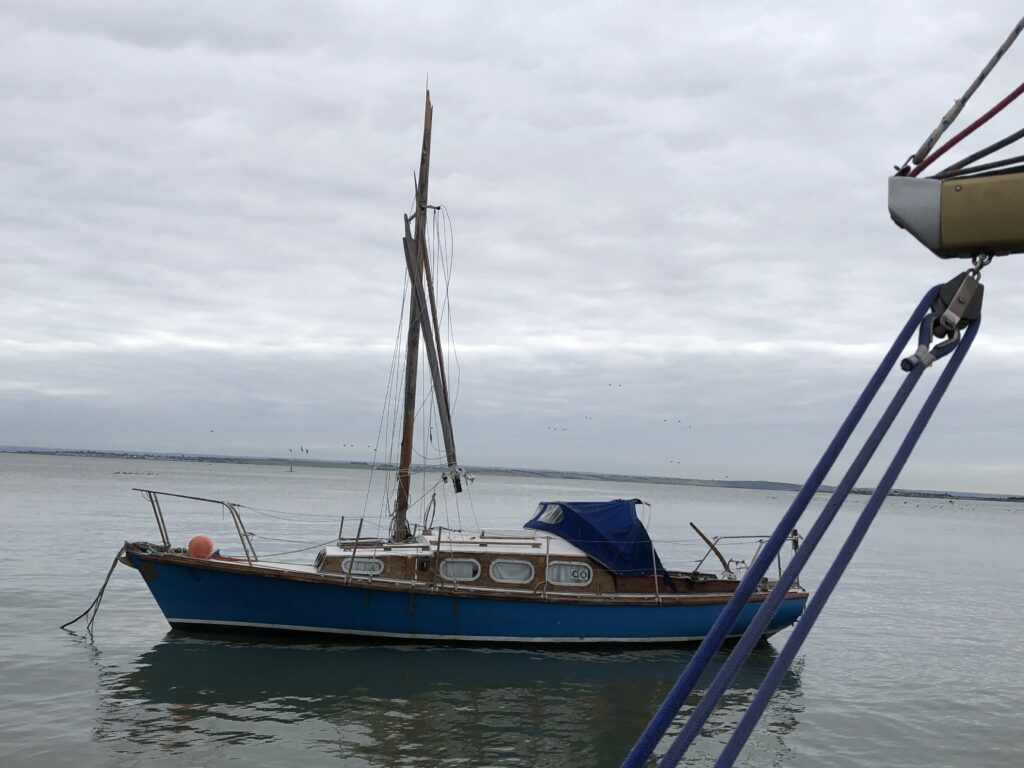
The Teal on the Leigh Flats.
The book begins in a normal enough sort of way. The Teal’s owner gathers together a friend who often sailed aboard and his younger brother. The owner has just completed his finals to become a doctor.
Embarking aboard the Teal they set off on an east coast cruise taking in the River Medway, Havengore, Burnham, The Rays’n to Maldon then up to Harwich.
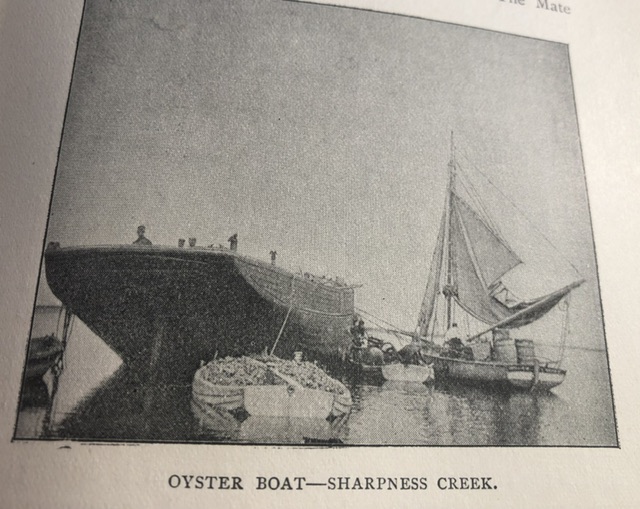
On the River Medway they cut through ‘marsh islands from ‘Sharpfleet’ Creek to investigate the oyster fishery in Sharpness Creek – now just an inlet.
Yes, oysters on the Medway. Sharpness Creek is just an inlet now.
From Harwich, the Teal then sets off, ostensibly to go either to the Deben or the Ore.
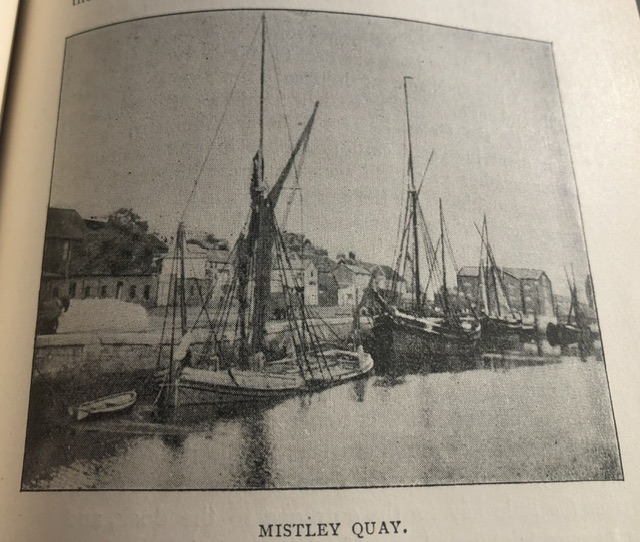
Mistley Quay visited o the cruise.
I went back several times to try and find the reason for their’ change of plan, to no avail – I clearly missed something!
The wind gets up and they are well clear of land.
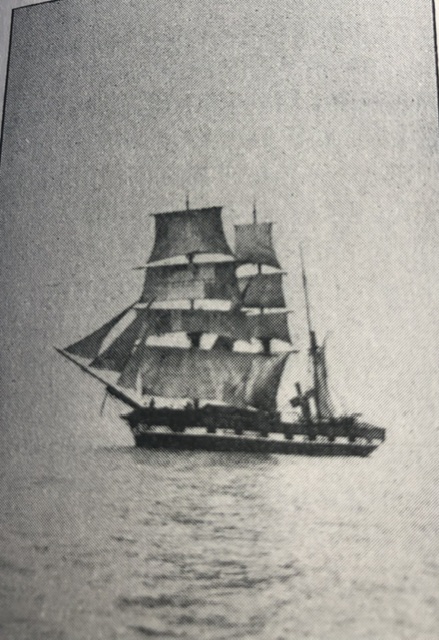
A burning sailng ship is spotted> they sail closer, close enough to see that she is unmanned. Two masts are down and they see the foremast tumble, sails ablaze…
The stricken ship?
The wind increases. The compass is broken. A full gale rages … an old sail is cut up to make a cockpit well screen and sea anchor. The story has apparently gone past he ‘informative narrative’ to pure hokum…
They are driven before the gale. The skipper was using his watch to get a kind of directional drift – it gets broken…
This goes on for what seems like days. They realise that their drift has not been as expected: they would have been cast p on an east coast shore long before!
Surf is heard. The lead is cast. Nothing. Fifteen fathom. Less. Then less again. Then more, but calmer, until an unseen sheer cliff gives protection.
The anchor is pitched over…
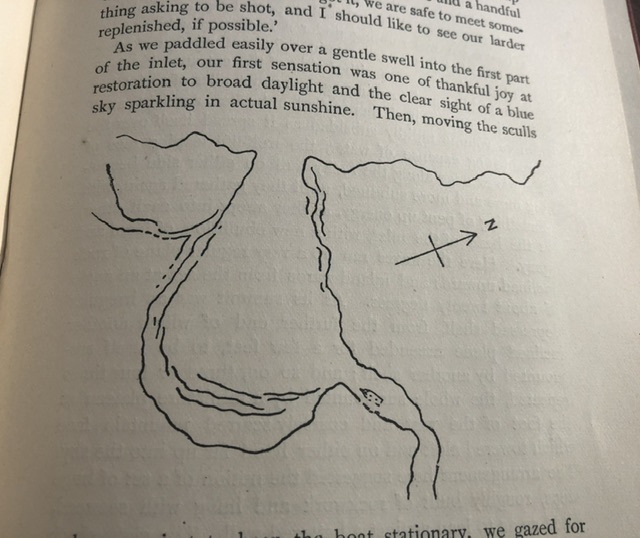
There seems to be around 25% of book exploring the cove they find themselves trapped within. A huge sailing ship wreck dominates one shore. The cove disappears into the cliff, literally, in a stream in a cave.
Making an attempt to get out of the cove, they lose anchors and are swept back, into the cave and find themselves hurtling on the ‘flood tide’ deeper inside the rock. The rock they had already discovered to be salt rock…
Sketch map of where the Teal ended up after the storm…
An amazing ‘slalom ride’ ensues, the water turning from salt to ‘fresh’. Masts are cut away … the Teal is all but wrecked and finally they beach. Their dinghy takes them out, eventually, into fresh air.
Finally, the dinghy could float no more. They set off walking living off the land and find a village. The tongue is alien to all three educated young men.
I’ve had enough …
From the village they are sent by various means of transport to Trieste and a ship home!!!
Now, anyone with a modicum of geography knows that for them to have ‘come ashore’ with Trieste as a port of releases must wonder how they got into the Baltic: that is what I perceive.I finished the book, but blimey, it was gung ho ‘boys own’ stuff.
There are some superb black and white illustrations in the first half, but after ‘the ship’ there are none. The story line says there weren’t anymore for equipment was damaged. A batch of plates were boxed and sent ashore at Harwich, apparently…
Did I enjoy it?
Well, yes. It wasn’t as expected and would make a good read for most people…
Thank you for the recommendation, John, and to my mate for its ‘expensive’ purchase…
During last autumn, I came across a book about the ‘lost’ route to Portsmouth from the R. Thames.
The Wey and Arun navigations formed the backbone of this route from the ‘east and west’ respectively (although it was almost north-south). The route was effectively closed around the time of the trip made and problems were encountered. Sections remain navigable today, but the central link has been lost.
I then alighted on a short tale by J B Dashwood in which the chap describes a holiday cruise from the River Thames along the ‘lost’ route to the sea via the River Arun, then a coast passage to home on the Solent shores…
The book is a reprint edition.
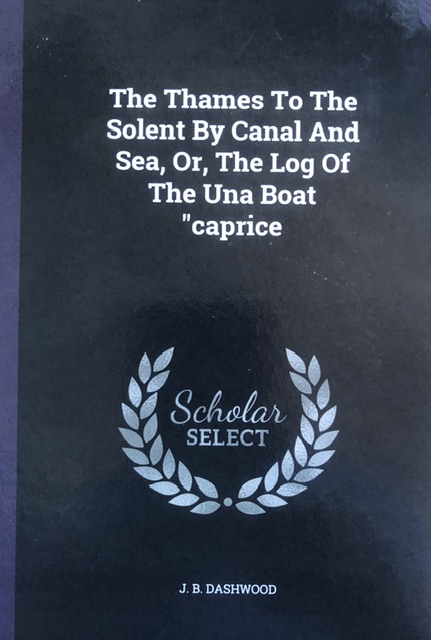
The reprint cover.
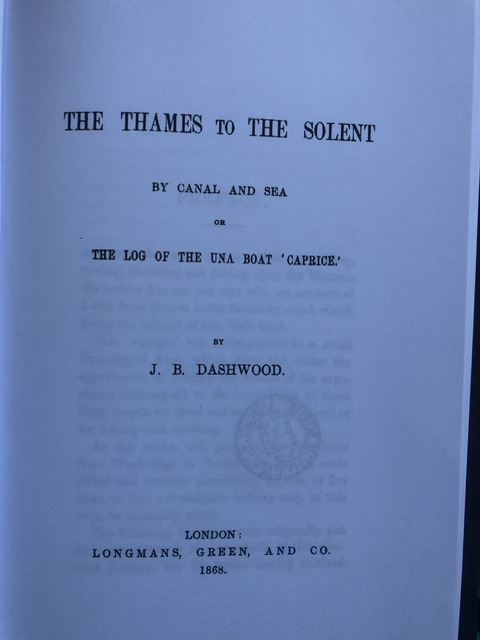
The book was first published in 1865, at the insistence of Dashwood’s friends!
The original title page.
It is striking for one major reason: his mate for the trip is his wife who seems to have been of hardy stuff.
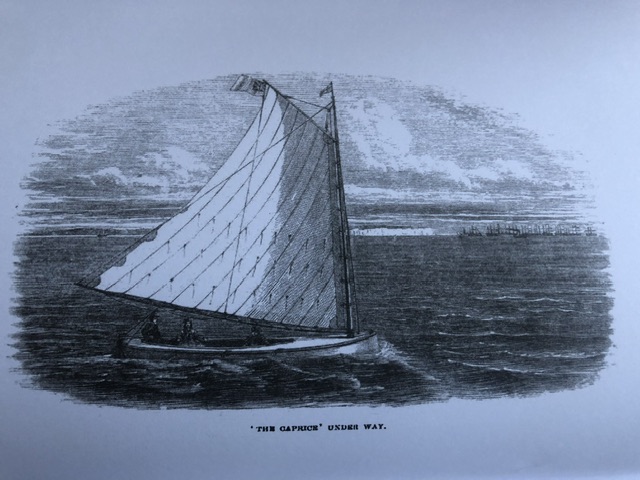
Their craft is a Una-rigged sailing canoe. It was built for sailing the upper reaches of the Thames and for sheltered coastal hops.
Towards the end of the book, Dashwood describes the trip round Selsey Bill and another covers her suitability for coastal waters and alterations made.
The Caprice in full flow…
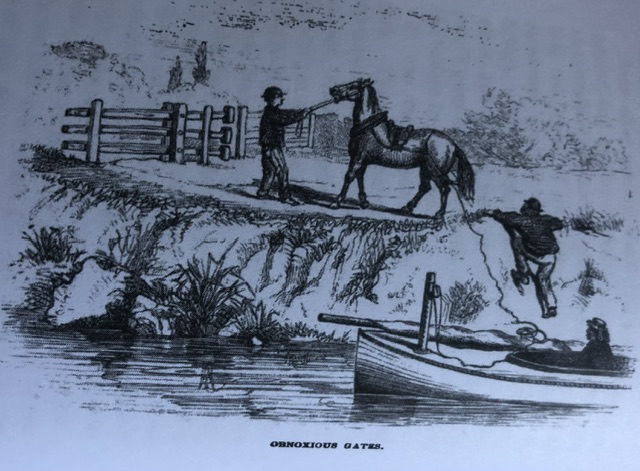
The Dashwood’s hired a pony to tow the boat and a canal man to manage the towing. That did not mean the holiday couple sat back. No, they played their parts fully.
The nights were spent at wayside inns along the route.
An author sketch of working the towing pony.
For me, I just loved the way the journey is described. The wild-life, fauna and his little injections of local history. Diversions, on foot, to ruins or the many large houses. It was so reminiscent of many of my own books.
Completing the journey with the Dashwood’s, I dearly wanted to stop and chat to them…
A lovely read. If you can find a copy, I thoroughly recommend it.
Some weeks before the early days of August 1983 we had cycled from Canvey Island, up Benfleet Hill and along a leafy lane cutting through extensive woodland to the yard of A F Platt Ltd, based in its own woodland paradise on the Daws Heath/Hadleigh border.
Our son did the trip too, at a little over a year old he was snuggled up to mum in a baby carrier!
The story is told about at the beginning of a large chapter in my book, The Jottings of a Thames Estuary Ditch-crawler which is available from bookshops on line, where I detail the Alan Platt boat yard story.
Our visit was to cast a serious look at several boats that were currently in the Platt’s yard. There were three Finesse 24s in for various reasons among a couple of 21s too. It was only the ‘24’ we were interested in.
Our first boat, a Yachting World People’s Boat, was on the market and we felt she was about to be sold away to the Burnham river. The signs were very promising…
Although we had viewed these lovely twenty-four footers afloat while sailing, it all depended on whether the mate was happy with what she saw…
There were just three tick boxes!
Standing head room.
A flushing loo.
Decent auxiliary engine.
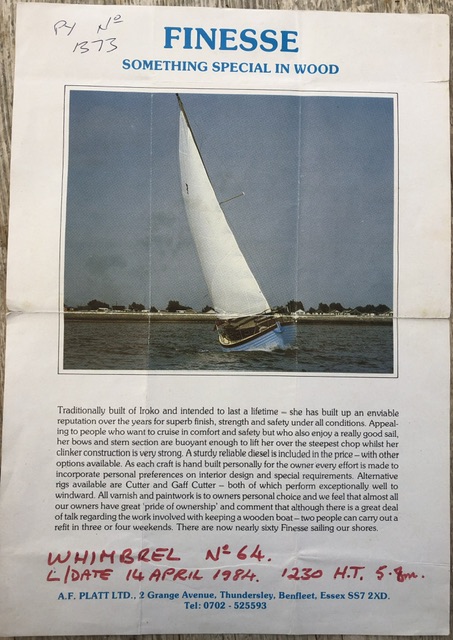
Front of sakes sheet.
We also studied the sales sheets and discussed our possible requirements with both Alan and Shirley Platt.
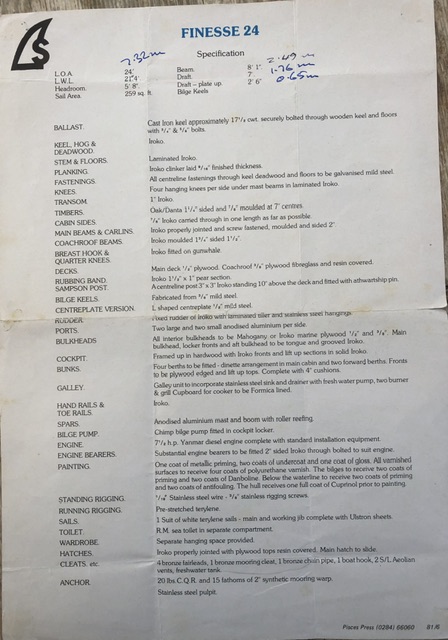
Back of sales sheet giving build details.
We went away with a plethora of details a whirl in our heads. Back home we made plans, we couldn’t avoid it: we were truly smitten.
We even had the un-ordered boat’s name ready…
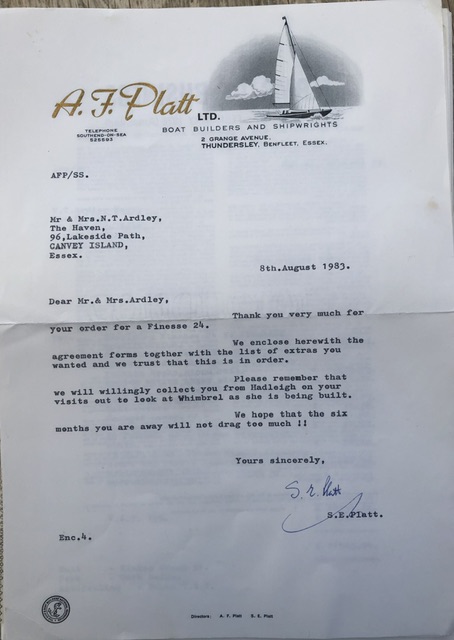
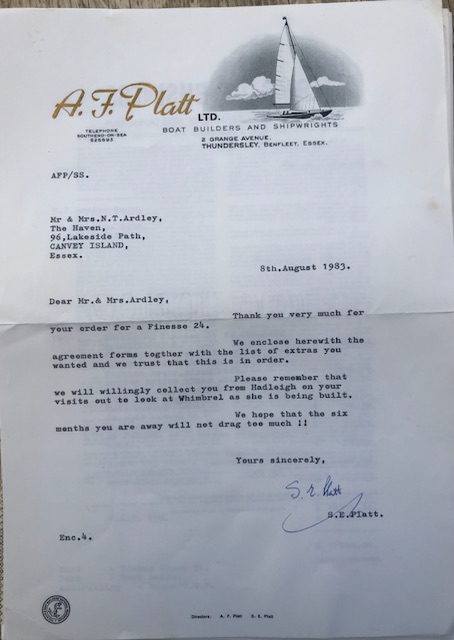
The letter of 8th August 1983.
So we did it!
We had a whole list of ‘extras’ as they are known in the ship and boat building world. The major of these was upgrading to a two-cylinder engine, a Yanmar 2GM, from the basic one-cylinder model. The unit lasted us until 2011 when we again upgraded to a fresh water cooled Yanmar 2YM.
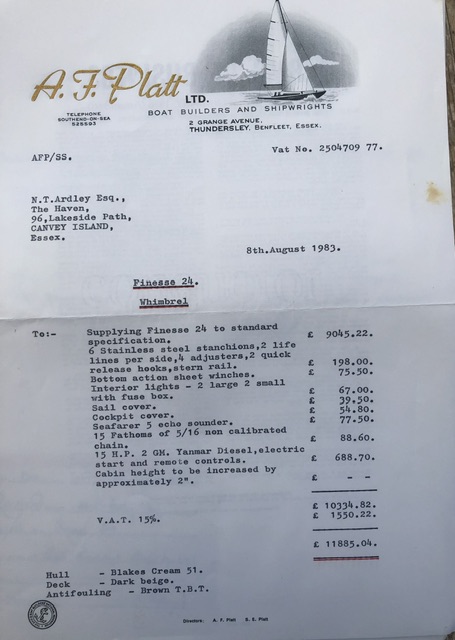
The build and additional costs to suit our requirements.
More letters were to follow…
Clinching a marine mortgage, laying of the keel – a major, planking up etc…
Sadly, I was soon back at sea on a ship pootling around Caribbean waters working with an EU and USA fleet of warships on drug patrols, so consequently, I did not see any of the build processes – this was all left to co-owner, Christobel, the mate who wrote enthusiastically about her visits to view ‘chunks’ of wood…
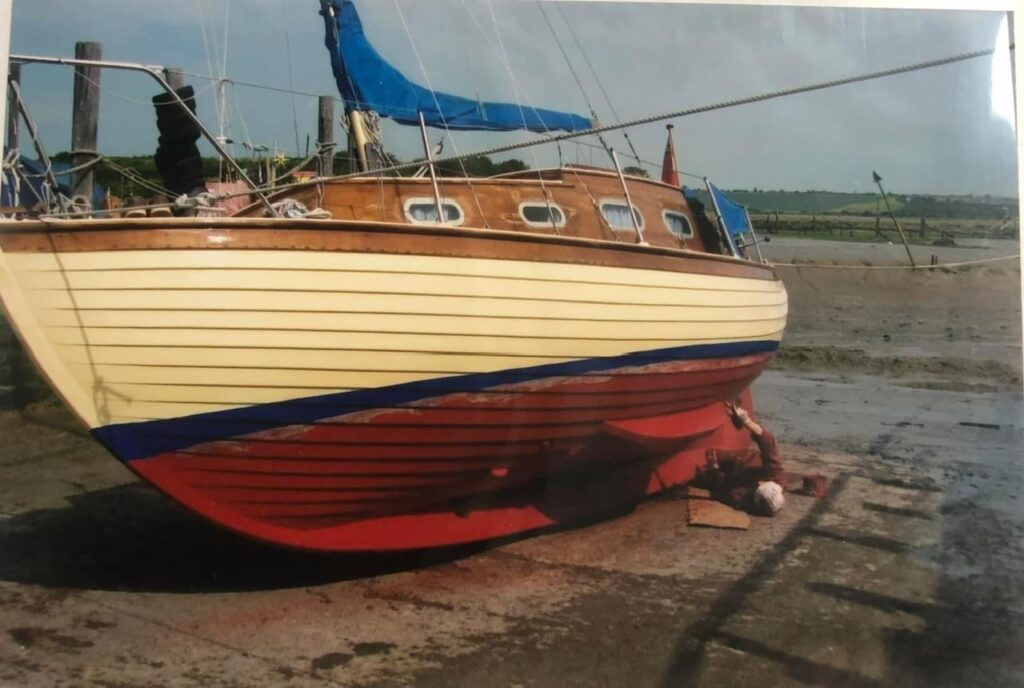
Whimbrel at the Blackwater Marina in July 2023 looking as good as the day she was launched.
My first view was of the completed boat at the end of March 1984, sitting ready for launching. One of our requirements discussed prior to my return to sea…
The ship’s good mate insists on there being another person in our long marriage – yes, she alludes to a mistress – but as I always point out, it is Christobel’s name on the ship’s papers!
However, more of that as the ‘build’progresses…
So, if ‘Ownership’ can be dated to the date of our order, yes, it is a day to celebrate with a huge dose of pride in a little ship that has served us well.
Thank you Alan, Shirley and all who worked on her.
After much thought we have at last made the break with the Island Yacht Club, Canvey Island.
An incident over the Bank Holiday weekend in August 2019 is at the root of this decision, which I will publicly discuss further down, but has been further driven by other more recent events.
The final straw came after we submitted a complaint about the way club members/visitors treated ‘us’ whilst Whimbrel was under going her fortieth anniversary refit.
Vehicles were being driven fast past boat by around 25% of drivers with no regard for the dust and debris being showered over varnish or paint being applied. Cones and a sign were routinely ignored…
We jointly made a complaint about this with a few specific cases and the club’s response was to call just me in to a session in front of the flag officers to explain ourselves.
Just what needed to be explained?
No where was there an apology and let’s talk about this. Just a straight in and be whipped demand.
Now, the leaders of this club are the very same people who assaulted’ us back in 2019 and since the end of that affair, they have been looking for a way to get revenge.
So, we decided enough was enough and have departed.
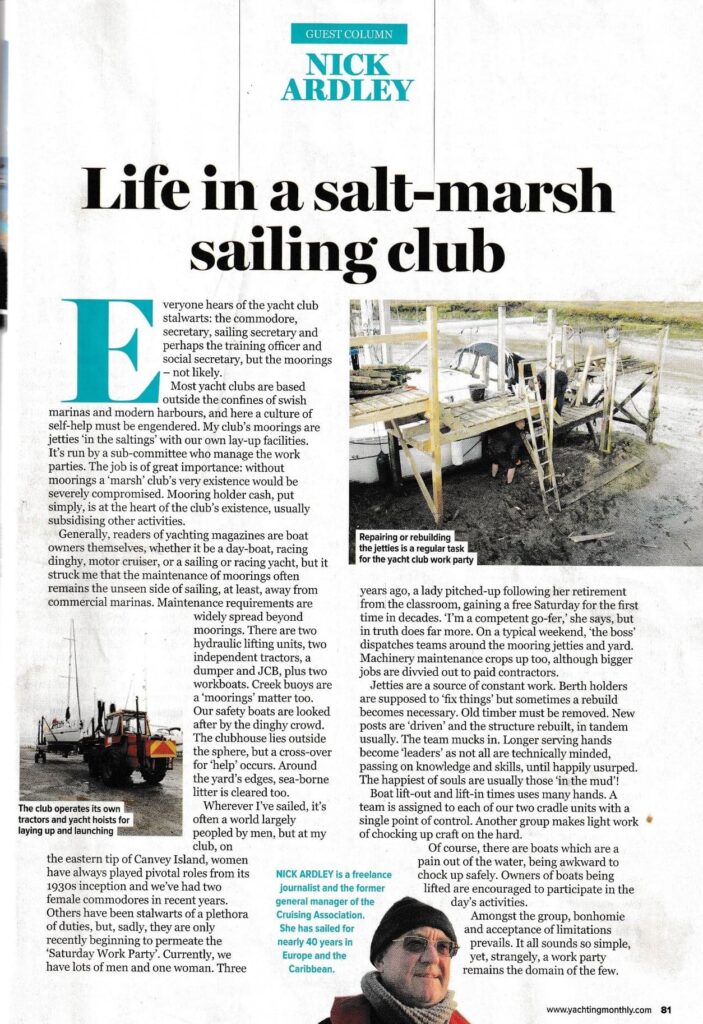
Some while ago I wrote about life in a marsh-land yacht club and how ‘we’ looked after our moorings and club infra-structure.
A copy of the Yachting Monthly article.
There pervades at the club I have departed from, like many organisations oft heard in the news media, a problem with institutional bullying. It is led by people who still ‘live in the school playground’ and if one is not ‘in the set’ life can be precarious. These people have broken the club and made it a toxic and an uncomfortable place to be part of.
In that respect, both Christobel and I have, since the infamous RIB incident, been circumspect with lodging any official complaint about anything, which in itself has been a travesty: the bully won.
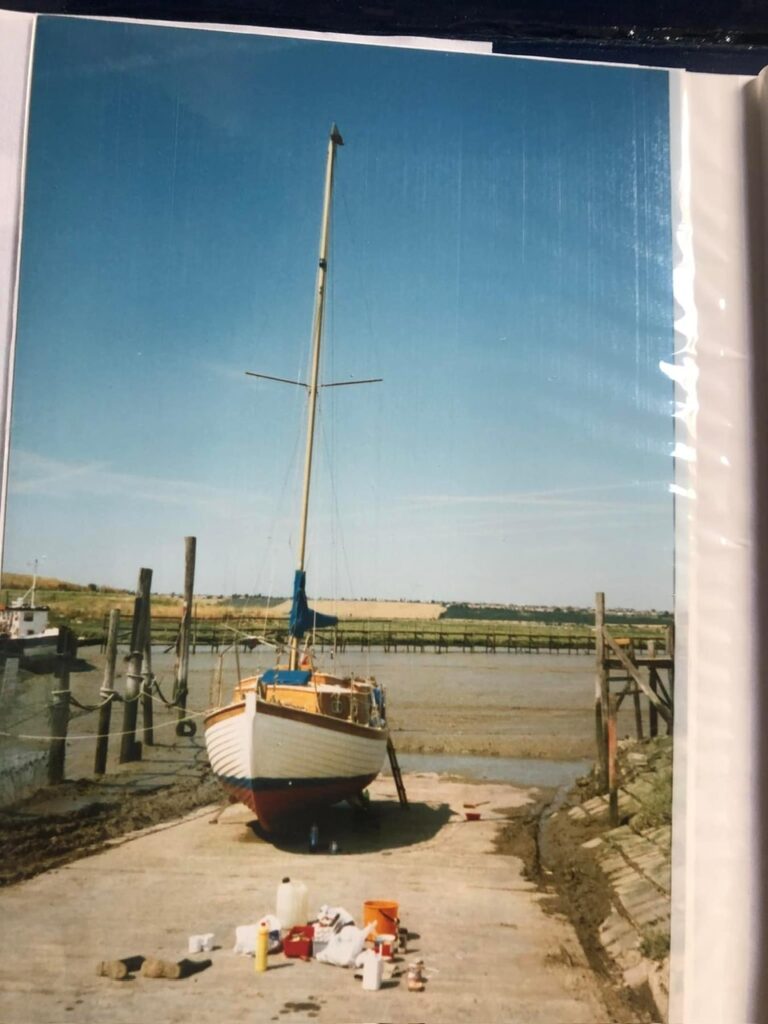
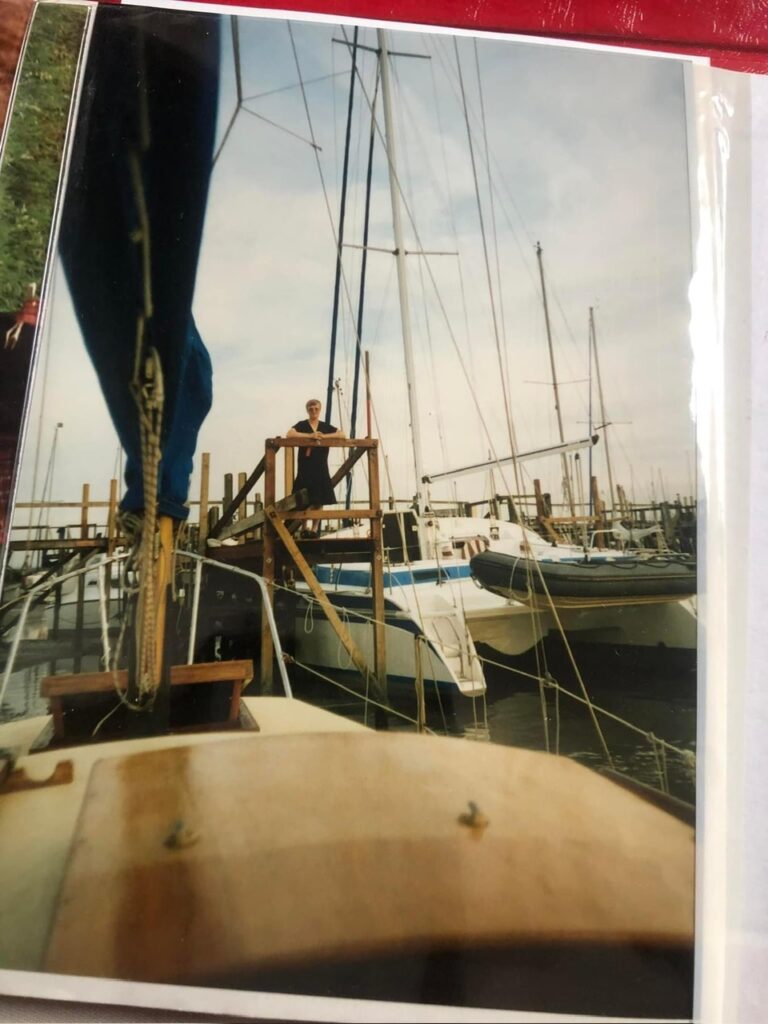
Whimbrel on the IYC slip in her early life. The slipway was later widened – I drew up the drawing (later digitised) for retrospective planning.
The RIB incident if 30 August 2019 will be documented in the files of the Port of London Authority. These are probably available if one wanted access – freedom of information.
It was over the bank holiday and an open cat event was being hosted by the Island YC.
So, the incident which has lived with me, in particular:
Christobel and I were making Whimbrel ready to depart our mooring to represent the Finesse class and club at Queenborough’s classic festival.
A club RIB (Furtherwick) came up the creek leaving a giant wash crashing through the moorings. I was on our fore deck clearing mooring lines. Although still aground, the boat lifted and surfed against her springs.
Meanwhile Christobel had called out, ‘Slow down.’ She was responded to with a single finger salute, which as most know, means: tickle your c—t or up your c—t. She was extremely upset.
We called the club’s commodore who said he was on way to club and would deal with.
We departed.
Nearing the outer creek, we rounded into the breeze (sw3) clear of the buoyed channel to hoist the mainsail. The boom was loosened ready. I was about to hoist when I spotted the same RIB exiting the club’s moorings.
It left the buoyed channel and came straight at us across the shallows increasing to a ‘displacement speed’ resulting in a huge wash. Christobel held her course with engine on tick-over.
I shouted ‘watch out’ and flung my arms around the slating boom as the RIB roared down our port side done 2-4 m off.
The boat dropped and then went ballistic with violent rolls back and forth. I felt the boat hit bottom.
I held on. I do not remember how I stayed aboard, but wished afterwards I’d gone overboard: it would have made what followed, easier…
Christobel was thrown across the cockpit, all but incapacitated in the corner. She eventually picked herself up and got the boat back under control.
I received wrenched leg and arm joints and Christobel a raft of bruises.
The RIB sped away rounding Canvey Point where a few cats were tuning up, then off east where others were doing the same… no one seemed to be in trouble.
Once under sail we made a further call to the club’s commodore – he fully understood the situation for I was shaking badly as I talked. Again, we got, I’ll sort it. That was the last I heard from him.
In the end after around two weeks, I filled in a Port of London incident report.
The proverbial hit the fan.
The upshot was that the perpetrators manufactured a defence (they got times wrong) and forced all discussion out of club minutes.
The outcome from the Port of London was that the club was reprimanded and reminded of how they operated etc, etc, and the driver was given a written warning. (All of this is held on file)
Whilst this sage was ongoing, I was coping with a huge lack of energy after completing radio therapy a couple months earlier and was on a programme of tablet chemo medication for prostate cancer.
The ‘three’ and cohorts didn’t give a stuff about that…
Early in the saga’s follow up, I had a call on my mobile from the chief perpetrator at around 2000 one evening. I asked where number had been obtained – commodore was the reply. I terminated the call.
On file with all paperwork of case, is an email from club’s vice commodore of time, stating that the phone incident broke club rules and national law regarding passing information.
I said it would be reported to authorities unless an apology was received. Time went by – nil response.
Towards the end of the year, a committee meeting was due and I had a call from our son relaying a message from a fellow committee member that ‘the three’ were engineering an ‘instant dismissal’ from club action against us both … unless we withdrew … because we were threatening a member…
After some thought, and with my energy problems, we wrote, saying due to my lack of energy and my mental ability coping with cancer that we weren’t able to continue … it was apparently accepted.
But, as we later found out, blood was wanting to be spilled.
For us though it wasn’t the end: whenever anything untoward occurred, I suffered from night-time ‘reliving’ of events returned with them cycling round and round with growing anxiety.
So, as said, over last few years we kept our heads low…
The pictures within the blog show a flash of our forty-years as Island YC members.
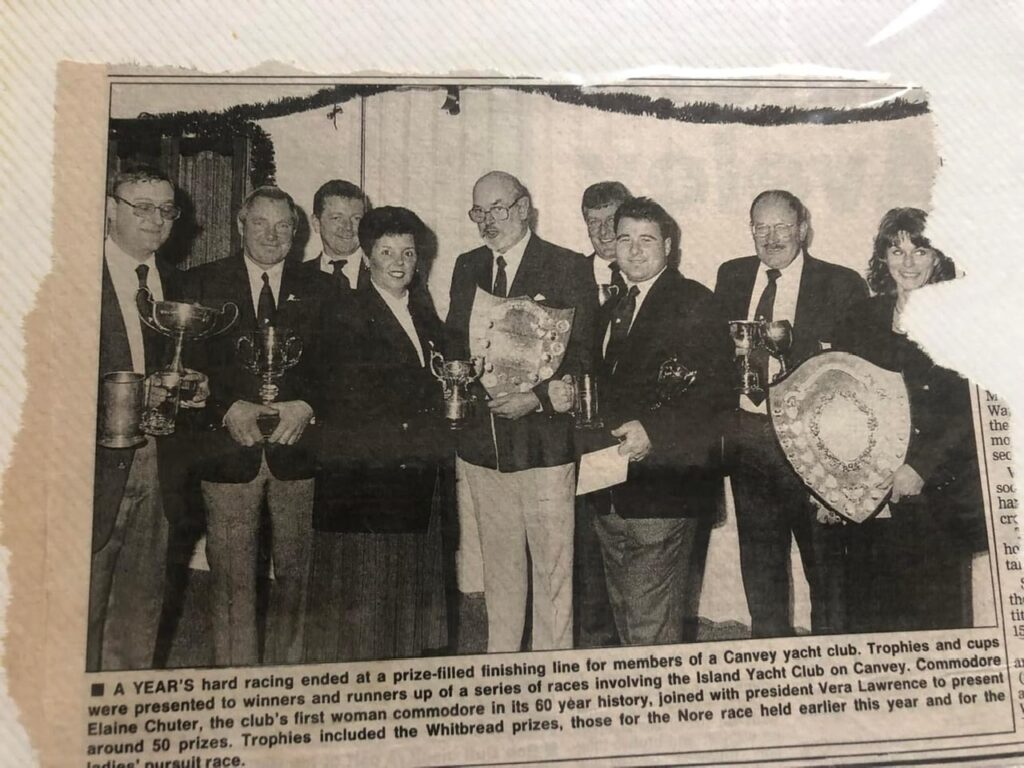
Collecting club silver ware during better days
We raced with success for a decade or so. I was a work party member for thirty-three years and Christobel for a decade since retiring from teaching.
Christobel ensconced beneath Whimbrel’s bottom applying antifouling around 1990.
The projects, personal and joint/team, have been numerous. I looked after the creek buoys for twelve years or so. There was walling and concreting the edges of slipway, doubling its width.
Returning to our berth held and maintained for thirty-three years, probably again around 1990.
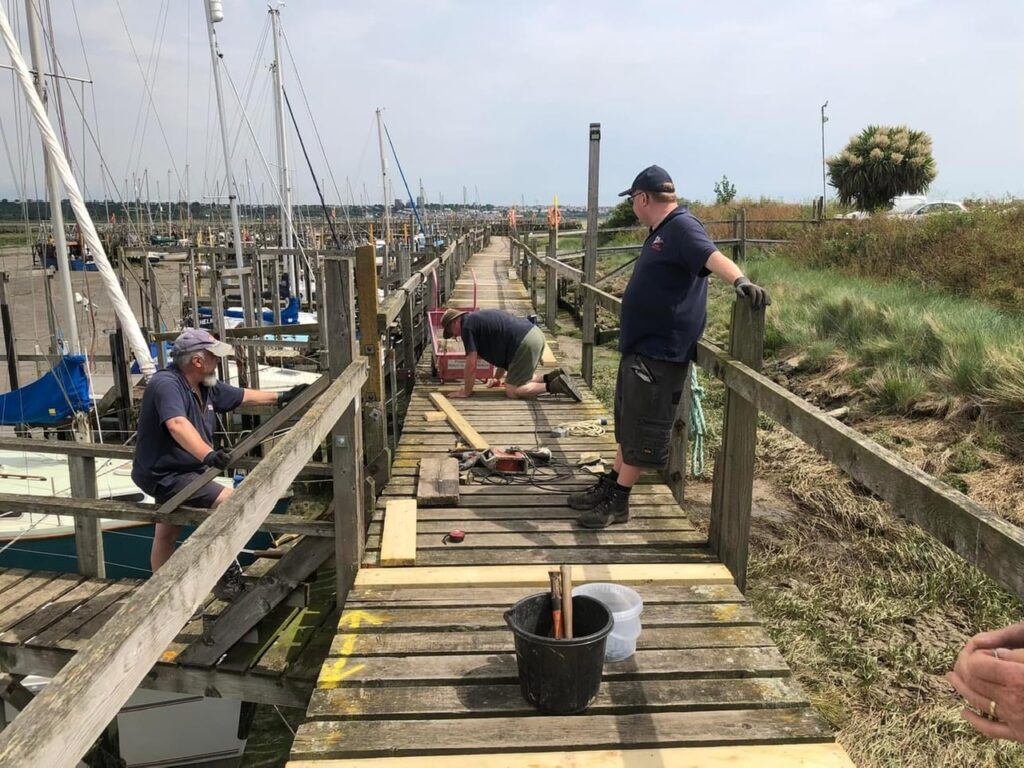
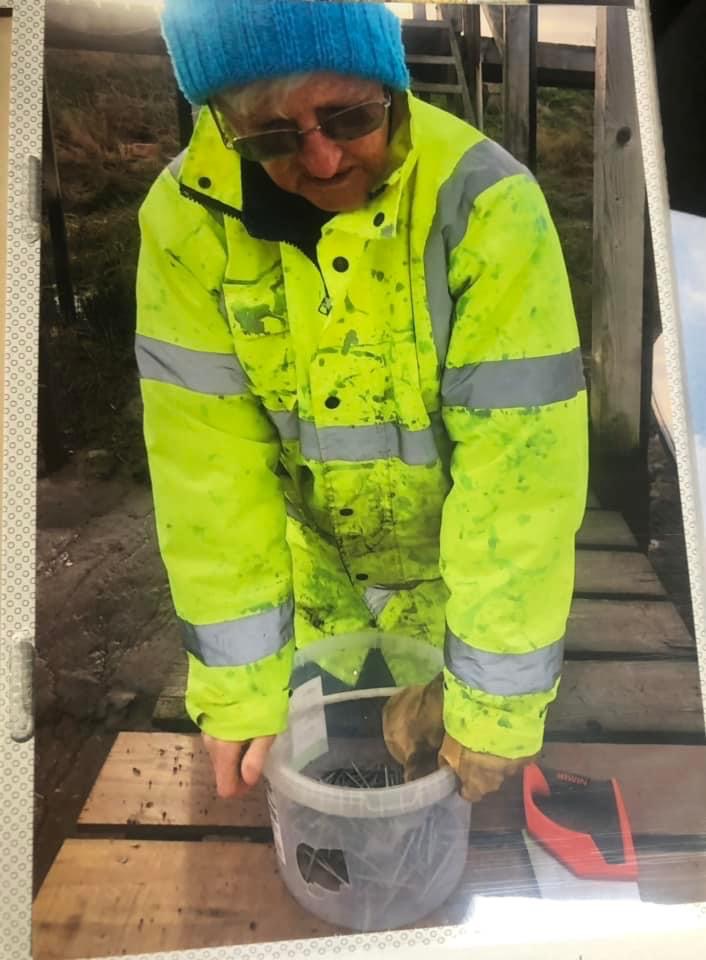
During Covid, as we were a ‘bubble couple’ we replaced hundreds of walkway boards.
Carrying out walkway maintenance.
During the early 1990s the club’s compound was extended over rough infilled land, with layers of crushed building refuse and street asphalt scrapings. We were both part of a small team doing this midweek.
Christobel working in the ‘below gang’ during 2022.
Laying of water and electricity around the extended yard…
Water services round the walkways was laid on…
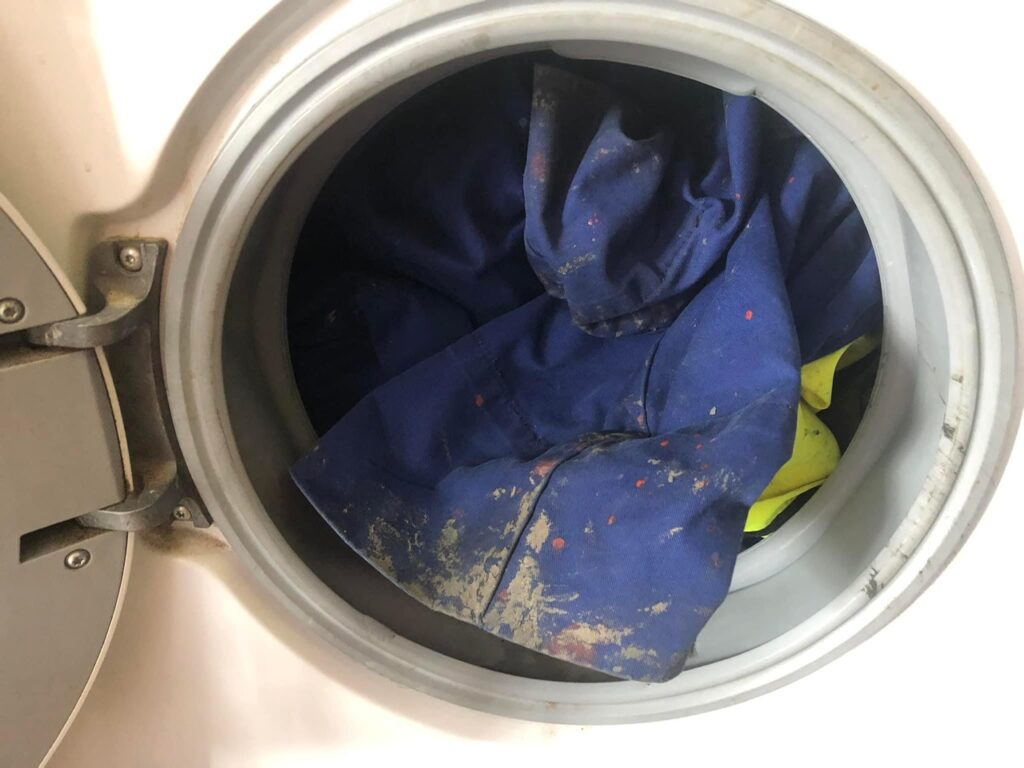
Another Saturday afternoon washing machine load
Not forgetting, years and years of mooring and walkway repairs/renewals.
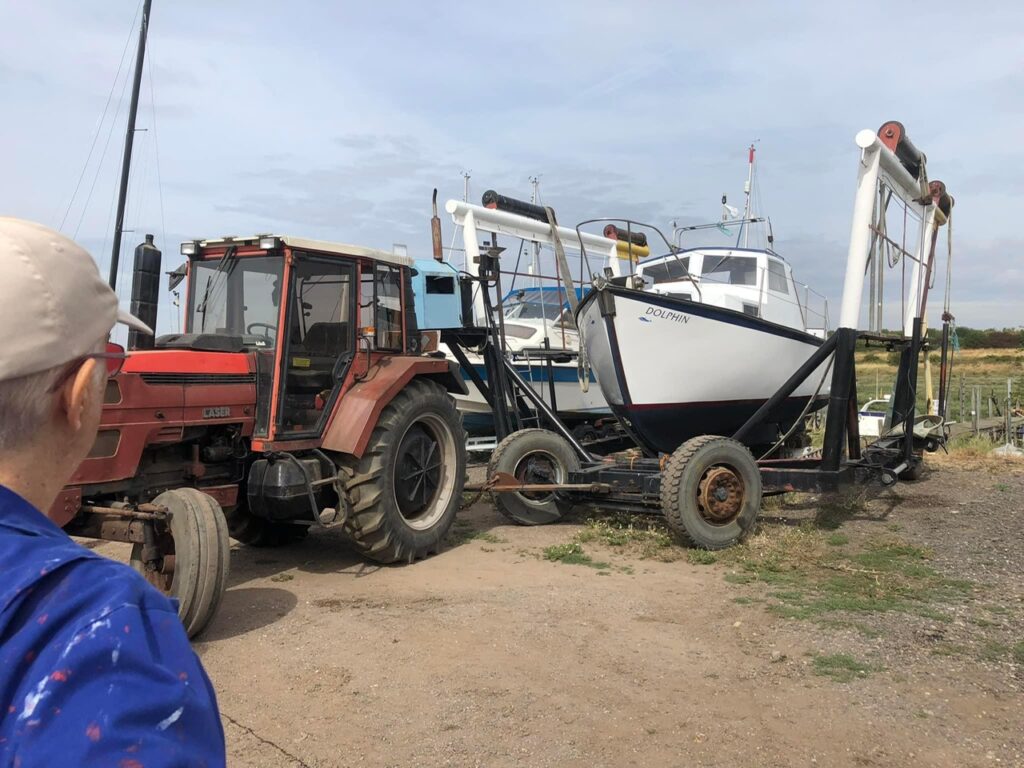
Boat launching with what became No.2 rig. The rig was originally fitted with chain blocks, needing four bodies. It was converted to hydraulic lifting which was initially messed up. I took on the project and had it all stripped by contractor, cleaned, reassembled and tested to statutory requirements. The only time I ever received a formal thank you…
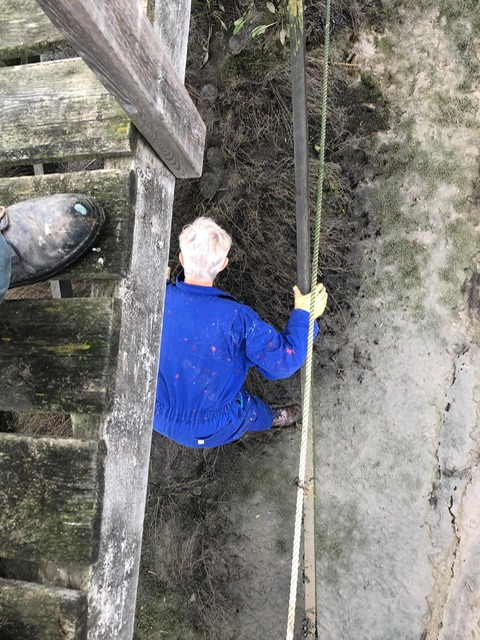
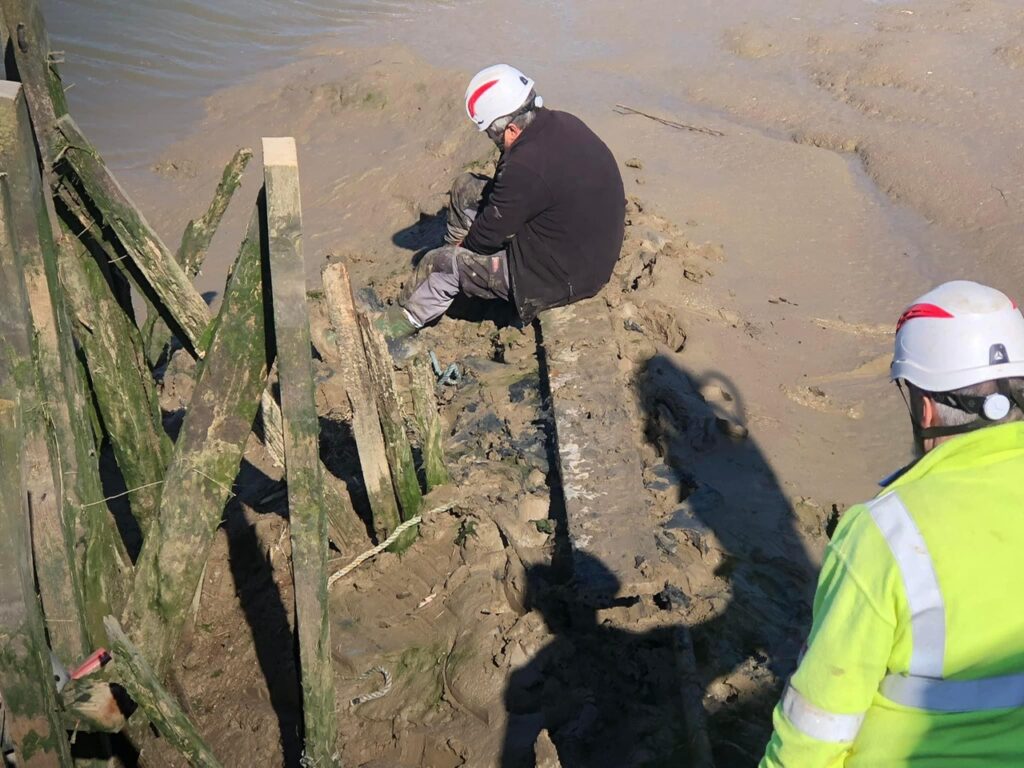
Sometimes it was very a very muddy experience enjoying ourselves in this marsh-land yacht club…
Sometimes it is a very muddy form of enjoyment…
There were good moments afloat too. Early morning winter sails. Later winter afternoon arrivals back after a gentle potter.
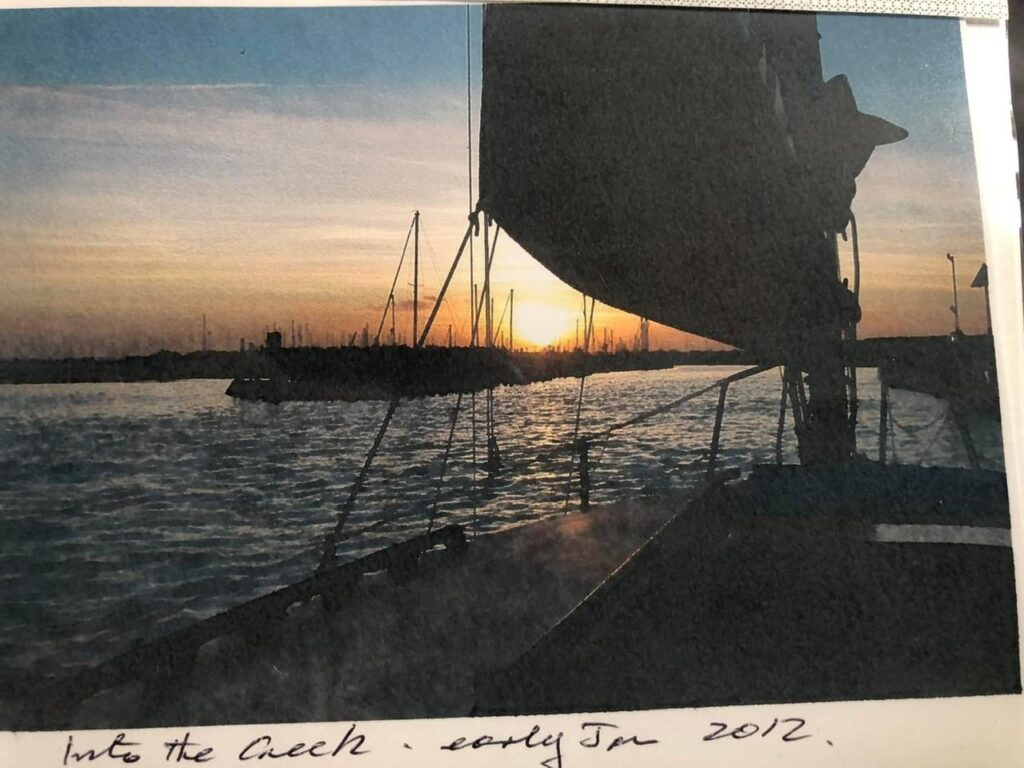
Creeping back into Smallgains Creek after an afternoon sail,
Taking a cue from an ‘old boy’ now long departed, did I need one after being brought up afloat, I made visits to the boat’s mooring to check during high tides – checking and saving many another boat too at the same time.
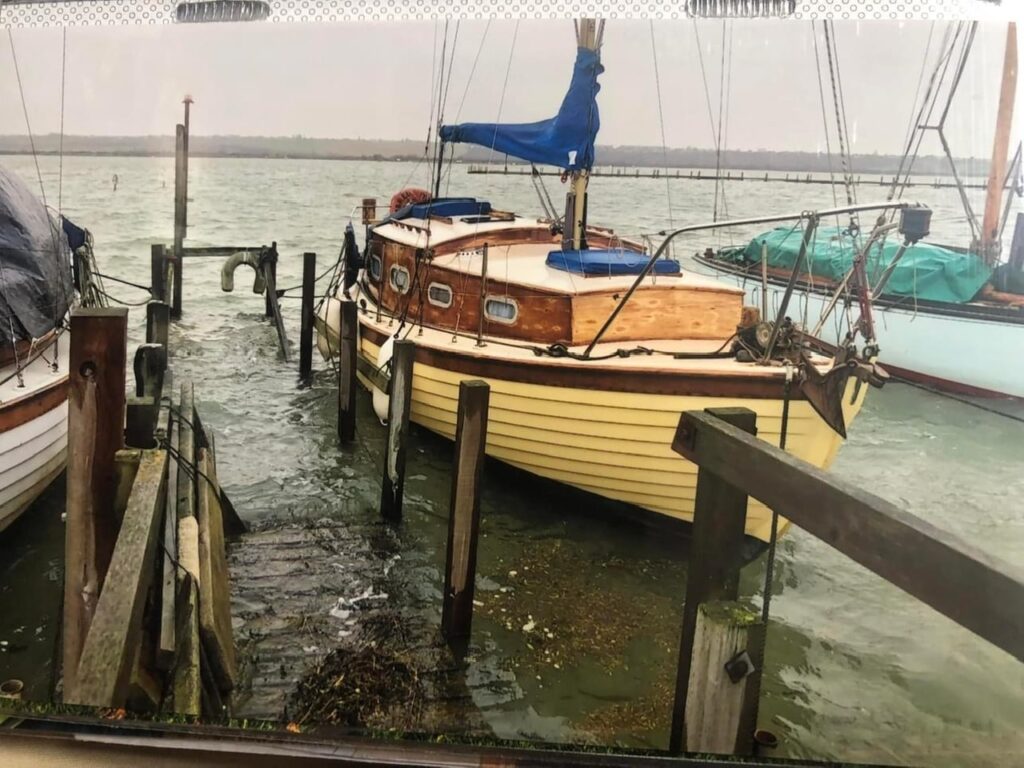
A high tide … on mooring watch. Many a time trouble with members boats has been avoided by direct action!.
During the last few years following the RIB incident, the mood within the club changed for the worse. Actions of the club’s hierarchy was causing angst – certainly among the club’s do-ers of the working parties – and the atmosphere was becoming toxic.
It was becoming ‘not a nice place to be’ and I silently began looking for alternatives, should that day dawn.
During Covid, Christobel and I worked as a cohesive team replacing hundreds of walkway planks. Often almost being ‘kicked aside’ by other members frustrated at having to wait. One chap said, during the period, ‘without people like you, we’d struggle to get to our boats…’
So, following the lodging of our complaint while away for a week at the end of June we decided to throw in the towel and make the final break.
Once our resignation letter had been sent, my anxiety cycles began to wain and a resemblance of a normal sleep pattern returned. Praise be.
Now we are gone!
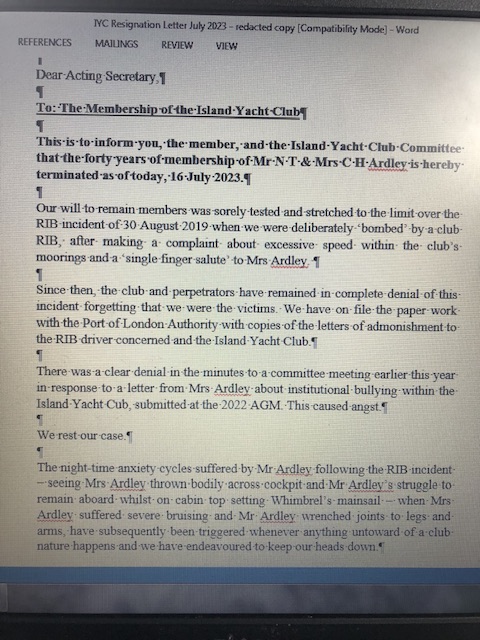
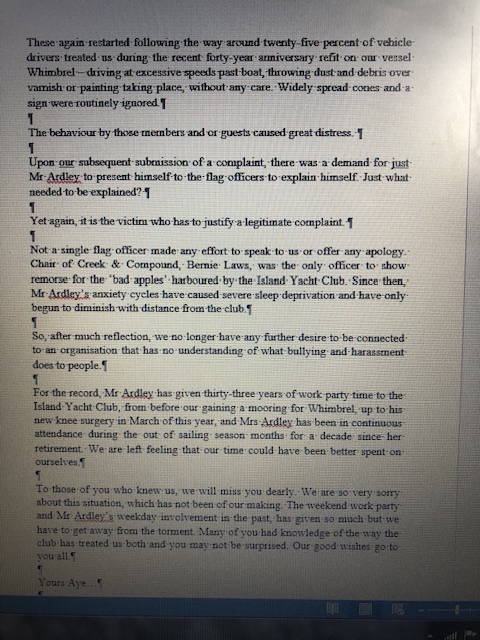
Our open letter to the club’s members is unlikely to be honoured, but it is gradually making its way around via various routes from people who have supported us.
So, below is our letter. We don’t care who reads it: the hierarchy of the Island Yacht Club do not deserve any reserve…
First page of my open letter to members, which….Second page of letter…
A third page was directly to the Island Yacht Club committee and remains private.
So, farewell friends.
Some of you we will see afloat from time to time, others, well, we will both miss you. You gave us so much whilst members of a job, project, or just nattering over a piece of cake at tea time…
Thank you to all who we have been honoured to work with.
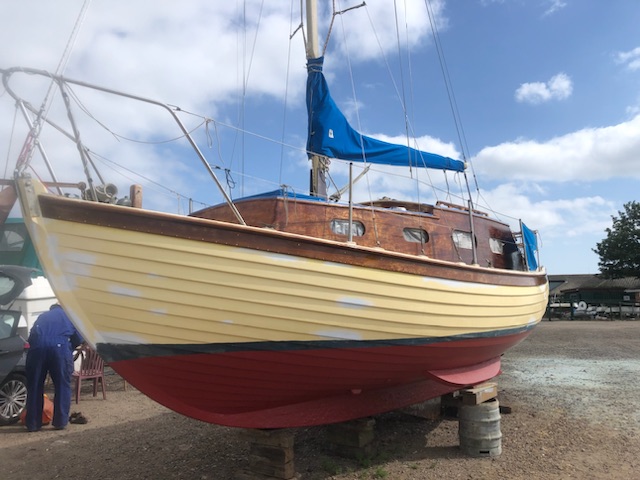
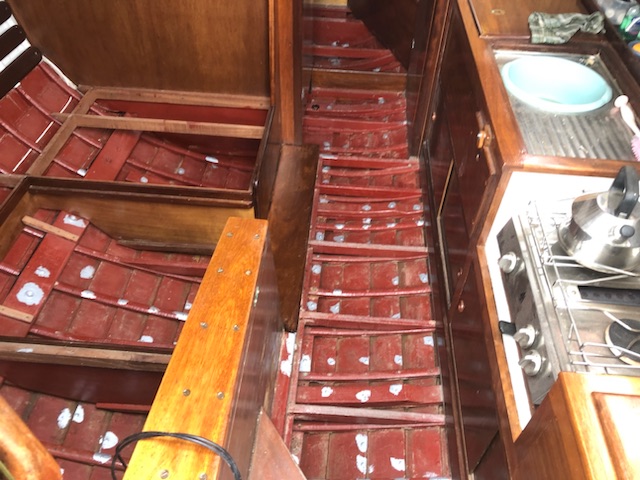
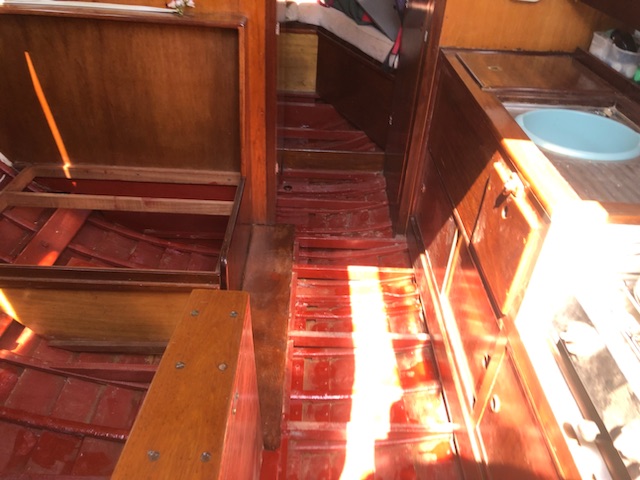
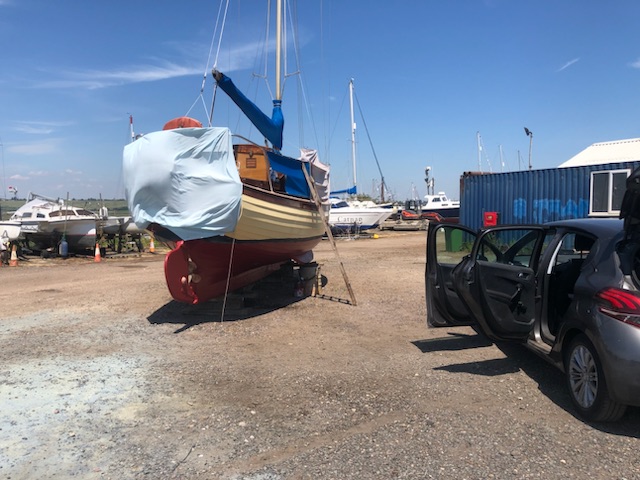
But seriously, this is a boat that had everything going for her. She is in a bit of a state now, but could be refurbished with a little time and effort.
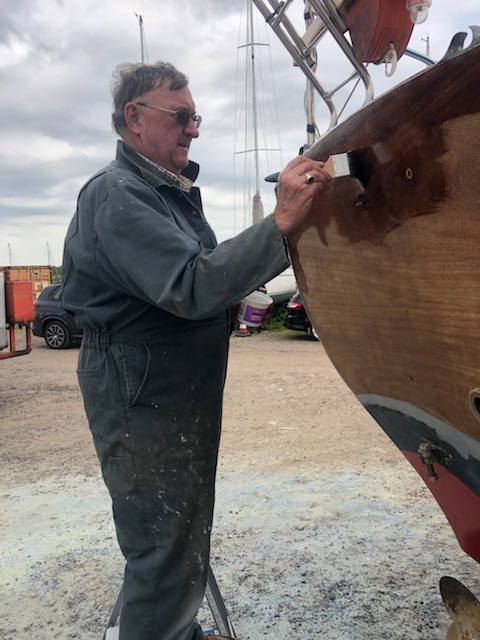
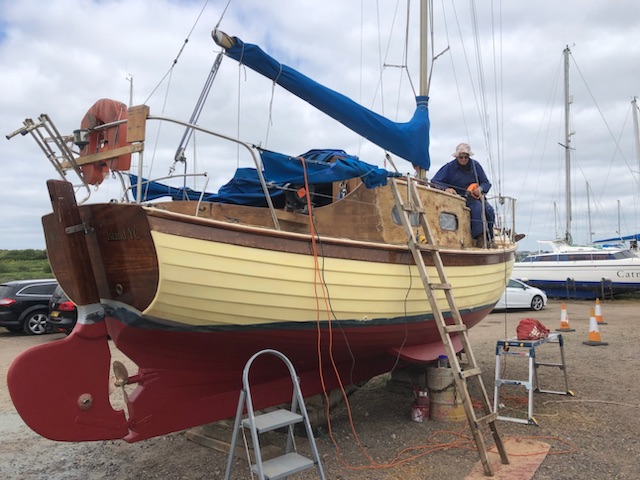
In just four weeks my mate and I completed a 40 year refurbishment to Whimbrel’s brightwork. All it takes is applied time and effort. Taking back to bare is something not done before, boy has it been a worthwhile exercise.
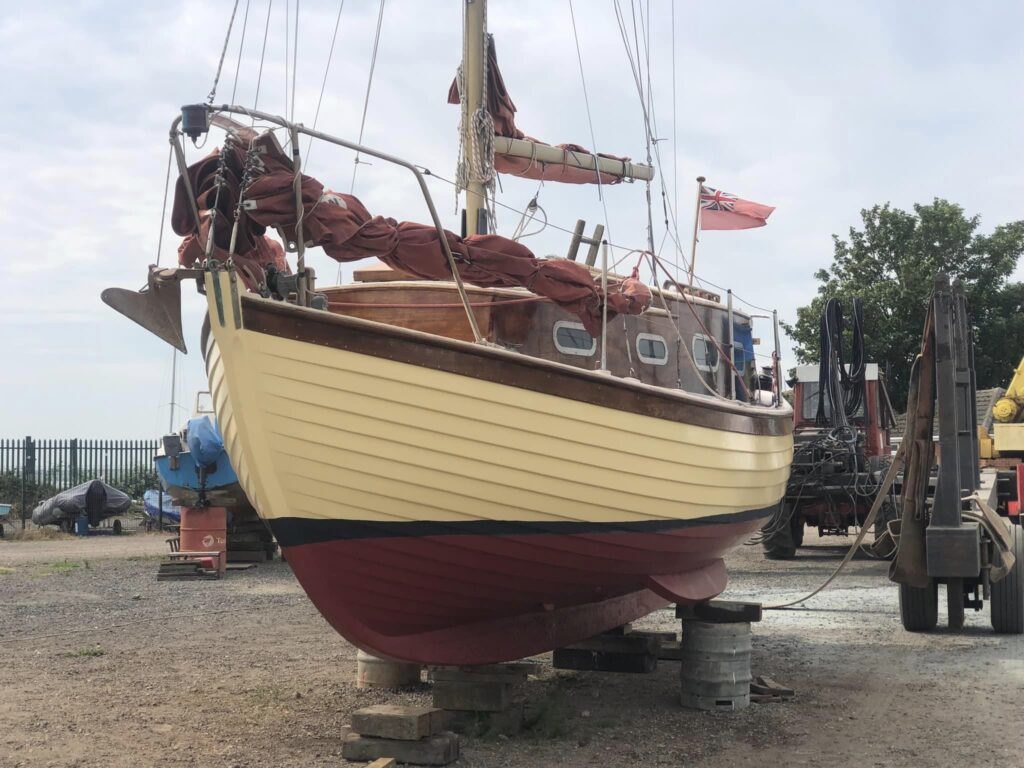
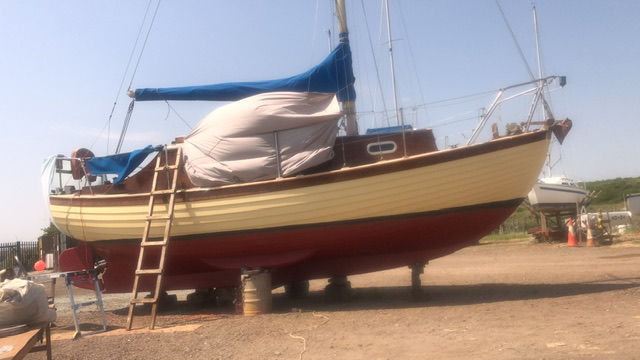
Our Finesse 24 Whimbrel built in 1983-4 ready for the water after four weeks ashore to strip varnish to bare and build requisite number of new coats. Hull was dished and overcoated, as well as bottom doing, of course..
Last year we’d decided that it was time to strip off all the boat’s varnished surfaces to bare wood and start again.
The last time she’d been ‘naked’ in these areas was prior to her first coats in the autumn of 1983!
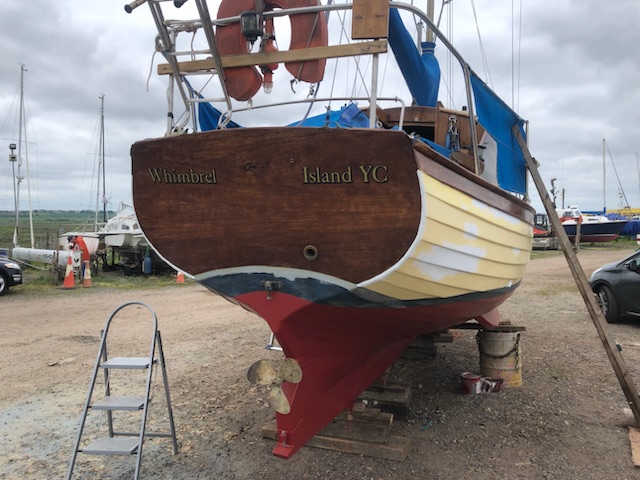
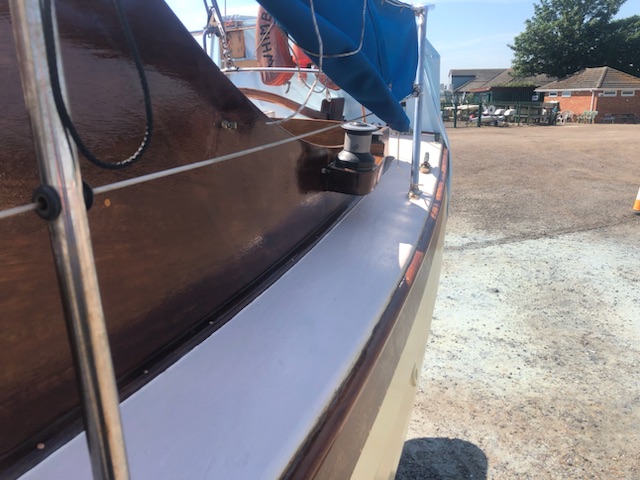
Whimbrel’s varnished areas include the rudder, transom, sheer strakes and entire cabin sides.
During last autumn a ‘spanner’ was thrown into the plans. I was booked into a hospital for a new right knee – I went in a week early on our 45th wedding anniversary on 27th March!
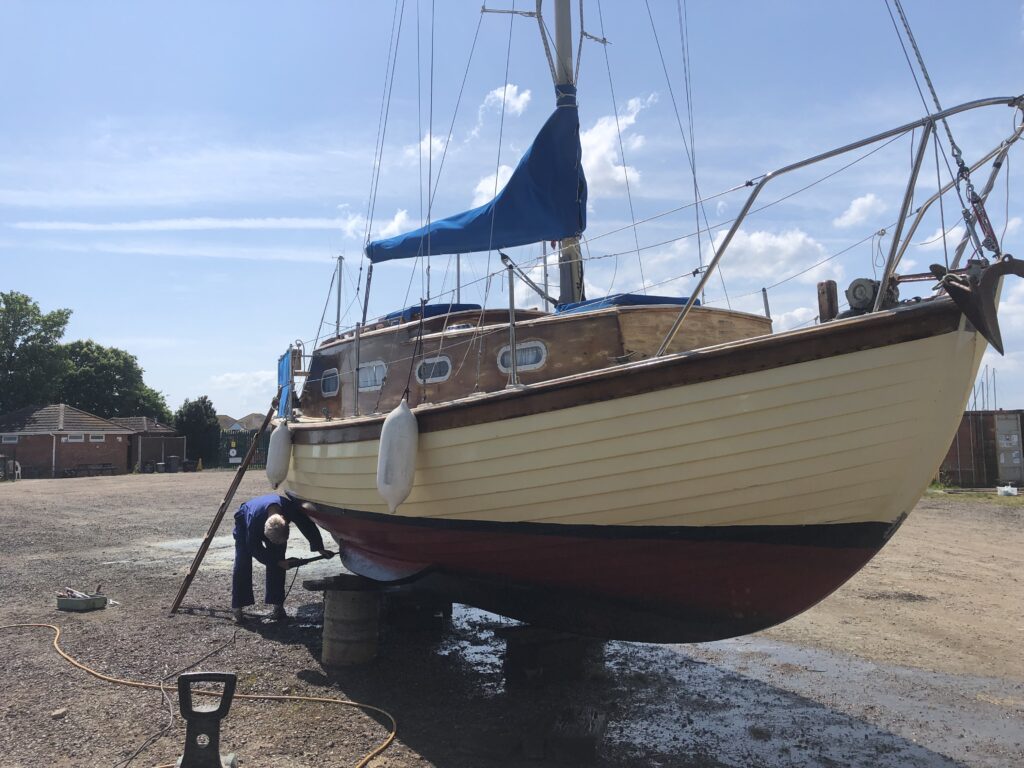
The Mate pressure washing ‘her’ bottom…
After my knee operation, I worked hard at the physio exercises and was walking up to a 1km at the end of first week.
Out walking…
Whimbrel’s lift was duly booked for Saturday 20th May.
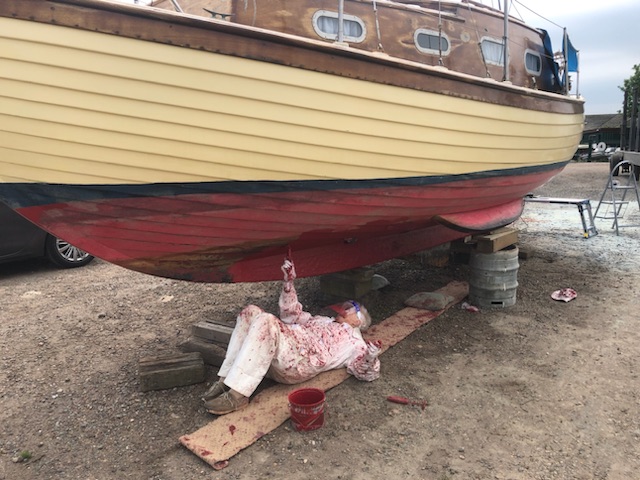
Christobel applying antifouling…
Before lift out I was able to enjoy two sessions sailing with The Boy and the Mate aboard, which was a great tonic.
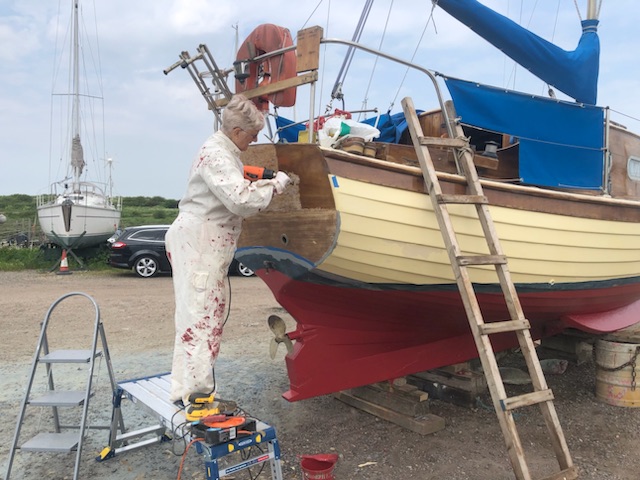
And here, stripping varnish off the transom.
It wasn’t long before the first fresh coats were being applied, starting with the transom and then the rudder.
Transom – first coat…
I had chosen to use Le Tonkinois No.1 which is a semi man made concoction which I had winessed on several craft.
Transom completed with name buried under the last of two of nine coats.
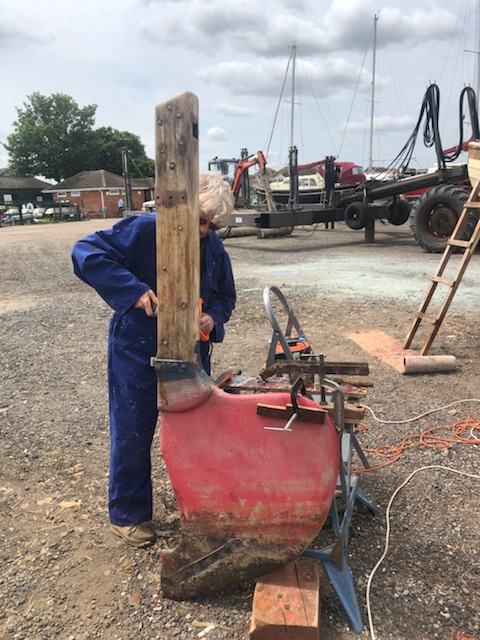
The rudder also was given nine coats!
Rudder stripping in hand.
A glitch occurred during the second week- my GP had decided I needed an additional blood pressure control tablet. They made me exceedingly sick. I lost appetite for any food, was nauseas and had blinding head aches, finally I couldn’t eat at all!
I took myself off and got an appointment. A sensible clinical pharmacist agreed. I was retching by then and had lost over a stone in two weeks…
I saw the chap after a week and he confirmed that I did not need the new tablets – it took that time for near normality to return!
The Queen of strippers nears the finish line. Note rudder refitted. I got a fellow club member to make up two new fitted pintles which has taken out ‘rudder knock’…
As areas were stripped and sanded, varnish coating began. Pencil tick list to eight for each!
The port side ready for window fitting.
In between times, the hull was prepared. An all over sand, repairs as required going through the use of primer, undercoats and stripe coating with top coat. Leaving the final coat for when ready.
The bilge gets chicken pox!
Having completed stripping for England and sanding for the World the mate morphed into Bilge Babe…
The Bilge Babe strikes off another milestone…
During the whole time ashore we had to cope with a generally easterly wind pattern and with the very dry conditions the club’s yard was a veritable dust bowl.
The majority of drivers passing us acknowledged this and passed by slowly, however, a significant minority gaily traversed the yard at a speed well above the posted 5 mph. I had to remonstrate with some.
After a ‘bad day’ we got hold of a collection of cones to screen the boat and made up a big sign saying ‘Slow’…
The cones and signs had no effect on many of the minority! One driver actually sped up followed by a white van. I shouted in frustration as I slammed brush down to fetch white spirit and cloths… a lady came back and apologised…
Several times lengths of varnish had to be wiped and redone – when going sheer strakes mainly. It was frustrating and annoying.
While away sailing for a week after the boat was launched and upon reflection, because we have never had a comfortable time with the club’s hierarchy, I made a formal complaint. It took several emails to get an acknowledgement … typically showing the club’s institutional attitude.
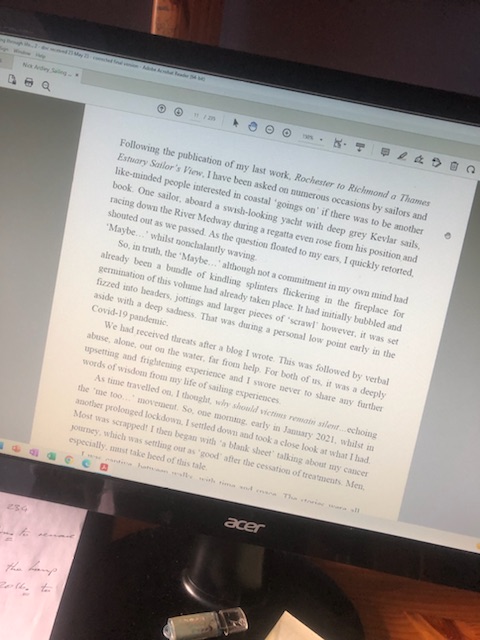
Another ‘bug-bear’ was the arrival of an email from my publisher with the final corrected book draft.
The next stage is a QA check and conversion to print files, when I will see the whole book together with covers…
Tired as I was, the job had to be done. I was still sick too, but checking against corrections had been the easiest of this publisher’s processes… Hey Ho!
A snippet of the front piece…
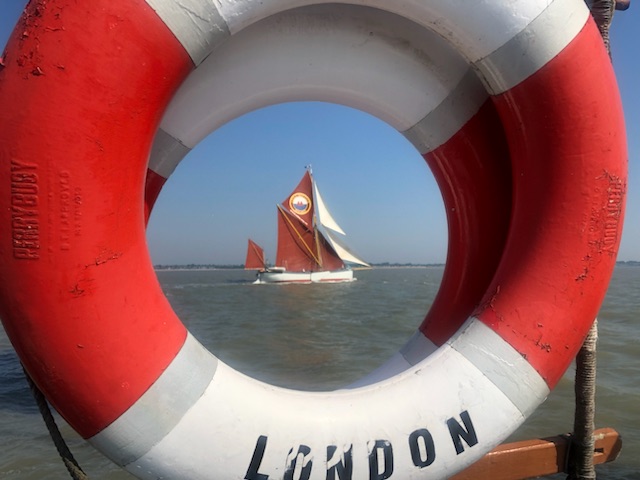
My birthday – 68th – came round and because we could not be away sailing aboard Whimbrel, Christobel had organised a wonderful day aboard the spritsail barge Hydrogen, following the Blackwater & Smack matches.
It was a wonderfully relaxing day.
The Blue Mermaid captured through a life buoy…
The ‘holiday’ over, it was back to work. Even on my actual birthday day, we went down early to re-coat all areas needing them!
The rest of the day was then ours to enjoy together…
Topsides painted and boot top cut in.
With time moving on, I judged we would be ready for a launching this coming weekend and duly booked with the head of our club’s compound and moorings team.
The side deck painting bears completion.
All varnishing having been completed, the side and poop decks were prepared, meanwhile Christobel had graduated to supreme chief cleaner, working her way through the boat…
Today, we jointly finished our respective tasks!
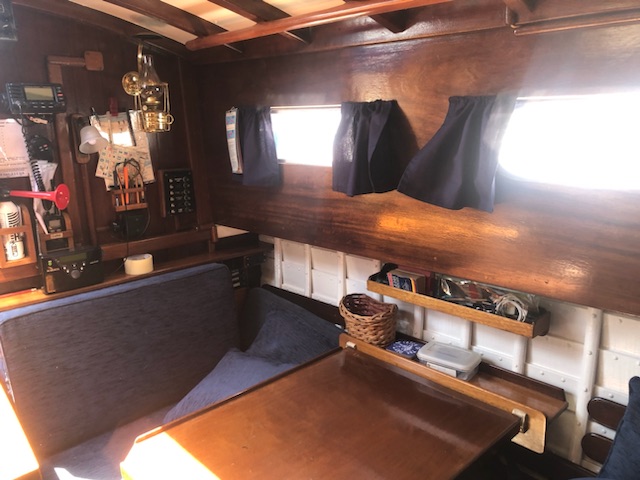
The cabin returns to normality!
The inside has had various areas of varnish redone. The loo compartment had been completed the week before my knee op … and Christobel’s home-sewn curtains are a treat, matching the berth and cushion colour beautifully!
Ready for the water…
So, on Saturday 17th June, just four calendar weeks after lift out, Whimbrel looked as good as the day she left Alan & Shirley Platt’s yard in the Daws Heath woodland paradise that surrounds our home on the northern edge of Hadleigh.
I am sure they and the family would be proud.
Forty years on from ordering Whimbrel, we are exceptionally happy…
That was early in my knee replacement rehabilitation. Having since reached the boat, been for a sail even and completed a job of tensioning the engine belts, my mate in escort mode, carted all our life jackets and charts ashore for checking/correcting.
Upon perusing the Imray web site I soon discovered that my set of charts would need to be replaced, as edition was no longer supported. There were changes that I considered important.
I initially contacted a chandler regularly used – they failed to respond to calls and messages … great!
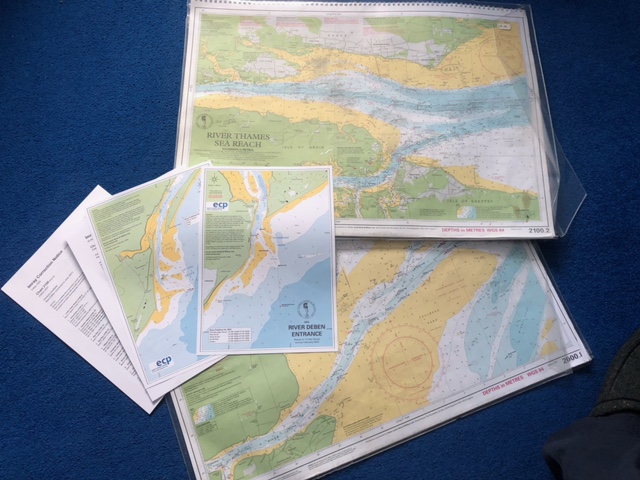
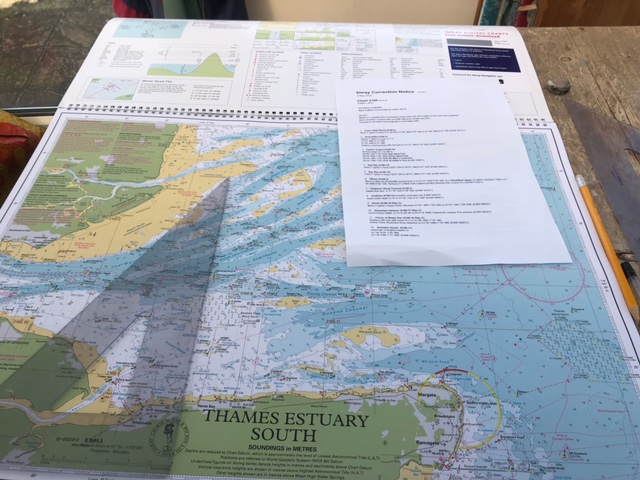
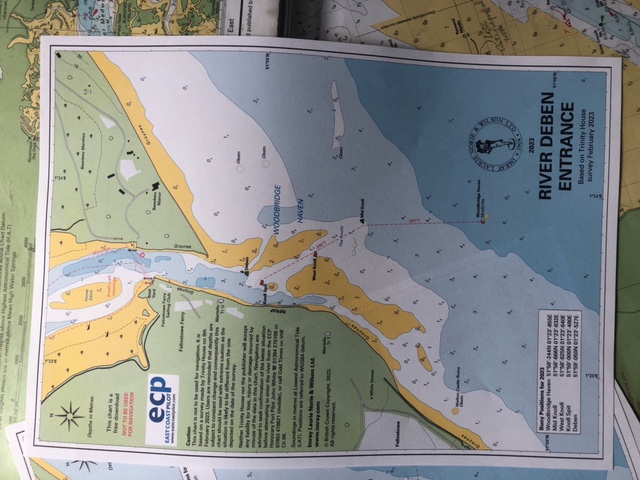
Old sets of chart (not very old!) with corrections to new editions and Deben/Alde entrance chartlets.
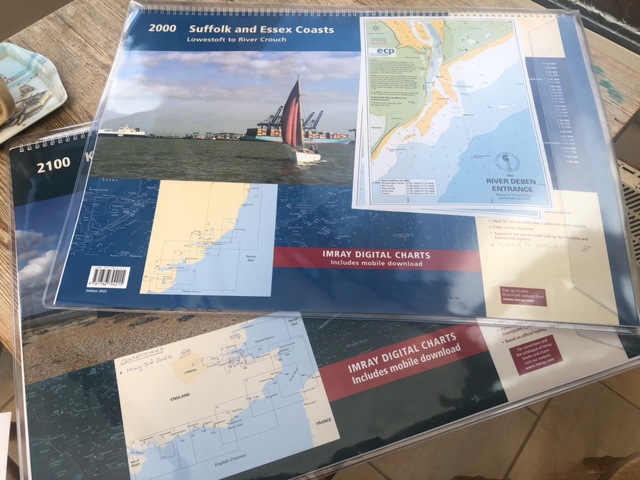
Series 2000 and 2100 were duly ordered direct from Imray. They were delivered one hour before I passed the front door of the chandlery the following day in Maldon!
They were probably cheaper than those from a chandlers, and nil postage was charged. Thank you Imray.
New chart packs!
Then, of course, there was the little matter of correcting those ‘new’ charts.
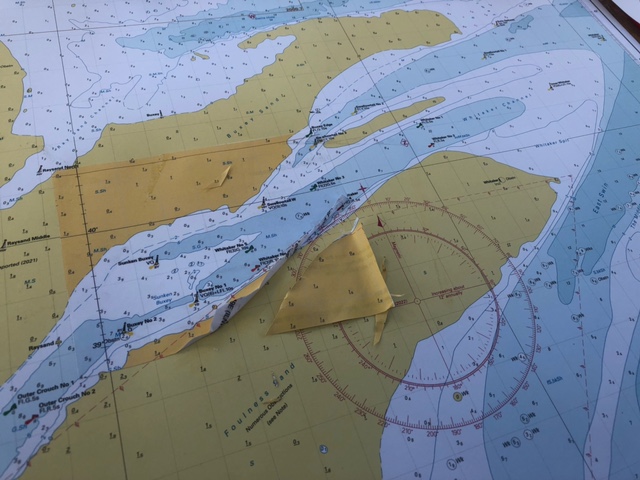
Corrections in hand…There was a patch correction for the R. Crouch – note the chunk I had to cut away to avoid covering that all important compass rose! New R. Deben entrance!
One of the major changes to have taken place over the winter is the route of the River Deben’s access to and from the sea. For a number of years it has been close in and then a long run along the shingle banks in a NNE direction, turning northwards further in.
Now, it has burst through a swatch that has been growing in prominence south of Bawdsey land point. I discussed this with a brother and a cousin crewing last year as the cousin took Whimbrel into the river for the very first time. Not sure if the helm took it all in, but I was more than relaxed about his competence, watched by my brother…
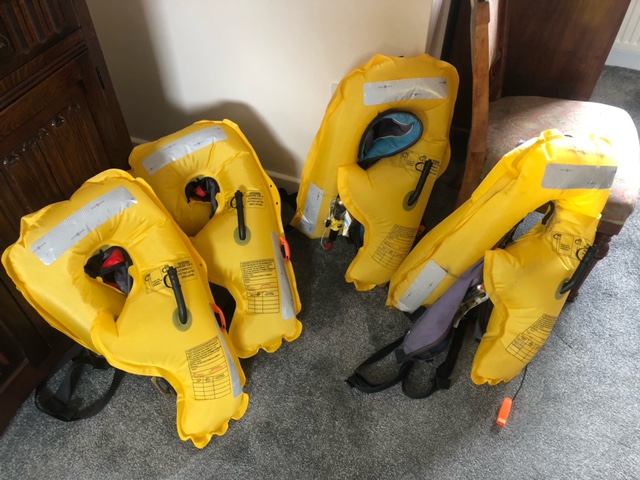
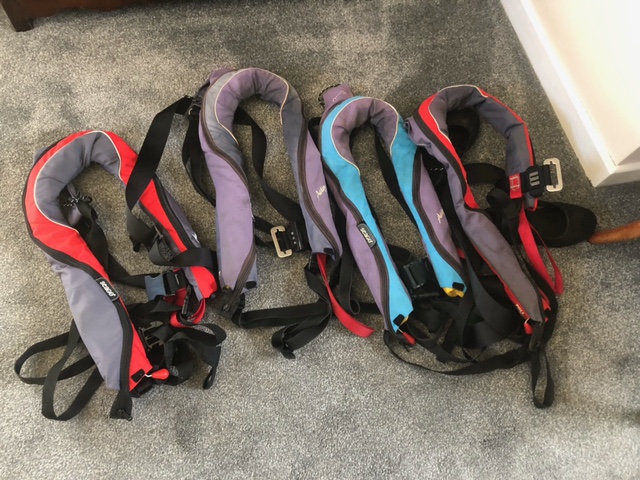
So, with the charts corrected and out of the way, the life jackets were opened out and inspected. Dates and condition of firing units and gas cylinders, creases etc, etc, carried out before all were inflated.
Inflated jackets!Cleaned and repacked.
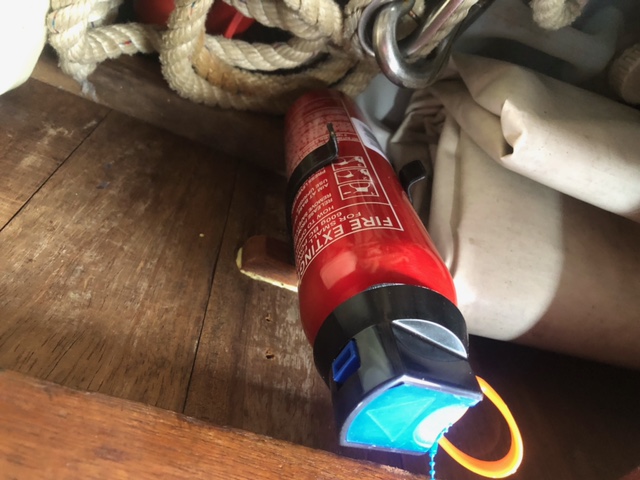
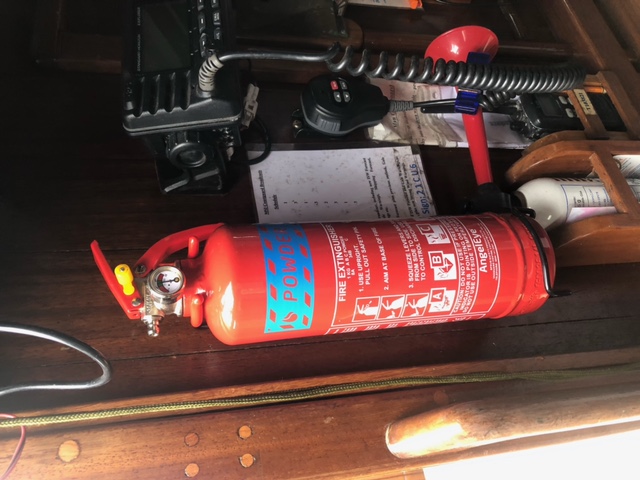
Then there were the fire extinguishers (including the one at the home galley!) to be changed for newly purchased units!
Rarely are these extinguishers renewed where they can be clipped to the brackets already fitted. With my cockpit unit, I fitted a ‘universal’ bracket some time ago: provided diameter is similar, it is a straight swop.
Unit kept in a cockpit locker.
This wasn’t the case in the cabin at a unit located by the companionway entrance. One of the bracket screw holes was different – making a hole filling, sanding and a varnish touch-up before job completion!
Companionway entrance unit.
I fired off a couple of the old ones – both worked!
All of these jobs are necessary, whether replacement or inspections, during a boat’s annual ‘servicing’ – they are not onerous and give peace of mind.
I take various family members and friends sailing aboard Whimbrel so I feel such things should not be put off: it is a responsibility and a duty of care…
Not many people know much about the history of the Coastguard. It was formed in 1822 by the amalgamation of three services set up to prevent smuggling. Often the individual services were acting against one another in effect assisting the smuggling gangs.
As boaters, we are all mostly aware of the presence of the Coastguard at various times, listening to the forecasts, perhaps seeing their cutters in the distance and the rather smaller RIB type vessels closer up. Marinas are often used for mooring…
Since the 1820 professionalisation the service has been saving lives along the UK coast and at sea, as well as coordinating rescues for those in distress in international waters.
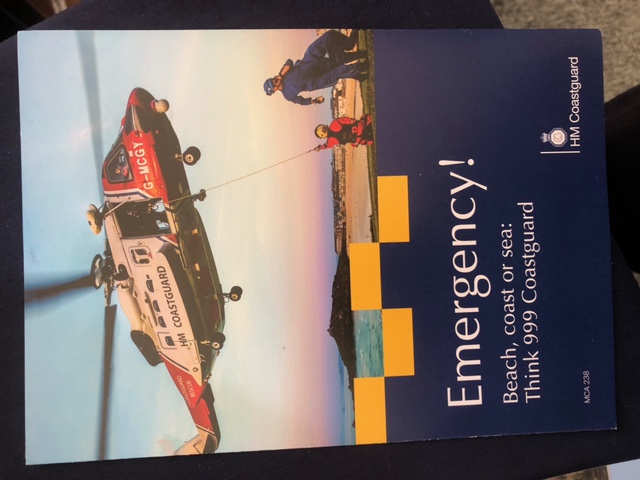
With the advent of the telephone a 999 emergency system came into being in 1937. A caller had only to call the operator and ask for whatever service needed or just state the emergency and operator directed…
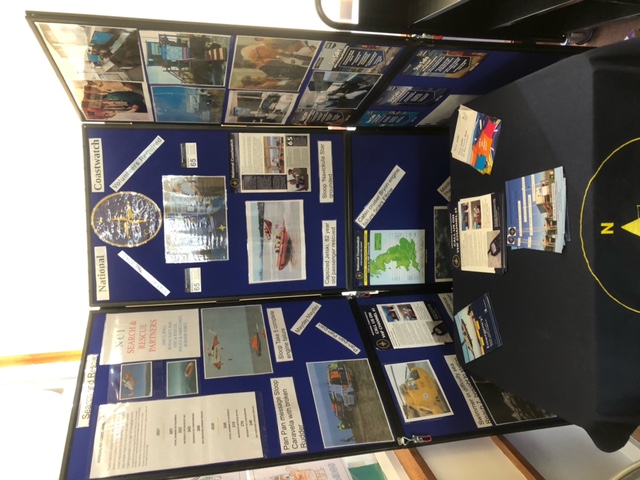
From a display in my local library, Hadleigh, Essex.
However, public knowledge has been on the wain so back in 2018 a campaign was launched, based around a seaside cartoon type postcard couple…
Item from as far back as 2018 regarding a campaign using old techniques…
Clearly, the lack of awareness has continued to spiral downwards. It has been said that around 50% of people living in the UK don not understand this system or service, or even have any knowledge of it.
For seafarers this is a damning as it could mean literally life or death…
Now, I have been one who ’caused’ a call to be made, but it was made by a person who didn’t understand what we were doing. I had sailed Whimbrel onto a bank. It being shallow, jumped overboard to push boat’s bow round – I succeeded, but the tide still left us high and dry. A lady ashore (On Mistley Quay) called the Police/Coastguard – a life boat pitched up…
Told about in an article published by Yachting Monthly and retold in full in my forthcoming new book…
We were not in any danger.
The coastguard duty officer in discussion with my good mate (a local sailor himself and professed to grounding more than once) gave some excellent advice: If you go aground and are not in danger, let the Coastguard know so that if reports come in they can stop unwanted dispatch of emergency services…
They had this conversation at around 0100 the following morning as we reported floating and clearing away…
But the 50% figure has caused and a new website has been launched to promote awareness of the 999 service.
When the Maritime and Coastguard Agency slimmed down its shore stations in a fit of modernisation with a centralised centre ‘somewhere in Hampshire’ from where experts , we are assured, will know a dinky little creek off a tidal waterway anywhere … many of the old CG Stations were taken over by an organisation called the National Coastwatch Institution. Many ex MCA staff transferred upon retirement – it is a volunteer organisation.
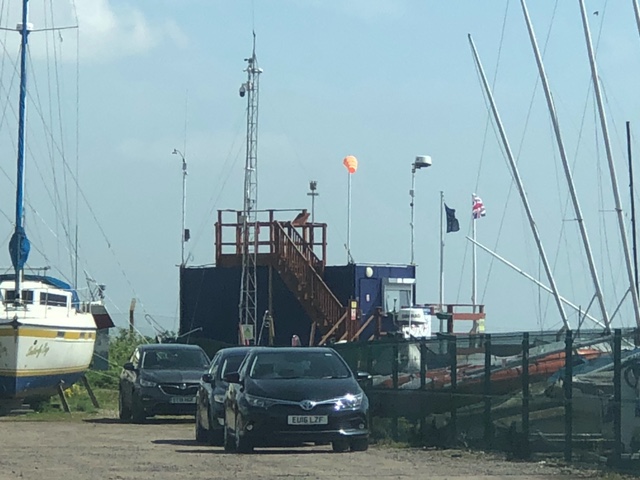
A branch opened at Holehaven – a singularly dire choice where other than big ships travelling by, little happened! They talked there way into hiring a chunk of the Island Yacht Club hardstanding, out on its south-eastern corner. A much more appropriate spot to gaze over the areas used by the general public.
The National Coastwatch look out at the Island YC.
The display I saw at my local library appears to be in conjunction with the new MCA initiative.
The Hadleigh library display.
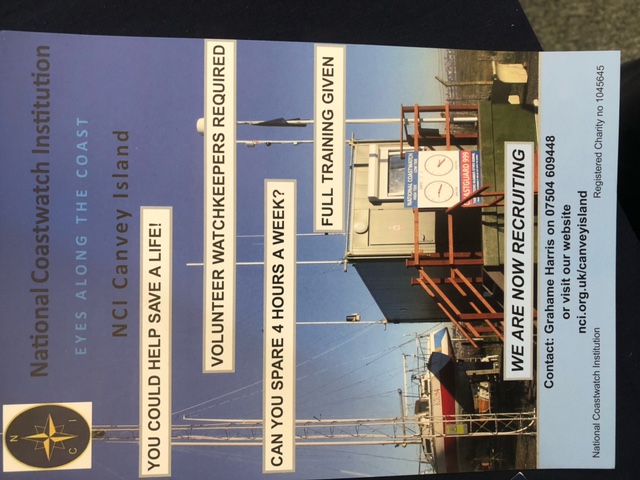
Like may organisations, the National Coastwatch are after your sevices!
So, if interested, look them up in your area and there may well be a local station.
Your ‘country’s coastline’ needs you!
Now this leads me onto the helping hand that has, by tradition, been freely given by one seafarer to another, for generations – the lore of the sea…
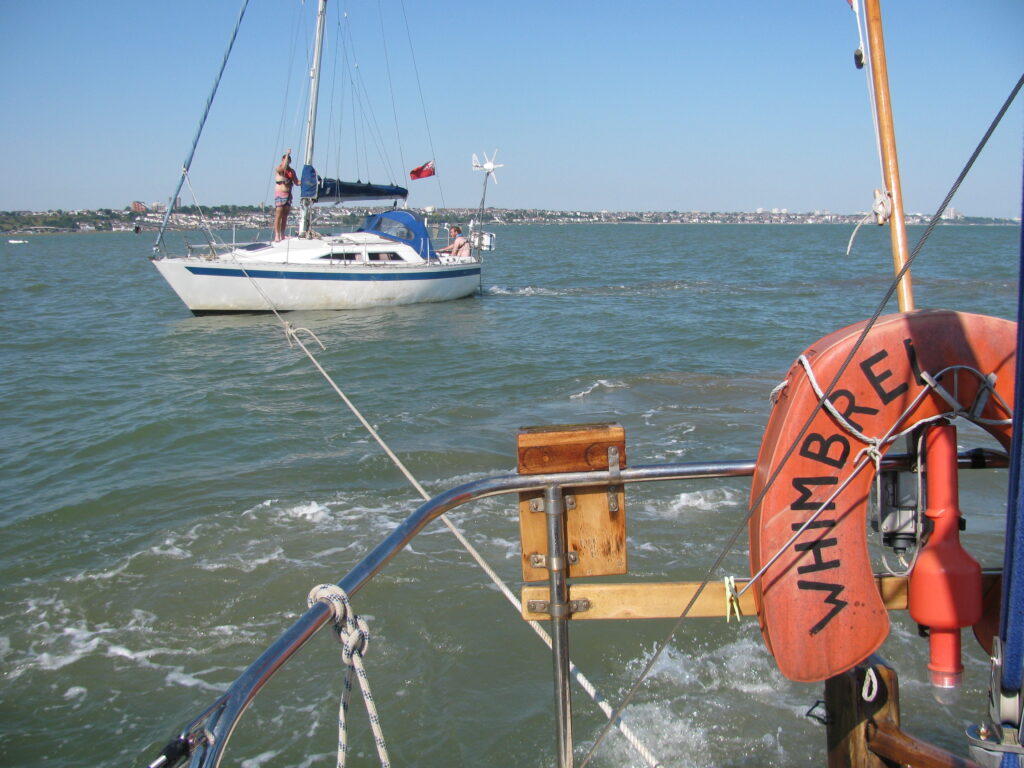
Whimbrel attempting to tow a vessel from the Benfleet YC from a mud bank in the Ray Channel in 2020. We failed to shift her!I advised the boat’s crew to appraise the RNLI – we had already called the Port of London VTS. The RNLI later took the crew ashore. The boat sat on the bank for a couple of months while the boat’s club did nothing.
The above attempt to tow a ‘stricken’ vessel was made in 2020 during the Covid spring, when sailing was granted. The tow rope was my quickly joined mooring warps – dropped by our club workboat when they arrived to try and help. I never got the warps back from the Benfleet YC boat – it is told about in forthcoming book!
Sailing alone on a fine day with a good sailing breeze I was gazing at a little cabin cruiser going along when her mast folded at the hounds and collapsed.
There were many powered craft zipping about and a fair spread of sailing vessels. Other than myself, NOT a single one took any notice!
I sailed over to ask if they were okay and if their prop was clear. With their assurances, I left them puttering back towards leigh – all told about in my forthcoming book.
A few weeks later, I passed by and had a closed look. Looks like a typical splintered wooden spar!
Now, recently, I heard, a vessel from my own club had run aground on a mud bank in Hadleigh Ray. They were returning to the Island YC after being ashore elsewhere. The bank, Bird Island, sits in the Ray Channel abreast of Two Tree Island and Marks Marsh Island.
I named it years ago and it was taken up be a chap at the Benfleet YC who surveyed the waterway from Benfleet YC to the Leigh Buoy – see BYC web site. I also produced a chartlet years beforehand marking where the buoys sit in relation to creek banks/gut way. It remains on the Island YC web site.
I have been monitoring the growth of this island fro a couple of decades and wrote to the PLA about it. The PLA denied its existence, but would look when next survey carried out!
Bird Island – Ray Channel abreast of Two Tree Island. Note: clump of cord grass to rhs.
I have sailed regularly up towards the BYC for decades and eventually ‘mapped’ the route from the seawall. There is a dished and fairly deep swatch to the north of Bird Island and Two Tree Island which is wide enough to tack through. The deeper and narrow channel runs to the south with hard steep banks.
The boat that grounded, fortunately ‘fell’ the right way, otherwise she’d likely to have suffered sinkage. The crew were taken off by the RNLI. A boat from the Island YC went out and plucked her off that night. Self-help at work.
Self-help does not appear to be the norm now though: I heard from a sailing friend about his problems with a folding propeller – leaving his mooring he found to his horror that the prop was thrashing about beneath the water not doing a lot!
‘I was drifting sideways up the creek…’ he said, ‘and called to people ashore at the Island to fetch a dinghy…’ The blokes stood and watched, doing nothing…
It was a passing kayaker who turned and sped up-stream to fetch out the boatyard boatman … my friend was taken in hand, lifted, sticky prop freed and greased and sent back on his way. Probably cost him, but help could have come from closer to home.
But I was dumbfounded by the lack of help from my own club members.
Shame on them!
It wasn’t a RNLI or Coastguard situation, just a simple within creek incident that was ignored by ignorance and a ‘don’t care attitude’ which I find extremely sad.
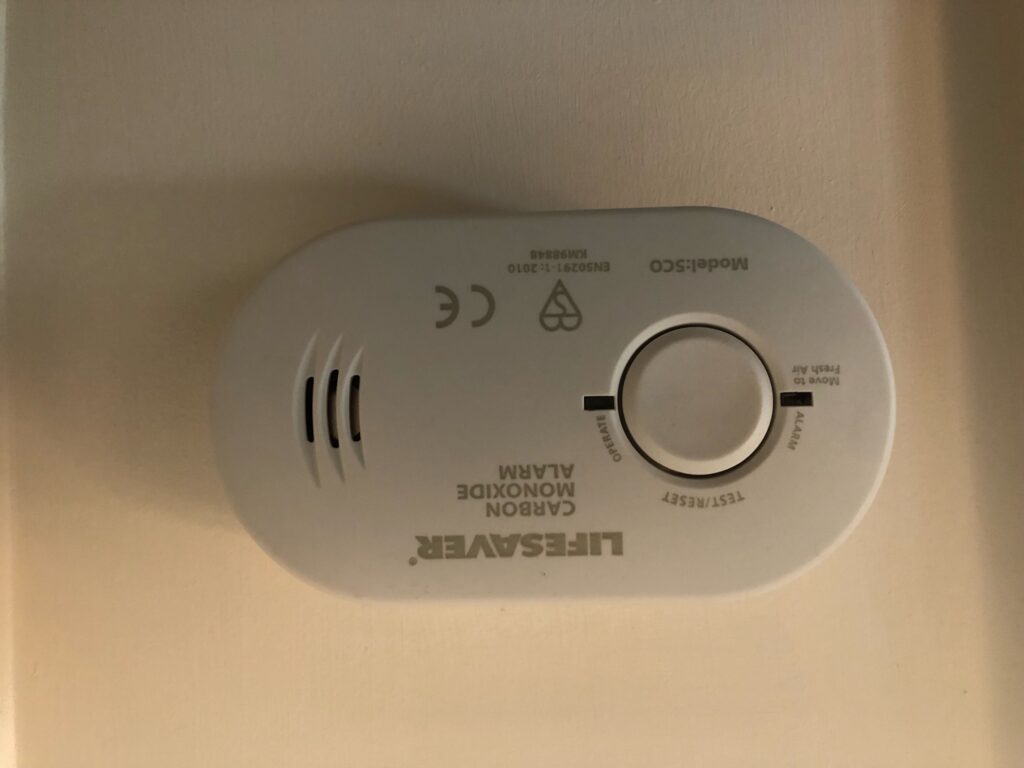
Deaths due to carbon monoxide (CO) poisoning is something to be feared, either in the home, a rented holiday pad, caravan, motorhome or aboard one’s treasured little ship, which is this post’s perspective.
A typical carbon monoxide (CO) monitoring alarm unit.
Many years ago, when Whimbrel was new, I retrofitted ‘gas’ alarms beneath the drinks rack seen in the cabin view below. They were rather expensive marine units that were wired into the boat’s electrical system. They both failed – twice – before I went looking for different units.
In time I found that the best source for such items was the caravan and motorhome world. For CO units, the world wide web has a plethora of battery operated units that have a designed life-span of around seven years. An alarm sounds when battery is flat – besides, a lack of the tell-tale winking light is a damned good sign!
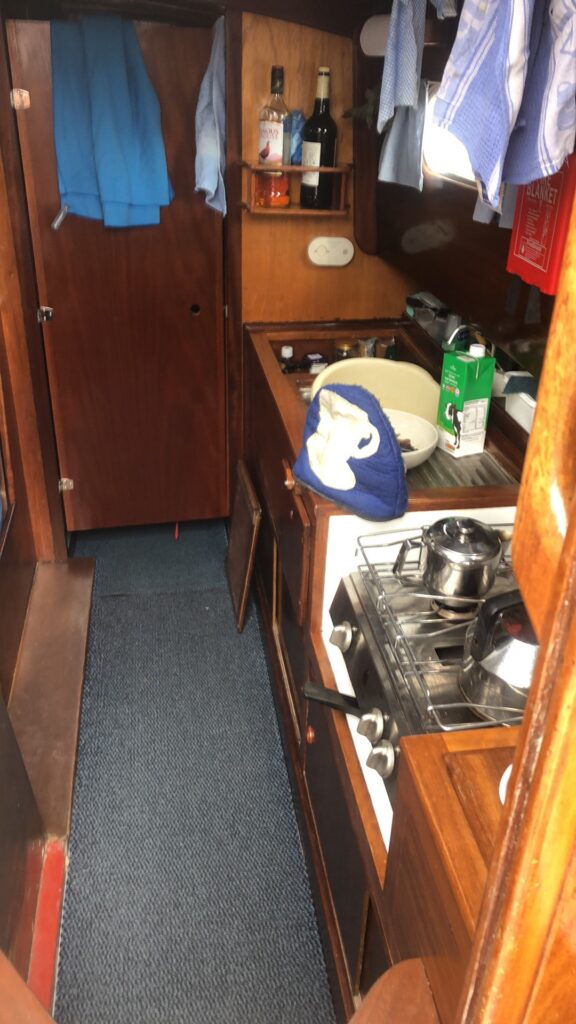
Looking into Whimbrel’s main cabin – note CO alarm on bulkhead under bottle rack.
I have a gas alarm fitted low down under the step into the cockpit to tell of any butane/propane gas leakage. Incidentally, we have found that both will operate under ‘test’ should the mate’s underarm spray reach a sensor!
I was aghast to read in a marine industry editorial about the deaths of two boating folk in a Southampton Marina earlier this year. They were on a winter weekend. They had run the engine, a petrol unit, to charge batteries and get everything in order for a day afloat the next day.
However, during the evening/night, bothe passed away…
The report came up with the probable reason and, the fact that no alarm to monito carbon monoxide had been fitted.
The number of deaths investigated by the Marine Accident Investigation Branch (MAIB) of the Maritime & Coastguard Agency (MCA) has rapidly risen giving cause for concern.
On inland waterways craft, they are a necessity for a licence…
The most tragic side of this is the fact that a unit can be obtained online for a pittance – £15 – buys a unit lasting seven years and operates independently of the boats power system.
Be warned, if you do not have a carbon monoxide alarm, fit one. Funeral costs a darned sight more than the fifteen quid for a little box of electronics…
So, I thought, it’s about time the satnav carried aboard Whimbrel was updated while I had the time.
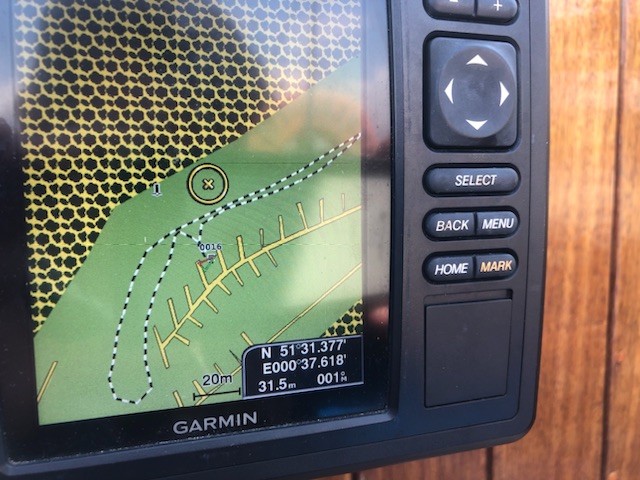
The unit, a Garmin GPS Map 557, was purchased back in 2014 and it has served alongside the traditional charts carried aboard, kept updated annually (Which reminds me!) for I have never relied upon the electronic unit alone.
Last season, I finally decided that the update was necessary for there had been a number of changes which were of importance, even though I use it for cockpit observation on the whole.
I had the unit updated a few years back now some while after some major buoy position changes made in the Swin Channel, including a movement of the Maplin Sands firing range boundary eastwards. That was a waste of money!
Last summer, sailing with my youngest brother, we strayed over the line. We were steering for a green ‘dot’ away beyond the bow. A fast launch was seen astern. It was clear that it was curving our way.
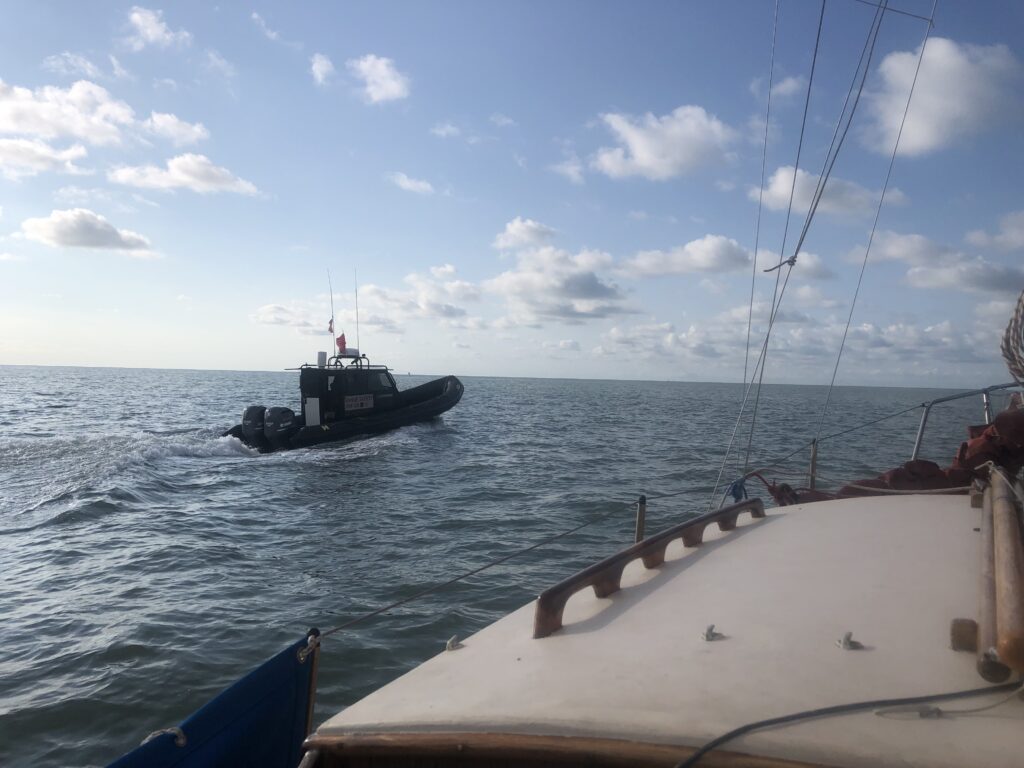
The vessel morphed into the Firing Range Patrol!
Range Patrol ‘upsetting’ the quiet of our morning!
‘Are you aware yo are fifty metres inside the range…’ a call floated across the gap.
‘Well yes..’ I said, adding, ‘I am on course for the Maplin Middle…’
‘You know you need to keep outside the Maplin Bell…’ the caller said.
My crew and I looked at one another. ‘Been sailing this passage for over forty years,’ I called, grinning, and adding, ‘so, yes!’
I got a wave … then the launch careered away…
While laid up nursing my new knee I have settled to dealing with all sorts. One being this update.
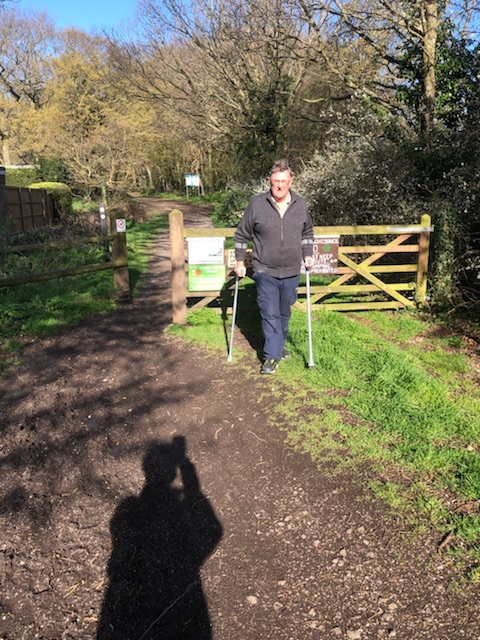
Out on a walking exercise…
Easy, one would think. NO!
I trawled around and kept finding that the unit had been discontinued and was no longer supported. Garmin searches kept directing me to the ‘American’ web site.
I remembered I had a Garmin log on, and surprisingly I got on after many years of non use. Again, I saw the ‘557’ was no longer available.
All very strange as units were clearly still on sale!
I eventually alighted on a company based in Peterborough, Active GPS, which seemed to have what was required.
An email discussion with James at customer services confirmed that the 2022 (current) update was available and he gave me details of Garmin UK based in Southampton, to check on the quality level of the update.
Email: marinesupport.europe@garmin.com
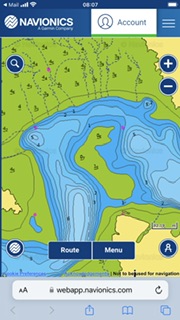
An email produced a telephone number and a very nice chap, Rob, confirmed that all chart corrections up to when sd cards were updated in 2022 were included. With that came a navionics link to the charts loaded onto the new card.
Section showing Sharfleet off Stangate Creek. I straight away noticed the clear loss of a ‘bay’ along the north mud edge.
I ordered a new card from the very helpful Peterborough firm. Within a couple of days it duly arrived.
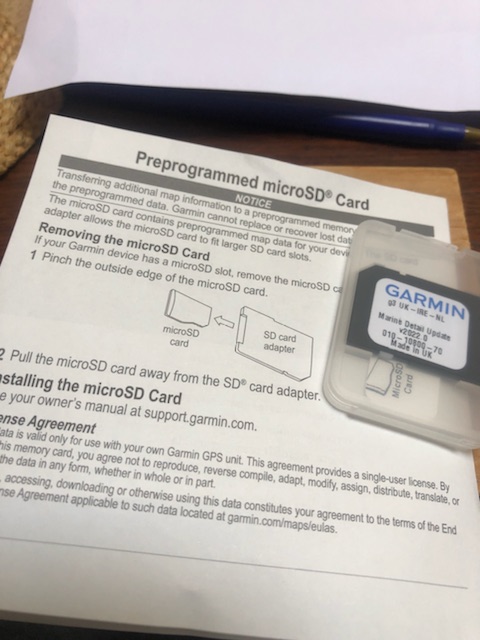
Garmin sd update card.
This last Saturday was a fine day with an early afternoon tide allowing me to comfortably board Whimbrel with my good mate in attendance.
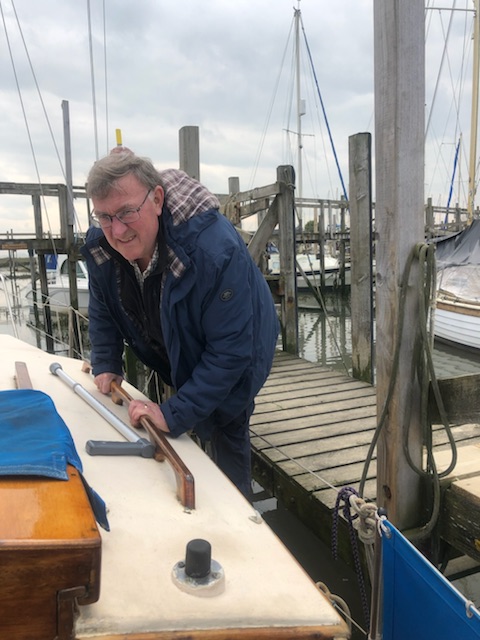
Aboard… Note down to a single walking stick by twenty days after op!
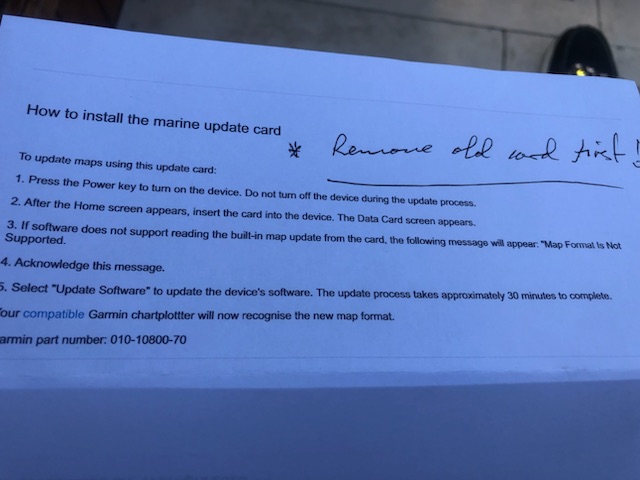
The update instructions are short and sweet. The sheet stated it would take up to thirty minutes … in actuality, it was all done in less than ten.
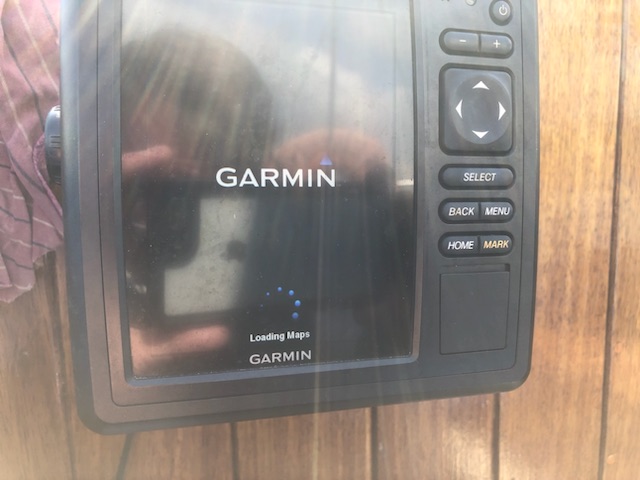
SD Card update instructions.Doing its stuff!
While the machine whirred internally, I was able to sit back and enjoy the ambiance of being afloat on the dear old girl…
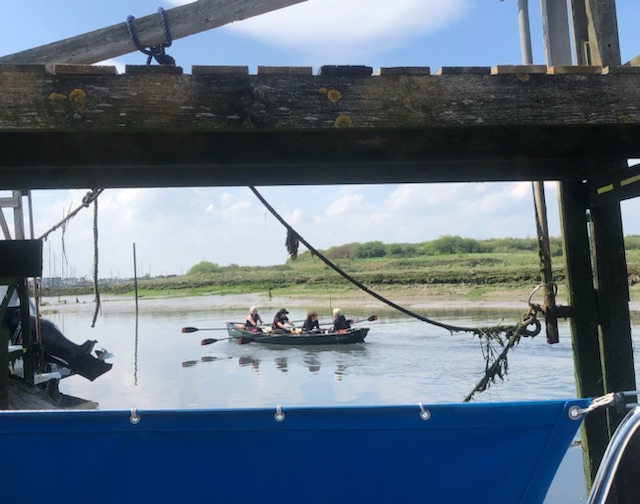
Three separate four-oared skiffs rowed past, bound, I assume for the Island YC, something I know they do from time to time. There are three rowing clubs in the Lower Thames. I didn’t see which.
The third of the three skiffs framed by boat and my mooring jetty.
I was handed a mug of coffee and sandwiches as the GPS screen went to start up – all done.
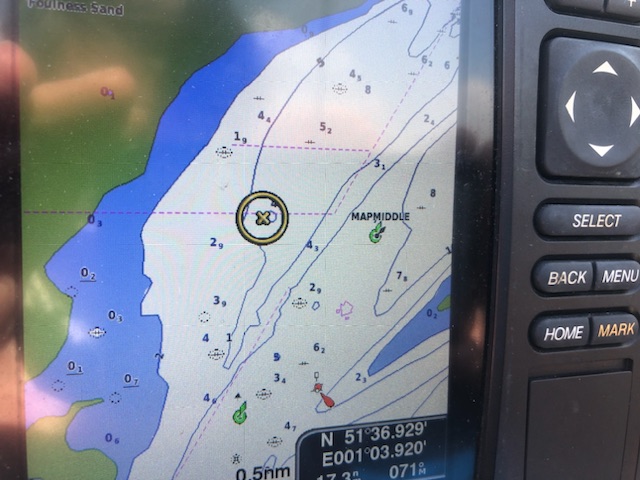
A few clicks, while sipping and munching and I was checking the Swin Channel…
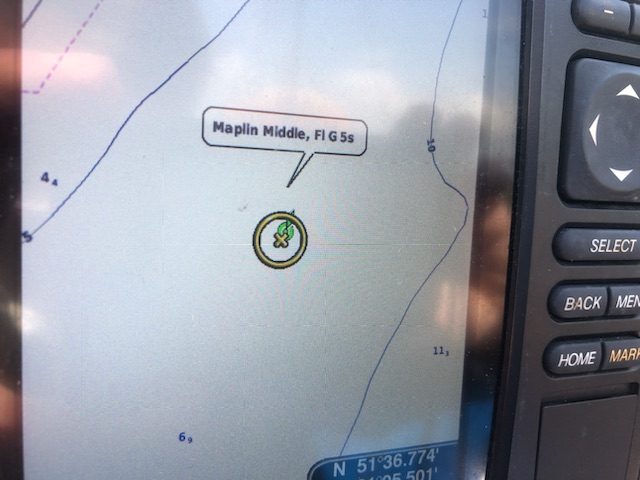
Swin around the Mapli Middle – note black mark – this was marked by a New Zealander who was crewing with me a few years back, as we passed closely. Bang on!
A bouy marked up years ago was bang on the current charted position. I deleted the ‘mark’ for it is no longer relevant. There are others to delete as time progresses.
Buoy with ‘mark’ deleted.
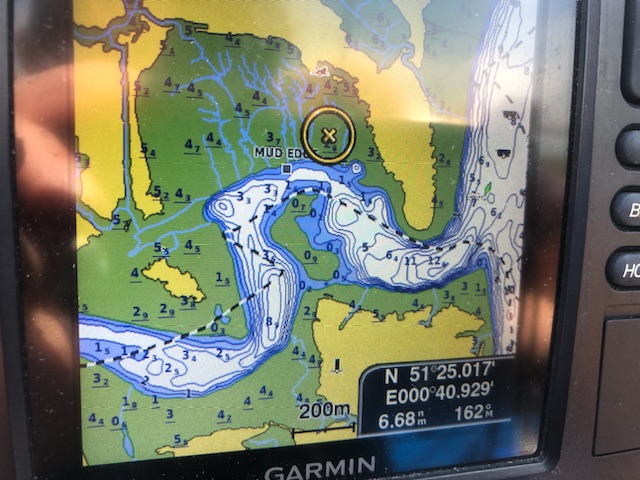
I then went to an area where I knew there had been a pretty drastic change to the position of the low tide mud edge over the past decade – Sharfleet Creek, which is off Stangate Creek on the River Medway system.
Note ‘mark’ – ‘Mud Edge’…
Last summer, after a ‘brush’ with the mud in Sharfleet, I marked the edge while enjoying a coffee and waiting for the tide to lift us…
It is clearly as good as bang on!
Lastly, upon returning to current position, the Garmin actually showed me to be sitting in the correct mooring (ignoring orientation!)
Home mooring!
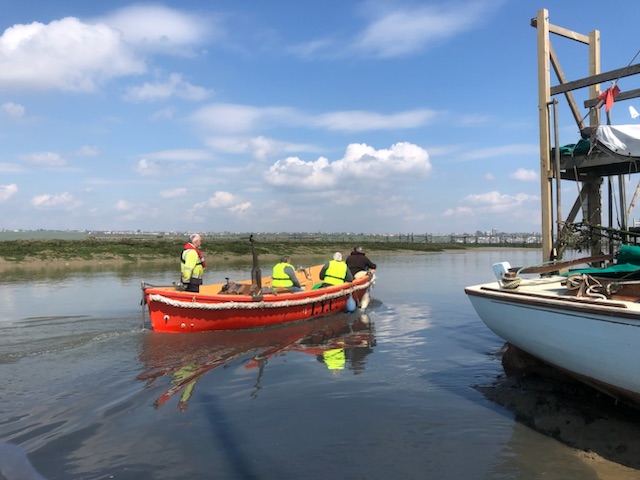
One of my club’s work boats on the way to a task on the fine afternoon.
The ‘little’ work boat.
So, now all there is to do is get out there and use the darn thing. When? Well, I’m looking to get afloat for a sail at six weeks post op, on a quiet day…
My sincere thanks to James at Active GPS in Peterborough and to Rob at Garmin UK in Southampton.
It was just so great to get such positive helpful advice. Priceless. Bless you both.
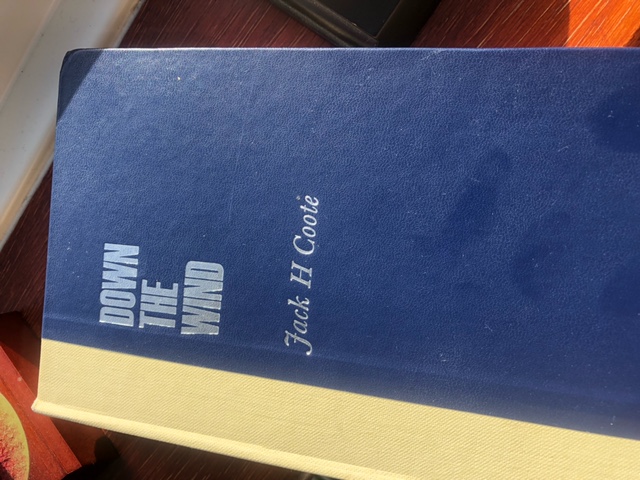
Down the Wind appeared from beneath the Christmas tree some months back – kind of Father Christmas, I thought at the time. So, I took it into hospital with me to give sailing succour when disabled with a new knee!
Have I read it before? Not sure: couldn’t find a copy on my well stocked shelves, but may have done a very long time ago.
Down the Wind was published by Hodder & Stoughton in 1966, and is a compilation of articles from varying magazines from the obscure club type to the public and excerpts from books dating back to the germination years of sail cruising with the likes of R T McMullen, Claud Worth, Sir Alker Tripp amongst others. Many pieces are by authors from club annuals, such as the Royal Cruising Club and the Clyde Cruising Club etc.
The book begins with excerpts from sailing fiction. Few will know that the Hammond Innes yarn, The Mary Deare, was spawned from an encounter at sea in real life… whilst most sailors of a broad reading spectrum will know, We Didn’t mean to go to Sea, by the inimitable story teller, Arthur Ransome – the excerpt covers the ‘realisation’ of their situation after losing the anchor and being swept out of Harwich Harbour…
There are two sections of yachts in action pictures – mostly in a bit of a blow! A few are of the tranquil ‘normal’ type…
The cover – did it once have a dust jacket?
The first thing that is clear is that it is a ‘man’ book for women are barely mentioned. There is the odd piece where a woman features, apart from the couple written by women. Racing off-shore features heavily, in conditions in which the majority would avoid or not contemplate to cruise in.
A touching piece comes at the end of an excerpt from, A White Boat from England, pub 1951, by George Millar. he and his wife depart in the hours before dawn, quietly down the Lymington River (before the advent of plastic and massed marinas) bound across channel to France. It was a good passage but with rising wind they slipped into the Pointrieux River to anchor in seclusion above a village.
After discussing differing passages, good a anchorage, warmth and comfort below, the author says, ‘It is to enhance such contrasts with the sea and the wind that the truly wise yachtsman sails in the company of a beautiful or intelligent woman- it may be his wife.’
Setting aside a tendency towards misogynism, indeed. It is the reason I have always tried to ensure the cruising comfort of my mate, not overtaxing her, that I have a dear mate still sailing with me.
How many wives/partners actually sail? Not many…
Women writers or otherwise don’t feature greatly apart from two writers in pieces from from a novel by E Arnot Robinson, The Regatta, a great yarn based around Pin Mill on the River Orwell in Suffolk.
The other, Felicity Ann in New York by Ann Davison ‘laughing’ about chauvinistic attitudes of men discussing her boat and whether or not it could be sailed across the Atlantic and certainly not with the author, a woman, who had…
Just once are children mentioned – in Dawn at Crinan by ‘TEW’ where the author has spent a lazy half-hour watching the dawn while his crew get up, commenting on the chattering excitement of two young boys with their father heading towards the anchorage and their dinghy…
Then, as he re-boarded his boat with the waft of bacon emanating from the hatch, he pauses to watch as two, ‘little girls exploded out of the fore-hatch of a boat lying three out astern of us, shouting with laughter and calling to each other…’ they scrambled ashore and raced to the sea lock.
A scattering of line sketches throughout by artist Paul Sharp livens the book.
An excerpt ‘Fitting Out‘ from, A Capful of Wind, by Aubrey de Selincourt, 1948 struck a chord. An owner is fitting out with a friend who is clearly of more robust stature and probably younger. He discusses fitting out done by owners and those tasks left to a yard. A paragraph about antifouling too…
‘Now scrubbing and antifouling a yachts bottom … is hard work. It has to be done against time, to get the paint on before the tide is up again.. The composition works extremely stiff, and certain parts of the boat’s bottom are difficult to reach. The work gives one a crick in the neck, an aching back and a numb wrist.’
I bless my dear mate: she has for so long done most of ours, leaving me to cut in and do boot top…
Most owners thee days antifoul in the boat or club’s yard, but many still use a slipway, or even the beach.
So, did I enjoy the read. Yes, I did.
Like may books in this genre, dating back to over a hundred years ago, and less, the language can be ‘old fashioned’ and, don’t be surprised to find sexism or views of a misogynistic tendency. We’re ‘better’ people now, hopefully, in inclusivity…
If you have a copy lurking on your book shelf, give it another airing. If never read, well, you’re missing out on a myriad of sailing mignons, which may set you off on finding the books from which the pieces have been taken…
The Calor Saga has developed a little, but don’t become euphoric: it remains bad news.
I began to ‘worry’ about this nearly two years ago now and contacted the Royal Yachting Association (waste of space) and the marine leisure press – only one outlet initially interested the story – and eventually decided I had but one choice.
I looked at diesel cookers – problematic in fitting of a flu, and briefly considered old fashioned paraffin and even methylated spirit – sorry, but these on a boat used for long periods of the summer are not suitable.
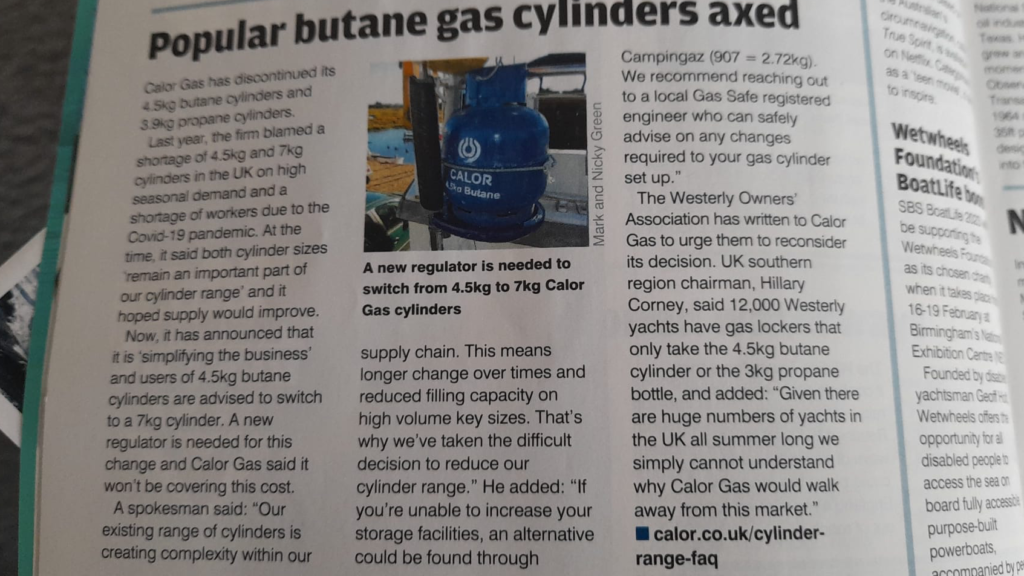
So, a Facebook post from a sailing friend popped up with news from the Boat Safety Scheme people(BSS) in which is an announcement from Calor of a suspension of their original public statement, however, the small 4.5/3.9 kg cylinder will be going, but in a phased manner as cylinders reach life-time limit.
The BSS main statement is copied below.
‘Our advice to boaters is to take advantage of this new Calor position and use the opportunity it affords to, if changes are necessary, find competent expertise in local boats yards or through the Gas Safe Register www.gassaferegister.co.uk/find-an-engineer-or-check-the-register/ and ensure any changes are safe and compliant with boat LPG Codes of Practice and BSS Requirements.’
I just love the bit, ‘ find competent expertise in local boats yards…’ presumably this would be for redesign and changes to locker access and the like.
As said in my original posts, for many wooden boat owners, a complete redesign of cockpit/locker arrangements would be required associated with problems in maintaining locker bottom drainage…
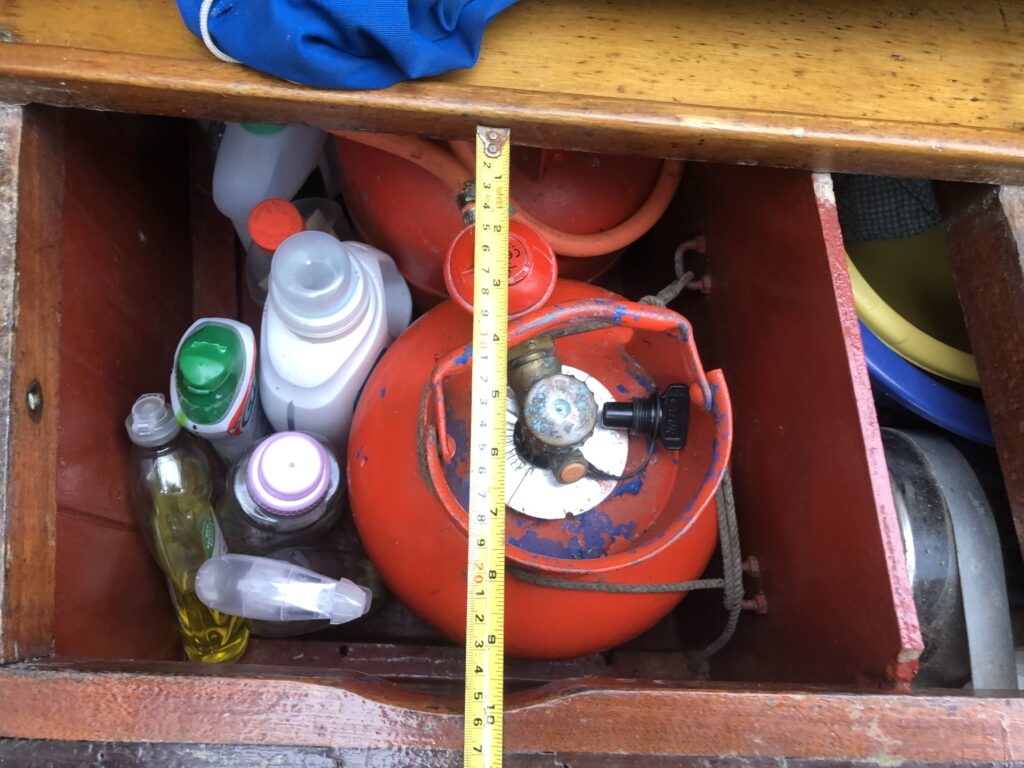
Access made ‘just’ wide enough to slip a 250mm diameter cylinder in. The locker floor has a drain, but when well heeled it ‘floods’!
So, a major cockpit reconstruction. Are Calor going to pay for this?
This changes absolutely nothing for so many people in the boating and caravanning world, as the only alternative remains changing to Campingaz. That is a 2.72 kg butane cylinder at twice the price of Calor’s 4.5/3.9 kg butane/propane exchange prices.
Many east coast sailors know and love the pretty little marina at the head of Woodrolfe Creek at Tollesbury. But, how many realise that just up the road, a little beyond the tide line, sits a world beating innovative company.
I didn’t, but I have known of Tollesbury’s connection to the wider maritime world in a communications company and a ‘control’ engineering company going back to my time at sea.
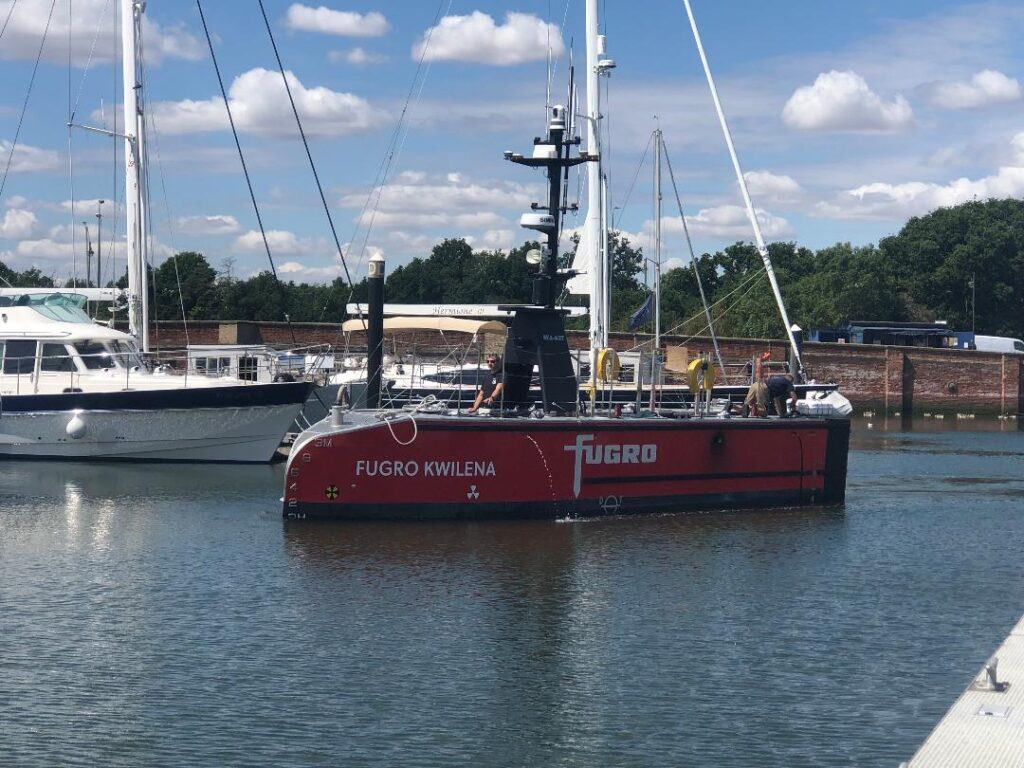
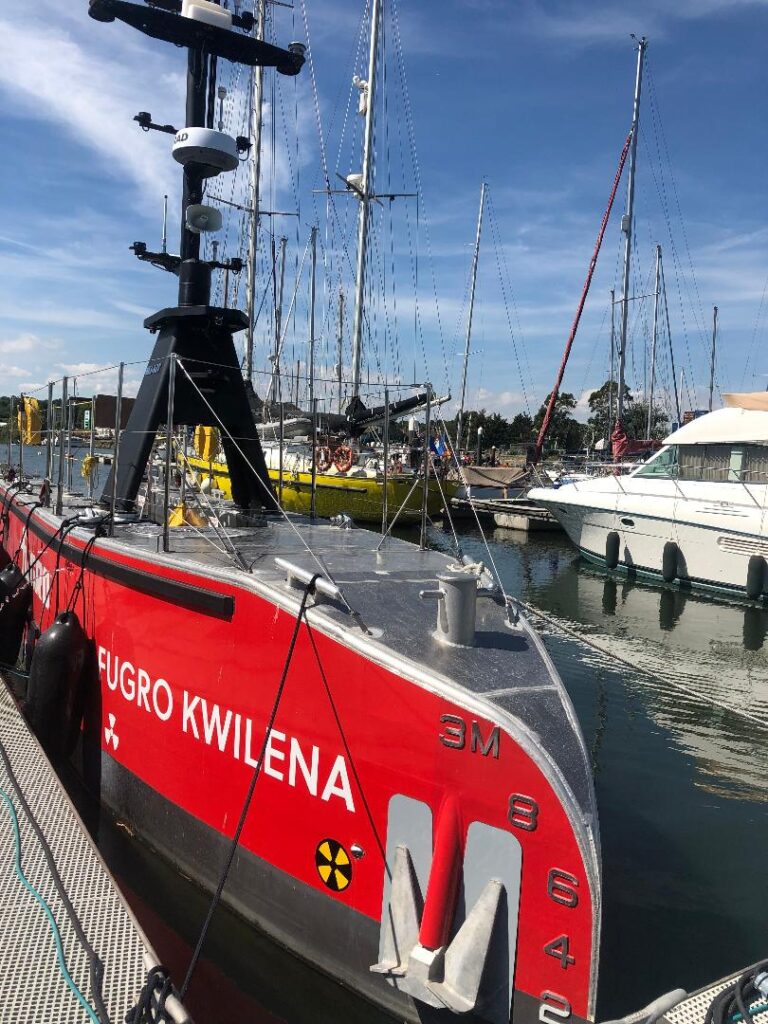
Last summer while we were berthed aboard Whimbrel in Fox’s Marina, I spotted a strange looking vessel.
Upon talking to the harbour master, I discovered that it was an autonomous boat built in Essex for ocean exploration and survey work. ‘Down the coast…’ he said, presumably not knowing where.
The little ship under manned way!
I later found the company on a web search. It is based in Tollesbury, Essex, just up from the old fishermen’s sheds.
Alongside the dock. Vessel appears to be a sister to boat in press release.
The company manufactures these craft to exacting parameters which enables the oceanographic scientists to do their jobs…
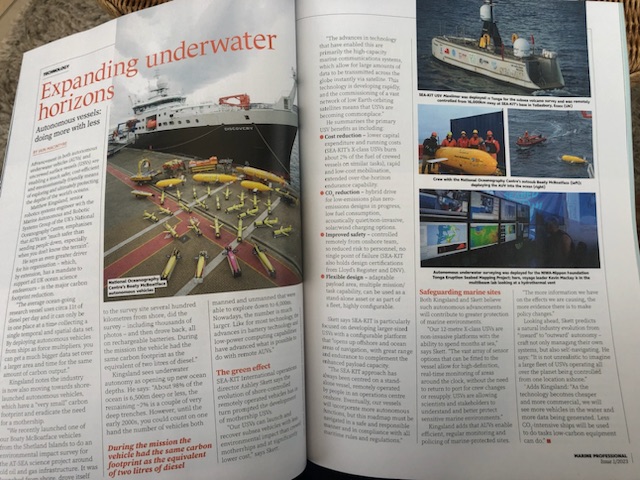
I ‘forgot’ all about the event, however, reading a recent copy my Marine Engineering Society magazine – Marine Scientist – I alighted on an article about the autonomous survey of one of the world’s undersea volcanoes in action – described as the biggest eruption man has witnessed or recorded.
The eruption was near the Pacific island of Tonga.
The Marine Scientist in which I read the article.
Sadly, for me, the article was light on detail of aspects I thought should have been expanded upon.
Close up of an array of craft carried by the British Survey Vessel Discovery. Courtesy: Marine Scientist.
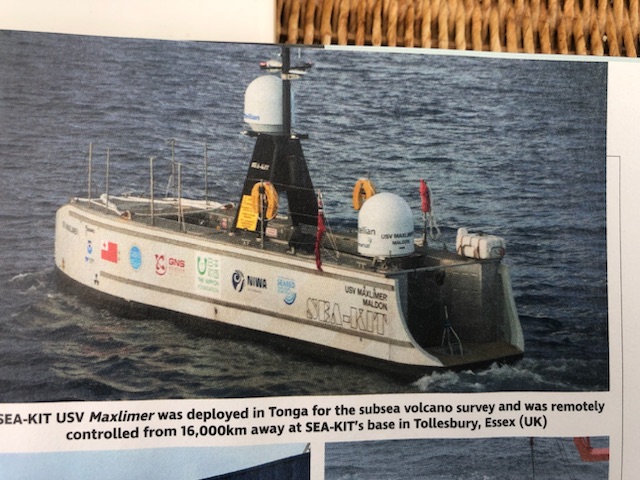
The Tollesbury Company has been expanding its output to cope with an increased demand for autonomous survey vessels. See Sea Kit’s press release.
Close up of a sister to the vessel I saw in Fox’s Marina during August 2022.
So, the next time you pop into Tollesbury, remember that this is not a sleepy little Essex waterside mud-hole, but a place at the heart of the Tech Community, controlling autonomous vessels on the other side of the world, built metres from the mud…
Fascinating and fantastic to learn that a marshland ancient centre for boat building, repair and fishing is still producing craft.
Having a professional maritime background, I knew that when the media picked up on Government attentions being drawn to the activities of the minority, then it would not be long before the associated department, the Maritime & Coastguard Agency (MCA), acted.
The law of the sea around the coasts of the United Kingdoms has changed – the law will be taken aboard by devolved governments.
I wrote about this during the Covid-19 pandemic, having been troubled by watercraft, and witnessing crass stupidity which resulted in Essex Police being called to the Leigh-on-Sea waterfront by members of the public.
The troubles around the waterways were raised by the Times Newspaper in a leader too. See attached posts etc…
A skiff in Queenborough Harbour beam onto an approaching wash. The oarsman turned, just in time to hit bow on.
The crux of a legal case brought up the terms within the act regarding personal watercraft and whether or not they were constituted ‘a ship’ as we know we all are under the Merchant Shipping Acts, the COLREGS and SOLAS instruments that lie at the heart of ‘the sea’…
Personal Watercraft (PWC) are designated vessels and must comply to same rules as the largest container ship!
This is going to be a shock to many owners of PWC’s where owners can live far inland, have little knowledge of area trailing to, or, more importantly the hierarchy of the sea and those upon it.
So, now the law has been changed by Parliament, it is the job of the MCA to discharge and disseminate.
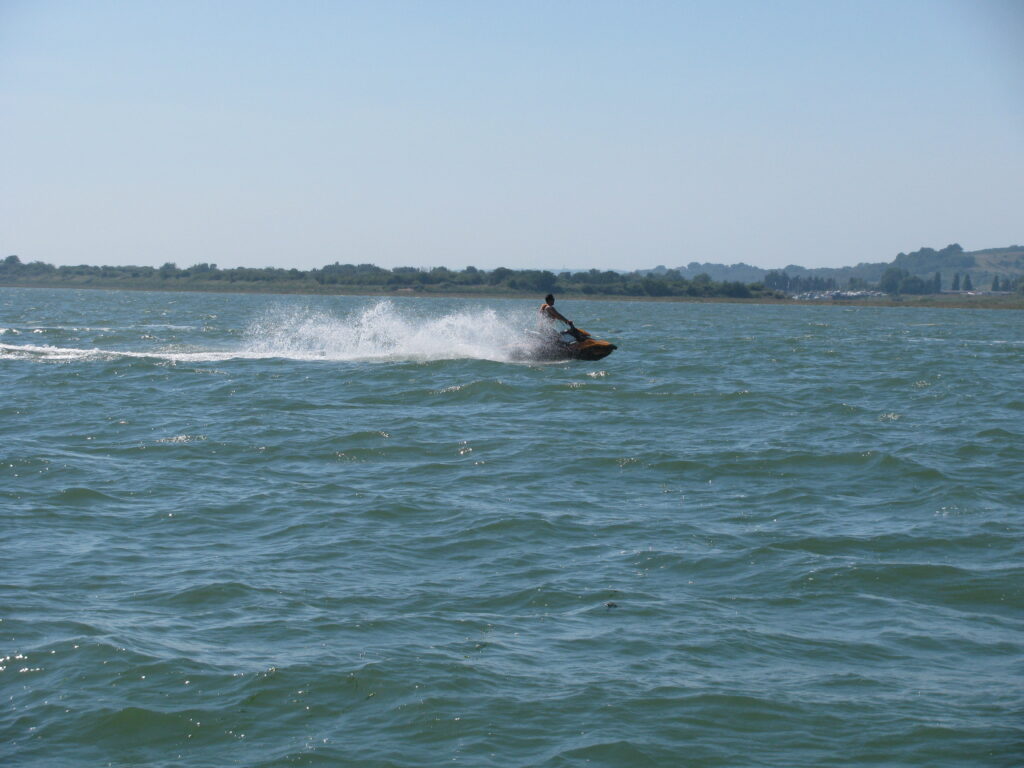
A personal watercraft skimming by – this one behaved sensibly.
Harbour authorities or their sub-acolytes Queenborough Harbour(?) in the first instance will be required to act and deal with. Sitting above are the police, and the law – MCA.
Confiscation and fines will be imposed, as they have by some authorities over past few years.
Many will applaud this long overdue action…
I suggest reading through all the links within the MGN684 link. It is interesting reading!
I was sitting in hospital with time, I thought, to get on with a blog I had earlier prepared. The plan was to use up those boring hours of waiting with time to muse and think…
It wasn’t to be for I was in and out after having a total knee replacement that there just wasn’t the space. Visits from doctors, nurses administering pain blockers and coping meant time ran away.
So, my earlier thoughts on a couple of news items that popped up on Leisure Marine News had to wait.
Wherever one walks around the coast of Suffolk, Essex and Kent, the story is the same. A plethora of plastic waste can be found washed up along the tide lines…
In many respects this problem has become worse over the last decade. Why?
Well, the simplistic answer is essentially obvious – it is thrown aside by the uncaring folk of the neighbourhood or from vessels. The latter is not the norm.
The littered detritus along the tide line of a sea wall along the R. Roach in Essex seen recently during February 2023. It contained large numbers of plastic items.
Some of it will be from wind-blown material, especially up within the headwaters of the waterway.
This is not just an East Coast – Thames Estuary – problem. Sailing some years ago in the Western Isle of Scotland we came across one particularly badly affected beach in a bay. In particular, I remember fish boxes from Portugal and plastic bottles with non-English labels. Never mind the rest.
To say the least, the media has been pretty forward in promoting the cause against plastic pollution but it goes on, seemingly unabated.
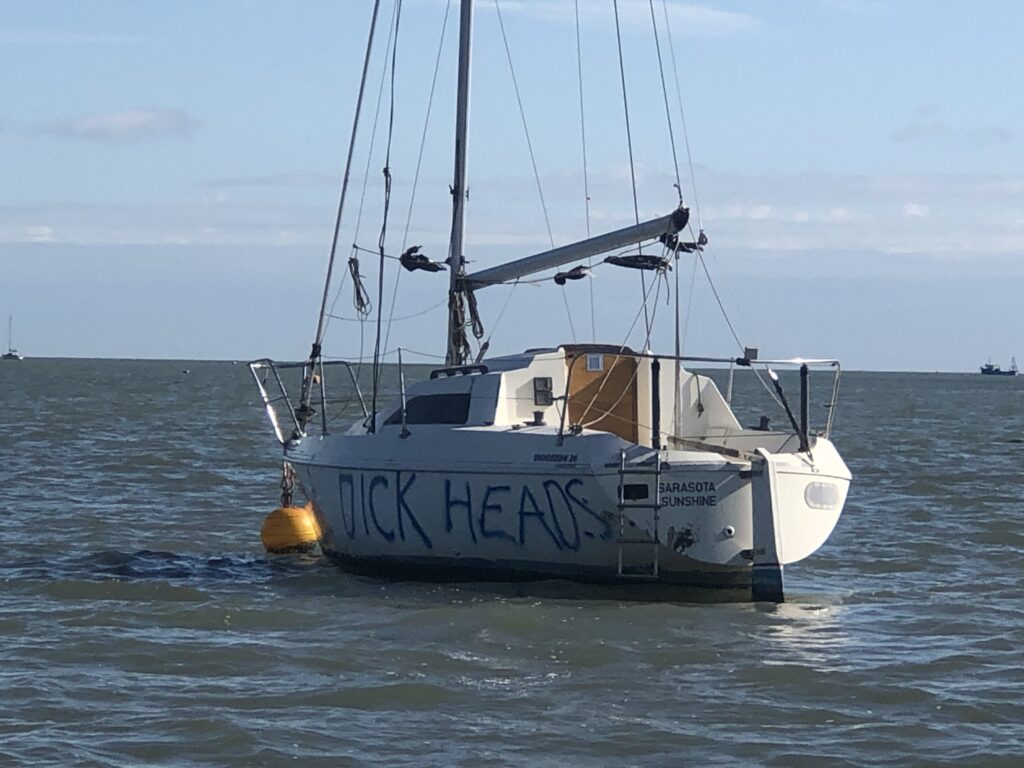
Boat passed locally which has been ‘flying’ plastic bags for years. I wonder why the perpetrator of the graffiti did this terrible deed?
The vessel pictured in my own local waters has been strung with plastic bags for years – over a decade at the least – and when they shred, as they inevitably do, they are ‘quietly’ renewed.
One has to ask the question: Is the owner stupid (unlikely) or just damned uncaring of the environment. The latter is the probable.
I could not possibly condone the graffiti, but clearly a boat owner, boarder or canoeist has seen fit to make a point… Forward of the ‘D’ for DICK is a crude drawing of an erect male member! The picture was taken in October 2022 and recently when passing that way the message was still in situ but the flying plastic bags have completely shredded into the local waters.
Some years ago I landed on Burntwick Island along Saltpan Reach on the River Medway in Kent. I was looking at the old remnants from a military boom defence establishment. The ‘land’ is being eaten away by the rising tides and poking out of a metre high edge some distance from the surface there was plastic! How long it had been buried, I wondered…
Evermore dire reports are floating into the media to be read by those who are interested and ignored by, probably, the majority whether or not they condone pollution or not. Most water users are as good as gold, but we have all seen some pretty bad behaviour going on.
So, what did I read that prompted these thoughts?
From Leisure Marine 9th March 2023:
The item said that:
‘Scientific study has found that there are now 171 trillion pieces of plastic estimated to be floating in the world’s oceans. The data suggests this is an increase from an estimated concentration of 16 trillion pieces in 2005.
Plastic represents a huge threat to marine life, as it can kill fish and sea animals who mistake it for food. Plastic can take hundreds of years before it breaks down into a less harmful state.’
A recent UN treaty of the seas is signing up nations to designate protected areas around the coast – the UK is part of this system already – and around 30% of the world’s oceans would become protected too.
The article went on:
‘The reasons behind such a sharp increase are not confirmed, although researchers say it could be explained by legislation around pollution being replaced by voluntary agreements. It could also be linked to larger pieces of plastic breaking into smaller pieces — or the amount of data collected.
Prof Richard Thompson at Plymouth University, who was not involved in the study, told the BBC that the estimate adds to what scientists know about marine pollution.
“We are all agreed there is too much plastic in the ocean. We urgently need to move to solutions-focused research,” he says.
Authors of the study argue the best long-term global solutions involve standardised monitoring frameworks to track global trends, and creating binding and enforceable international agreements to prevent the emissions of plastic pollution.’
There are things that yachting folk can do to help cut the volume, other than not throwing overboard. Also, in a yacht yard, wind-blown material becomes a watery hazard.
A week or so back there was a mid-week work party team combing the foreshore along the Island Yacht Club’s moorings on Canvey Island.
‘The team, consisting of scientists from Plymouth Marine Laboratory, University of East Anglia and the University of Plymouth, exposed juveniles of the mussel species mytilus to three treatments of microfibre, which reflects both current and predicted future concentrations of polyester and cotton microfibres in the natural environment.
Studies suggest that as much as 4.8 to 12.7 million metric tons of plastic enter the global ocean every year.
Fibres are one of the most common forms of microplastic identified in environmental studies, accounting for up to 91 per cent of the total identified microplastics in some studies.’
The microfibres are small at around 0.01mm – 0.5mm in size and this sizing was used in an experiment with mussels in a laboratory.
The results howed slower and small size growth of maturing molluscs.
A team member said:’
‘Additionally, “Reduced growth rates could alter the energetics of food webs, as smaller mussels are less nutritionally valuable, both to their predators in the natural environment and to us as consumers of seafood. Microfibres and other microplastics expose marine animals, such as mussels, to an additional risk in an environment already at risk from other challenges such as climate change.”
Note here, plastic bag flyers:
‘Fibres that are less than 5mm are termed microfibres. These tiny fibres are predominantly generated from the fragmentation of textiles, stemming from the day-to-day use and washing of clothes, and from the weathering and abrasion of marine infrastructure, such as netting and rope.
Microfibres are typically composed of polyester, polypropylene or nylon. However, numerous studies also report the presence of naturally derived and semi-synthetic microfibres (e.g. cotton, bioplastic) in environmental samples, which have received relatively little attention compared to their plastic counterparts.’
So, to combat household washing pollution, micro-filters are being developed. The retrofit and integration of a filter to a washing machine and captures and recycles microfibres as small as one micron.
As said previously, the general public have a lot to answer for and could, at a stroke, contain much of what ends up in the seas around our shores.
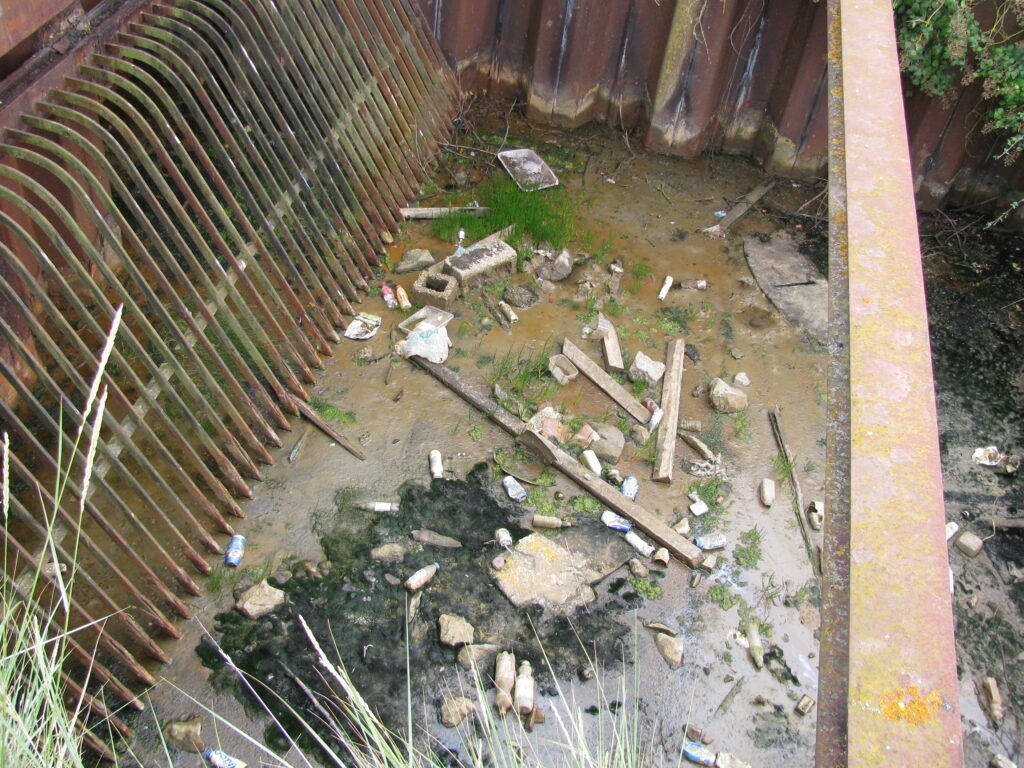
Waste thrown into an emergency sluice near Conyer, in Kent on the England Coastal Path & Cycle Way.
The answer to that is highly probable. If I was ordering Whimbrel this year, and not forty years ago. Times were hugely different then. We were just getting away from the petrol or diesel fit, scenario.
My main use is for entering and leaving marinas, leaving my mooring and returning, making/completing a passage when the wind has expired and a number of incidental uses. Sails are Whimbrel’s main source of motive power.
Whimbrel sailing out of Smallgains Creek, moments after clearing her mooring.
I leave and return from my creek mooring as often as is possible. Any engine use is minimal. I have sailed into a marina, once, and sailed out of others on a number of occasions – usually early in the morning…
Now, for a new vessel, the most difficult question is, do I fit diesel or electric drive? The answer to that sits with what type of vessel, what is the main use and where – area being navigated.
New sailing yachts will be powered in this way as a norm before too long.
The news item reminded me of a Finesse 21 based down in the west country which has been converted to electric drive. The conversion work took place during a major refit after the vessel was sunk during a flash flood – fresh water from heavy rain – at the boat’s tidal mooring.
The boat was originally powered by a Yanmar 1GM diesel unit. It had a stated torque of around 34 Nm and it was replaced with an electric motor of 32 Nm torque at 1550 rpm supplied from 2 x 24 volt batteries. These were charged from solar chargers fitted on the cabin top.
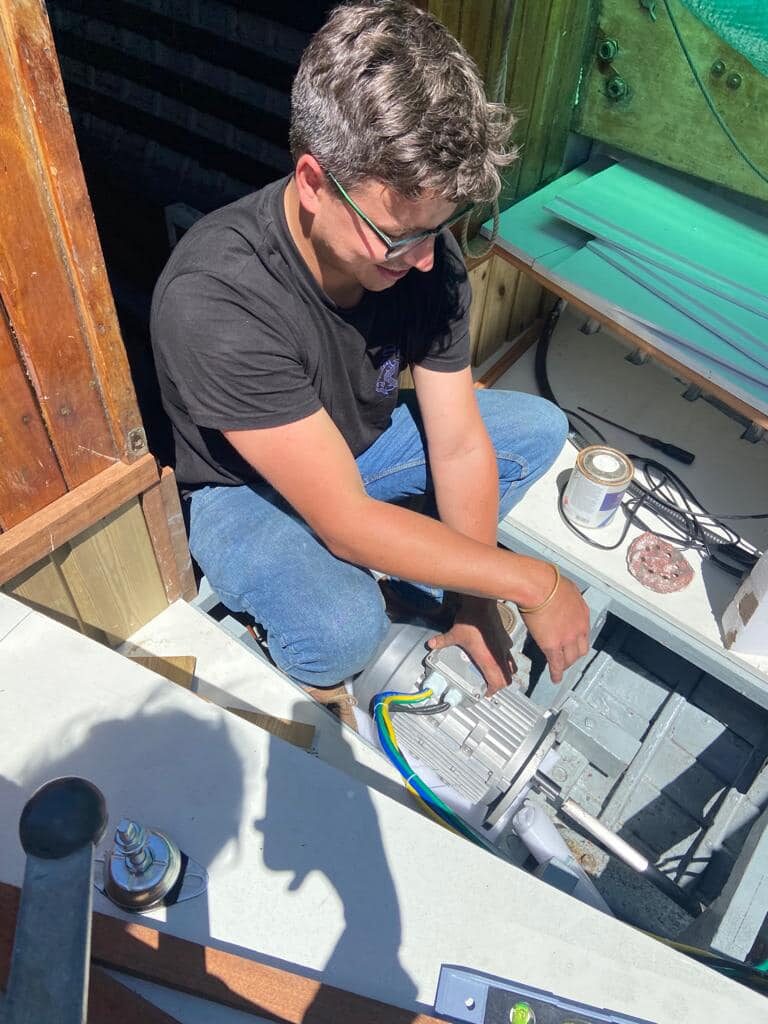
Owner of Finesse 21, Ivy May, completing his new electric drive.. Courtesy: Joe Andrews.
The owner reported achieving 4.5 knots in slack water and against a gusty 20 knot head wind. Apparently, the 5kw unit and uses around 1.8 kw to achieve cruising speed.
Thanks to The Finesse Facebook Group for information.
So, that has been a successful conversion.
The duration is relatively low – reported to be around five hours. That would not suffice for east coast cruising, however, if one is able to sail up to a marina or whatever, requiring minimal use then, bingo. Slip in and plug in…
But, in the media there has been a growing number of all electric vessels coming onto the market. These, in the main, have been launches and ‘speed-boats’ with an occasional sailing yacht build being announced with electric drive.
The big problem with operation away from shore for long periods is the ability to recharge at a rate acceptable for use. When that happens, then we will be there…
There are, of course, weight considerations of the battery packs, but like their growing use in the automotive industry, these constraints are waning with technological progress.
Another news item caught my eye. This was about a maritime innovation hub which is returning to a spring boat show at MDL’s Ocean Village Marina in Southampton.
There is a host of interesting events and companies taking part.
Areas such as low carbon fuels – hydrogen and methanol, sustainable sails and sails acting as charging units. as well as ideas on protecting the marine environment.
All very interesting giving much food for thought in these ‘end days’ of winter!
In the dark days following the New Year, a rerun of the ‘Sailing’ programme Howards’ Way, first filmed and screened in 1985, was advertised on Drama Television. The series originally ran from 1985 -1990.
My mate laughed. I smiled, for a spark of nostalgia was ignited…
I was away at sea at that time and apart from the odd episode, I did not see much of it. So, purely for historical research, I have been sporadically watching some of the first series and rather less of the second. The series appear to be running consecutively.
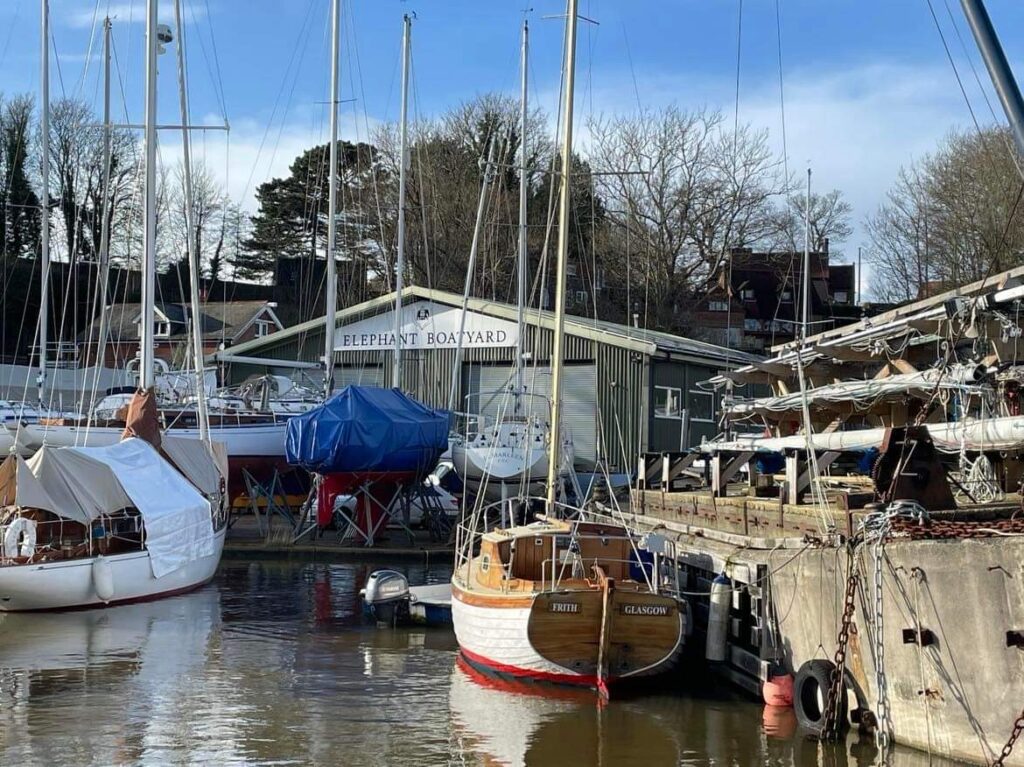
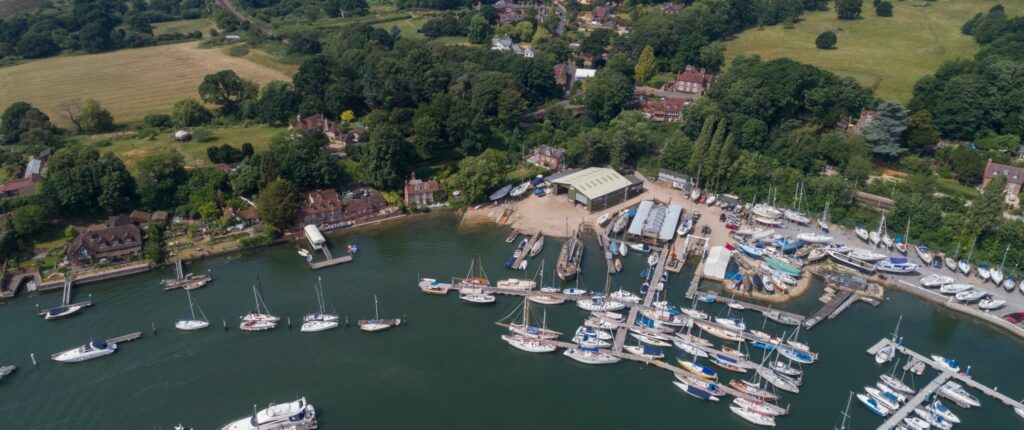
The programme was based around an ‘old style’ boatyard – The Mermaid Boat Yard in the Southampton area. The yard in reality is the Elephant Boat Yard.
For those that have never heard of the series or know anything about it or the boats the programme was built round, look at the following web source:
The Finesse 24 Frith awaiting hauling for keel bolt renewals at the yard. Credit: Alexis Harrison, owner.
In an early episode, I clearly saw the shapely hull of a Finesse 24 up on the yard’s hardstanding. Amazing! To cap that, a friend took his ’24’ to the yard for keel bolt renewals last autumn, showing that ‘Jack Rolf’ the Mermaid’s owner was right: there will always be a place for a good honest traditional yard…
View of the Elephant Boat Yard -courtesy of EBY web site.
The series opens with yard problems and a growing ‘community’ where sex, family infighting, double-dealing and financial intrigue swirls back and forth at every twist and turn of the tidal eddies…
However, it was the boat, the Barracuda, that has always interested me: one of the class has been in our yacht club for a number of years.
The boat, herself, has had a bit of a murky past of late, being involved with people smuggling for which the perpetrators are residing at His Majesty’s pleasure…
Summer Breeze, owned at the Island Yacht Club.
The boat was severely ‘stripped out’ by HM Customs & Excise at Ramsgate after their ‘collaring’ before eventually being placed on the market. I have to say, under new ownership, she looks a treat.
Apart from the people and the rather dubious fashionista content, central to the plot were the yachts from the yard and those early flashy motor cruisers then beginning to infest the waters marketed by ‘Ken Masters’ … a waterside dodgy dealer similar to the oft lampooned car salesman type!
The boats: The Flying Fish, a Laser 28, was the family owned yacht of the Howard. Then along came the Barracuda of Tarrant, the prototype of the Sadler Barracuda 45 a vessel which came from ‘Tom’s’ drawing board after being made redundant as an aircraft engineer. Another was the Spring of Tarrant, the prototype of the MG Spring 25. Both the Barracuda and MG Spring were in reality designed by the inimitable Tony Castro!
Sadly, the programme makers had the boat – the Barracuda – designed and built in just a few weeks worth of the first series. Of that, very little appeared on the screen and I was too slow to grab a camera shot of the first boat being laid up in resin bonded cedar round her formers. It is a system used by Ipswich builders, Spirit Yachts.
The boat’s hull, when GRP sheaved was used to make a plug used for the production of following craft in GRP. There were a few shots of the boat’s hull being laid up. Then, as if by the waft of a wand, she was launched and sailing!
Barracuda on ‘sail trials’ in 1985. Courtesy of Drama Television.
She had a lifting wing keel, carrying a large part of her ballast. The boat certainly shifts and can broad reach at well over 20 knots. Her twin rudders were a bit of a rarity back in those days but it wasn’t long before they became common-place, especially from the big French yacht makers who ‘grabbed’ the mass market that grew exponentially during the 1970s and into the 1990s. Now the mass of gleaming white GRP has reached saturation: marinas are overstuffed with oversized and underused craft!
A marina stuffed full on a gorgeous sailing day when just a few, very few, craft came and went… Dwarfed by her larger sisters’ Whimbrel has her bunting up during the 2021 Finesse Rally.
I missed an episode or so and came back in with the daughter of the boat’s fictional designer on her way across the Atlantic, sailing to New York, on a stunt. It made great television and publicised the boat. However, in reality, the yacht did not take off and fly… Only around a dozen boats came off the ways, as it were.
Sorry about the clarity – from the screen! Courtesy of Drama TV.
There was an ill-fated catamaran – it sank and blame was inferred with the designer. It turned out to have been an accident, exonerating the yard. The craft seemed to ‘disappear’ into the ether…
Most people know of the MG class of yachts. Many are still seen sailing around, although as with cars, the class boats grew in size, leaving behind a market tapped by the French and German industrially built boats, until they themselves went into ever larger craft.
Now, there are few ‘pocket’ cruisers for the first timers, who, in any case, become dazzled at boat shows and slick marketing executives, buying a 35-footer as a first yacht!
A long flat bottom section is a hallmark of this yacht and others that followed. Summer Breeze at the Island YC.
Two of this countries casualties were Sadler (the actual builders of the Barracuda) and British Hunter based at Sutton Wharf, Rochford in Essex – just down the road from me. I used to know the company’s sales executive!
Nostalgia eh.
History, perhaps, in a way.
Whatever, there is an absolute plethora of ‘stuff’ on the web about this series, dubbed, Dallas on Sea by the media. Take just a little look and let yourself smile your way into spring, and into real boating…
I have been forced to be very selective about when to go for a sail with a knee that is a little unreliable … therefore the number of times I have got out has been reduced. I am pleased in a way that the weather has helped in my decision making!
So, after helping out at our club for the early part of the morning until ‘tea break’ we readied Whimbrel and slid out as soon as the boat picked up. The tidal cycle was neaps, rising, however the tide seemed to take forever to come in and we floated later than usual for predicted tide…
Christobel tweaking the jib foot tackle…
It was a bit of a grey day but there was a decent enough breeze to make sailing worthwhile.
It was good to hear the rustle along the boat’s sides as we forged over the flooding tide. We cleared the creek and ran eastwards to abreast of the Crowstone before making a long tack inshore taking us to the Essex Yacht Club, which seemed devoid of life.
In towards the Essex.
A further long close reach took us out close into Canvey Point, passing two of the Lower Thames Rowing Club boats.
Jolly Boats!
Bird life was a little like the weather, devoid! There were a few Brents about but I suspect many of them were in amongst the winter wheat under the Hadleigh Downs. There were a couple of swooping flocks of waders in the distance over the Canvey saltings. I mused to myself about the nearness of spring: it’ll not be long before the terns are back in residence … I’ll be ‘on the beach’ by then ‘banned’ from sailing until my new knee allows.
Whimbrel was still sporting its temporary main hatch while the actual unit has been undergoing a small repair and a complete strip down and recoating. (It is now back in place, looking resplendent after nine coats of varnish)
We sailed up into the Ray to the Two Tree Island slipway where the mate took the helm. As Christobel brought the the boat round, I slipped the main down as we came through the wind, stowing it while she ran back towards the creek. A well practised procedure, as many of my crews will vouch for.
Upon entering the creek a bee-like buzzing had me searching the sky around – annoying to the extreme – and i found the source. A drone hanging just off to our starboard filming us close to. So bloody rude.
Drone hung in the air filming our activities at close hand – intrusive and damned rude.
Pity the drone wasn’t around to shots of us on an earlier January sail – they never make contact and offer a picture, unlike this person did…
Thank you David.
Whimbrel captured by a fellow Finesse sailor as we crept in during a late January sail…
It was good to get out, especially with the mate. Bless her.
Happy Valentines Day dearest, and I hope you enjoy our ‘dirty weekend’ in Faversham … I promise not to gaze too fondly at boats!
This is no longer a joke. Boaters and caravanners to an extent will be champing a the bit in frustration at the news from Calor that the small 4.5/3.9 butane/propane cylinders are discontinued as of now.
The size that has replaced these are 7kg/6kg butane/propane which are appreciably taller and will not fit most locker compartments built into boats especially. A new regulator will also be needed for the butane cylinder. The larger sized bottles are 495 x 256 mm whilst the smaller 4.5/3.9 kg butane/propane bottles are/were 340 x 240 mm. A bit of a difference.
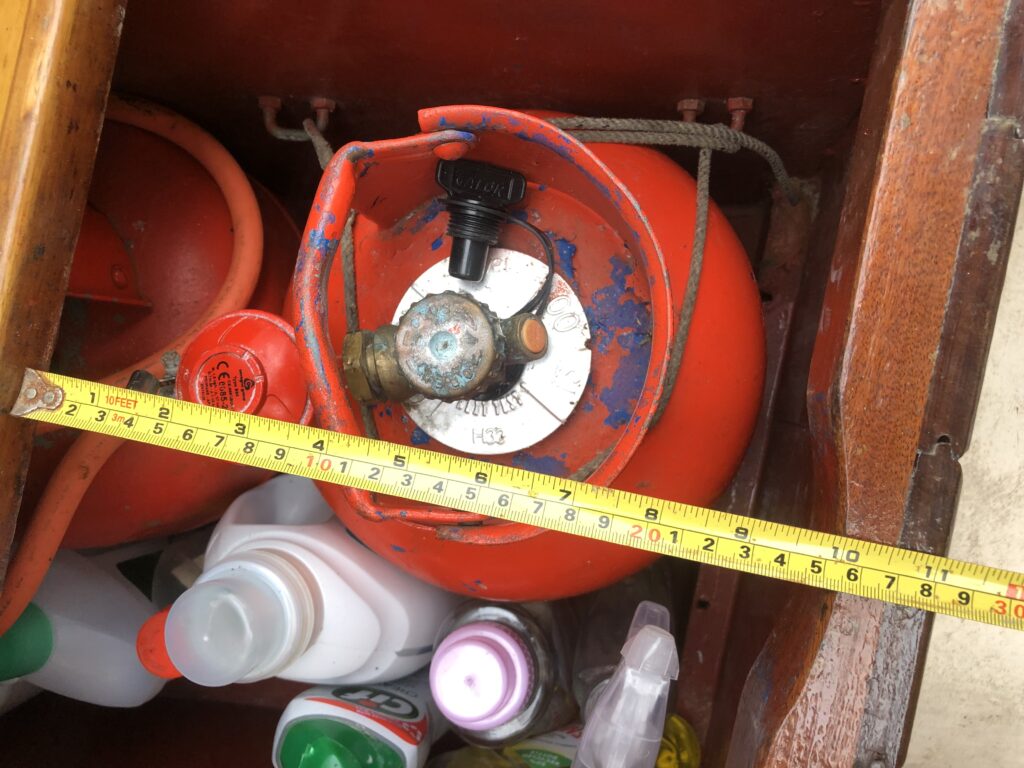
Looking down into Whimbrel’s gas locker. Note: width 250 mm achieved by scalloping cockpit structural fore & aft member. The calor cylinder at 240 mm (nominal) diameter just slips in.
Now, I launched a ‘campaign’ last year, following on from problems of the previous year, and I asked the Royal Yachting Association (RYA) to investigate and put pressure on the gas supplier.
The RYA could not even be bothered to respond to my letters (emails) so it was clear that an organisation that is supposedly looking after boating interests is not interested in the problems of its cruising members one minute jot. Gold medals is the only thing that activates them.
I terminated my forty year RYA membership in response.
During 2021 whilst away for the summer cruising on the east coast we had to change to propane due to acute shortages of the 4.5kg butane cylinders at all marinas we enquired at. Propane 3.9kg was little better, but we managed…
2021, when we were forced due to shortages of butane to change to propane. A new regulator was ready waiting to be fitted too…
The available bottles from Calor are ‘huge’ in comparison to their small bottles and there is absolutely no way for me to fit one or even two with a locker bottom above the waterline to achieve gas drainage.
Calor says: If you’re unable to increase your storage facilities, an alternative could be found through Campingaz (907 = 2.72kg). We recommend reaching out to a local gas safe registered engineer who can safely advise on any changes required to your gas cylinder set up.
Wonderful!
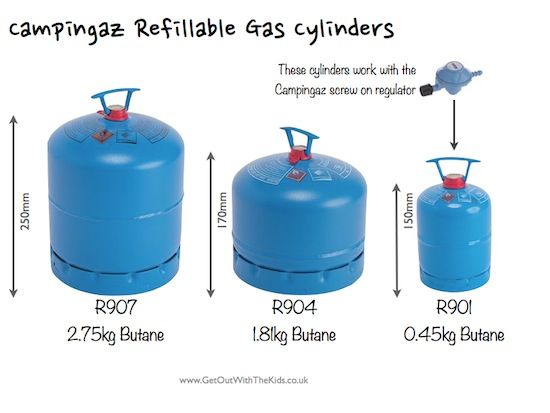
Camping Gaz R907 holds just 2.75kg of butane (they do not do propane) and will keep a two burner cooker going for just eight hours. Bloody wonderful.
Courtesy of ‘Getoutwithkids’ web page
Yes, the bottle which has a diameter of 203 mm will fit into gas lockers specifically designed for the Calor 4.5/3.9 (butane/propane) bottles, but this is not the point.
Aboard Whimbrel, our Calor bottles have consistently lasted around three weeks when away summer sailing. The Campingaz will need changing almost weekly in comparison and at around twice the price.
New camping gaz bottles with an exchange agreement cost around £90.00 and a refill costs anything up to £45.00
Yes, one could turn to diesel cookers. I investigated these and as a flue local to cooker is required, it would be under water when sailing….
We could go backwards and use a paraffin cooker, but, bloody heck, they take time to get going. Methylated spirit is needed – dodgy stuff – or even a meths cooker. Meths and cooking do not make good partners. No thanks…
My good mate says that tomorrow whilst out for a sail on the tide we will take a look aboard and decide where to keep a third campingaz bottle!
I will follow up…
This is the response received from Calor Gas after I sent a complaint:
Does anyone believe this. I certainly don’t!
Since writing the above, I have looked at other gas bottles on the market of the smaller sizes.
Flo Gas: has a 5 kg (patio) cylinder measuring 384 mm in height and 305 mm diameter.
Flo Gas has a Leisure 6 kg cylinder measuring 495 mm height and 256 mm diameter.
Calor have a 5 kg patio cylinder (propane) 314 mm in height and 306 mm diameter.
I found a BOC 4.5 kg propane cylinder: height 390 x 270 mm diameter, but BOC are not easy to obtain other than online/direct. Again, size is a problem.
None of the above could be fitted without major cockpit reconstruction!
It would appear that Flogas has a ‘calor’ sized bottle: Propane, height 340 mm x 240 mm diameter. It would need marinas to stock these to be of any real use.
However, I am currently investigating the possibilities of a ‘Calor’ sized cylinder with a different supplier. I will follow up…
The only alternative, as Calor say on their web site, is a Campingaz 907…
Update 17 Feb 23:Company I wrote to failed to respond – well what a surprise!
Practical Boat Owner has an article in its April 2023 issue which gives the ‘Calor Line’ but does not cover the other issues I found by talking to the marina outlets and other suppliers over the past two summers.
It is a great shame that the media and our industry did not take up this issue when it first surfaced. We have been failed by all those that supposedly look after our interests.
Article courtesy of Practical Boat Owner – April 2023 Issue.
Good luck to this coming summer. Be prepared to rejig systems, change regulators and cylinder size and ‘lash’ a bottle wherever it can be safely fitted!
The misuse of jet skis in the Lower Thames (Sea Reach), River Medway and Swale has been an ongoing and increasingly dangerous problem for many years. This of course has been a problem not just within the mentioned areas, but everywhere.
During the Covid-19 pandemic many people new to water borne activities purchased personal watercraft (jet skis) for they knew that a summer holiday abroad was an unlikely scenario.
When we were all released after the first lockdown (April-May 2020) to go afloat, the water became at times a night-mare place to be due to ‘virgin’ operators with little or no experience whizzing wherever they minded to without a care for others on the water around then.
This one chopped across our bow…
I would add that not all operators acted thus and I am sure experienced jet ski operators may well have been eaqually aghast at the antics seen.
Police were called to the Leigh-on-Sea waterfront due to adverse activities on one particular day. My wife and I were ‘cut up’, circled and suffered close passes too – which was written about at the time.
The Times newspaper even picked up on it with an article and a leader column too. The Government said that the Maritime & Coastguard Agency would be looking at the legislation and stated they would act if the regulations (law) required to be changed.
I wonder if Kelly Tolhurst, a Member of Parliament for Rochester & Strood, who was working in the ‘shipping’ Department was involved: she had direct access to The Medway & Swale Boating Association, a powerful lobby group acting for and in the interests of boaters.
There has been a couple of ‘missives’ from the Port of London Authority (PLA) on water safety, the effects of wash and draw-down which was aimed at all craft including merchant vessels in the spirit of co-existence and education.
The PLA have also successfully prosecuted mindless jet ski owners in the last few years. Picture evidence was crucial in this.
From the Marine Industry News web magazine 18 January 2023:
‘The UK is introducing new legislation to crack down on the dangerous misuse of watercraft such as jet skis, with the Maritime and Coastguard Agency (MCA) being granted more powers to prosecute perpetrators of accidents.
The new law will come into force on March 31 2023, before the busy summer period, and will enable watercraft users to be prosecuted and bound by the same laws that apply to ships to help to prevent accidents.
This follows a boom in the watercraft industry during the pandemic, with the number, size, power and availability of watercraft like jet skis increasing, and their use in UK waters rising.
The government says today’s move (18 January 2023) will help ensure the UK continues to have some of the safest waters in the world.’
It should be remembered that personal watercraft were not covered by maritime safety legislation. The new law will mean those found guilty of using their watercraft in a dangerous manner could receive an unlimited fine and even up to two years in prison.
The article went on to say:
‘For those who cause accidents involving loss of life, the new offences could be used to better prosecute perpetrators alongside wider manslaughter charges.
Personal and recreational watercraft will also be bound by the “highway code of the sea” — international regulations which require users to act safely by maintaining a lookout, driving at safe speeds and outlining their responsibilities to other vessels.’
Indeed.
But, beware: the same regulation will surely cover all craft.
Best advice as an ex merchant seafarer: Keep a log, as one is duty bound to do under the current legislation.
This is not a problem just associated with jet skis. RIBs, sailing yachts (usually faster and larger) and motor boats can be a menace too.
We all make mistakes, but there are errors of judgement and plain barmy decisions…
Not always a RIB or Ski Bike. Here we were cut up by a large yacht, initially heading across our stern. She changed course and passed along starboard side. Her stern ‘passed under our bow’ as she swerved and subsequently gybed ‘behind’ our sails during which a man below leapt onto the helm – air flow deflections.