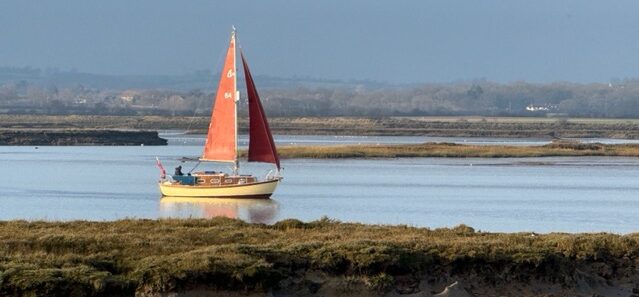
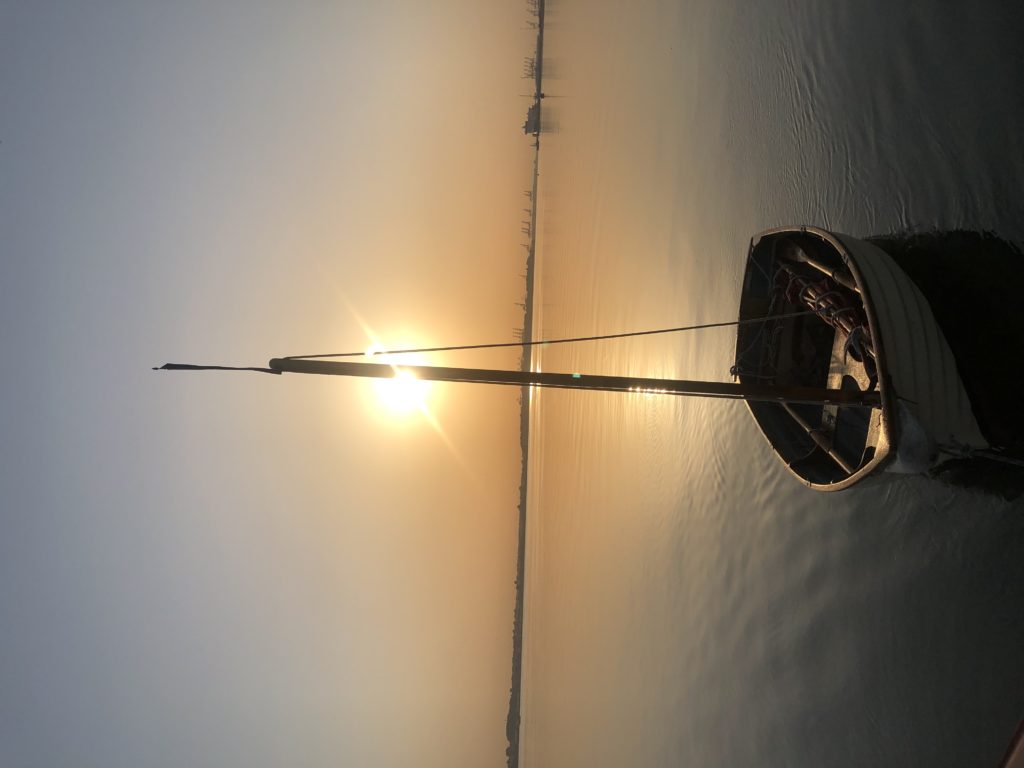
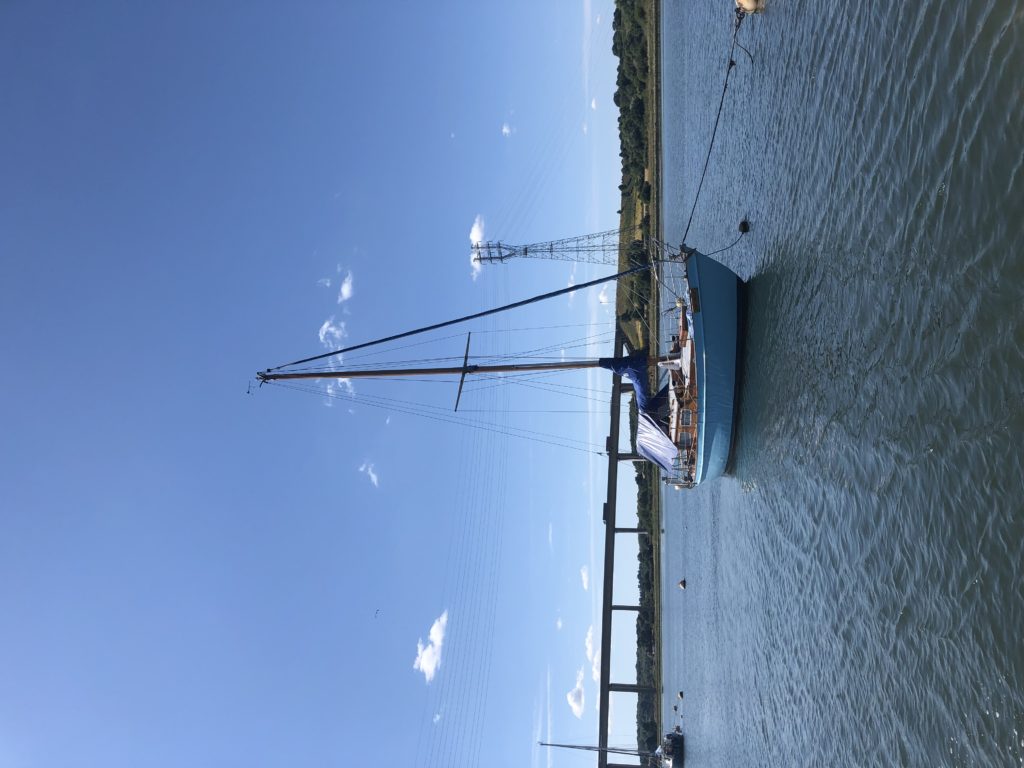
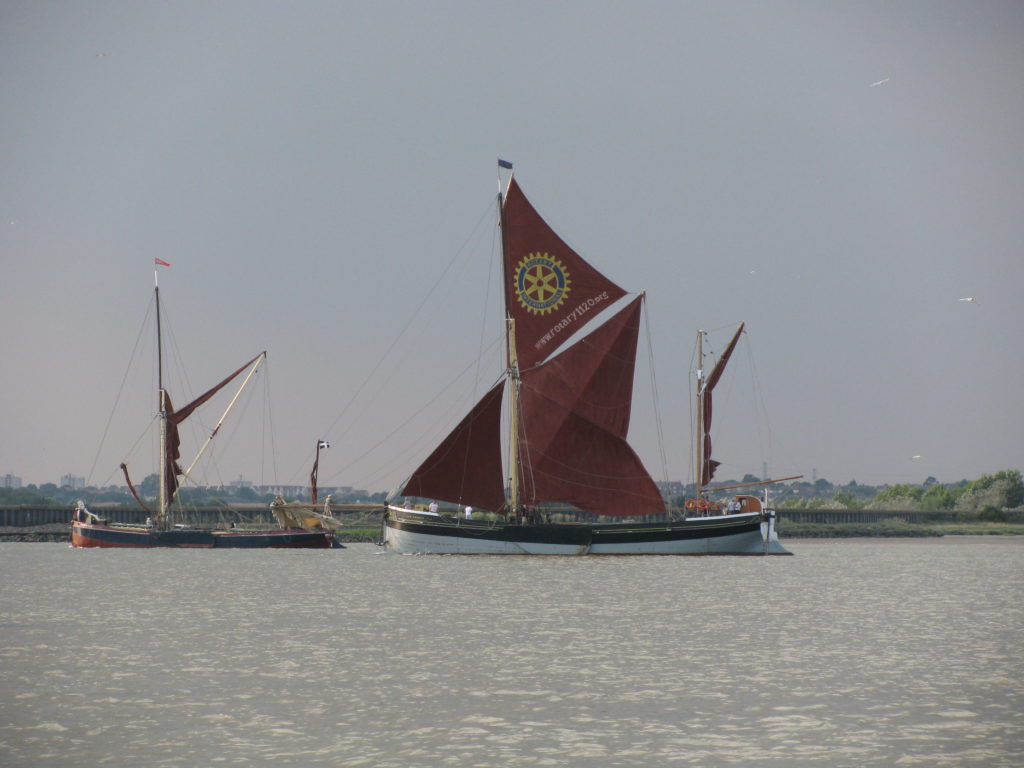
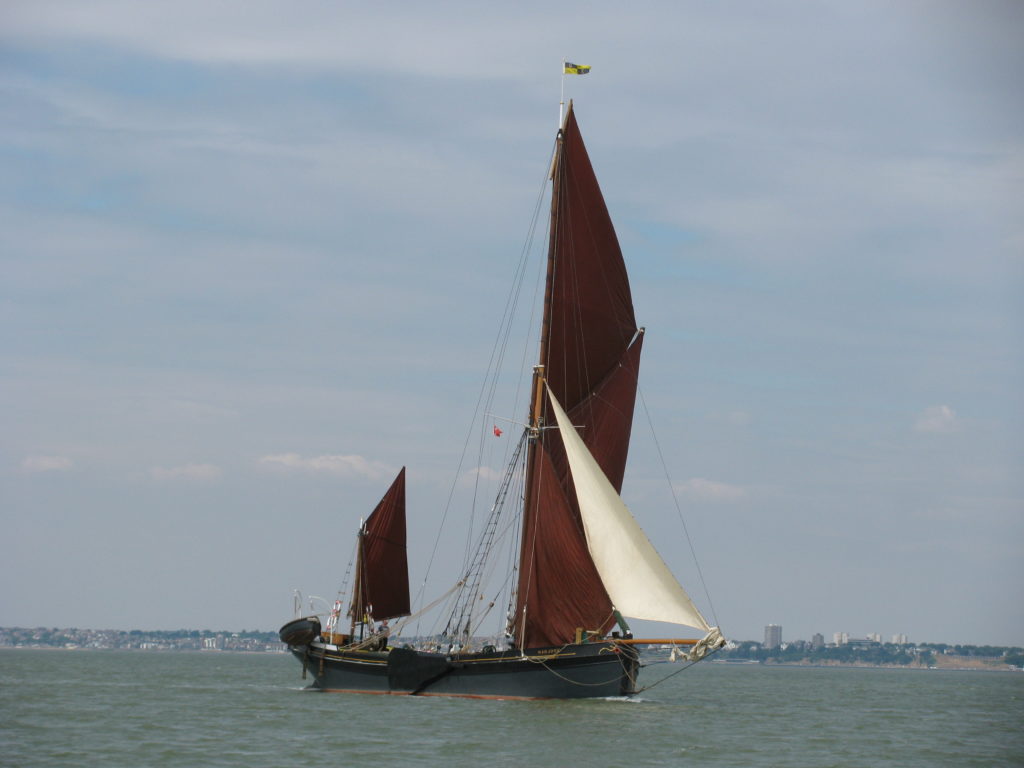
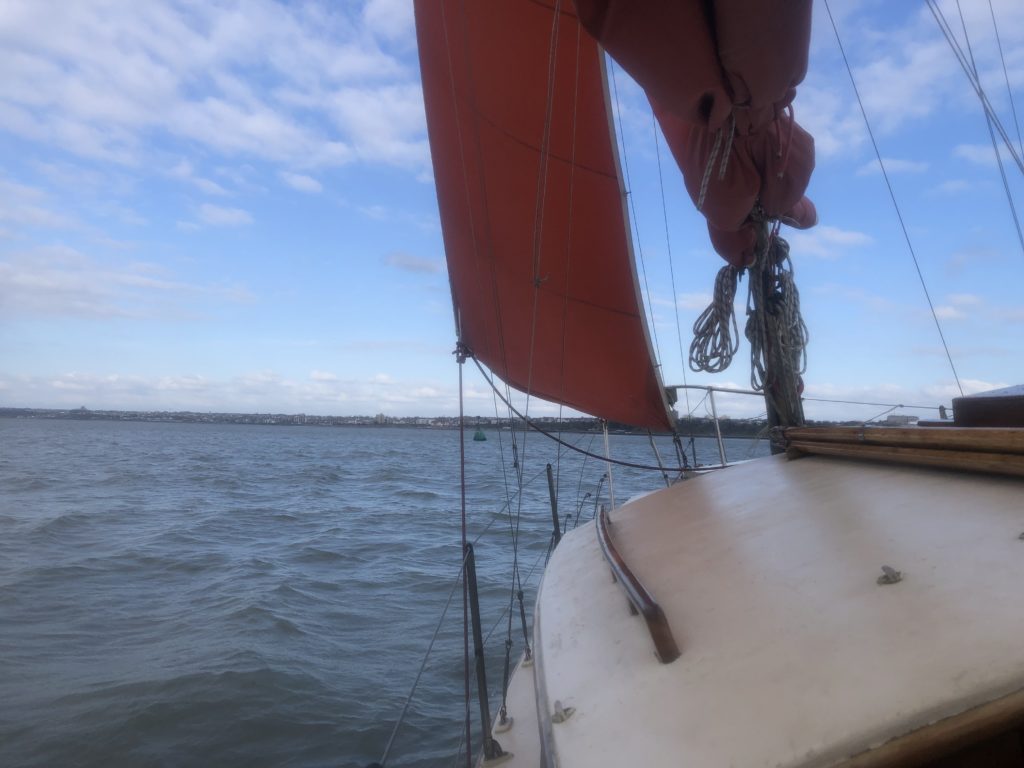
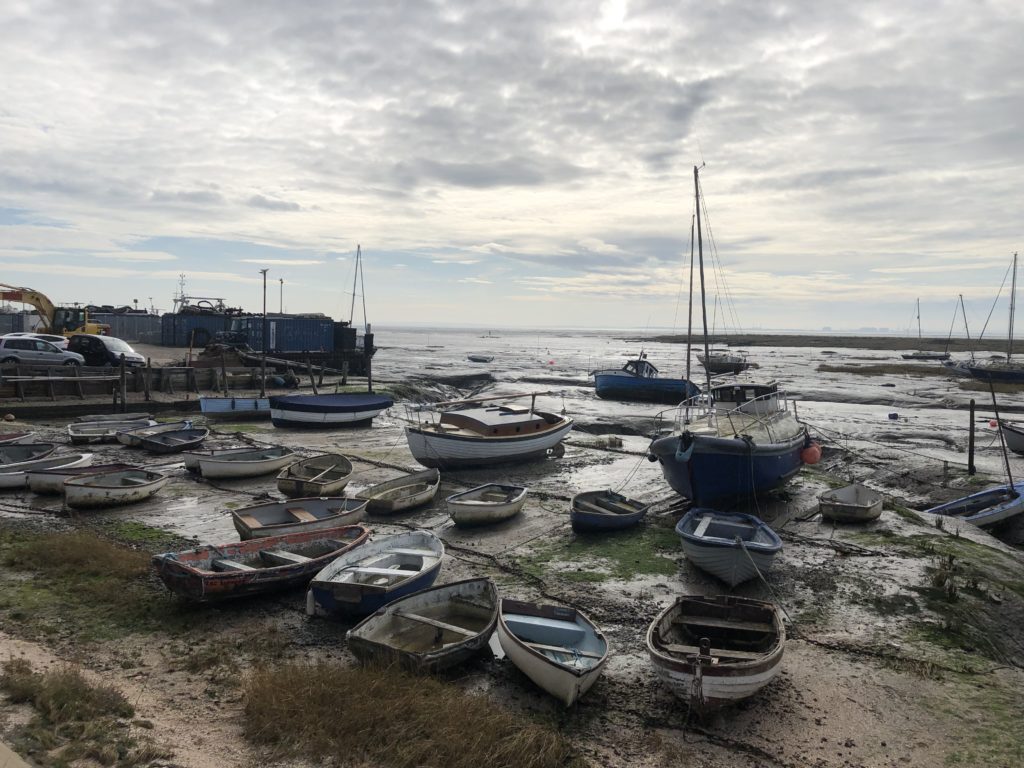
The Southampton International Boat Show is currently on.
The impression I get from the media razzmatazz surrounding this event is ‘Goody, let us flog more £100K starter boats to awe-struck punters…’
There are of course definite signs of a greater interest in environmentally friendly craft, especially on the power side. However, like the grandiose ‘starter’ boats always ‘flogged’ to the punter, these are very expensive.
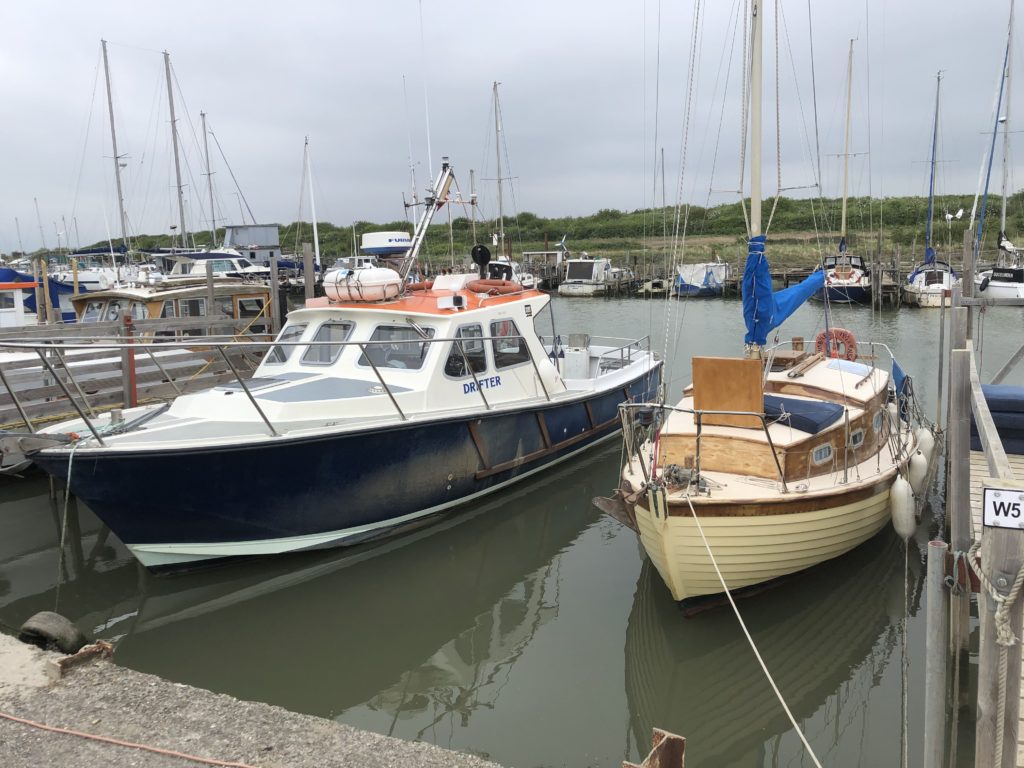
There is an alternative to all of this if a punter wants to begin his or her passage into ‘boating’ in an affordable way and that is the second hand market.
Boatyards and yacht clubs are stuffed with decent vessels which can currently be purchased for a song. These craft, both power and sailing, are so often bypassed. It is a great shame for they could provide that inexpensive gateway into the sport, past-time even, without that £100K price tag…
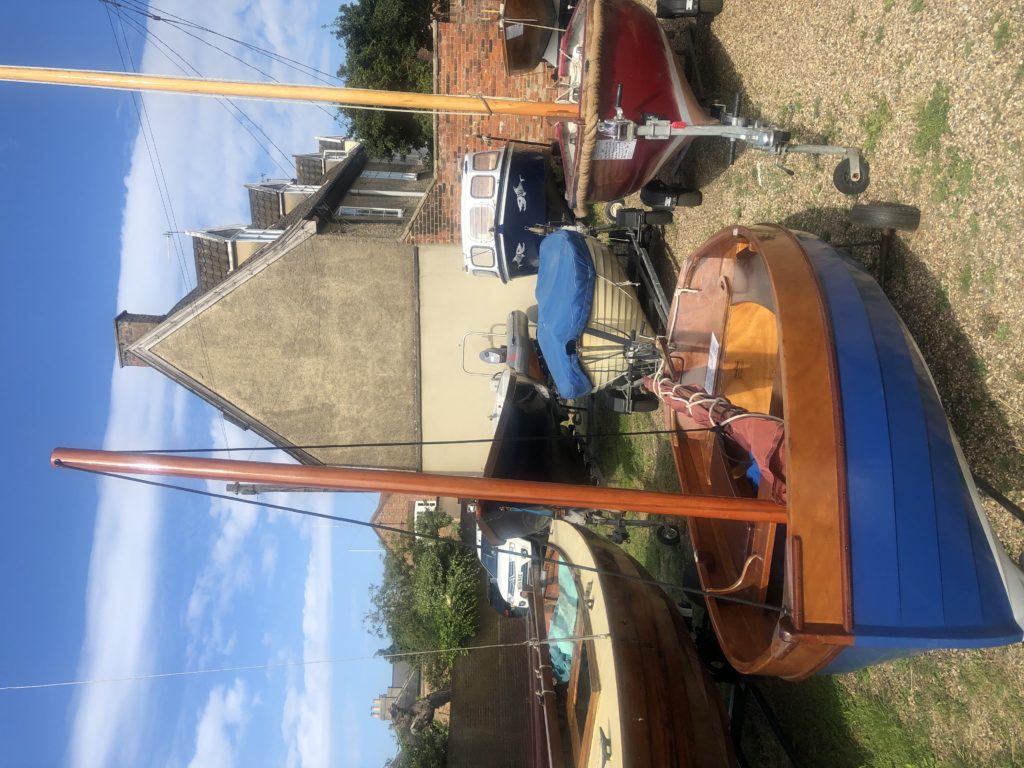
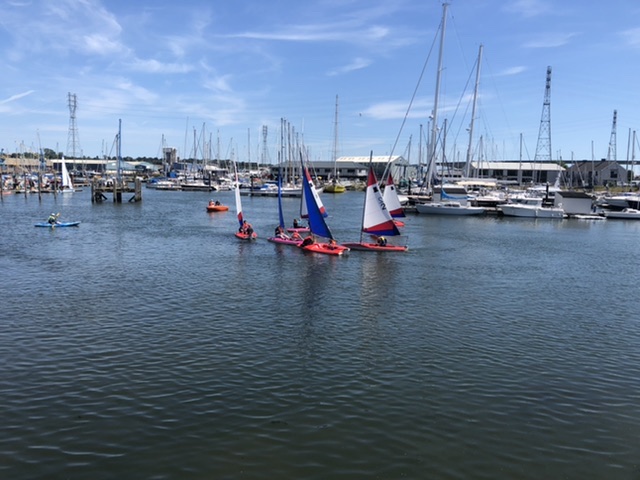
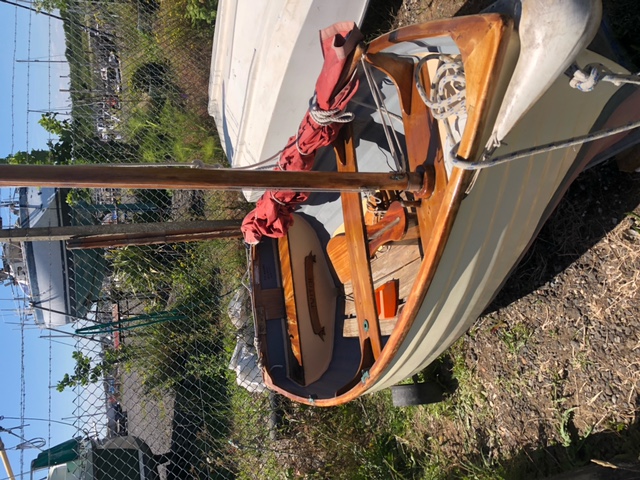
A pretty selection of dinghies and day boats…
I have mentioned Andy Seedhouse before. This outfit is based in Woodbridge, Suffolk, up on the River Deben.
There is an eclectic array of small motor and sailing craft in his yard, begging for a loving home. All would make great starter packages – even for that first year or two, before going forward into the sport with a larger more expensive craft.
If it wasn’t the person’s cup of tea then no great expense has been coughed up and in all probability it would sell again.
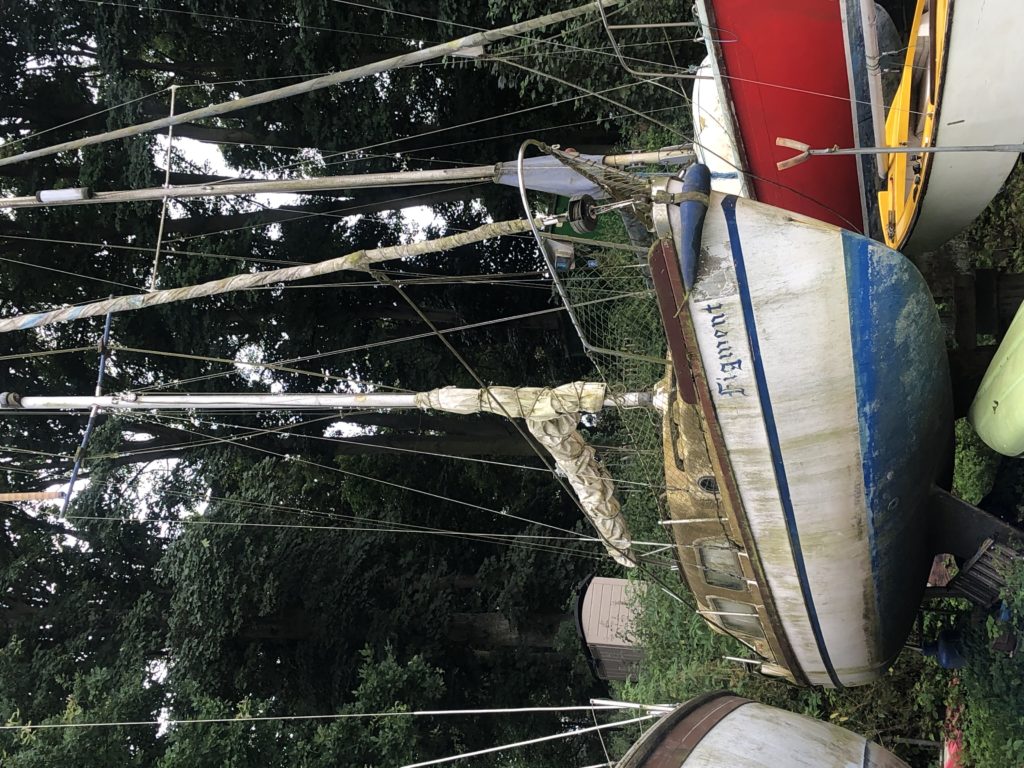
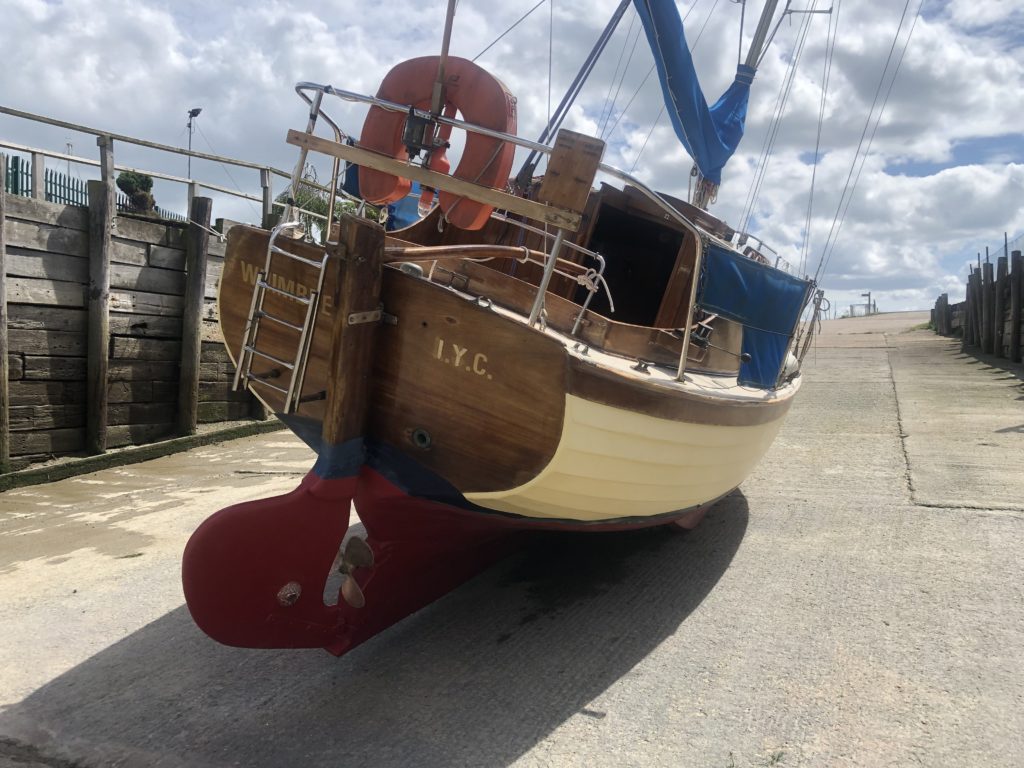
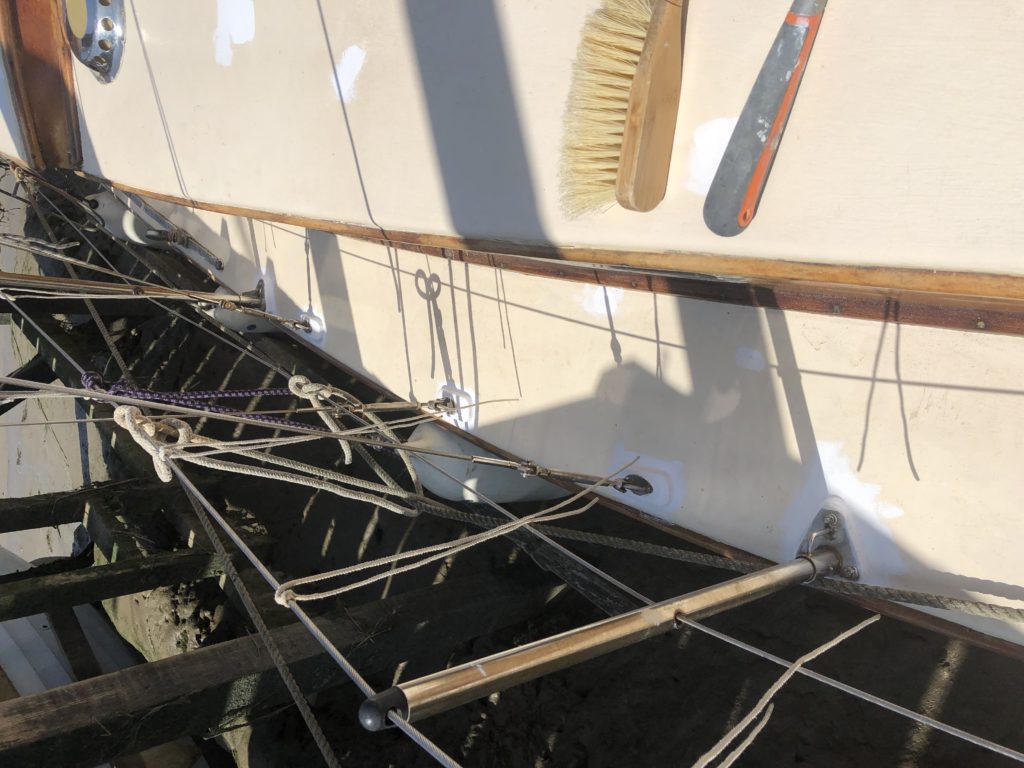
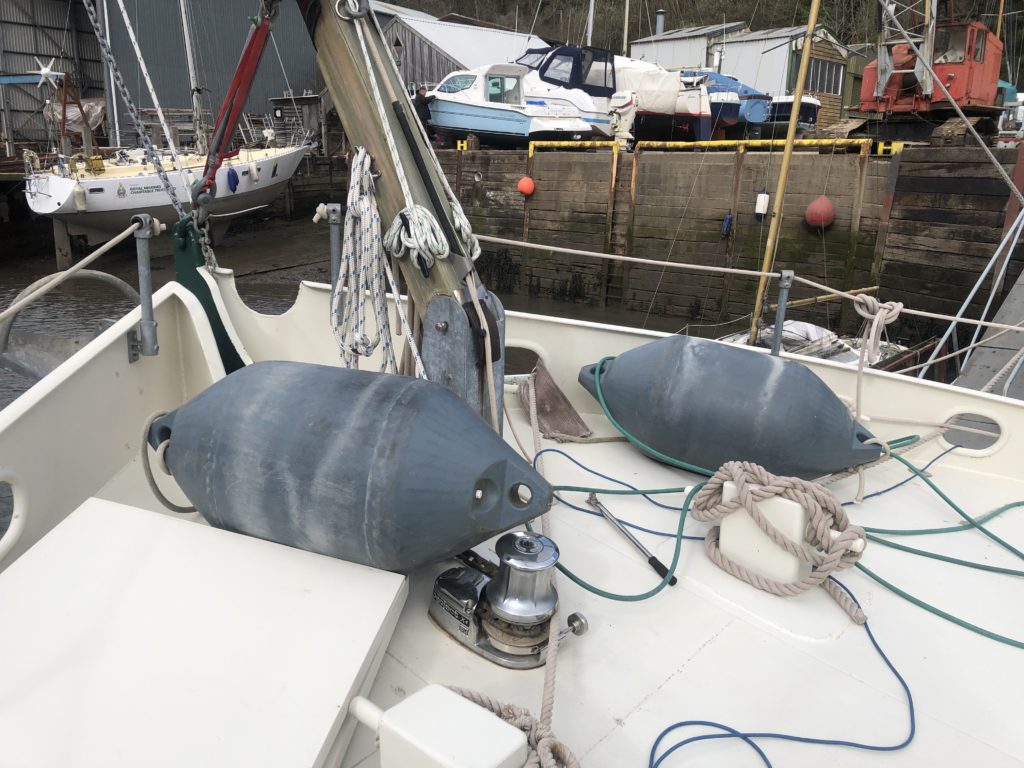
Sitting in a yard waiting for a new owner. She doesn’t look very good, but a pressure washer would bring her back. A bit of polish and varnish stain to woodwork and she’d be pretty again…
So often, with glazed eyes, a chap (usually) takes his family to a boat show. The family all go gooey eyed down below while the man twiddles knobs on an ‘instrument stack’ next to a shiny steering wheel and is hooked.
Within the first owning season, an expensive boat begins its sterile static life gathering weed in an expensive marina gobbling up family reserves.
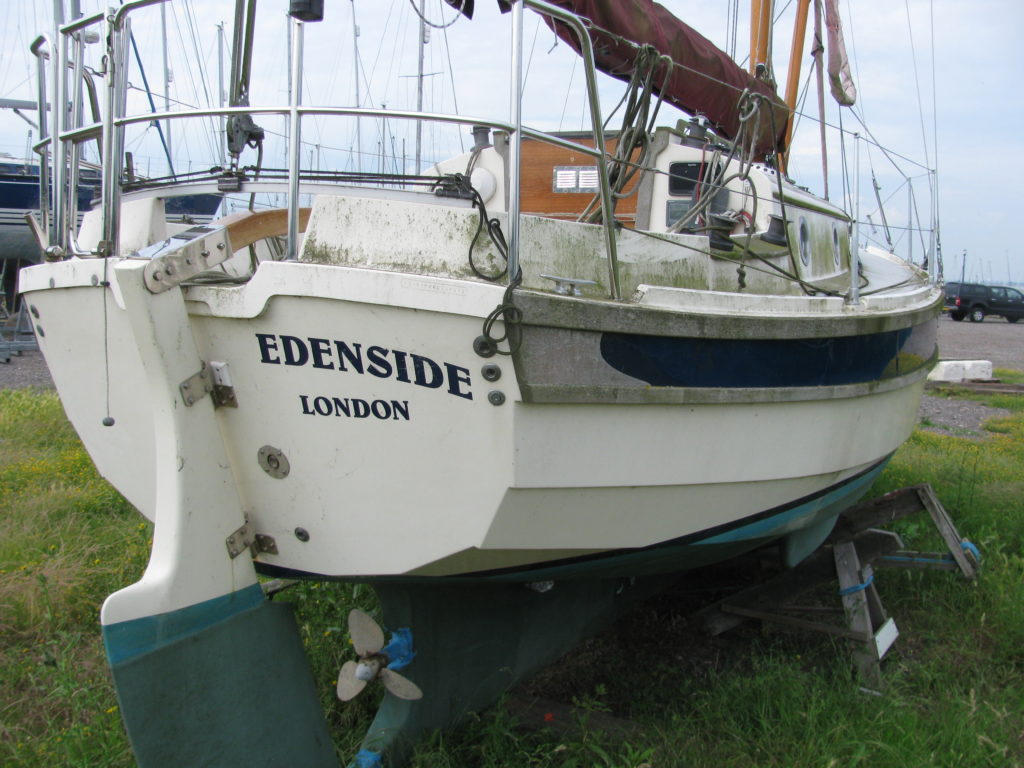
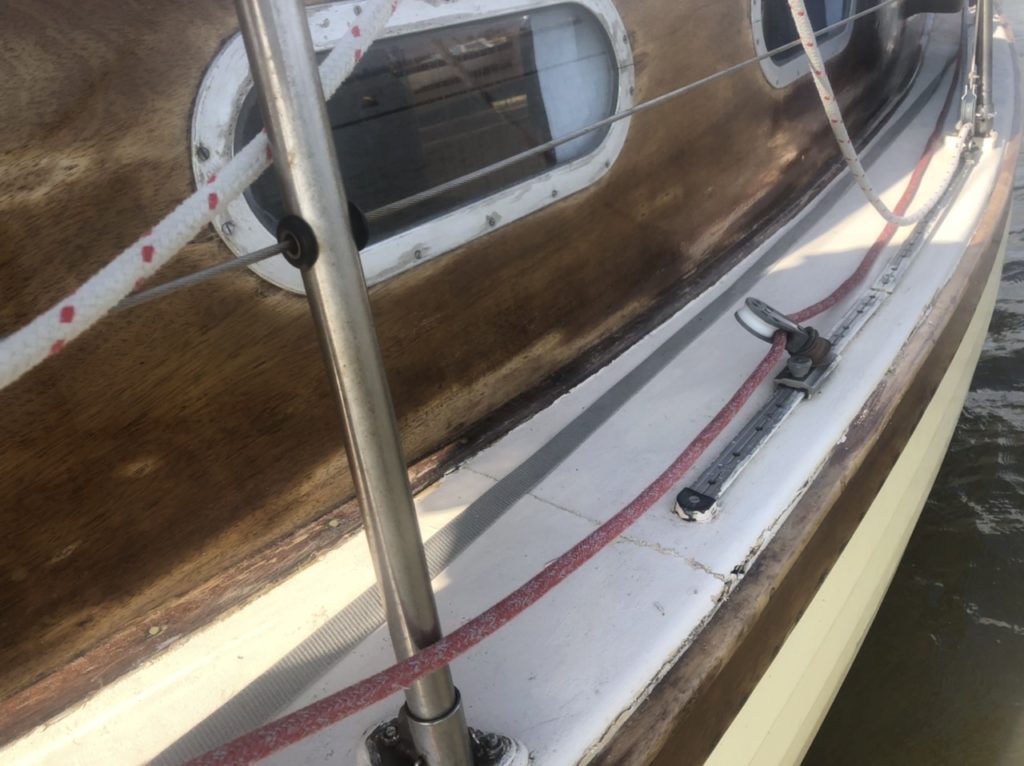
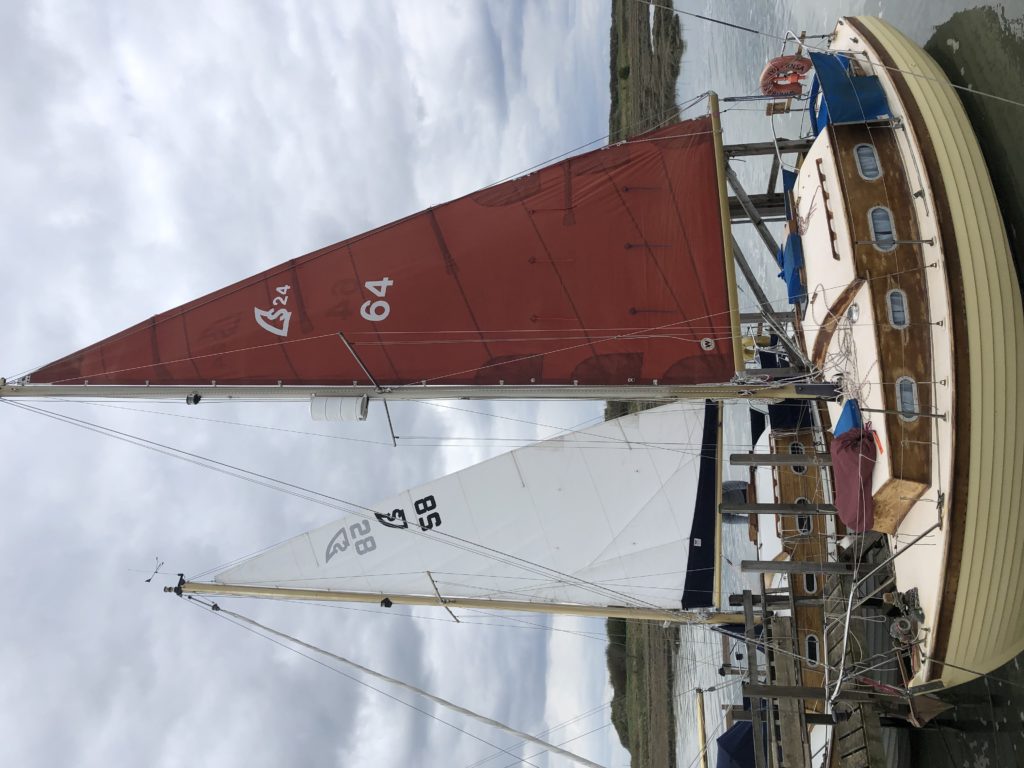
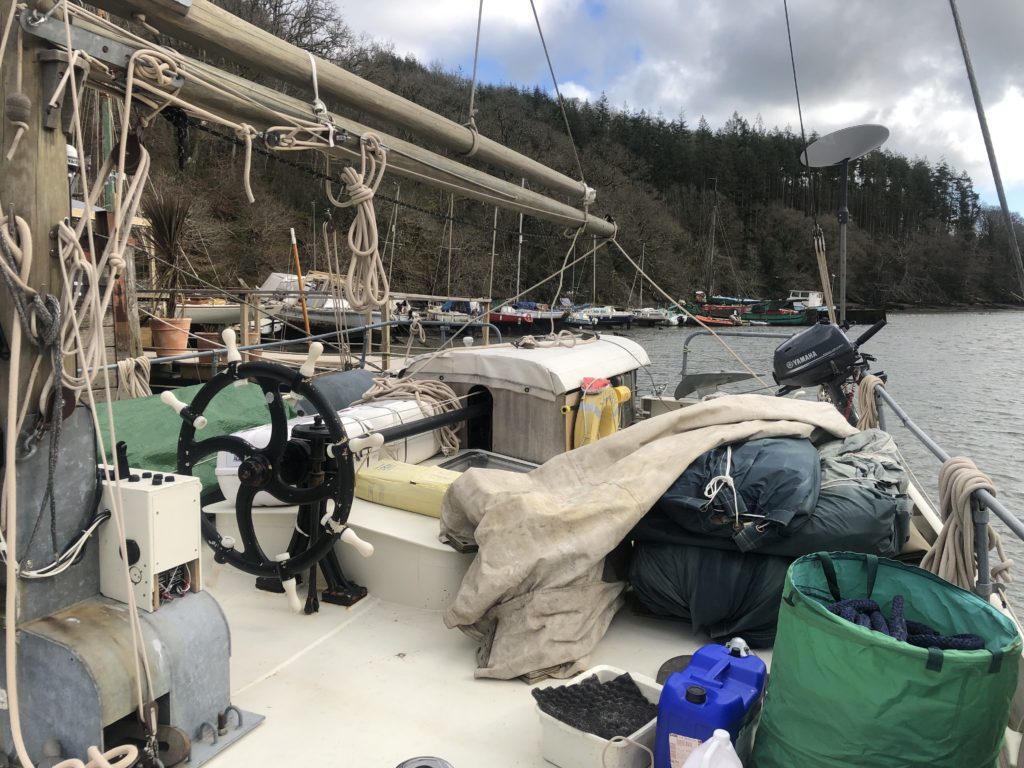
No bigger than my Finesse 24, with second-hand boats needing work available for a ‘pittance’ but these retail new in the £100K region. Bloody madness! Note that Verdigris is well established. Woodwork has deteriorated Sad.
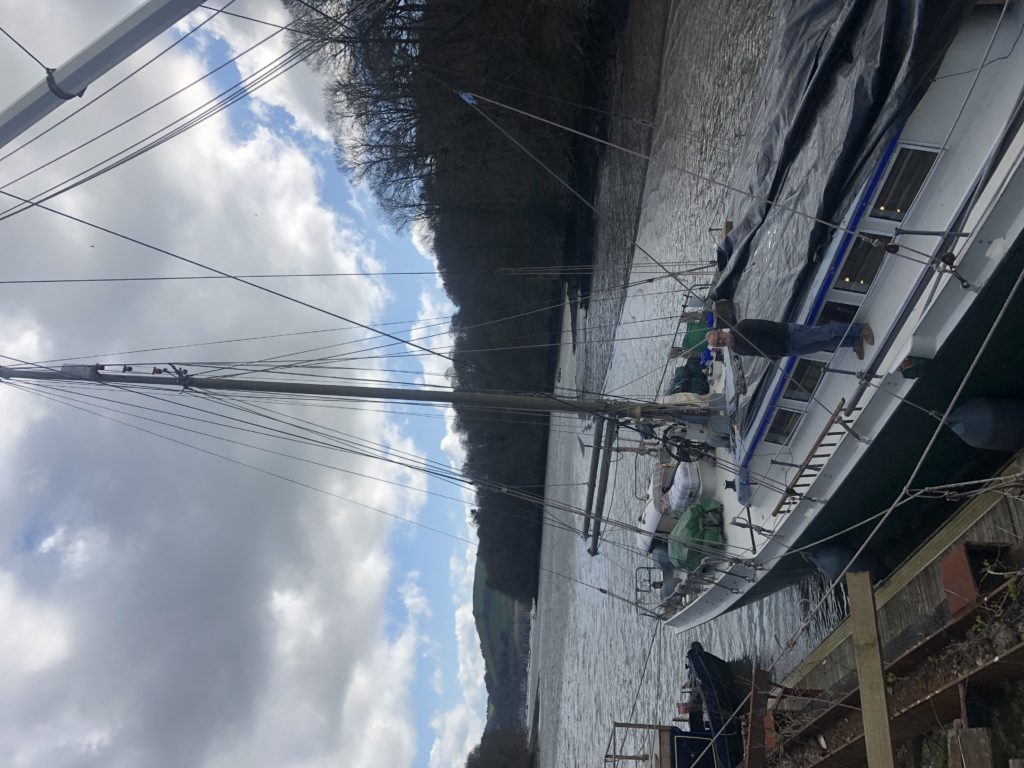
Let us all be totally honest: how often have you walked past a modern boat, covers, decks and ropes going green, and wondered about her?
I do. It makes me so sad.
Oh, yes, what was that opening ceremony all about with some chap flying on a hose cutting the ribbon…
It is now nearly three months since I was promised a response by the Royal Yachting Association to my investigations around the difficulty in obtaining bottled gas.
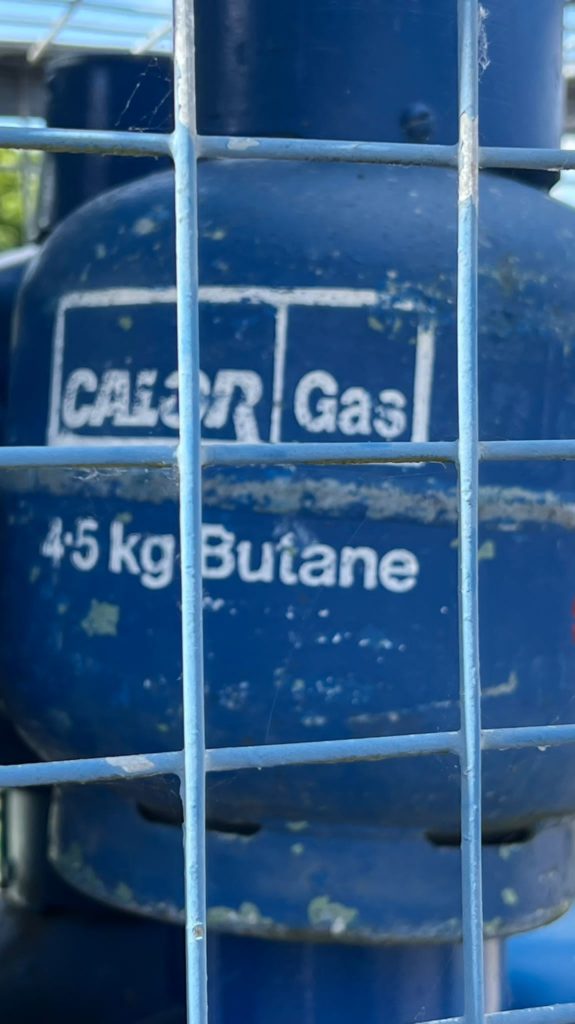
Enquiries wherever we went where gas was normally available was mixed. On the whole the smaller bottle sizes were difficult to obtain including a mid range bottle of 7 kg too (next size up from the 3.9/4.5 kg).
There was no outlet that had refills of the 3.9 kg propane and the 4.5 Kg butane – thank goodness we sorted ourselves out prior to leaving base!
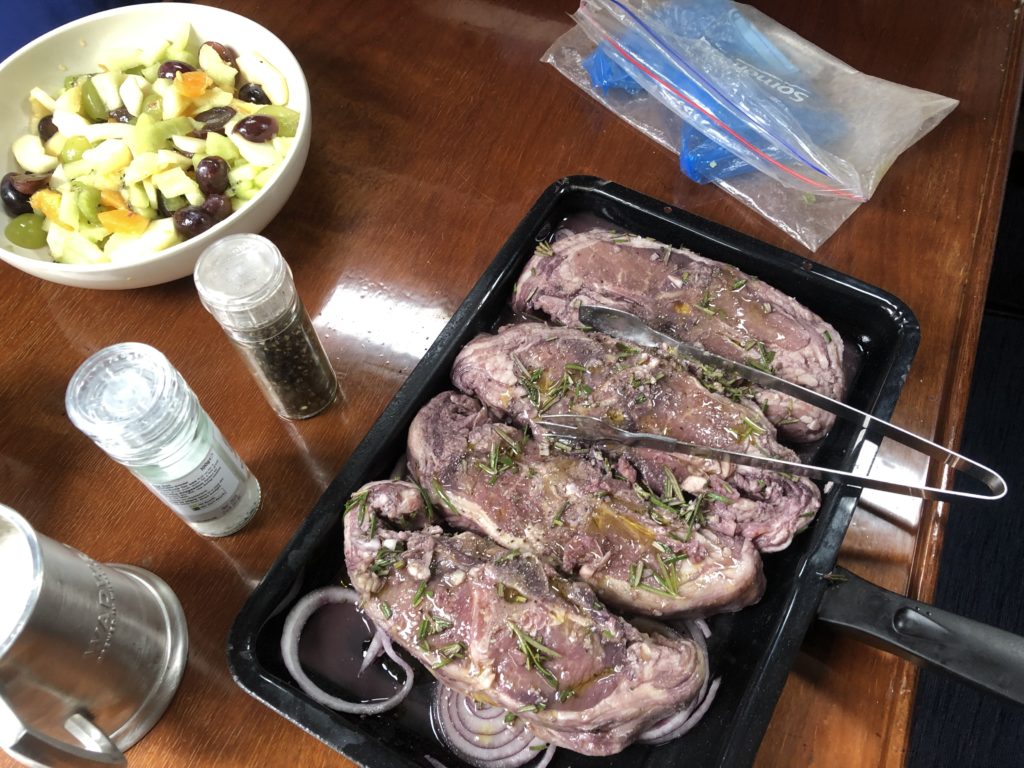
We cooked more often this year than last – marinated Barnsley chops for a hungry crew!
We felt safe in getting back to a more normal level of decently cooked grub cooked aboard this season again. We id eat ashore more than usual but only where we knew the quality was acceptable: last year we had some pretty mediocre and moderately expensive offerings…
With a return to base mid summer, we were able to replenish our gas from home, knowing a certain supplier…
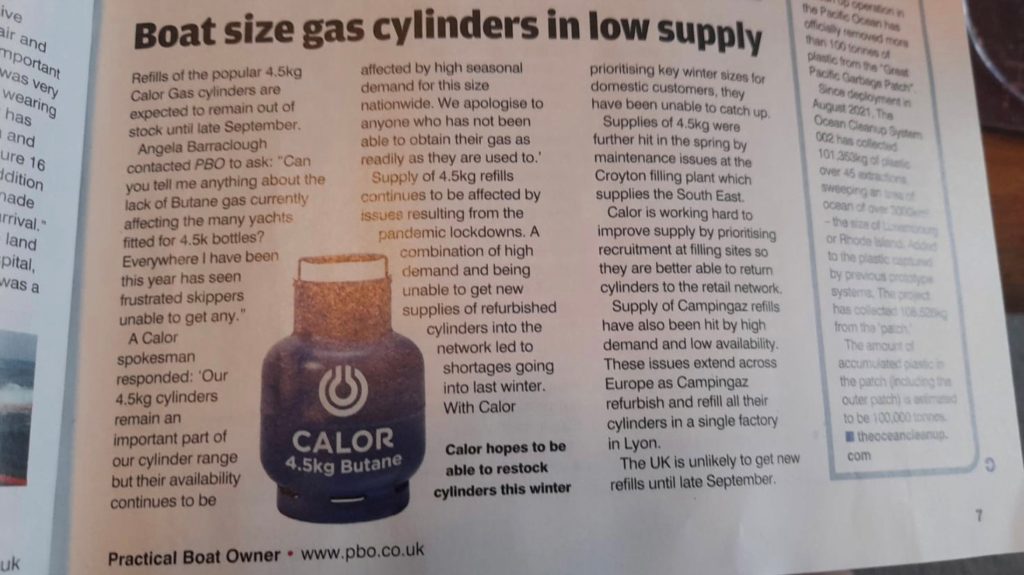
I was surprised to be sent copy of a letter response in Practical Boat Owner (September 2022) in which a lady asked the questions most of us have been asking.
Practical Boat Owner did not really answer the question – seeming to me to be biased towards the industry excuses…
However, here it is:
Courtesy of Practical Boat Owner – September 2022
Hope for next year?
Wouldn’t it be nice to be able to replenish with the ease of those ‘pre-covid’ days…
I wasn’t aware that Bill Turnbull was suffering from prostate cancer when I began my investigative journey which led soon after to a diagnosis that shook me to the core.
It was a BBC R4 Breakfast programme that jolted me into action. That was not so long after Bill’s diagnosis, which ultimately claimed his life…
Bill died this week.
Rest in Peace, Bill.
For me it was a reminder of the ‘escape’ I made by my demand for a test. Bill, on the other hand in an interview said he’s had a test at age of forty, then fifty, then for an unknown reason not again until he was in pain – in his back, dating to his years of lugging heavy reporting apparatus, so he took pain killers and dismissed it…
As he said, it was a bad move for when eventually when getting on for sixty-two he visited his doctor, a psa test showed a high number. It was bad news.
Bill battled and campaigned. Thank you Bill: their are many in the media industry who haven’t ‘shouted’ about it and should have done for men take notice of a favourite pop star, etc…
When I was undergoing my initial tests I was preparing for an Essex Book Festival talk. That was during early February for a March date.
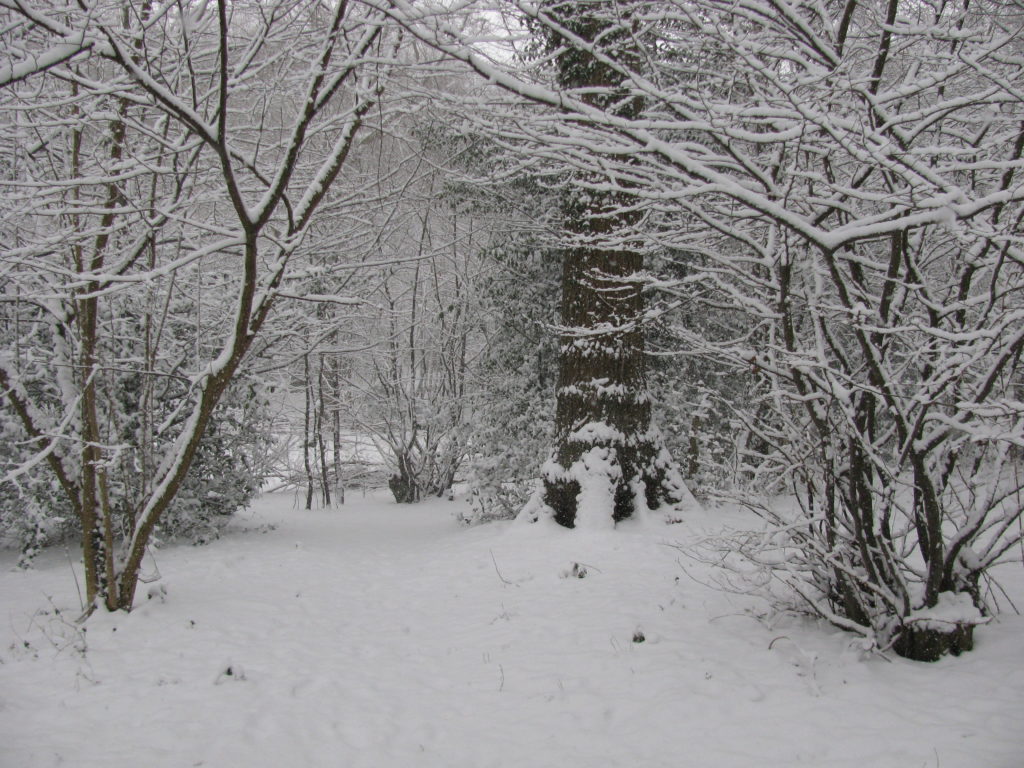
A winter wonderland in February 2018…
I’d had my first prostate specific antigen test which was ‘high’ but the doctor at my surgery said was nothing to worry about. I was called for a further test: the hospital were by then activated. They weren’t happy … for damned good reason too as it turned out!
Strangely, I am in the end game of the editing of my next work, which has been a longer drawn out process with my new publisher than with previous, however, I am assured all is well and my review of final changes is close.
It would be nice to think that the Essex Book Festival organisers will be interested in a ‘re run’ in 2023 – book event that is, not my illness…
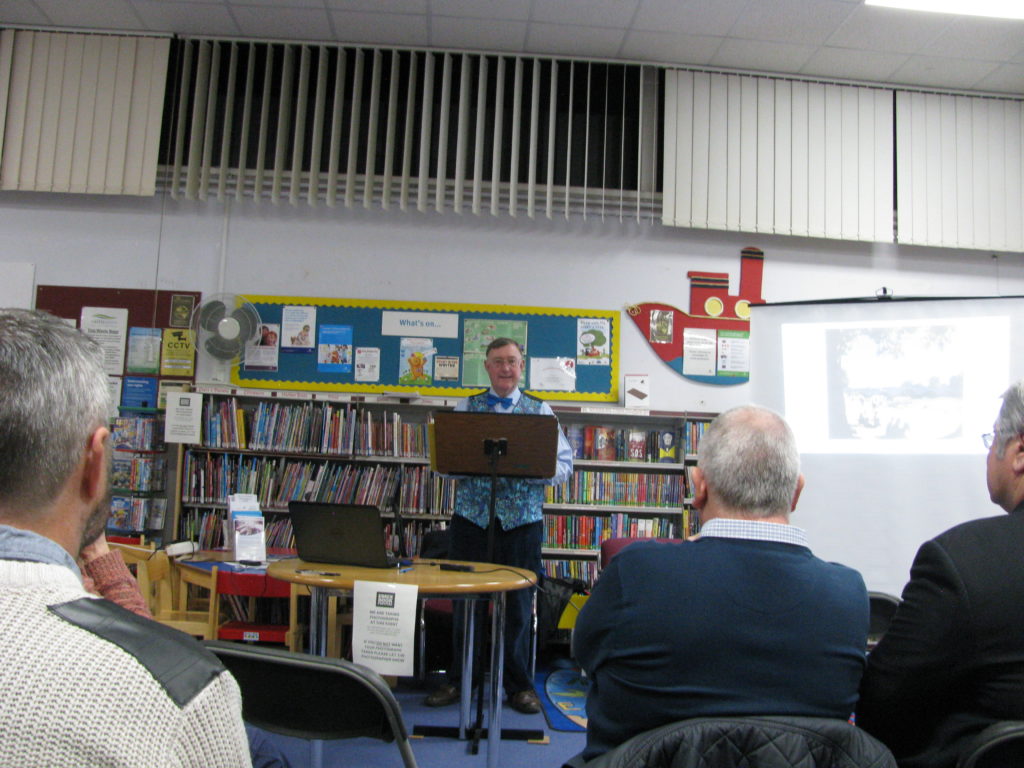
Delivering my festival talk…
This morning prostate cancer was being discussed on the BBC R4 Today programme by a presenter and various, including the oncologist who ‘dealt’ with Bill.
Here are a few current facts to digest:
One man dies every hour of prostate cancer in the UK…
Get tested.
The earlier the diagnosis, the greater chance of a ‘cure’…
Late diagnosis means a certain early death, still…
Men get by- passed by the system within the NHS, unlike women.
It is still a ‘Cinderella’ cancer…
So, in memory of Bill Turnbull, please, I am asking men to think about a test, then get it done. The NHS cannot say NO!
When one has had a near end of life experience, the joys and preciousness of life are sharpened: one is a very long time dead…
We set off from Queenborough on the West Swale early the other morning bound for Gravesend.
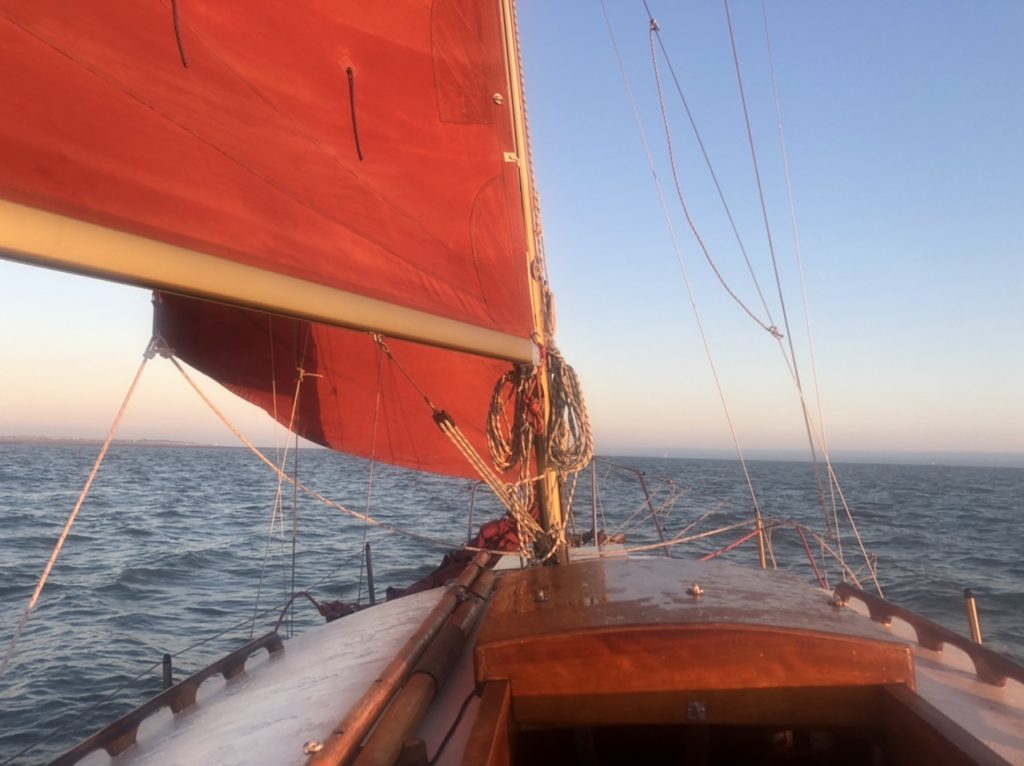
It was a quiet still morning n the harbour, but clearing Sheerness the sails were up and drawing nicely to a northerly – not the forecasted east-northeast!
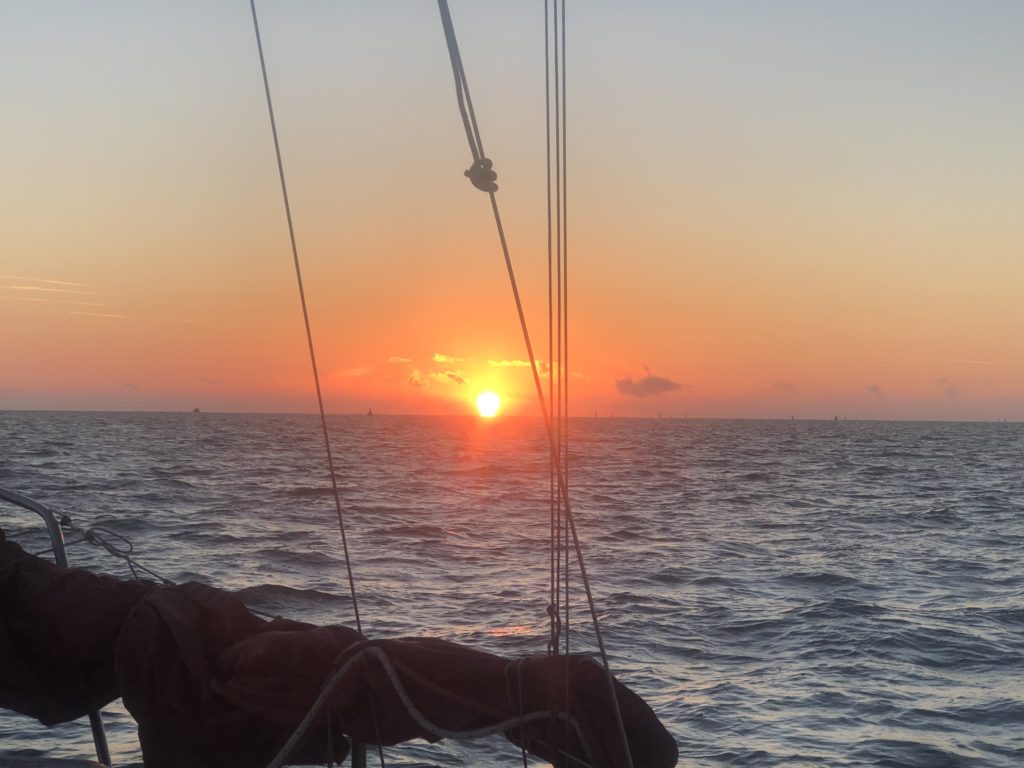
Sunrise…
We proceeded nicely up the Nore Swatch and passed the eastern end of Canvey Island.
Up the Nore…
After passing the East Blyth, we changed over and I went below for a wash and do the breakfast clearing up. The clearing up done, I set to with my ablutions…
I was half way through this without a stitch on when Christobel started the engine, saying something…
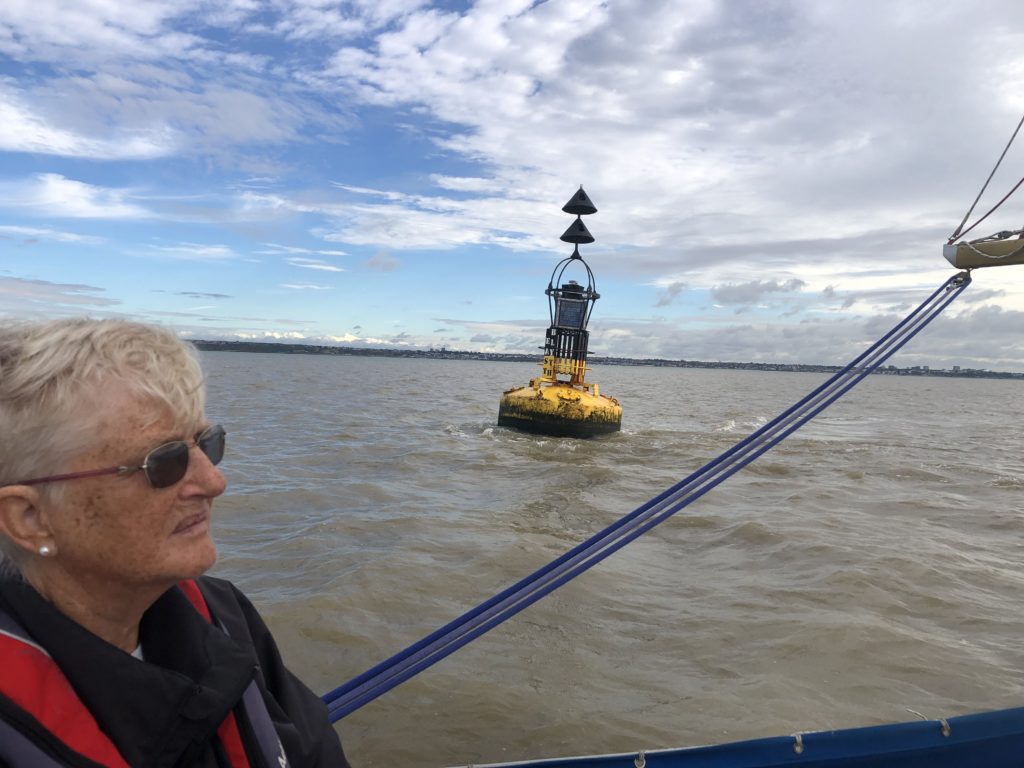
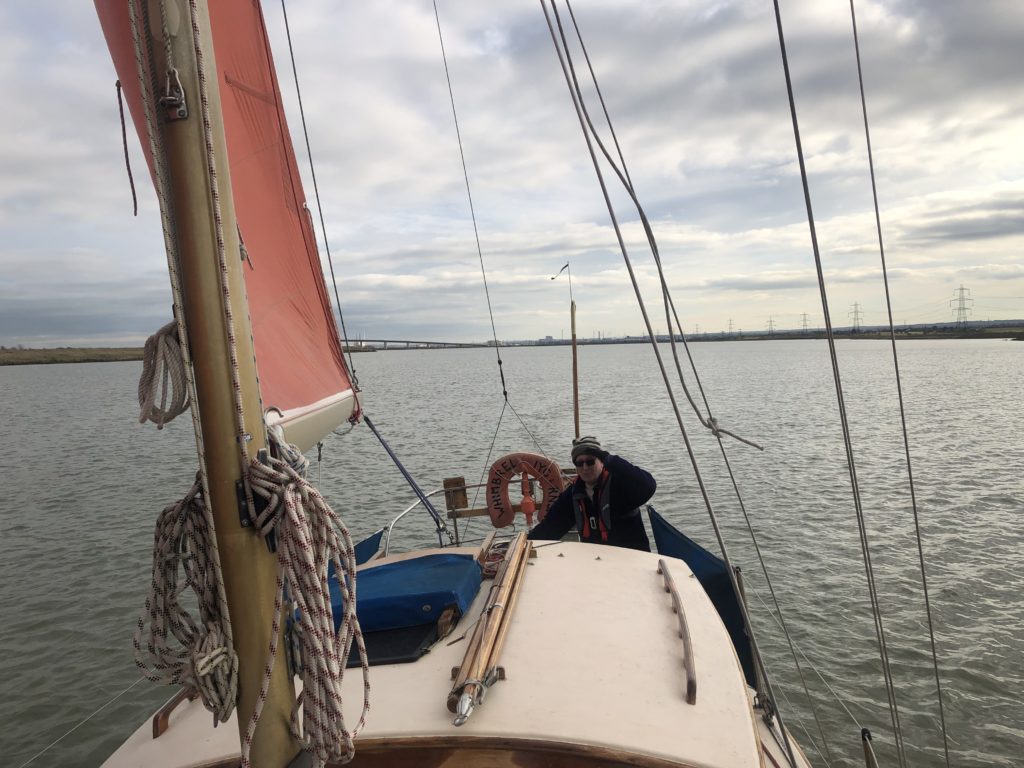
The something was drowned out by a tremendous crash with an unsavoury noise. I saw a buoy rush aft past the aft most port. We’d hit it a glancing blow.
I looked aft, the dinghy bounced off and we were clear. Below, I could see that water wasn’t rushing inboard, but what damage was there apart from my mate, who was in tears…
‘I got it wrong…’ she said, shedding more wetness.
‘I thought…’ she wailed.
We’d ‘bounced’ the Mid Blyth Buoy – a bloody big bugger!
I am always saying to my helms to leave buoys well clear: I can remember my father ‘mating’ with several in my childhood on the engine-less spritsail barge May Flower.
‘Carry on please…’ I pleaded. I need to check below properly for damage. I was shaking from the shock…
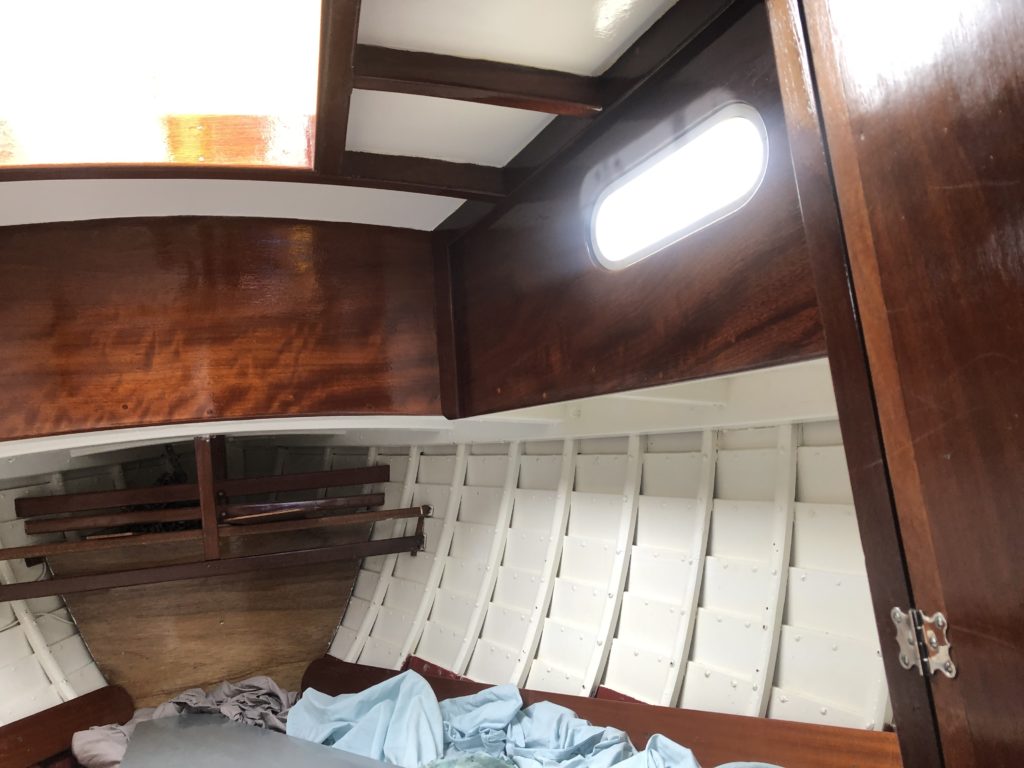
Splintered paint covered the table and cushions from ‘deck stress’ apart from that there was nothing to see below. I pulled the berth cushions out and looked around. Dry. No water was leaking in…
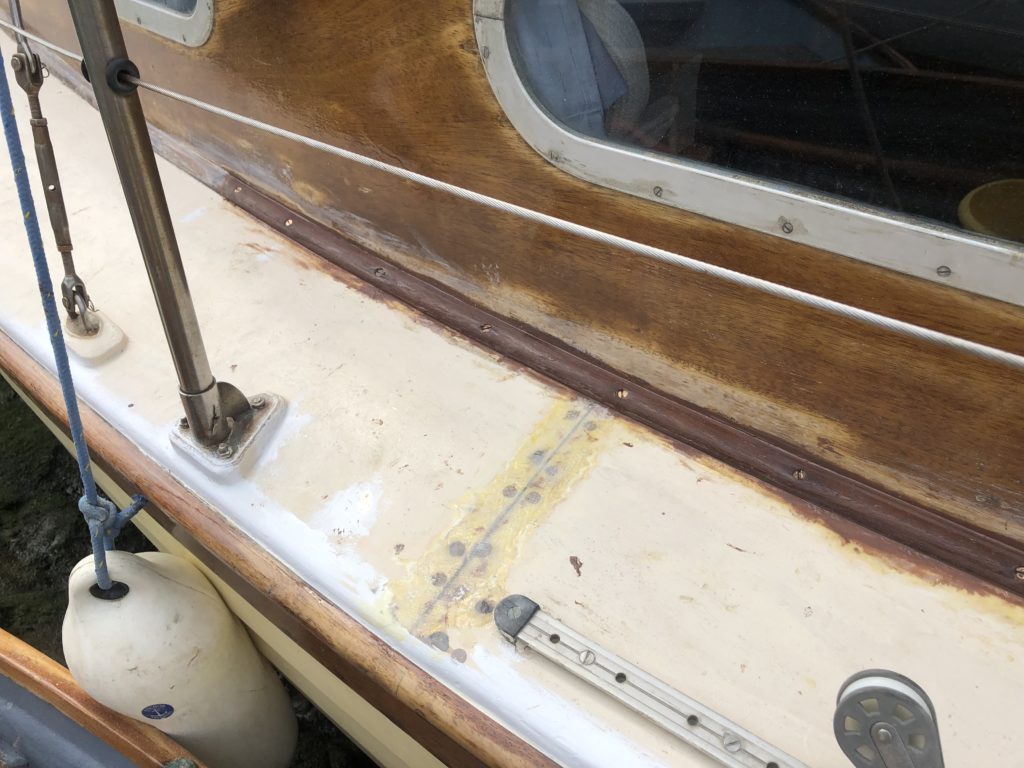
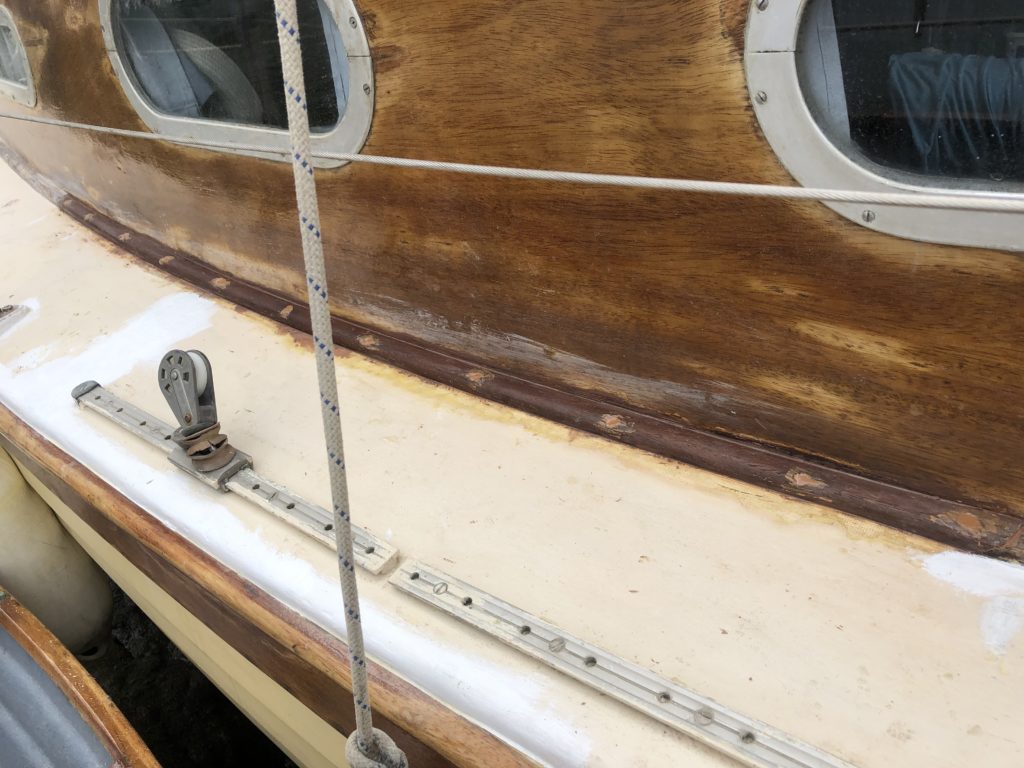
Above deck the damage looked serious, at first!
Closer examination later showed we had ‘got away with it’ and there wasn’t a mark on the hull or rubbing band…
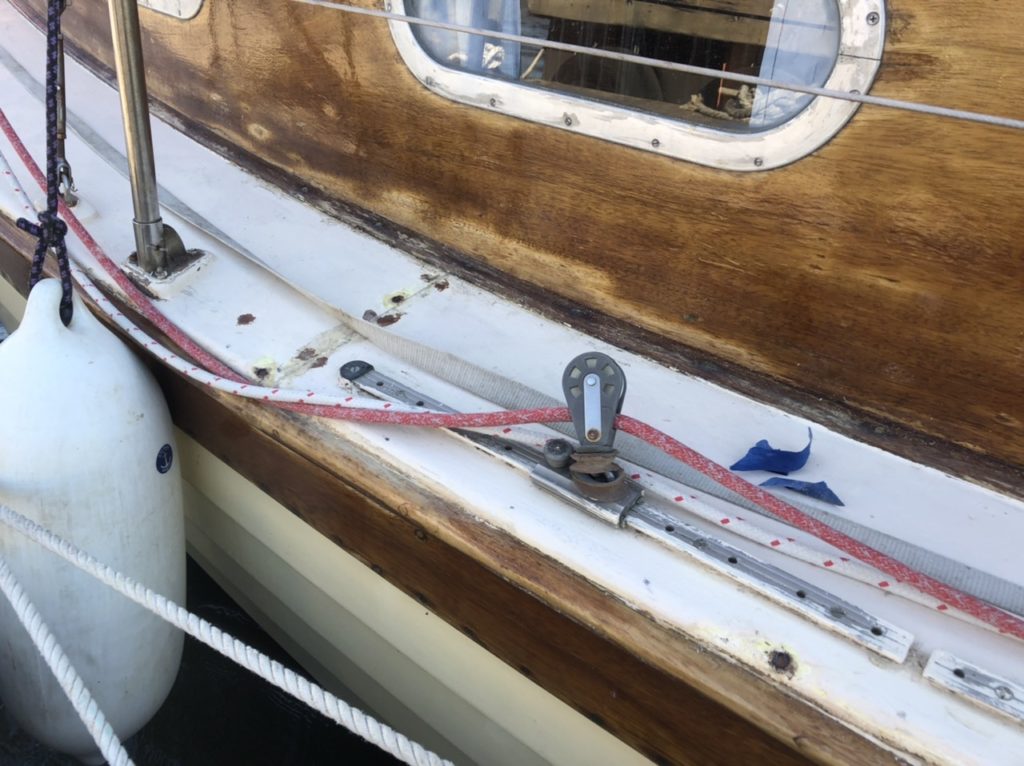
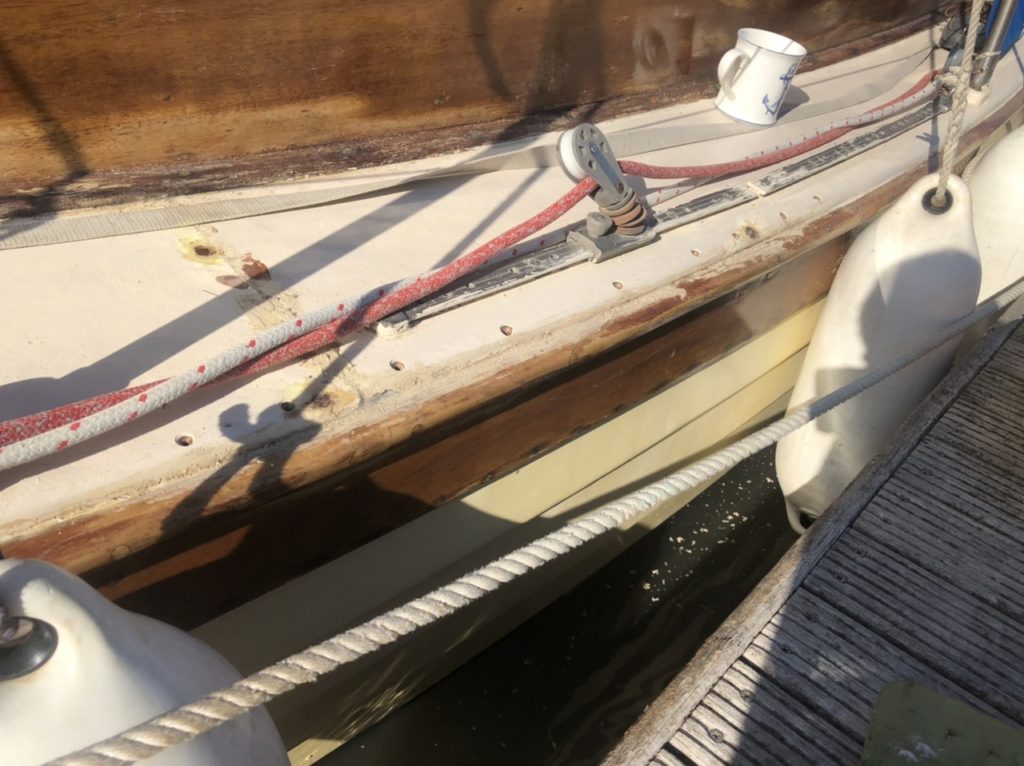
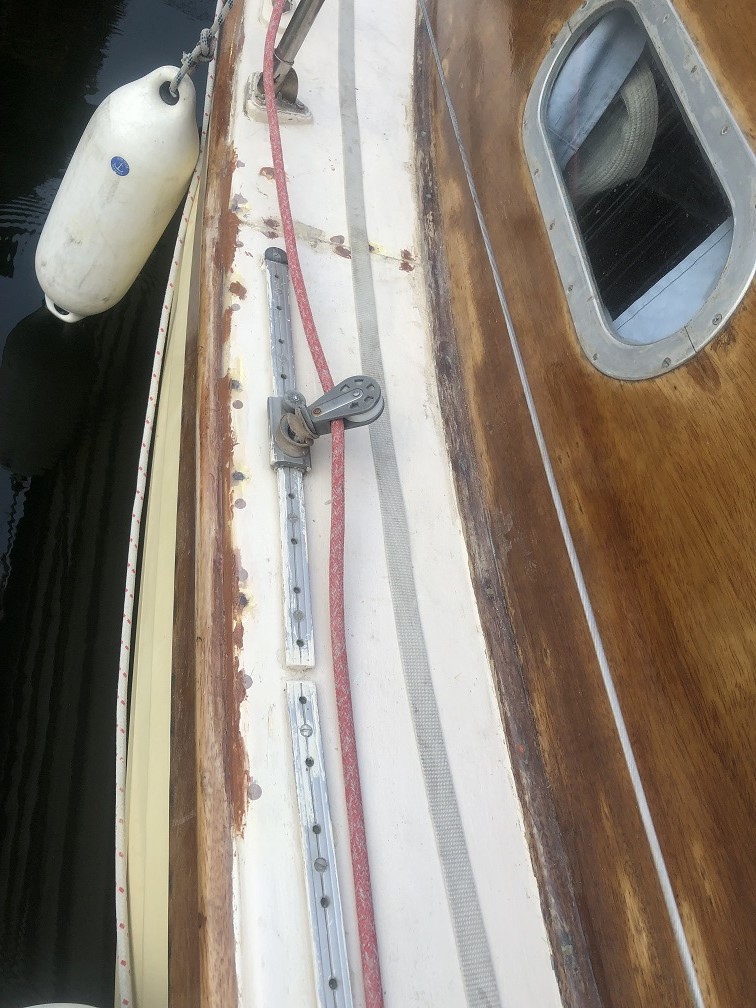
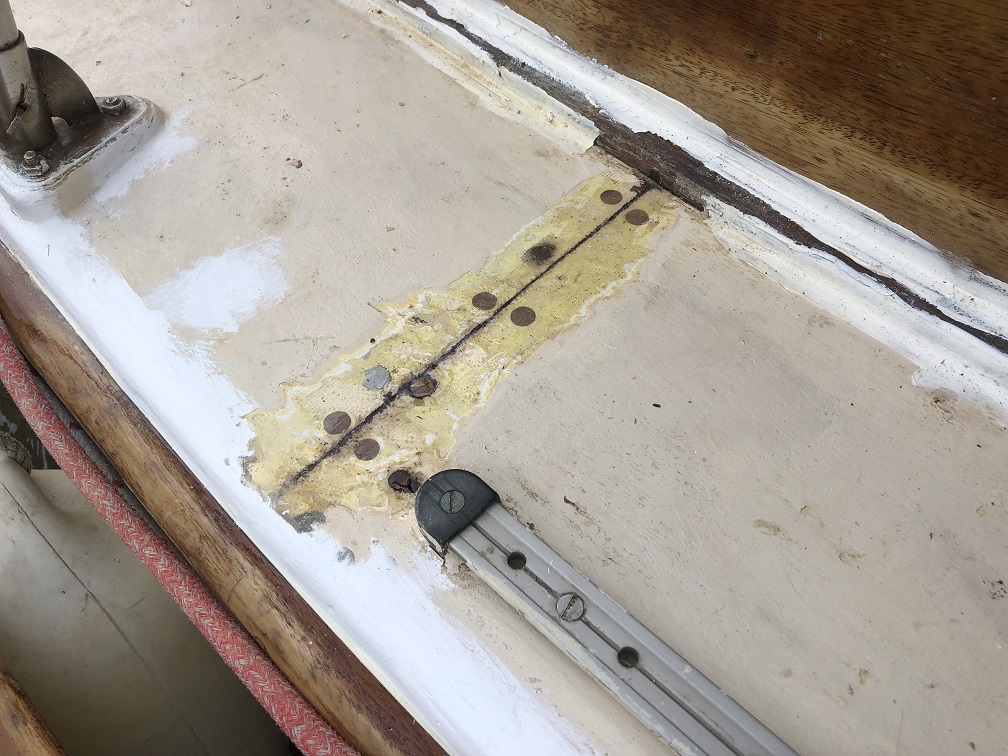
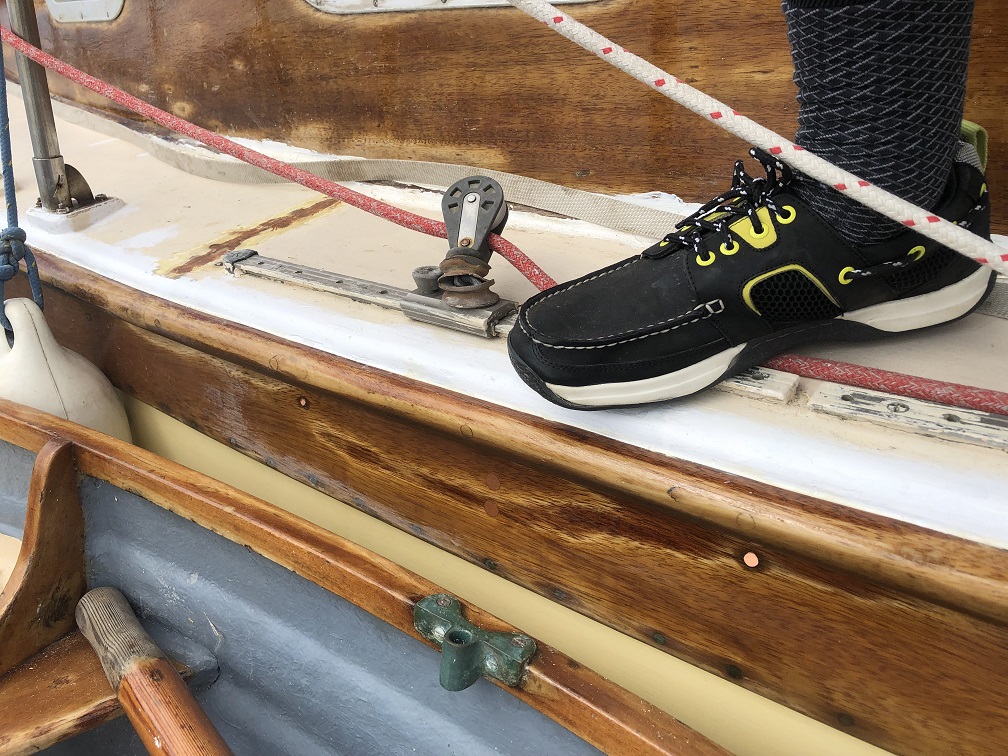
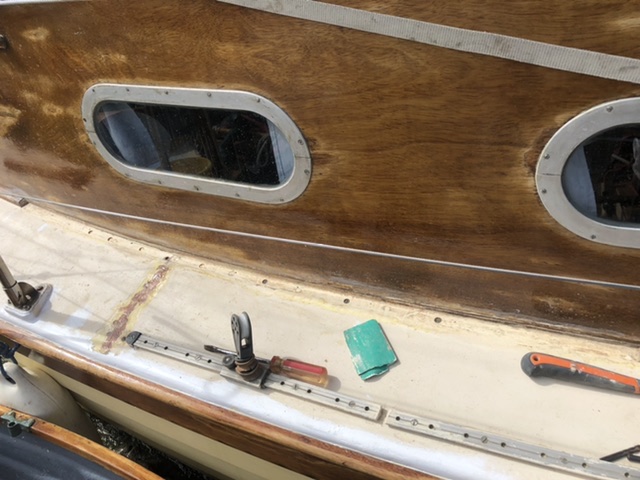
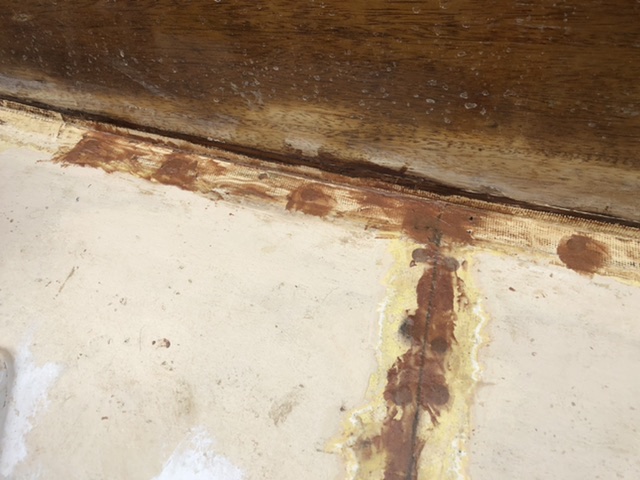
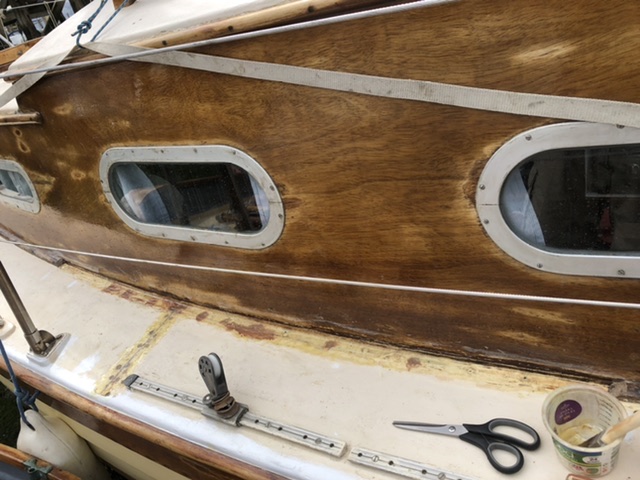
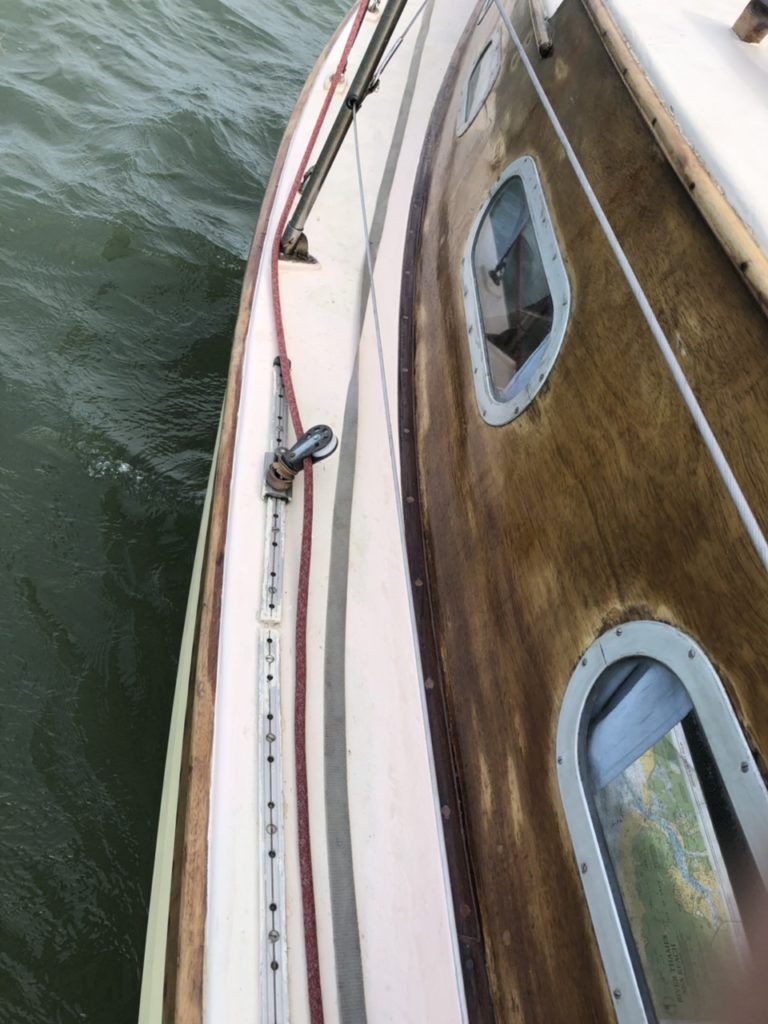
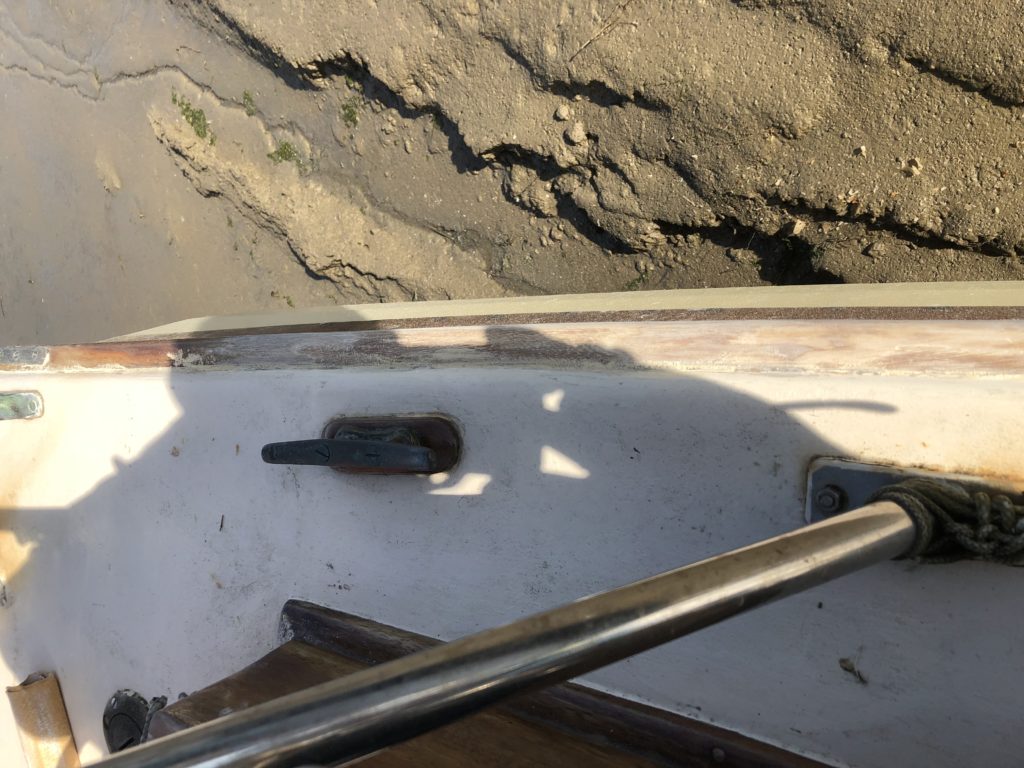
The deck edge was stressed and a join had opened with one side ‘popped’.
The deck damage…
Apart from the obvious, all looked sound, so we continued on our passage with the mate on the helm.
We did not discuss the ‘incident’ until moored at Gravesend – initially on a sailing club buoy before moving to alongside the Town Pier, which had been booked.
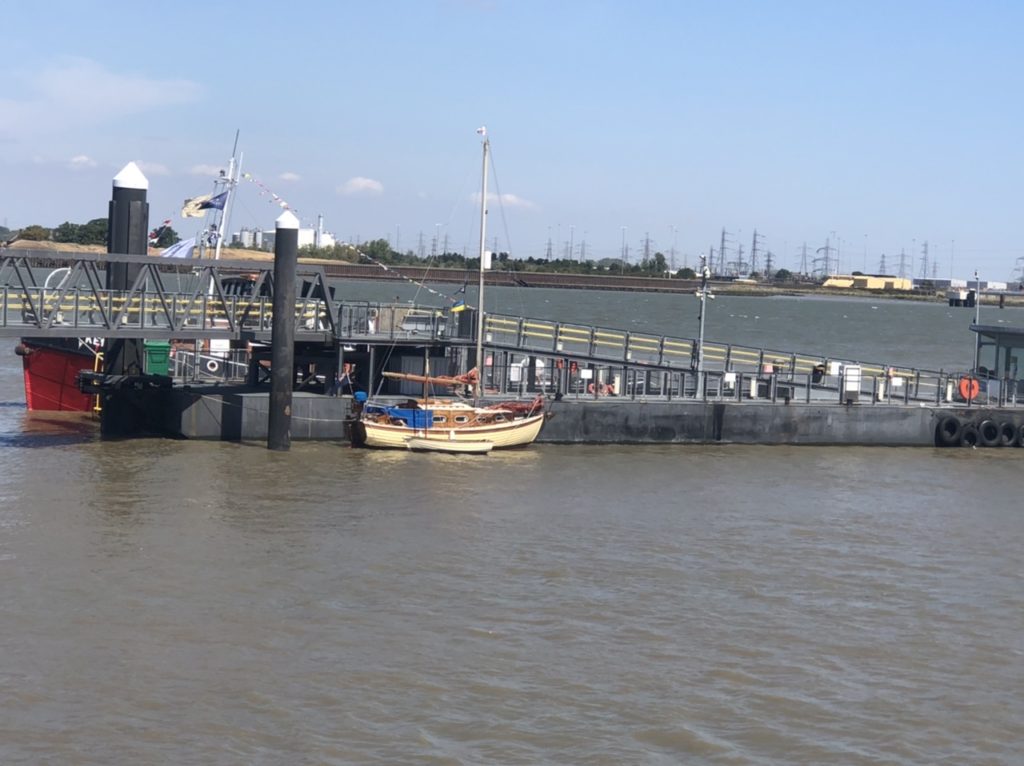
View of Whimbrel during our ‘court of inquiry’… over a glass or two!
At the ‘Court of Inquiry’ the Mate pronounced herself guilty as charged!
She’d got too close and then chose wrong way out… hey ho, cheers darling!
I had had a good look too. The cabin side beading has loosened and the deck edge lifted, with one deck join too.
The edges, join and beading were sealastic sealed … as a keep water out measure.
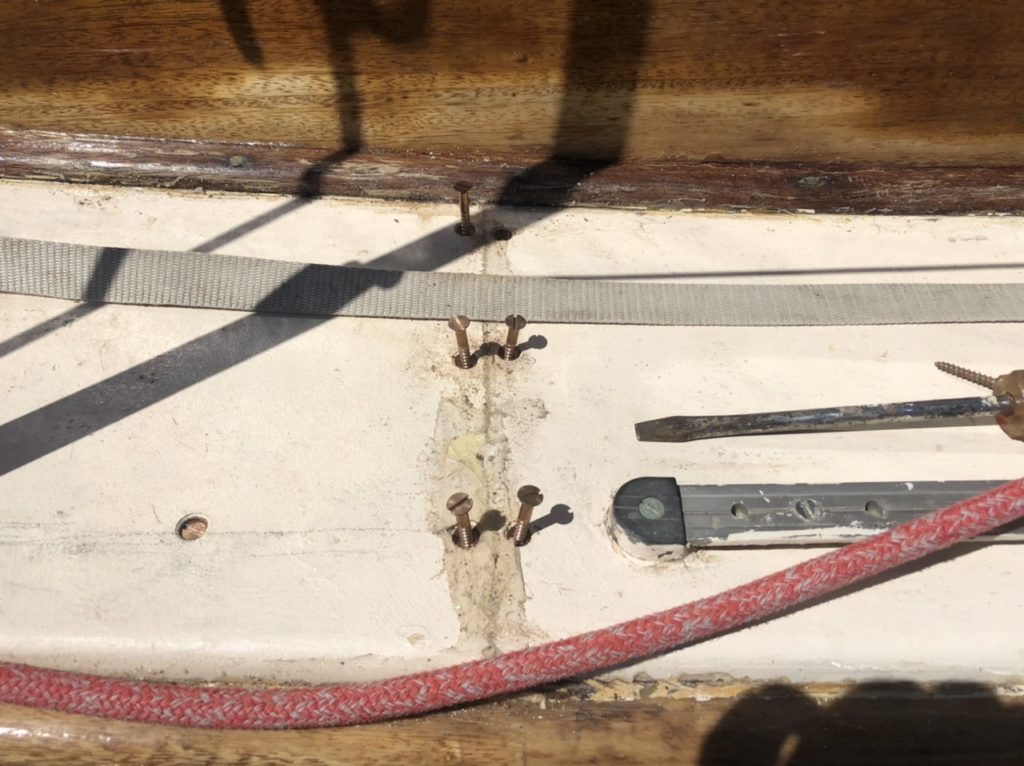
The join has been screw fastened which thankfully pulled the popped section down.
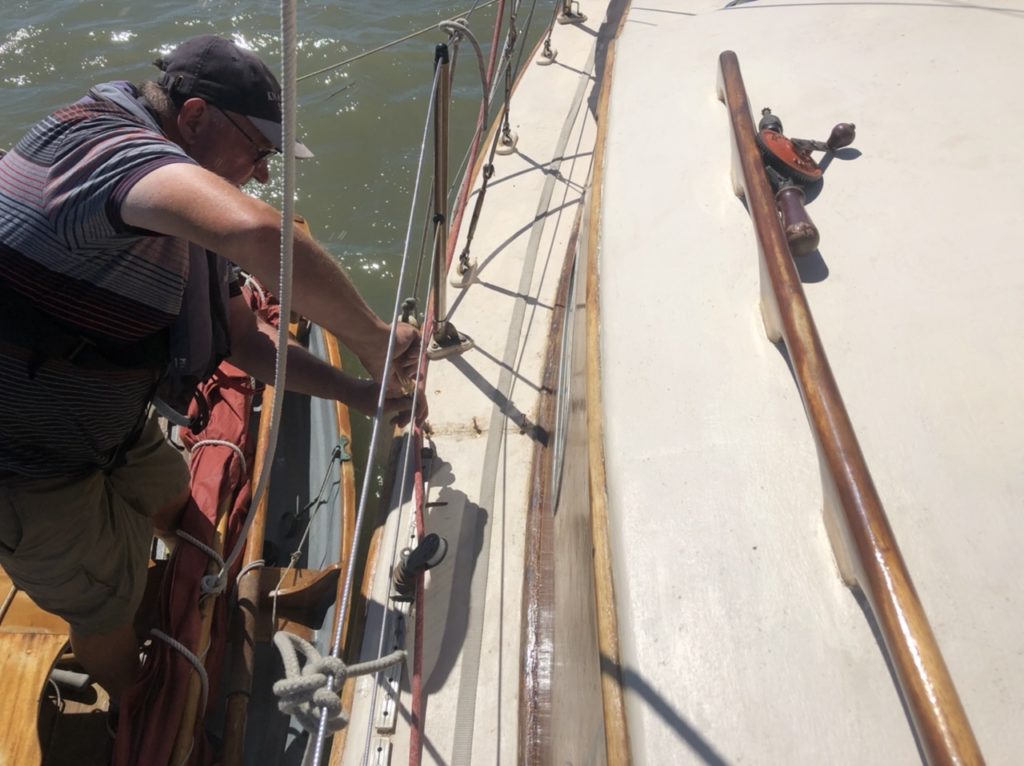
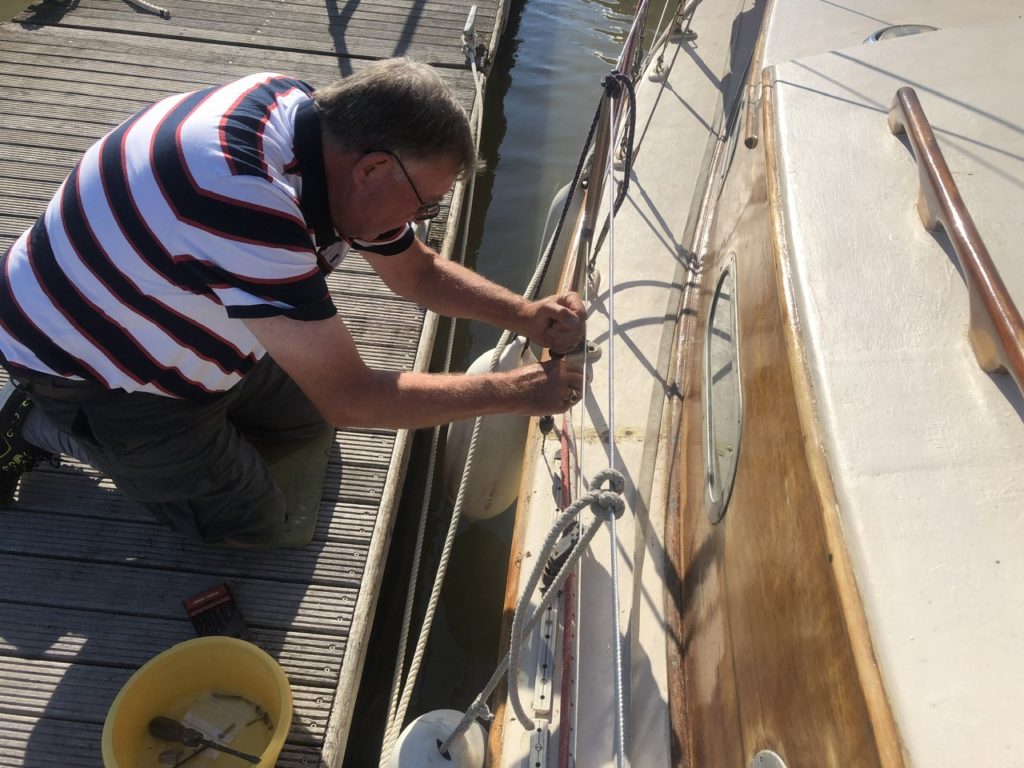
One done six to do…Off Erith – tightening screws…
Christobel helped with tool passing and some pictures…
Several original fastenings were punched a little, rust treated and plugged… (a common Finesse fault)
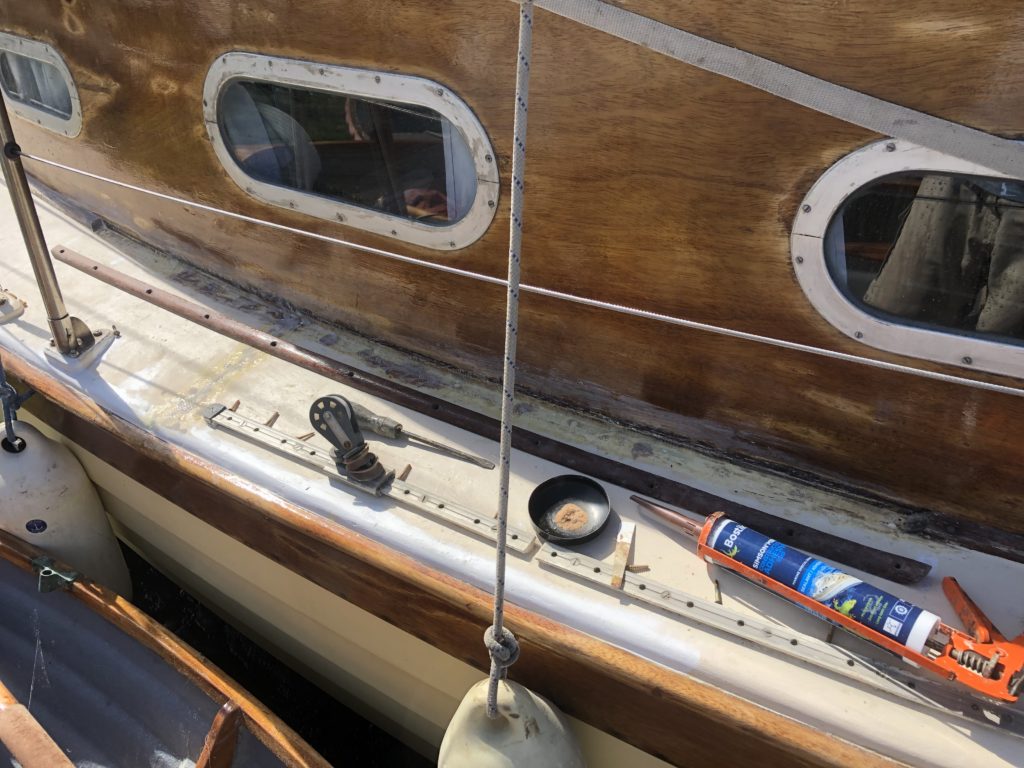
The deck edge and cabin side beading remain to be dealt with.
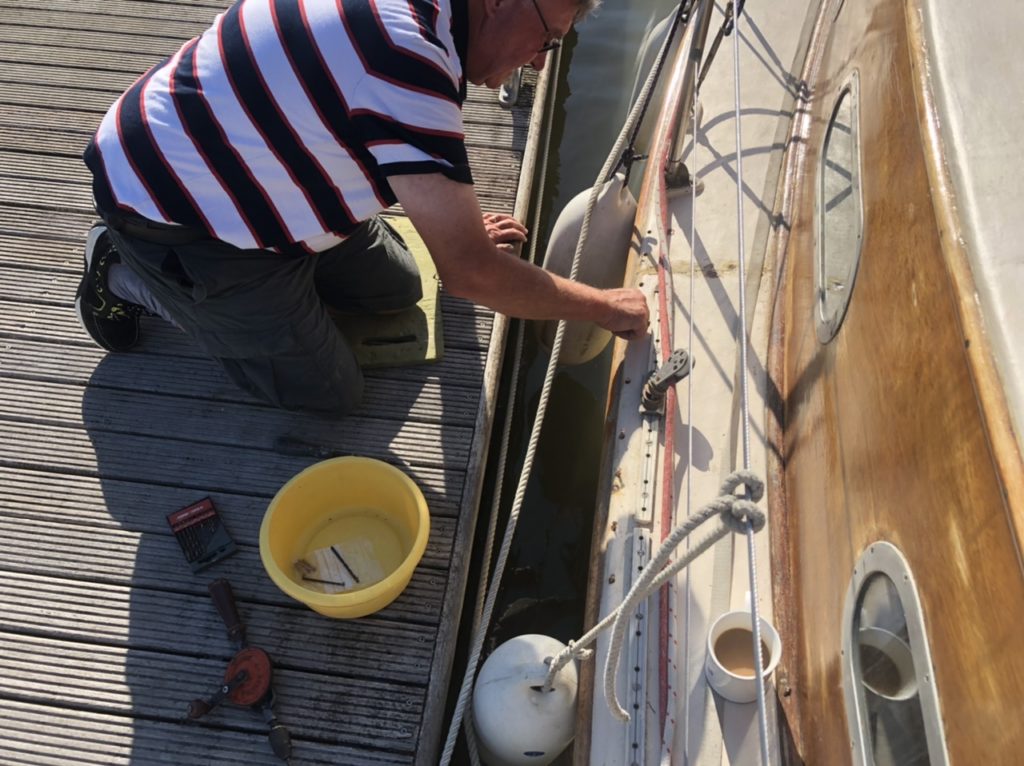
Alongside the Greenwich YC pontoon – old fastenings plugged, new capped with epoxy.
I have also got to ‘gingerly’ put a number of fastenings along deck edge into a 5/8” Iroko plank – tentative pencil dots have been made…
The good news is that all drilling swath is good coloured wood!
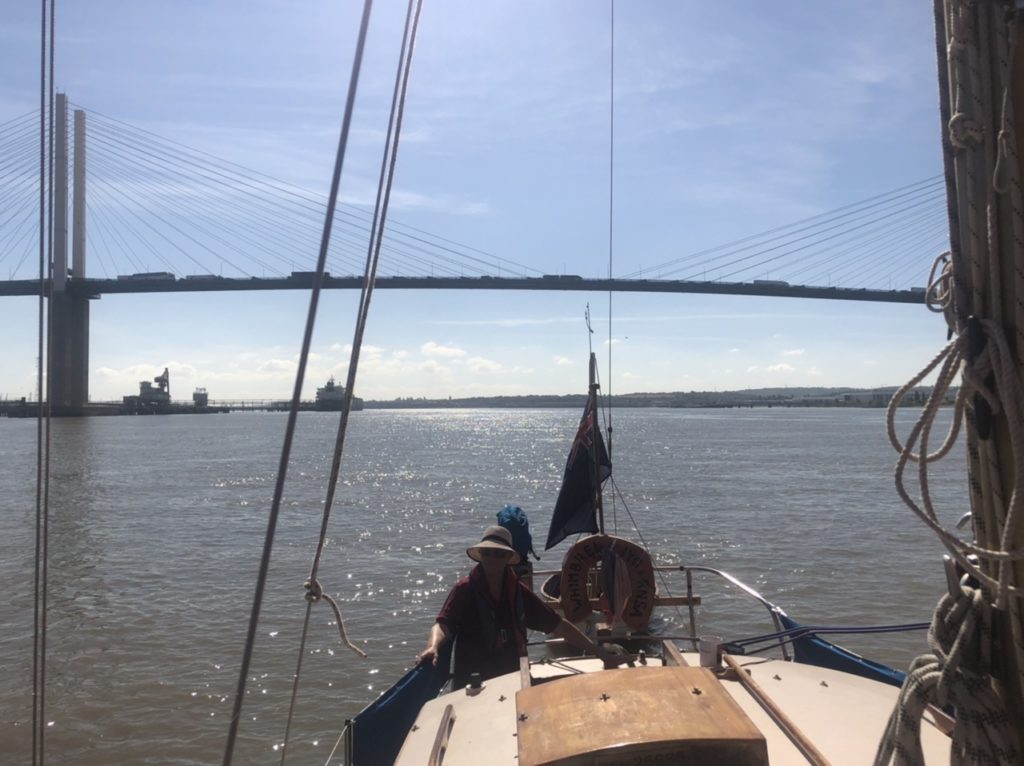
The Mate helming up Long Reach…
The Finesse is clearly a tough old bird. I really thought the worst and had a terrible night rescuing my Mate twice and failing once… Shock?
The good news is that Whimbrel survived, intact, and my Mate too is slowly regaining her confidence…
Bless.. xx
Update: Saturday 13th Aug.
Alongside the Greenwich YC pontoon (inside berth) a run of new deck edge fastenings we’re fitted.
After careful study of side plank angle … I marked and drilled!
All drillings – fine drill first- stayed in wood. The planks are max 5/8” thickness!
screw size drilling and countersinking done, my row of fastenings had the deck edge secure.
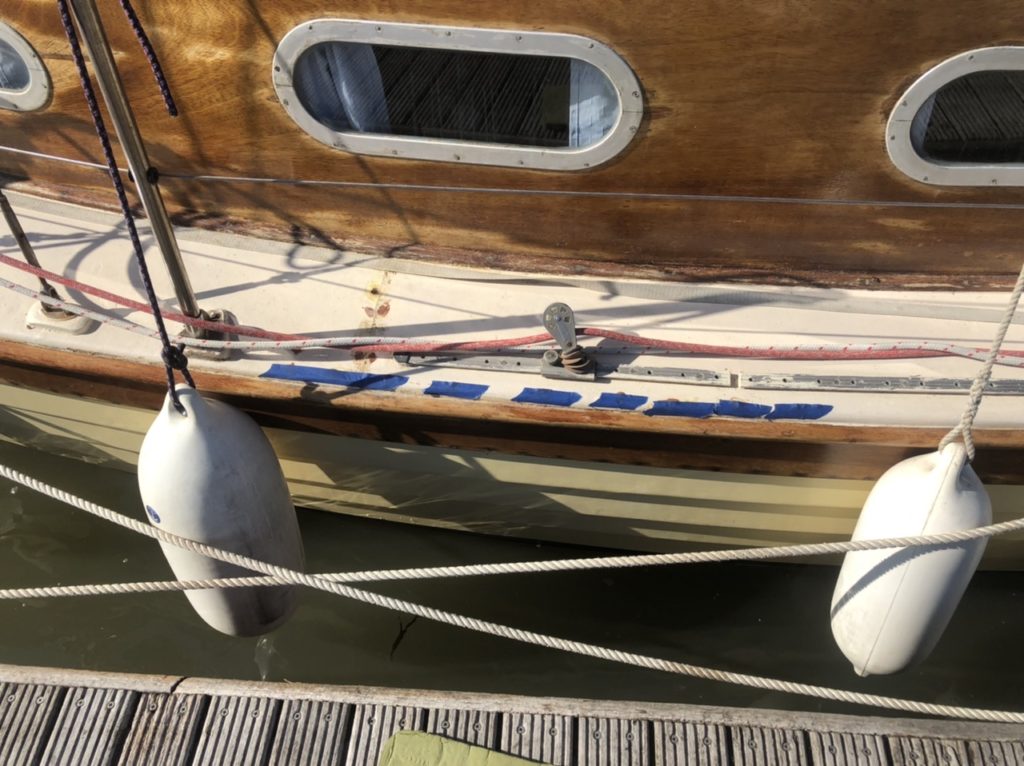
Good coloured wood in counter sinks…Fitting screws…Screw heads epoxy filled and taped over until cured.
There are a couple of old fastening tops to deal with … popped as deck was pulled down hard.
Those and repair to fabric of edge to do next…
Update: 20th August.
During our stay in St Katharine Docks Marina repairs were progressed.
The deck edge was carefully stripped of paint, sanded and the glass sheaving re-coated with epoxy.
Deck edge prior to final sanding.
This was allowed to cure before final filling, sanding and several coats of undercoat paint.
Initial treatment of join with epoxy run in…
The area of deck either side of a plywood join was then cleaned back to he original glass sheaving. Old capped fastening heads were cleaned out, fastening punched, an application of anti-rust treatment before wood plugs glued.
A further fastening head spotted was also dealt with before a filler coat was applied. Whether or not the join needs a piece of cloth epoxied over remains to be decided…
Area around a fine crack to sheer strake varnished
The last job before ‘hitting’ home was the treatment of a fine crack in the sheer strake. Creeping crack cure was dribbled along until saturated.
A couple of fastenings were added above and below for good measure and decrease chances of movement. The filled over screw heads are barely visible.
Next: the deck edge/cabin side batten must be removed, repairs made and batten re-bedded…
Update: 22nd August.
we arrived home on a glorious evening after having a Ray Day with scrub of Whimbrel’s bottom.
Working from the dinghy as a stable platform the cabin side batten was removed intact. The original sealant was removed and a section of loose sheaving cloth. Area was sanded.
Apart from clear movement running forward there was a gap to the cabin side at the inner deck edge aft, but it didn’t seem to be ‘fresh’ – from build? There was clear movement along the aft deck section. The edge was re secured with bronze screws.
A run of new screws fitted.
An old fastening was punched in and plugged too.
Epoxy was then run into the gap and movement crack followed by thickened epoxy. This was left to cure.
Close up of gap filling.
The whole area was then sanded ready for application of glass cloth.
Deck join and edge covered with cloth.
I was surprised at how translucent the glass cloth went, but it’s there!
The batten was taken home for cleaning, sanding and epoxy dressing of ends to allow fitting back flush at angled cuts.
And glory be, a tube of Simpson MSR marine sealant ordered while away arrived in the post!
Penultimate update – 23rd August.
The good mate joined the work party for this penultimate day of repairs.
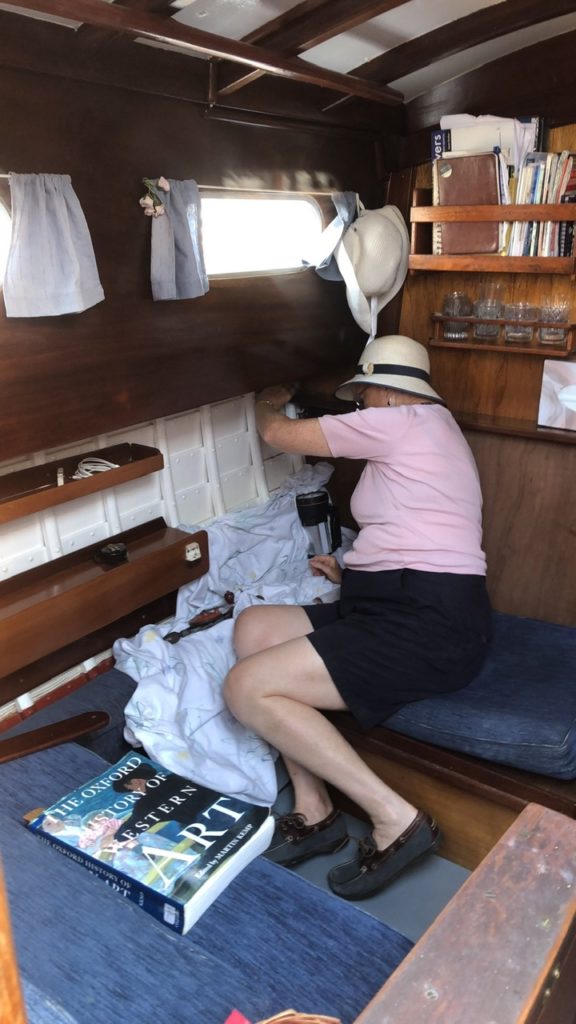
Her job was below – sanding and undercoating the cracked paint on the underside of the deck.
While this was going on I set to and prepared the batten for refitting, adjusting the bevels to fit. It was to be screwed back into place – holes were prepped too.
All set to fit batten…
The epoxy and glass cloth areas were sanded to take away any high areas. The deck join area too, ready for a coat of undercoat paint.
We stopped for a break before the final exercise – it was exceedingly hot and humid…
Sanding and one coat of undercoat done, the mate takes a break!
Break over, I set to work. Sealant – Simpson MSR compound – was applied to mating area then a little epoxy mixed and applied to forward end. I had to get on now…
Working from forward where curvature was greatest, the screws were driven home.
Forward end was secured first…
Reaching the aft end a further bob of glue was applied to batten join and last screws driven.
All secured.
Christobel in the meantime had done a clean through below around her working area. We had a lunch stop … allowing batten to settle.
While I went round the screws again and sealed tops with thickened epoxy, the mate applied her second coat of undercoat paint…
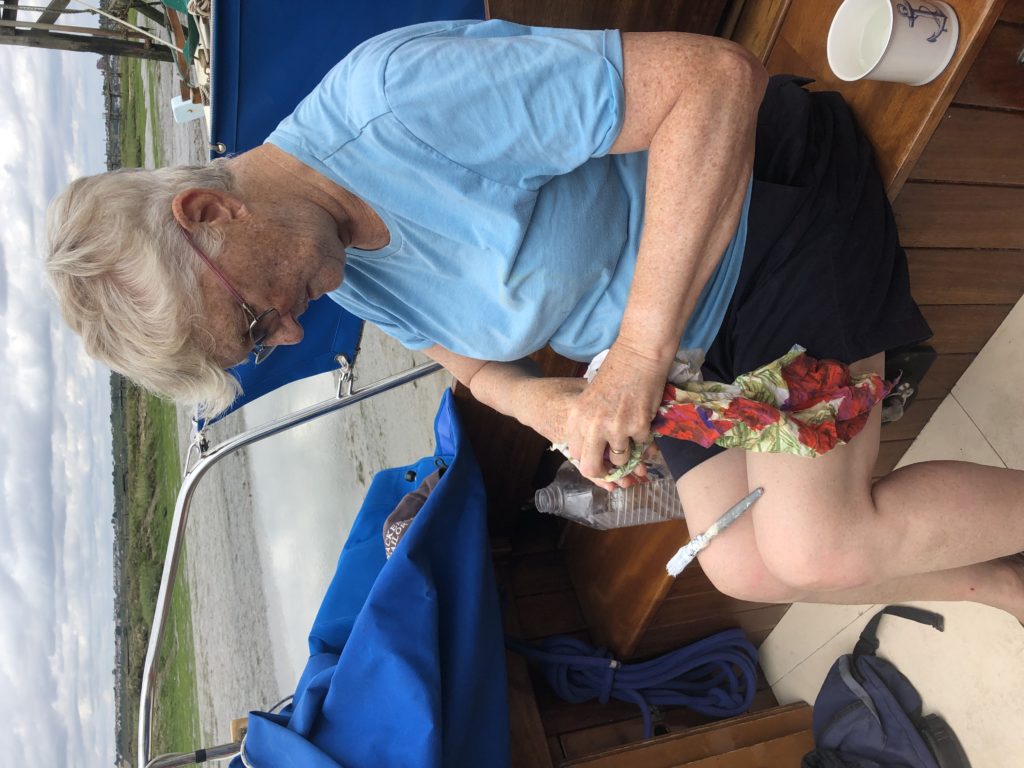
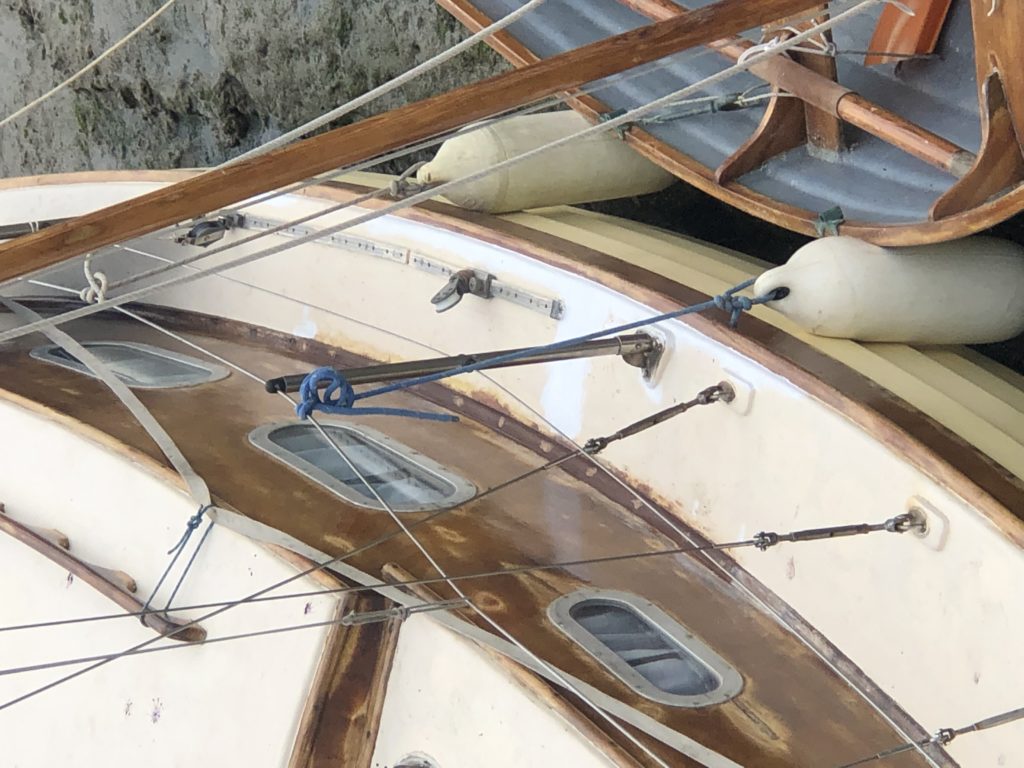
Mate cleaning her hands…The area from a distance – Whimbrel feeling much better!
Of yes, Christobel left this buoy a fair distance off. Look at the flow past its body!
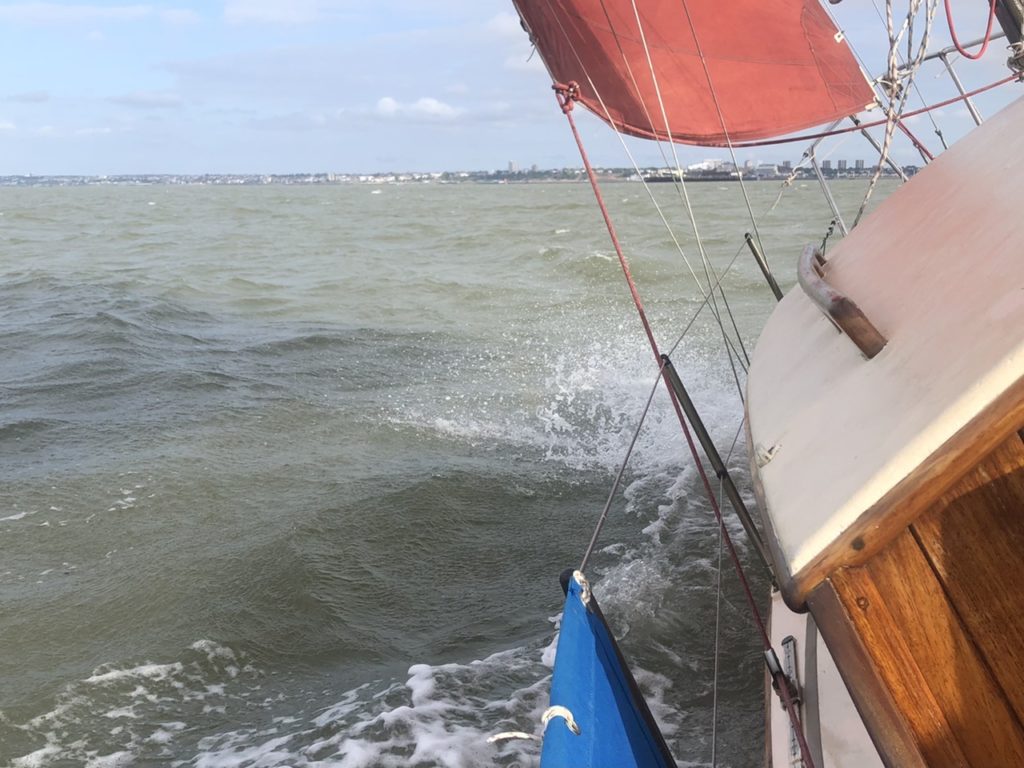
Mate on the helm reaching down along the Blyth Sands…
The end- all the sticking plaster comes off!
There was a ‘kick in the nuts’ to the job: I found that I had to re fasten the deck edge going forward of the stanchion. Also, the outer stanchion base fastenings go through into chocks behind the shelf strake set between the ribs.
Great. But, the chocks bare on the underside of the deck inside the sheer strake, thus inward pressure on stanchion was lifting the outer edge of deck which was not helped by failed/loosened fastenings.
The mate dealing with the underside chock painting…
I fitted a covering chock inside to go over the the infill chock and underside of the shelf. This was screwed to shelf and fastened through from sheerstrake. Pressure on the stanchion showed no movement if deck…
The edge was released and hardened up after application of runny epoxy before it had time to set off. Edge was then coated with thickened epoxy.
All painted…
I shall be looking closely around the other five stanchions…
All is now painted and has been tested in the estuary!
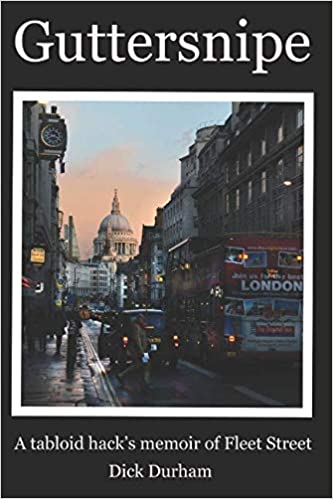
Ah, Dick, you whipped out your colt 45 and blazed away, words zipping as the tale unfolds…
Courtesy of Amazon.
I was enthralled. I laughed out loud while reading (most unusual) and nearly cried as sobering and sad words spilled from the pages too.
I always knew Dick spent time in Fleet Street on a new newspaper which hit the world in a blaze of tabloid hype and steamy stories. It ‘s a world I knew nothing about, other than the scandals that have trundled from the news with a regularity over the last couple of decades, leading to a massive tightening of regulations.
Dawn on the hottest day in July, ever…
I knew Dick when I was young – being a ‘Thames barge boy’ – when he used to come aboard my spritsail barge home, the May Flower, to help out! Dick later sailed as mate aboard the mighty sprittie, Cambria as no. 2 to the inimitable Bob Roberts. I didn’t reacquaint until years later.
Now, I know what he was up to. Dick learnt his craft with the Dundee Courier at their offices by Fetter Lane – the building remains with its painted advert above and can be clearly seen from a bus.
He was soon having a rollicking good time as he sloshed his alcoholic way through the miasma of Fleet Street’s news desks and pub floors. As a news hound, he chased’ news’ and the people behind them, insinuating himself easily into the cracks in the stories.
What couldn’t be had from the coal face was made up … but the paper’s readership from the start lapped it up, gullible to the very core!
He names characters without a care: truth cannot be challenged. It silences detractors … something I’ve learnt.
Big press names rolled off the pages. ‘Huge people’ discussed by the media talking heads and tut tutters. Wow, he knew them in the work place. Now we do too…
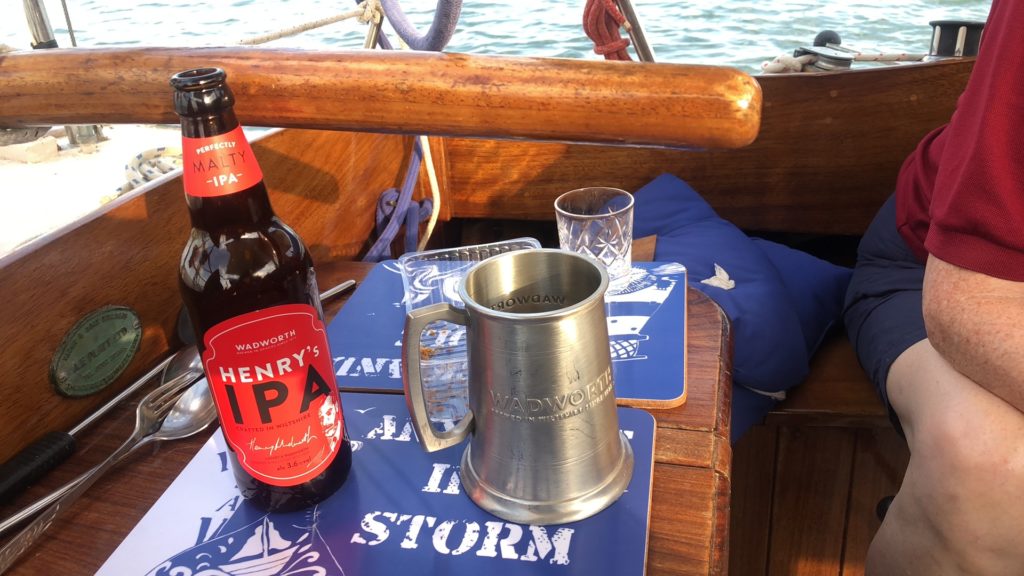
A beer helped the story flow…
A bloody good read Dick, which I quaffed with equal eagerness with a beer or two whilst keeping cool afloat this summer.
Not a sailing book, but written by an amusing and characterful sailor.
Towards the end of June I wrote to the head honcho of the Royal Yachting Association, Sarah Sutcliffe, regarding the cancelation of my membership and my reasons why.
I received a confirmation of receipt from her personal assistant stating that my communication would be placed before the Chief Executive.
Time has ticked by. There has been no response.
The problems remain acute with supply to marinas and other outlets of calor gas in particular, yet the RYA clearly does not have the balls to respond to a member cancelling membership after some 40 plus years of loyalty.
All I was asking for was pressure from what purports to be ‘our’ governing body to be applied to suppliers…
It typifies the crassness of this organisation that clearly exists as a self-employment project with not a care for the ordinary sailor, other than the gathering of gold medals.
I can think of many an Olympians and I doubt if they would be similarly treated. The Royal Yachting Association needs to remember the greater majority of sailors sit on the lower rungs…
Now, I wrote to the editor of the ‘Yotty’ Newspaper – All at Sea. The editor was back to me in a trice.
The July 2022 issue of the paper has my letter and their findings – no more than I had gleaned. But, and this is an important point, they responded in a positive manner, agreeing it was something that needed to be sorted out.
The piece is added below:
Courtesy of ‘All at Sea’ – thank you.
I always try and pick up a copy of this publication when seen in a chandlery or marina office: it is quite informative, if largely south coast orientated (aren’t they all…)
So, I would like to say thank you to ‘All at Sea’ and the rags editor, Jane Hyde, and Simon Everett.
Over the past month I have enquired at five different outlets about the ‘gas problem’ and ALL reported the situation as dire!
Coming upstream on the River Orwell yesterday I spied Jack Coote’s old yacht, Blue Shoal on the mooring trot below Ostrich Creek. The vessel, was, I believe, Jack’s last.
Many possibly won’t know of Ostrich Creek. It is the seaward end of Belstead Brook which runs down to the salty Orwell where Fox’s Marina and the Orwell Yacht Club are situated.
Blue Shoal.
Ostrich Creek was the first sailing anchorage of the inimitable Maurice Griffiths who shared a ‘tore out’ with a couple of buddies for a short while in the early 1920s. MG lived up the Wherstead Rd running into Ipswich.
The Orwell YC cadets under training in the small area of water left between Fox’s and the club’s moorings.
Janet Harber, one of Jack’s two daughters, told me recently that Blue Shoal’s owner gives her a sail from time to time. How lovely…
I never met Jack, but I am sure my father and grandfather did back in the late 1940s and the 1950s. I would have relished the experience.
For years I have kept Janet supplied with updates for the East Coast Rivers pilot book. Updates can be obtained from the last issue publishers, Fernhurst.
Finished the last jobs, I don’t think so! However, the target has been achieved many time over this season what with the fine weather enjoyed.
Just before leaving for my birthday June cruise, I completed the final edit on latest book. See earlier post. I am now awaiting it to be finalised for final acceptance before it moves to next stage. Hey ho.
Laptop and file has to come sailing!
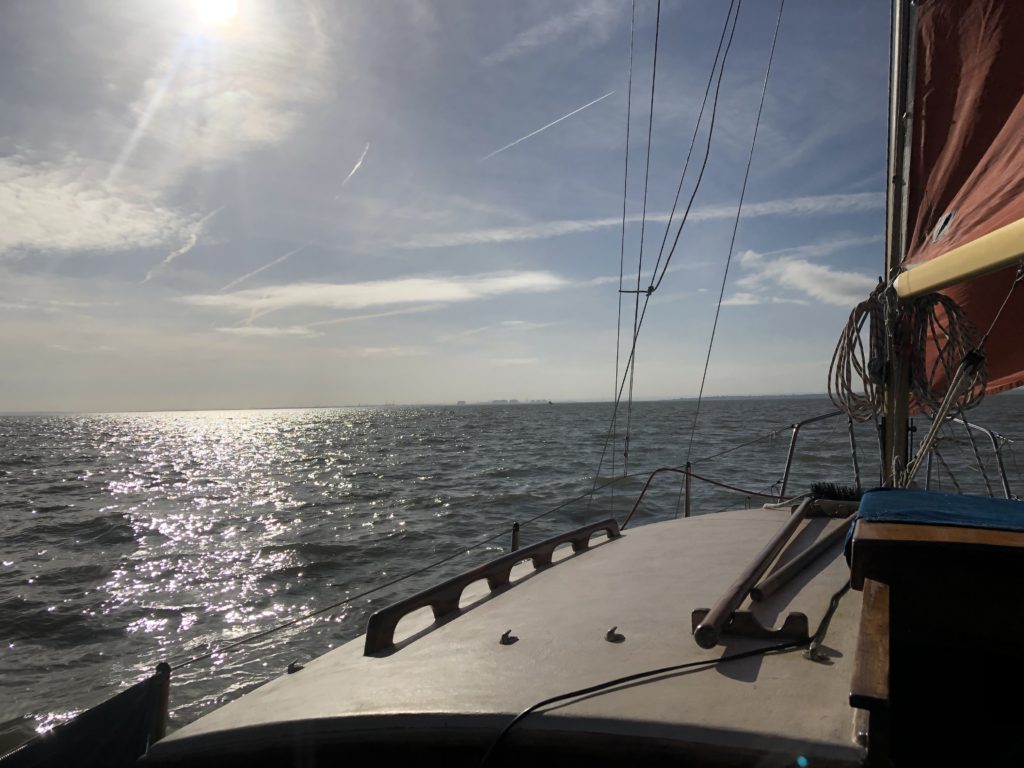
Sailing gently out of Conyer Creek this June…
We got home from an extended two week early June cruise around Medway and Swale, taking in the Pageant (that wasn’t) and the Finesse Rally on following weekends, two weeks ago now.
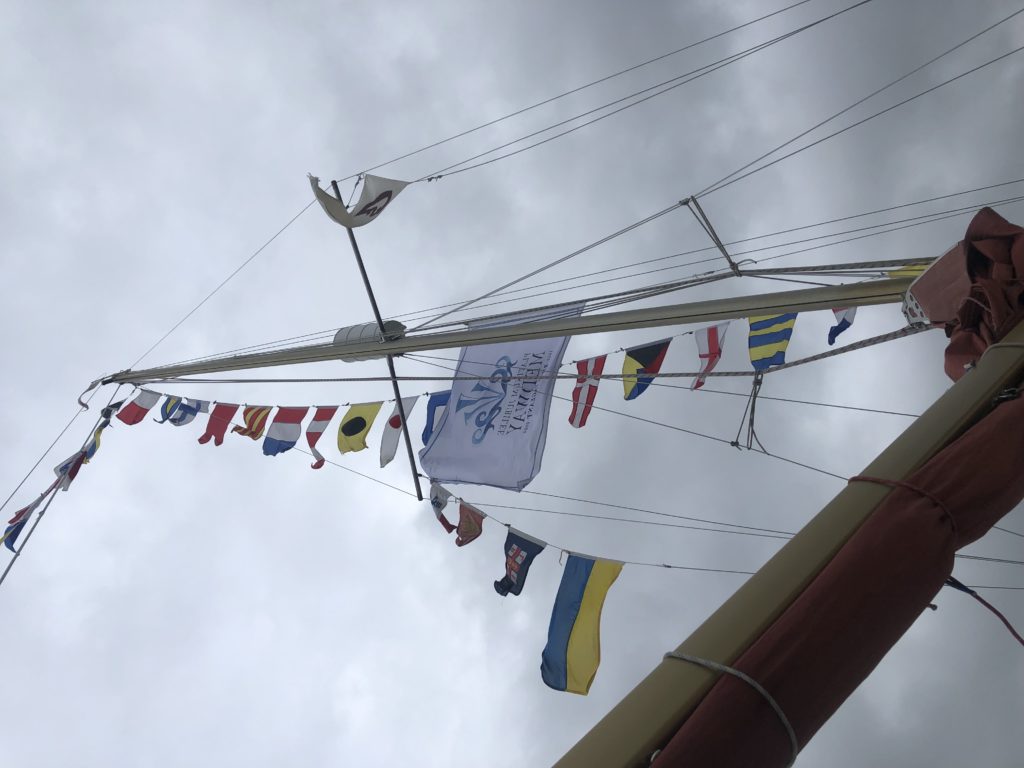
Whimbrel dressed overall on Jubilee Saturday – it blew old boots!
It seems an age and poor Whimbrel has had no sailing since – me as well!
There were various jobs to deal with. While away the mast step came adrift on Twitch. It was fixed but not completed while away – allowing it to be used. A coating of epoxy completed the job.
The mast leather needed re-tacking.
tacking the mast leather.
Then the thwarts had a sand and varnish too – the gunnels had been completed a couple weeks earlier.
All varnishing on Twitch completed.
In the meantime, I had to carry out some planking edge paint repairs caused by a hard mooring buoy – annoying!
The boat has been fully stored with her dry provisions ready for some weeks of cruising, pottering and exploring.
My sister and two friends join for a week this coming Saturday – a convivial little group, especially the chap who says he is Welsh, but actually only a quarter. We have fun!
I had an interesting conversation with the yotty paper ‘All at Sea’ and a letter and answer will appear. It is all about the gas problem. Editor was unaware, but staff on the paper were and no one had said anything!
As for the Royal Yachting Association – they have been given the big heave ho! A waste of space.
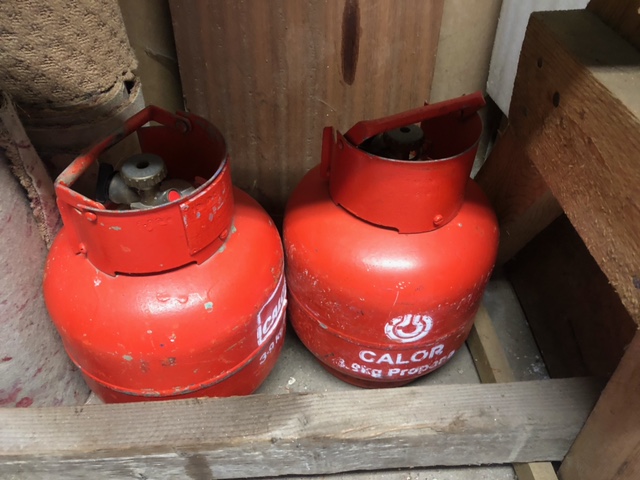
Spare gas cylinders to ensure our sailing security…
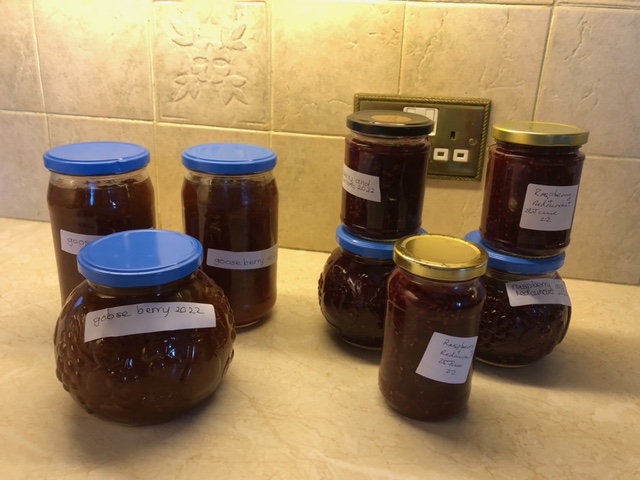
One morning was spent at a fruit farm picking luscious Gooseberries, raspberries and some red currants. So two types of jam now awaits our return from our holidays…
Jam time too!
If you yourself are off sailing or just off on land holidays, enjoy and make the most of a generally covid ‘free’ time.
Last year our summer sailing was particularly torrid in respect to an ability to obtain refill gas cylinders from marinas, or, as it later turned out, from anywhere.
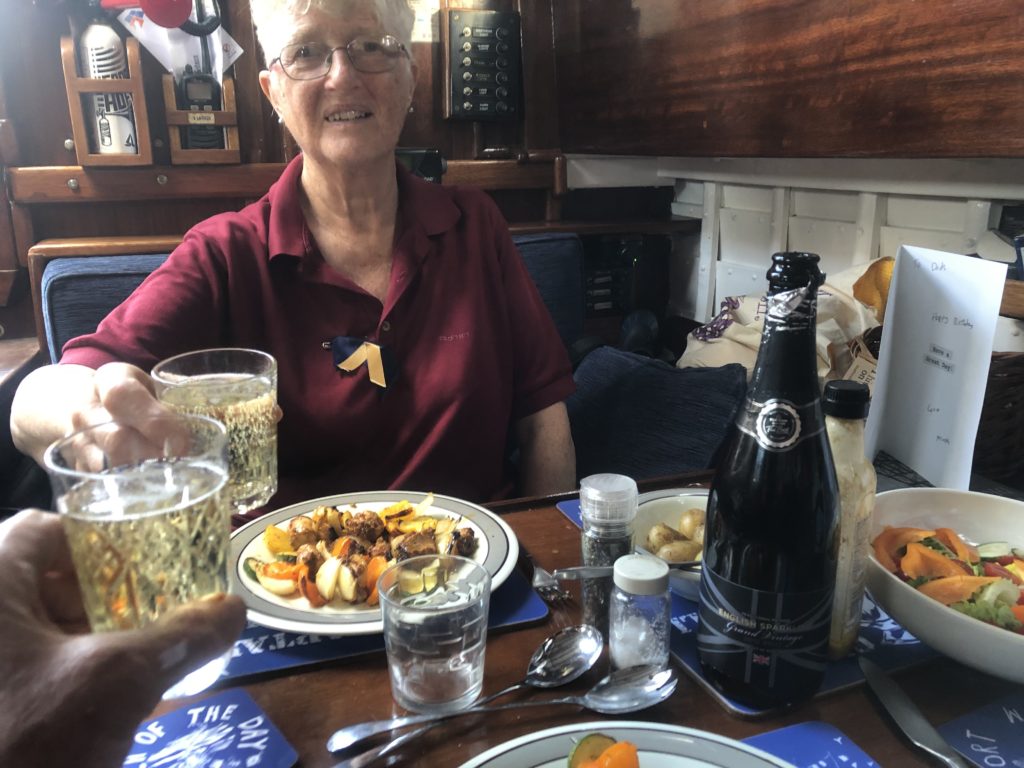
Cooking on the majority of yachts is done with gas – a Whimbrel meal.
I followed this up with a little research. It would seem that the problem actually surfaced at least a year beforehand. There are numerous entries on caravan and boating forums about the problem running back to prior to the covid pandemic.
As an aside, I was astonished to read that one person decanted gas from a larger to smaller 4.5/3.9 kg bottle. I am sure it is possible, but safely…
A 4.5 kg cylinder of butane in an empties rack… Picture: Theresa Ardley
Last autumn I wrote to a ‘cooing’ editor of the Royal Yachting Association magazine congratulating the British Olympic team in all their medal glory. Yes, I am sure all sailors are pleased.
But what about the ‘humble’ sailor doing what our Government advise – have a staycation. That for sailors and caravaners, including campers, means the use of bottle gas for cooking…
Section from the June issue of RYA Magazine.
Nothing appeared in following magazines … I wrote to the membership section asking them the same question.
Neither elicited a response, which when you read the excerpt from the June issue of the RYA magazine is, quite frankly, a load of rubbish.
The saga continues – Calor have apparently stopped blaming Covid, drivers and Brexit and now accept they haven’t sufficient bottles. Apparently, 100, 000 have been ordered.
The problem is many people are ‘sitting’ on empties or no longer used cylinders in garages and sheds…
Swale Marina and a yard shop in Maldon have none of the smaller cylinders. Garden centres and other outlets report dire shortage.
As would have it, on leaving the office at Swale marina during the past two weeks my eyes alighted on the latest issue of ‘All At Sea’ so I picked up a copy.
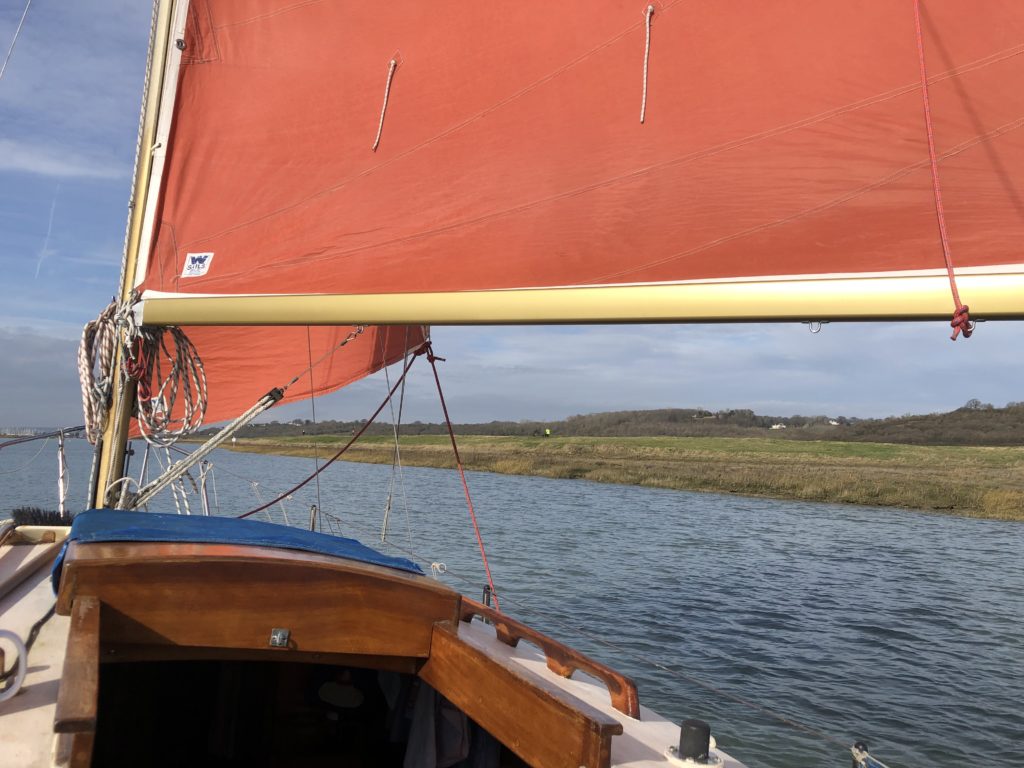
Sailing out of Conyer Creek after a very pleasant stay.
The All at Sea paper trumpeted the forthcoming season with total silence on an issue that is vexing the minds of many boaters – paucity of bottled gas.
I emailed the editor, Jane Hyde. Within a few hours she responded. Upon checking with a certain Simon Everett, it transpires he has had the same problem. This chap has been tasked with investigating. A copy will come my way before publication. I await with interest.
Now, that is what the RYA should have done.
Sitting in Whimbrel’s cockpit watching the world go by whilst reading … I mused upon all of this. Surely, I am not the ONLY person to have raised the problem with people who should and can use influence and pressure.
I canvassed my Facebook ‘friends’ with the problem. Those that chose to respond, all agreed, essentially, that they find it hard to understand what exactly the RYA actually does for its members – cruising members that is.
Yes, they lobby Government on some important issues, but they have completely lost sight of the ‘humble’ sailor…
What am I going to do. Well, cancel my membership for one, then pay that same amount to a charity that actually works positively.
Update: All at Sea have investigated and found that what I have said is correct. One of the paper’s staff has experienced problems – part time delivery skipper.
All at Sea are responding in forthcoming issue – hopefully July/August issue.
We have cancelled our future direct debit to RYA and emailed our (my) termination of membership.
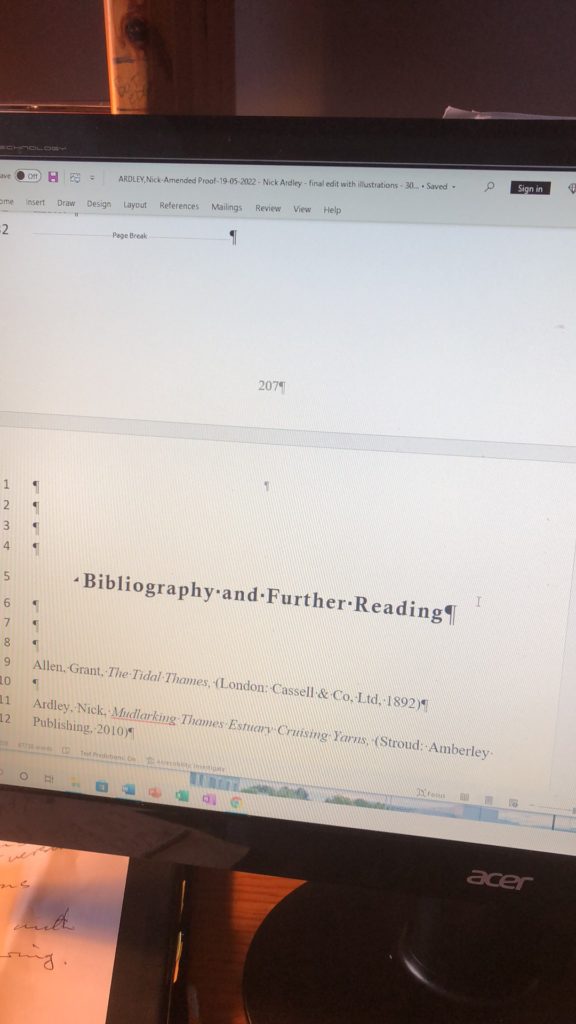
As promised for those who are interested in such affairs, I have been over the last week dealing with the final edit and insertion of illustrations and captions for the my editor to do their bit.
There is a little tale here: I quipped to the mate that I expected the job to appear in my inbox while we were doing the antifouling and hull touch-ups on Whimbrel.
Christobel getting down to one of her favourite jobs…
Well, we got on with the antifouling on a Friday evening a week and a half ago now. The job was all completed on the Saturday, including various ‘scuff’ marks being sanded and repainted – most due to damage caused by the modern ‘hard’ mooring buoys now almost universal around the east coast rivers. In the evening Whimbrel was returned to her mooring.
Well … checking my spam mail box on the desk computer on Wednesday following our boat work, with my finger hovering on the delete button, I suddenly noticed one from ‘AM Production’ – heck, my publisher.
Transferred safely and opened I found a request for my final edit. It arrived the day we started work on Whimbrel’s bottom!
So, I had to set to and get on with it. I had a week before we were due to sail off to the River Medway to participate in the Queen’s Jubilee Pageant on the river.
Christobel’s handiwork around the decks… This was before I found that ‘file’!
My current publisher was content for me to set the illustrations into the text, so once I got set up, it was just a matter of copy & paste.
The ‘book’ will later go through a pagination process where it is pushed into the published size, spacings and layout etc.
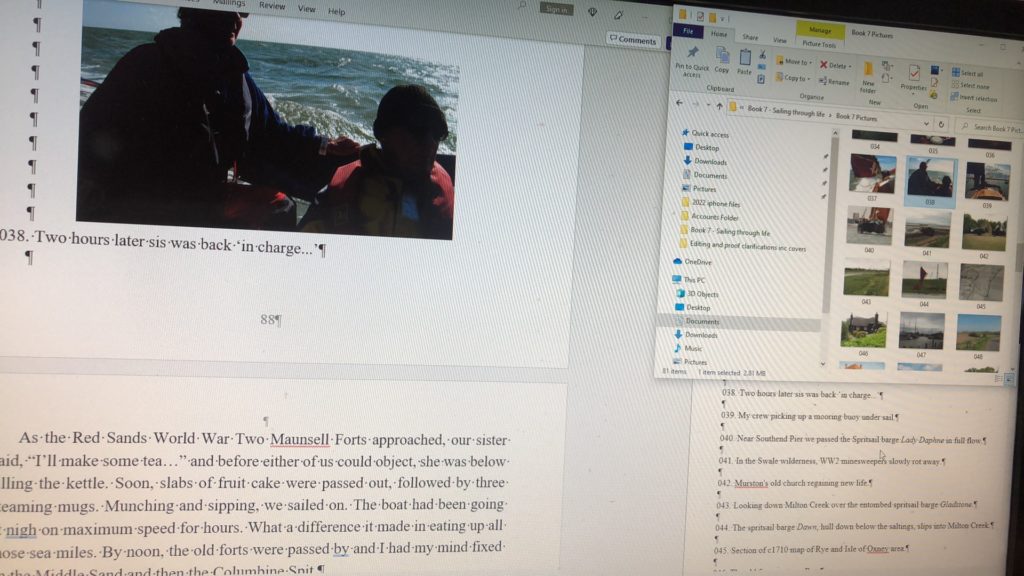
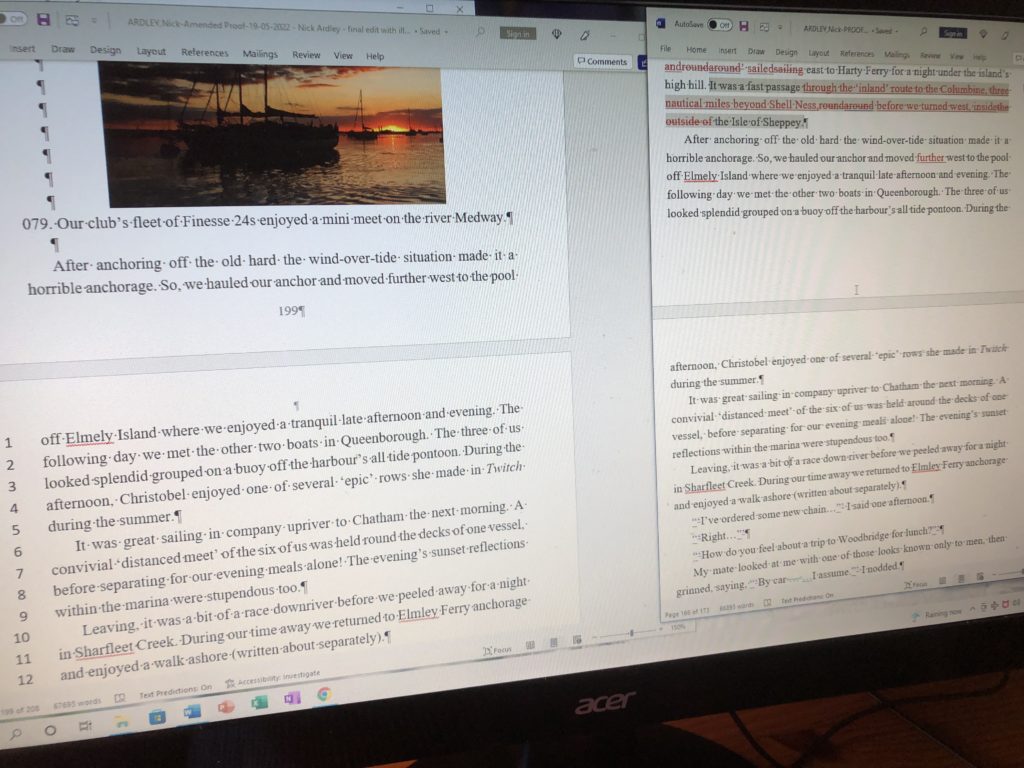
‘Planting’ illustrations and inserting captions.
Editing in hand.
Editing… The ‘red’ bits were my previous corrections
I had a break in the middle and overhauled Whimbrel’s two sheet winches. They were opened up, cleaned of old grease and crud. Pawls were checked and deburred. All was regreased and reassembled , then back to editing…
Finally, I came to the end!
The end!
A break was taken to clear the head and ‘sit’ on what I had done.
While the head cleared I had a couple of hours down the club preparing and antifouling the bottom of Twitch, the tender.
After dealing with Twitch, I again ran all the way through the text looking at my corrections. Around a half dozen other ‘mistakes’ were found too – some inflicted by others!
A busy couple of weeks for sure. Hey, but, you all say, you love it…
All my work has now been ‘put to bed’ and will go off to the publisher…
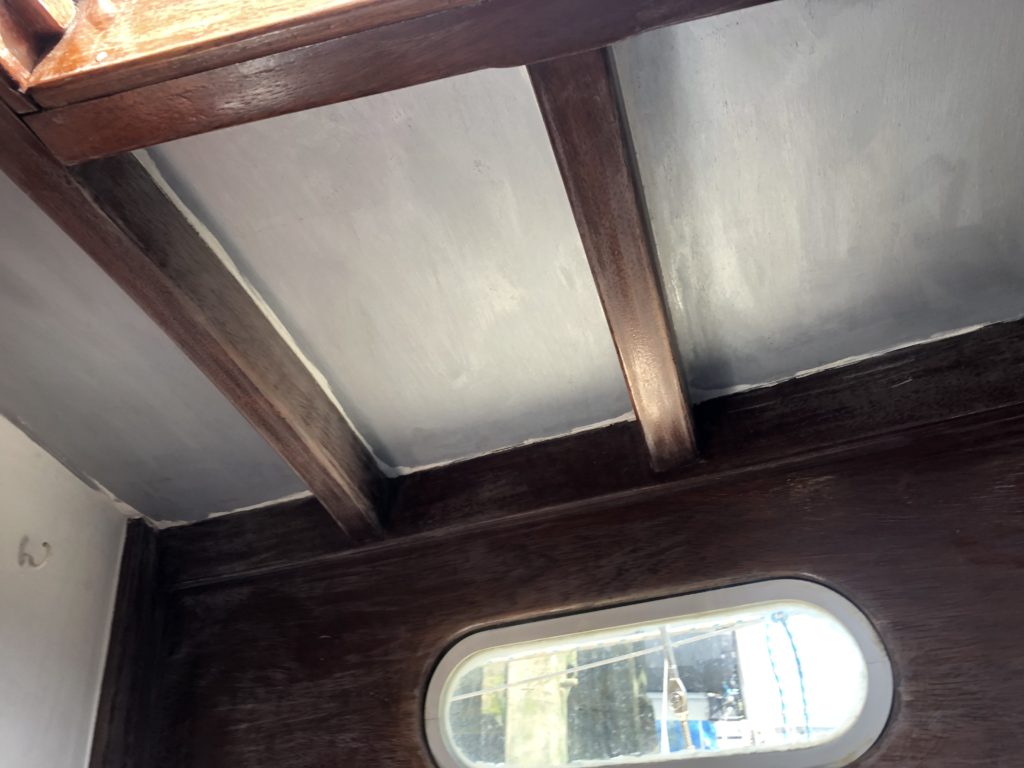
The paint coatings on the underside of the fore cabin top and fore deck had ‘crazed’ over a large area. It looked as if it was deep penetrated to the wood (ply) surface. It needed attention.
So, after moving to a club berth where we had a power supply, we set to work.
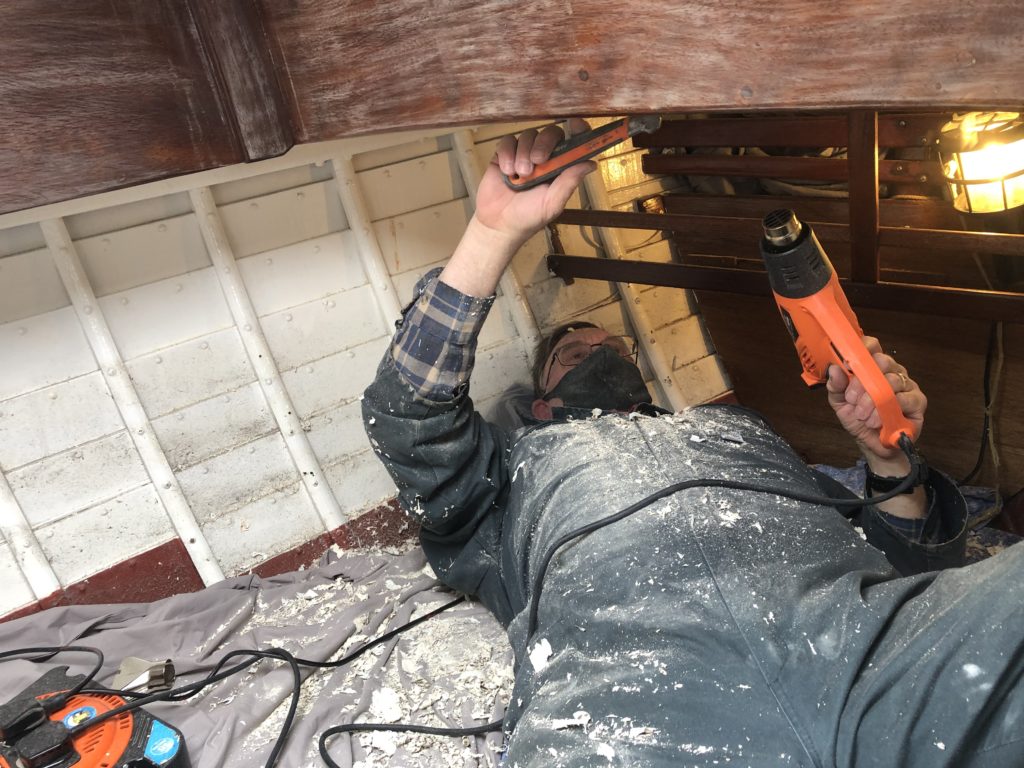
Stripping begins…
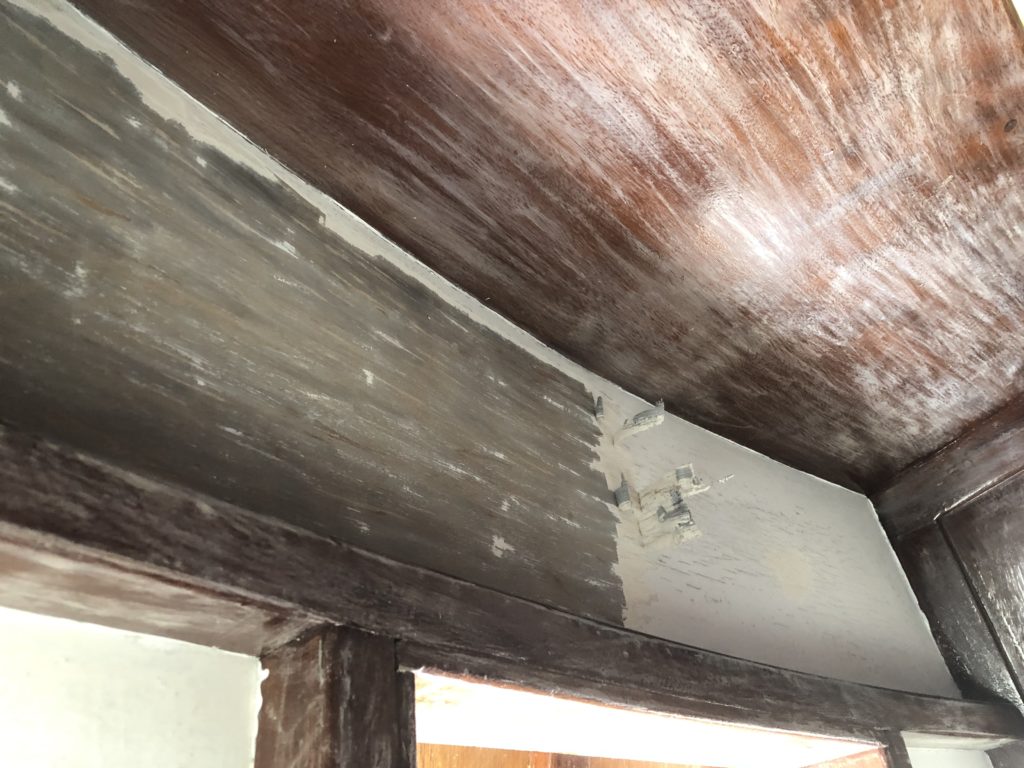
A large area on the underside of the fore deck was stripped back to bare wood first. During this operation, I noticed that the original coatings from when the boat was built 39 years ago were seemingly sound.
This was also found on the underside of the cabin top, however, stripping back continued. The original pink primer (long out of manufacture) was still well adhered.
Under foredeck done, onto underside of cabin top… Note the ‘pinkiness’ of the wood surface from original coats of primer.
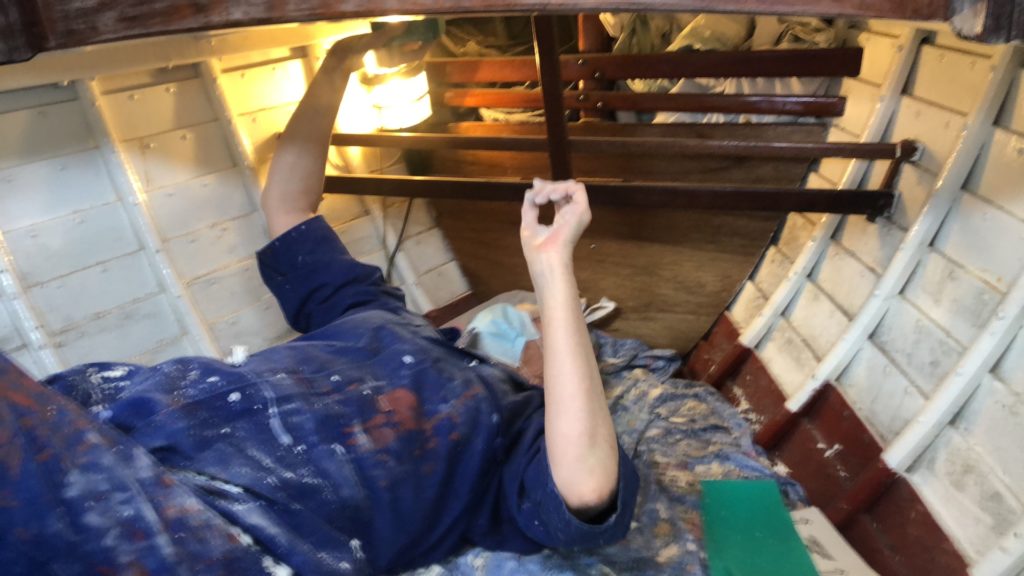
As I moved aft with the hot air gun and scraper, Christobel inserted herself under the fore deck with 80 grade and 120 grade sanding paper…
She’s a grand boat mate!
Later, all was hit with 180 grade.
Meanwhile, the mate wields her sanding hands…
The mess was horrendous, however, the old sheets spread around collected most of the falling debris. Paint chippings and dust still managed to penetrate far beyond!
I had toyed with applying a 2-part epoxy type base coat but reverted to ‘old fashioned’ practice with two coats of metallic primer, the first thinned a little for penetration.
Strangely, neither International or Hempels (Blakes) now do such primers, relying on a one pot primer/undercoat product. I don’t like this!
Application of primer…
Having applied the base coats, the job was left a couple of days … fitting in a walk in glorious countryside west of Maldon.
A day off walking around Woodham Walter, near Maldon.
Back on the job, mainly me, alone, as coat after coat was applied, three coats of International OneUp was used – the trade name of their latest reincarnation of the one pot does all – before applying the first coat of gloss.
A light sand with a fine sanding paper was carried out between coats. Ater the first gloss was applied, the varnish work was checked for paint ‘splashes’ sanded again where required, cleaned and coated.
For the varnishing, I used a mix of Hempels Favourite and their matt internal finish. The matt is far too matt! The mix I have worked up to is 5/8 gloss to 3/8 matt. It seems to work…
Both are alkyd products and seemed to mix together.
First coat of gloss is on and varnishing in hand…
In the middle of this job, I also hard sanded the starboard shear strake, touched up bare areas and finally complete coated. Mud walking boards were used for this!
A job is now saved from the list when we go onto the club’s hard soon to scrub and antifoul – another of my mate’s favourite activities…
Varnishing the port side shear strake some weeks earlier…
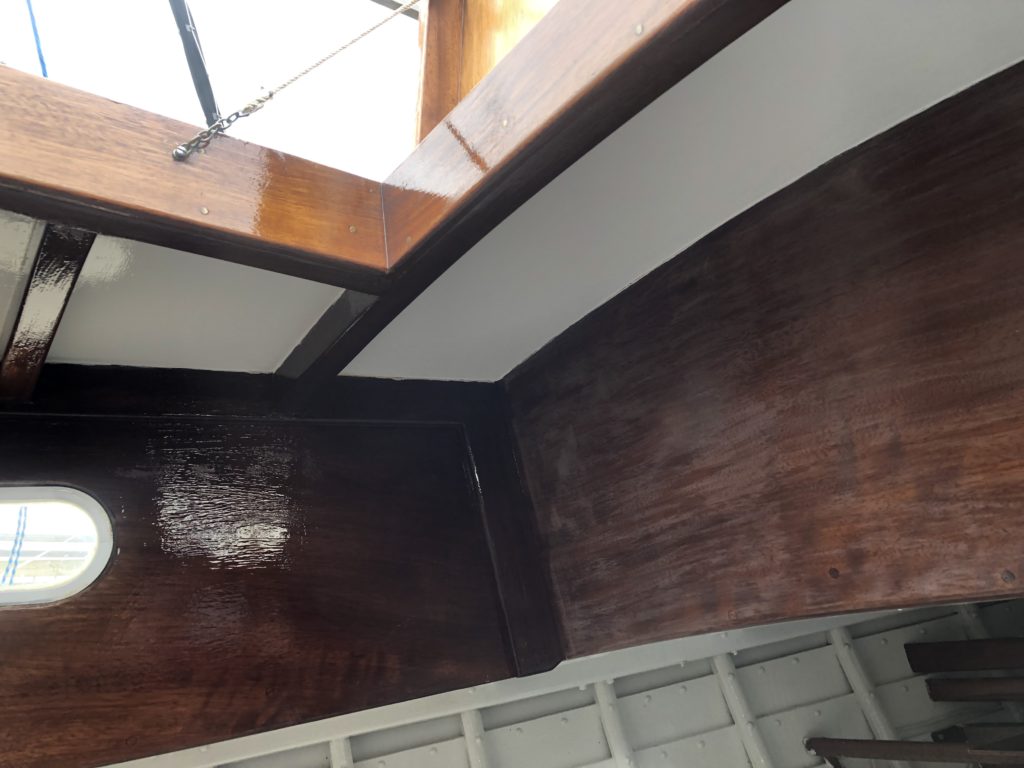
Finally, after what seemed n age, yet a little over a week, the job was completed.
Gloss and varnish completed…
The boat was then thoroughly cleaned out and washed by Christobel. It was done in two stages – I kept out of the way on a club work party for the final part in the main cabin!
I have to say, I spent a couple of hours the previous day clearing the way…
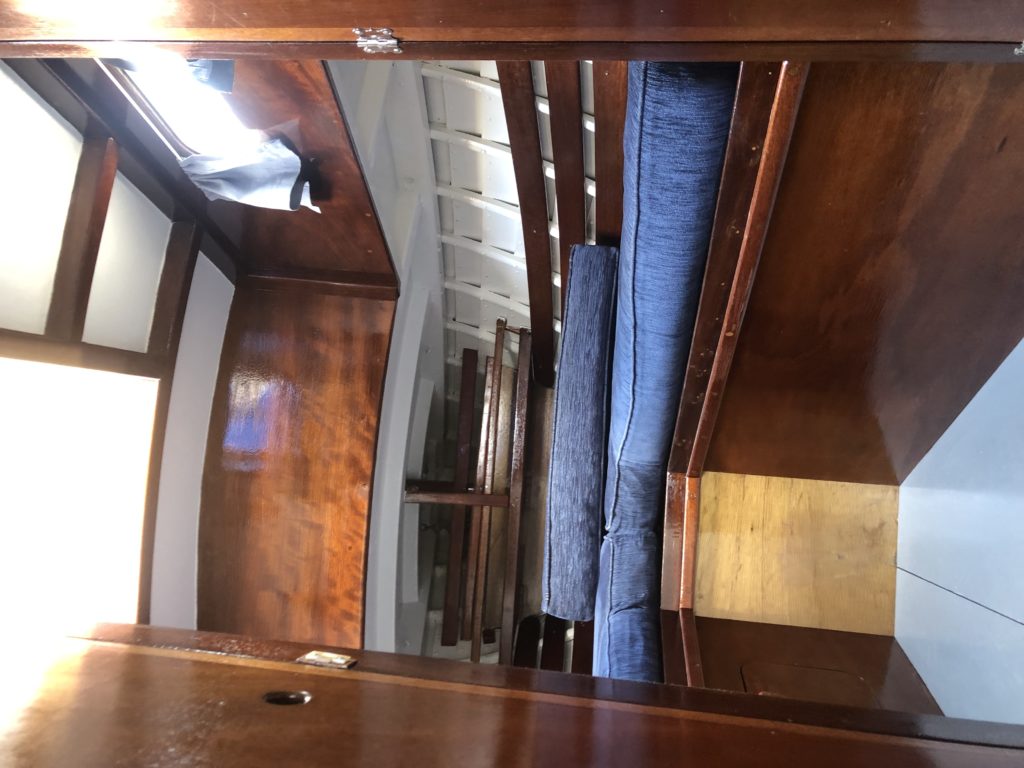
Normality restored to the fore cabin!
While cleaning the deck head in the loo compartment, the mate discovered some loose paint – well it came away during her cleaning ‘binge’…
Ah well, so another area awaits.
It is relatively small, but the mate said, ‘…if you make a mess, you can clear it up…’
Thankfully, the time expended upon my next book has petered away to virtually nothing of late. The final edit has taken place and it has been in the publisher’s hands for a little while.
A few days ago I received an communication telling me that they will be in position to send the edited copy to me for my insertion of illustrations and captions. After which it goes back for a final edit and then pagination – laying out into published form.
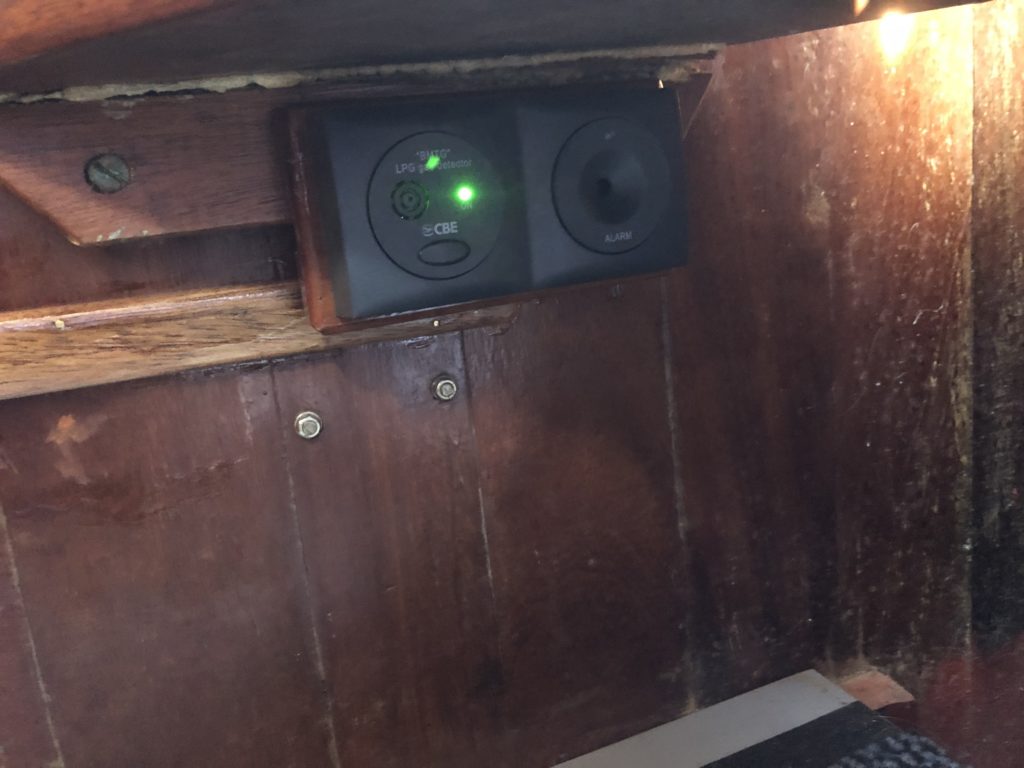
New gas alarm fitted in mean time…
I have never done the illustrations in this manner. Usually the publisher has a numbering system, i.e., 001 – 080.
As the edited manuscript is a word document, the editor will have to remove and reinsert full byte images as per my instructions. Word documents reduce quality of photographs…
Clearly it is important to ensure that an illustration has a correct corresponding caption number. It is all too easy to make a ‘cockup’ that’s for sure!
In the meantime, we got away for a proper Bank Holiday weekend, but more of that in another post.
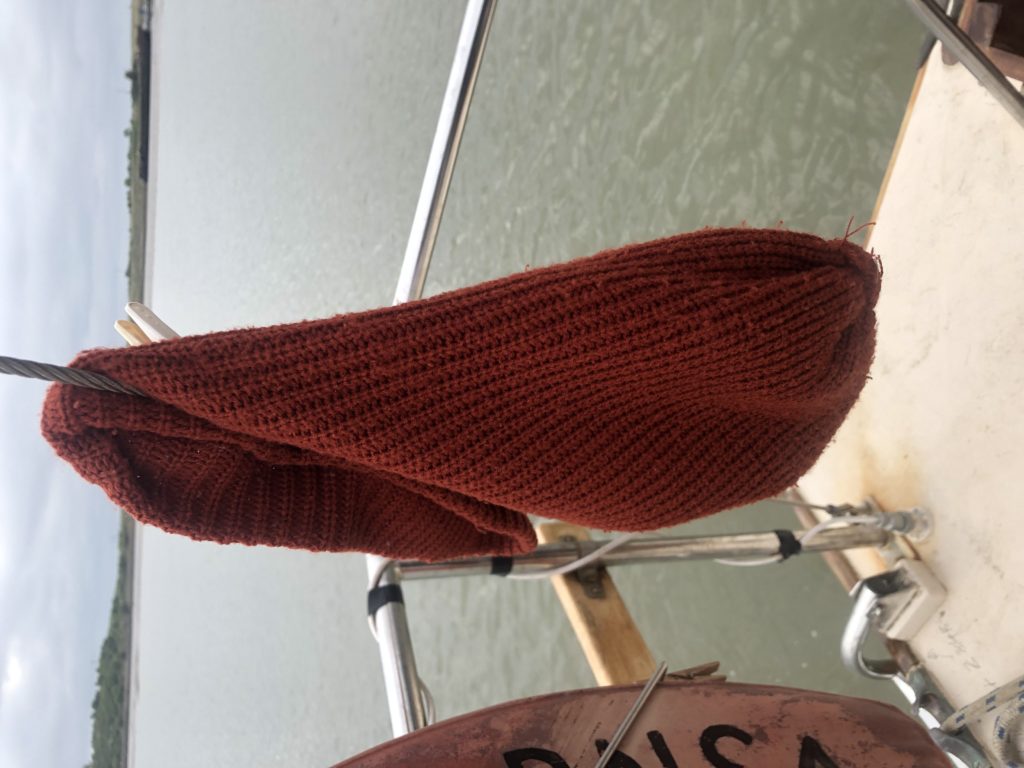
There was a spot of fun in that the mate’s hat went overboard. It was rescued safely and rinsed out. It took two days of the weekend to dry!
The mate’s hat…
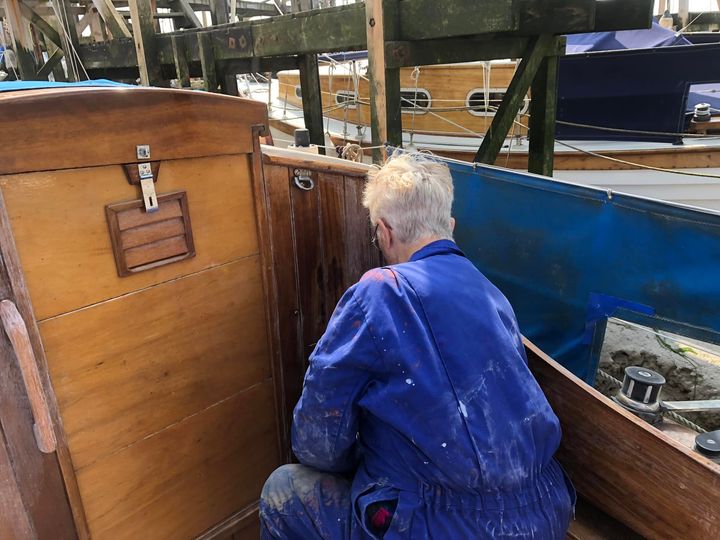
After the bank holiday weekend, Whimbrel was moved up the creek to a temporary berth for us to do a large job in the fore cabin…
Whimbrel in a temporary berth for a job…
So, I hope to have news soon of the books next stage. My guess is that it’ll fly onto my desk in a couple of weeks when we’re doing the antifouling…
All of a sudden April drew nigh and I knew time for maintenance to Whimbrel would be calling loudly.
It is not often that the month of April swings by with so little rain: we can’t actually remember the last time we experienced rain, even the ‘famous’ April showers have been absent.
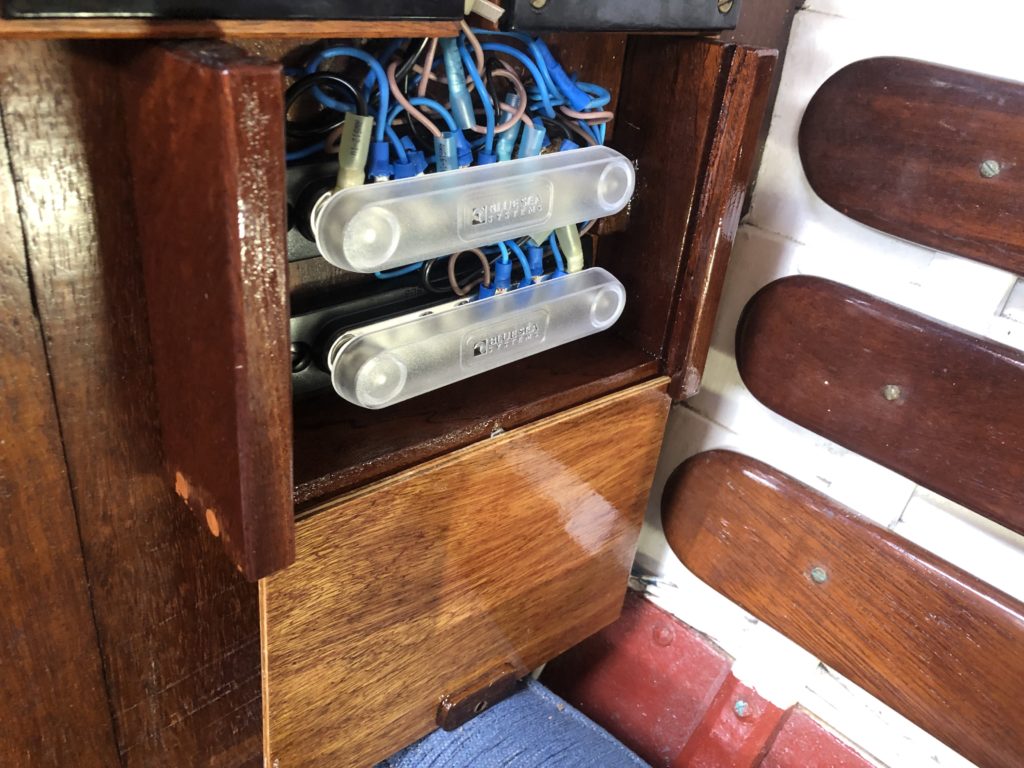
During March I carried out a job long overdue. Since the boat was built all the negative connections were on an ever growing terminal strip accessed under a cockpit locker seat.
Whimbrel’s electrical system negative terminals on dedicated busbars.
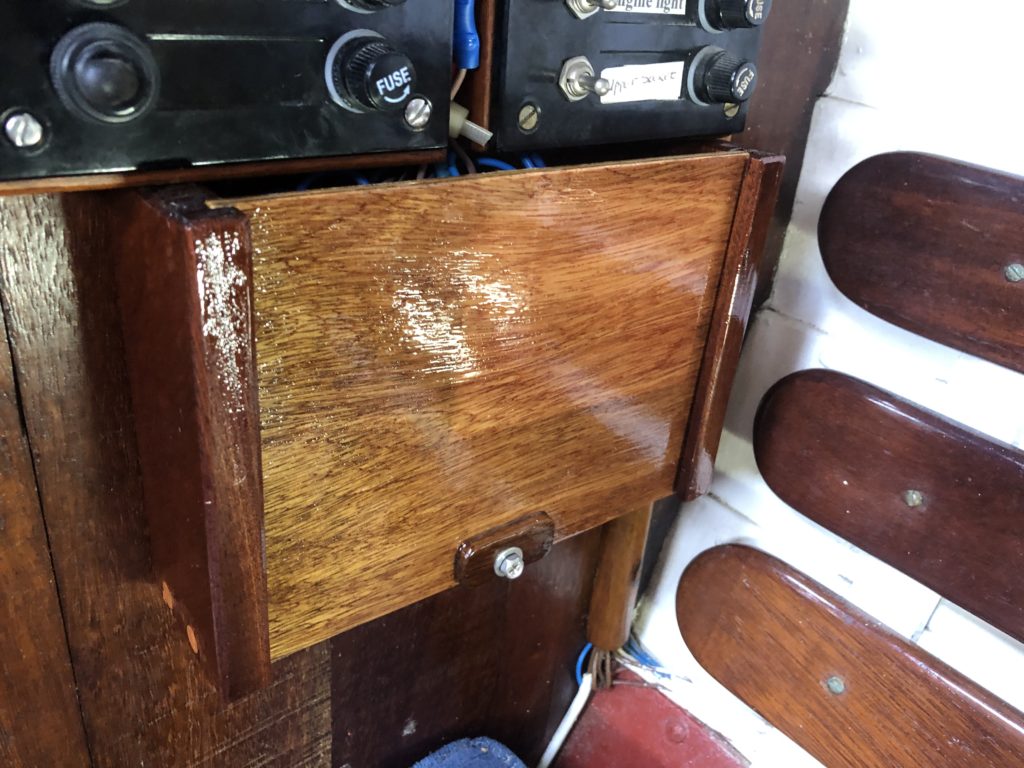
I obtained two busbars and transferred all wires to these over the course of a couple of days. Some wires had to be lengthened to make the run in. Having completed that job, I manufactured a boxing with a sliding cover for access – all completed as April dawned.
The completed job!
Back in February, we had popped over to Faversham to pick up our serviced sails, new dodgers and cockpit cover from Wilkinson’s Sails. I had pre booked a Valentines night away at a rather nice place we know locally too so we had a great time!
The boat’s old sails had been in use since October and it was about time the change back was made: we had plans to sail up to Limehouse for Easter, taking in the Passion Play at Trafalgar Square.
The ‘new’ mainsail back on. The other boat is the Finesse 24, Gypsy, who’s owner also fitted his sails ready for the season.
In the event, returning from the west country (Dartmouth) where we had enjoyed a holiday, we both went down with Covid-19. The mate’s ‘plague’ hung around and it took nearly two weeks to clear to a negative position so we abandoned going up the Thames and had a couple of nights away on the Medway.
Sanding winter damaged varnish work around sheer strake.
In the meantime, various areas of varnish were attacked. The winter’s damage wasn’t great so once sanded back these areas had coat after coat applied. I apply at least eight coats to bare wood…
Varnishing the port sheer strake.
Maintenance took a break over Easter Week when we got away – well not quite: time was used to build coats on those numerous areas.
Whimbrel sailing through Queenborough Harbour on her own!Whimbrel captured by Queenborough Harbour waterman, Harry Coughlan.
With the forecast, we had intended on sailing round the back of the Swale for a tranquil night in the South Deep, however, upon reaching Kingsferry Bridge and initially being told a lift time, the operator came back and said that due to traffic congestion we couldn’t go through. No update on when was available – apparently there had been an accident…
We cancelled our request and sailed round to Stangate Creek instead.
The mate enjoying a late afternoon row…An enchanting sunset…
It was an enchanting evening anchored along the west of Stangate along Greenborough Marsh. A huge flock of godwits with their russet fronts fed as the tide left the mud banks. A couple of avocet were spotted too.
The next day we poked right up into the entrance to Lower Halstow Dock with a fickle breeze before sailing to Queenborough for the evening. Of course, a pickled egg or two with a couple of pints just had to be enjoyed ashore at the Admiral’s Arm…
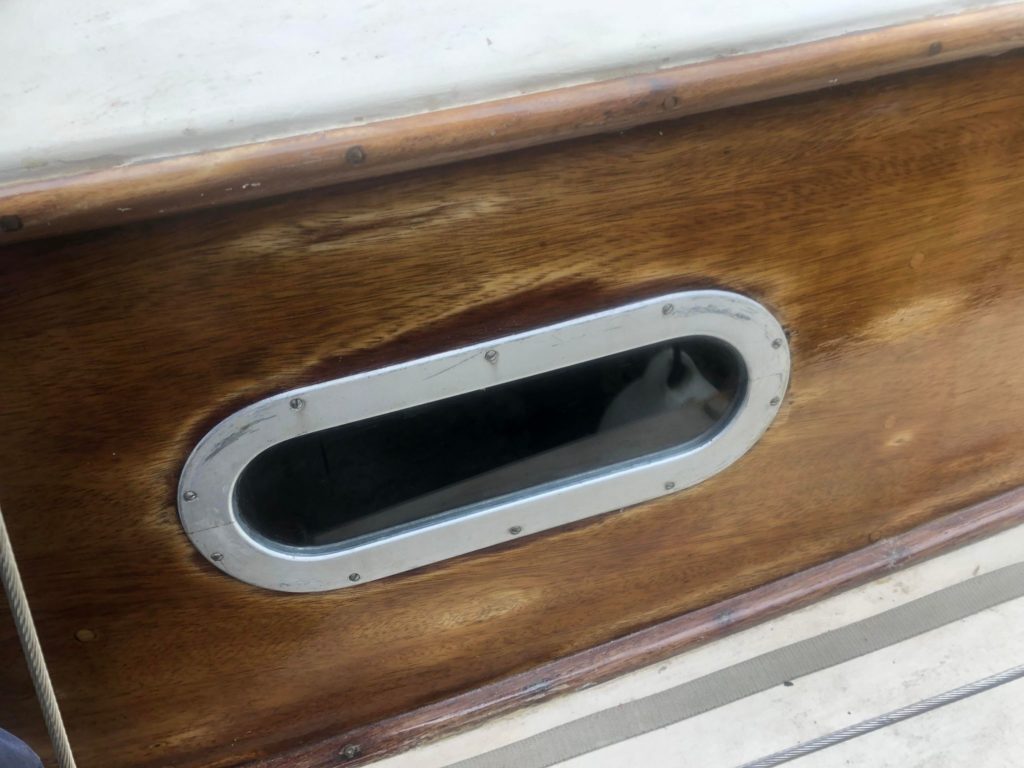
The window refitted and completing the job.
Returning to our home mooring, I soon had a window off for resealing and stripping back of varnish coating where it had broken down around the frame.
It was cockpit varnishing time this year too…
We attacked this after a morning on the club’s work party which was a mistake for post covid we both have lacked energy!
It got done…
Sanding the cockpit varnish work.
While Christobel cleaned up the mess and wiped the sanded area down, I added another coat around ‘my’ window – then she took a rest while I varnished round: working area is limited and the mate does not like applying varnish…
All bright and shiny.
With the grand conditions, I went overboard onto walking boards to strip back the bottom of the transom where the varnish had broken down. When doing this I’d decided to raise the boot top to keep the varnish out of the water. A few coats of primer were applied and a couple of hard boot top. It’ll get another when we antifoul in a few weeks time.
The varnished transom and rudder. The boot top was raised around 100 mm.
And so, the generally showery month of April draws to a close, with continued dry spring-like weather.
The May Bank Holiday weekend looms and we plan to be out there enjoying another bout of early season sailing in what looks currently like benign conditions. It wontr be ‘hot’ but pleasant…
Knowing we were going to be in South Devon over our Forty-fourth wedding anniversary on a ‘no boats’ holiday, I kept a little something up my sleeve…
Although we did travel across the pretty harbour on a ferry – for a trip on the Dart Valley Steam Railway, I saved it until last.
On the day planned for a scenic trip up the Dart Valley to Totnes with winding narrow lanes set deep into the land, I said, as we twisted past the head of Mill Creek, ‘We’re just popping along here…’ pointing to my right.
After the expected question, I added, ‘… the Snark is here…’ I saw a ‘look’ in the corner of my eye as I navigated another sharp bend.
We parked up in the yard alongside the creek with steep sided wooded slopes towering over us. Saying I wouldn’t be long, ‘Have fun, Snark Hunter..’ drifted from the closing door. I was met by the yard owner who had clearly witnessed our arrival.
As soon as I mentioned my quest, he grinned and took me to meet the owner, Paul Jenkins. I was welcomed aboard by Paul, but his partner wasn’t aboard at the time.
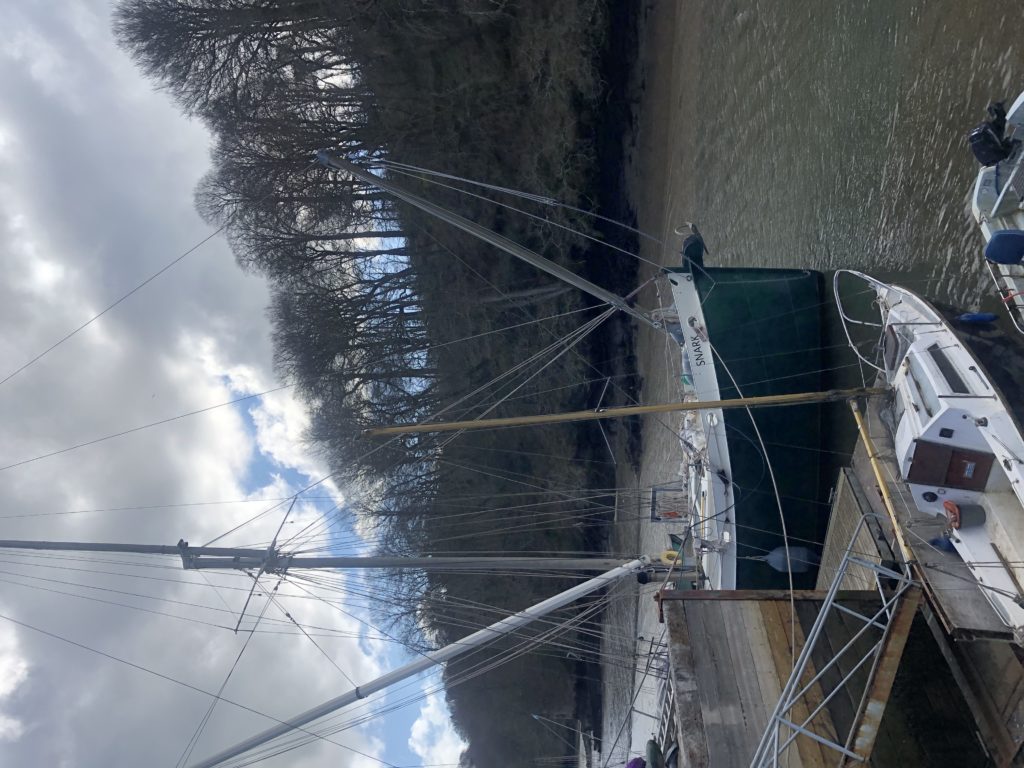
The Snark… Looks like a traditional sprittie. Her anchor is housed in a ‘snout’…
I first met Paul at the yard in Chatham where the Snark had originally been constructed from modules. The barge had originally been built at Walton-on-the-Naze some years ago. She ultimately was used for the barge on the beach for the film ‘Intonement’ from the book by Ian McEwan, of same name. The hull units were purchased by Paul who had them transported to Chatham where the hull was reconstructed with much rewelding. She was shortened too.
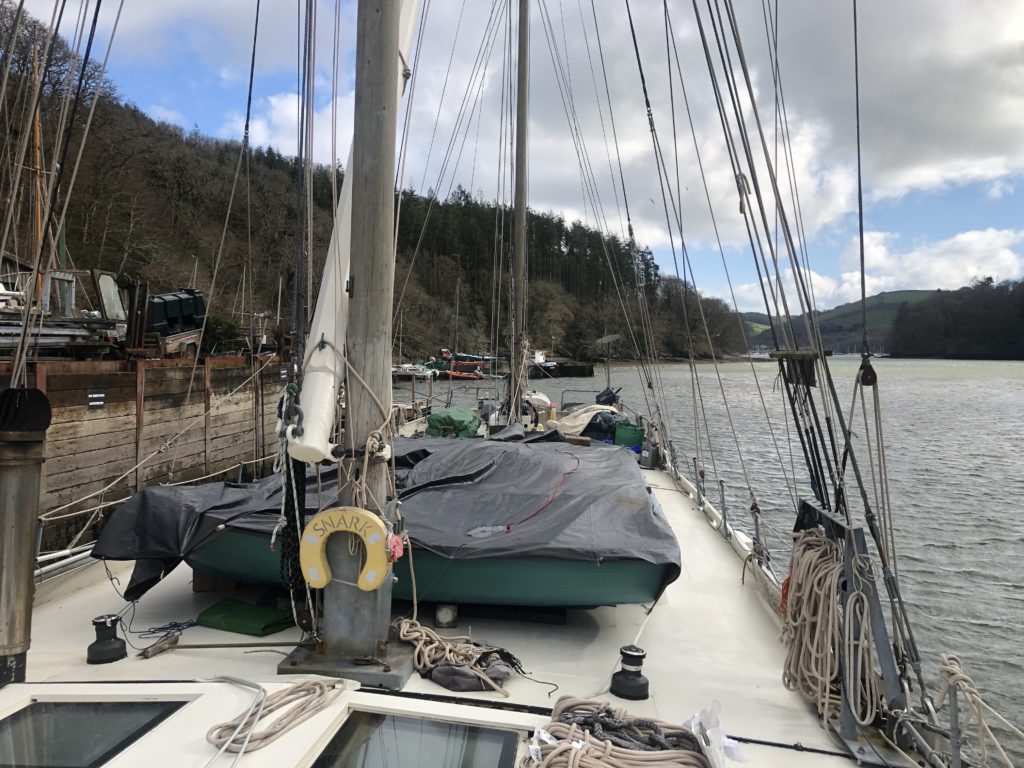
The Snark is an almost full sized spritsail barge, but is in fact a barge yacht and fits into the yacht category at maximum length of just under 24 metres. So, unlike a traditional Thames barge, she can go anywhere with the limitations of maximum of twelve passengers…
The Snark’s owners have plans this summer for a circumnavigation of Great Britain with a visit to Belfast in Northern Island. I picked up on this some time ago after seeing a post on a Barge blog site.
Berths are still available for most legs of the passage.
Looking down the main hull. Barge devotee’s will spot a number of differences.
It struck me that Paul’s Medway & Thames passage mirrors the passage in my book, Rochester to Richmond A Thames Estuary Sailor’s View. Changes to the river scenes are vividly described…
Additional cabins were under construction when I went below. My understanding is that these are two berth units allowing couples privacy and own space.
An uncluttered foredeck. No huge windlass. Note the ‘small’ yacht type anchor winch.
Back aft, the barge yacht has made use of the chaffcutter wheel and steering mechanism found on her ex-trading sisters. The barge has a large mullie mizzen with a slightly smaller main being fitted.
Snark has retained her traditional chaffcutter wheel and steering arrangements.
Interestingly, the mast, although in a traditional looking mast case is not lowered by the usual means. It would either have to be lifted out or lowered using a crane, Paul told me. Apparently a new mast is being fitted in 2023.
Paul heading for the warmth of down below…
Looking at the itinerary for the Snark’s summer cruise round Britain and Northern Ireland, I was greatly interested in the plans to sail through the Swale and through the lifting bridge on passage to Chatham. The date for the Swale passage looks likely to be Tuesday 14th June.
After that the Snark is due to reach Gravesend on the day before the Thames Barge Match which is on Saturday 18th June. From Gravesend she goes up to London for a change of guests at Limehouse.
After leaving Limehouse, she is due to be off Southend with plans to go through the inside passage at Havengore, enroute northwards…
‘Are you planning to race with your sisters…’ I cheekily asked Paul.
Paul told me that they wouldn’t be allowed – professional skipper and mainsheet man required – so his plans are to follow.
Spritsail barges setting off from Gravesend for start of 2018 Thames Match.
I suggested he should turn before the barges begin coming home to be in a position to witness the end.
We both agreed that it would be interesting to see how the Snark performed against her older sisters. I added that a visit to the Sea Change Sailing Trust’s Blue Mermaid should be of interest and a chat to Richard Titchener…
The line has been passed by the mighty engineless Cambria. Then, shortening sail, she sails ‘onto’ her mooring buoy.
I reminded Paul of what I wrote in my book, The May Flower A Barging Childhood: Put simply – ultimately, the future of the vessel type will mean building new for it is surely the rig and how it is operated which is of greater importance than maintaining very old vessels. The Sea Change Sailing Trust has since built the Blue Mermaid. The river barge Defiance has also been built (shortened to fit the 24 m rule).
Against the above, ‘millions’ from both private and charitable means (lottery largely) has been spent rebuilding wooden vessels … most of which rely on charities to sustain them.
I’m not saying it is wrong to preserve an original, but…
The day after, the lovely Marjorie ‘following’ Whimbrel across the Grain Flats in a little over a metre of water!
Last week, a milestone was reached a couple of days after getting away for a magical night afloat with my youngest sibling.
Reaching into the Ray under double reefed main and working jib, homebound…
The mate and I were out walking – a bit of a hike actually – on an urban yomp to Westcliff and back to home. Sitting over a coffee along the route I opened my emails on the iphone. There, sitting in the inbox was a communication from my publisher.
A view over the boat-busy end of Leigh-on-Sea.
The gist of it was – please read the edited copy of the manuscript, ‘your book’, make any necessary changes and any last alterations/additions, and return to publisher within twenty-one days…
For over a third of my allotted time allowance we were going to be on a holiday over our wedding anniversary. So, nothing for it but to get cracking.
The email sounded ‘complicated’ with instructions on what to do…
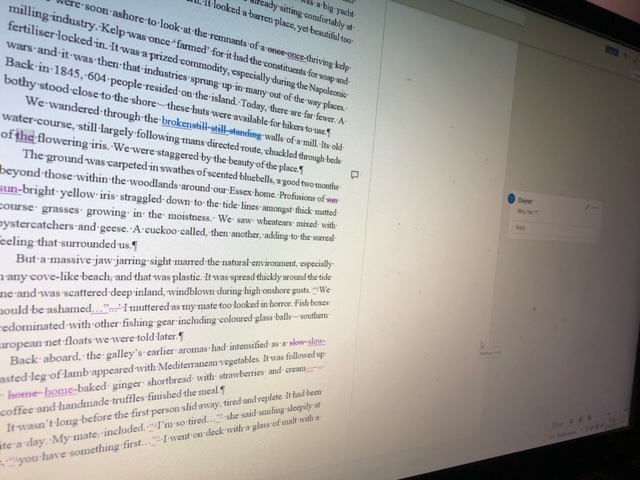
The file when I opened it was almost self explanatory. It used a track changes function. There appeared to be two lots of editing – proof reading and ‘errors’ but I was soon to find editor made errors too! The system used made it very easy to see what had been altered.
The proof and editing were in different colours. Editor questions were in another with an box on the side.
Any change I made was also in a different colour…
Small extract showing editing. Mine is the blue and the shaded and purple are the editor’s… Note: box to right hand side.
My part of the process is all but complete with a final check to be made. Then it’ll wing its way back to the editorial desk.
Another milestone was completed during this process too. The design for the front and back covers has been completed.
I cannot display this for obvious reasons!
Currently, I do not have a programme of event dates, but that time is drawing ever closer with the milestones so far reached.
Eventually there will be a little publicity video!
The Island Yacht Club was blessed indeed with the long and fruitful membership of Jack Fenwick.
Sadly, last summer, Jack died after a short illness. I only found out because I said to another member, ‘I haven’t seen Old Jack lately…’
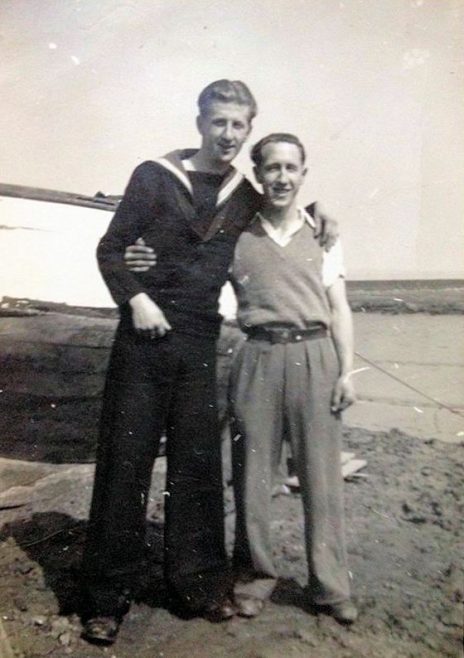
Jack Fenwick (right) with an old pal at the Island Yacht Club c1948 – courtesy of Jane Parkin, Canveyisland.org
Jack was around the water all his life. In later years he spent many years delivering yachts and he sailed when well into his old age around Britain – well nearly: after repeated attempts to weather the top of Scotland, he and his wife Shirley traversed the Caledonian Canal.
Jack sailed his boat as often as wind and tide allowed. His last trip wasn’t long before an illness prevented him and which quickly caused his death.
I got to know Jack many years ago. It wasn’t until my own early retirement from sea that I really had the time to stand and natter.
Jack asked me to sign a copy of my ‘May Flower’ book: he remembered the barge on the Leigh and Chalkwell foreshore on summer visits during late 1950s through to around 1965.
Before that I had taken over the care of a set of drum creek buoys marking the port hand side of the entrance channel. This came about after I had come up with a plan, later implemented, for the club to have red and green pier lights at the beginning of the moorings, using new technology in the form of solar powered lights.
I met Jack on the club walkways, he had muddy boots on and was carrying a spade. I asked Jack what he’d been doing … he explained what and I said, ‘you shouldn’t be doing that…’ I asked what was needed. The upshot was, I became the ‘buoy man.’ Jack was always on hand for any advice needed.
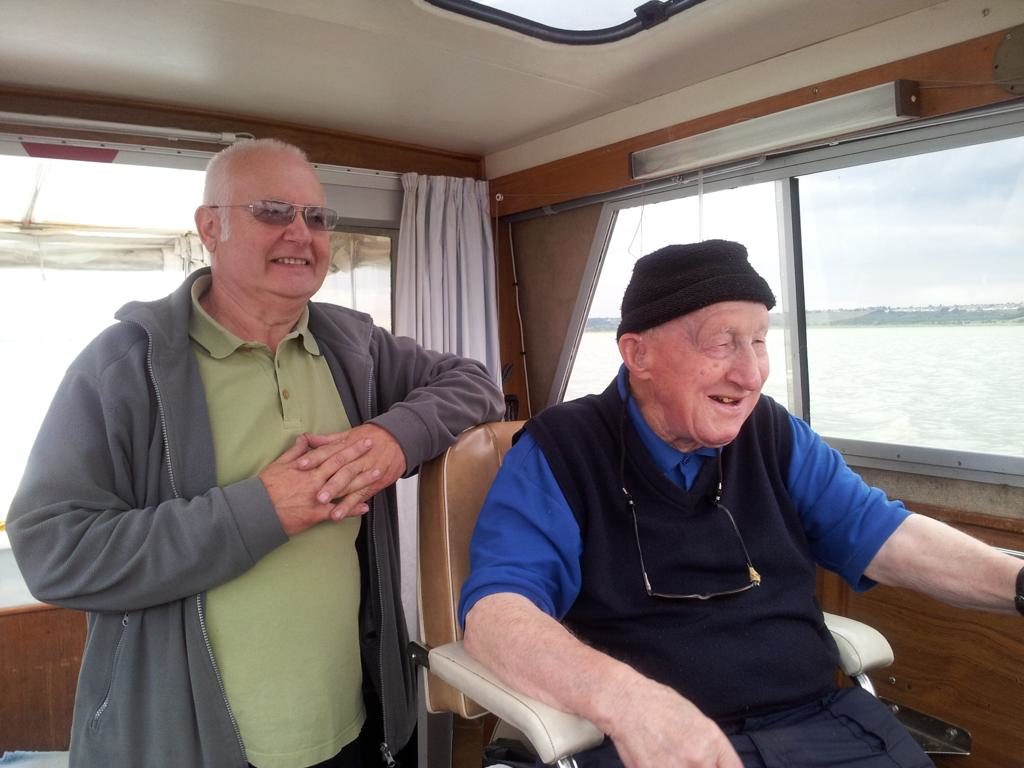
Jack aboard the motor-yacht owned by his friend Peter, a club member. Jack skippered down south and into the European waterways with the owner. Peter’s picture.
As a lad, Jack, with a few mates, used to go aboard loaded barges and help ‘poke them up’ the creek when coming in with a cargo for Canvey Supply (The wharf lay just below the old club at its West Creek base).
Ah, Jack could yarn…
One of his long self-promised wishes was to come out across the swatch out of Havengore. Well, one summer, some moons back, Jack, with a band of sailing friends made an early morning departure from the club, sailing and motoring down the Swin to the Outer Crouch. The tide helped them up and into the R. Roach and thence to the Havengore Bridge, passing through a little before high water. I believe the return to base was made via Queenborough the next morning.
Jack was delighted! It was simple sailing…
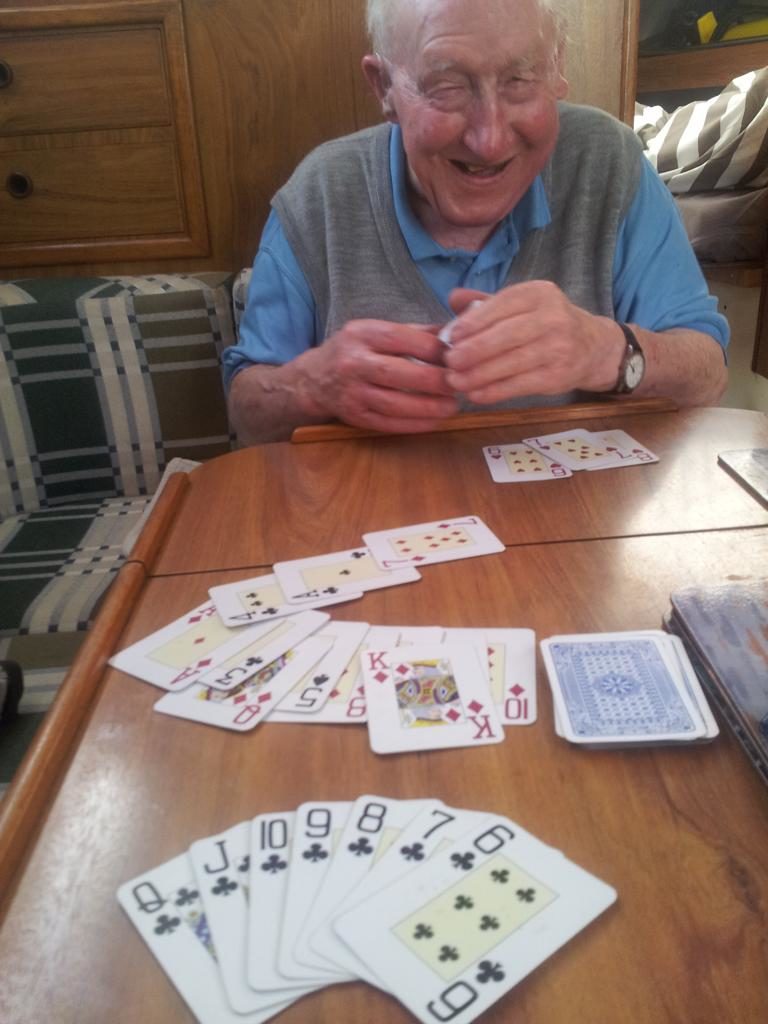
Jack enjoyed a game of cards and a pack always went afloat with him. Aboard his friend Peter’s Princess motor-yacht. Peter’s picture.
Jack was a gentleman. One of the best. A jolly good person who cared.
I could go on…
The only memorial I have found is on the Canvey Island community archive (Canveyisland.org), I found this very sad indeed…
There is a short message penned by Valerie Deane, a longstanding member of the Island Yacht Club, an excellent secretary in the past and subsequently, a competent commodore of the club. She wrote:
‘Jack Fenwick passed away 3 weeks ago aged 92 a member of the Island Yacht Club since 1947 and a great sailor. He will be missed by all who knew him.’
Indeed. I am missing our conversations…
The curlew will forever cry out for you Jack, Rest in Peace.
February, like January and the last two months of 2021 were particularly windy.
Round the Swale during the month’s dawn with my brother Graham…
I had a splendid over-night run with my eldest brother, Graham, while he was in England for our mother’s funeral, but nothing since, for this last month produced four names storms, with three, one after the other, a week or so ago.
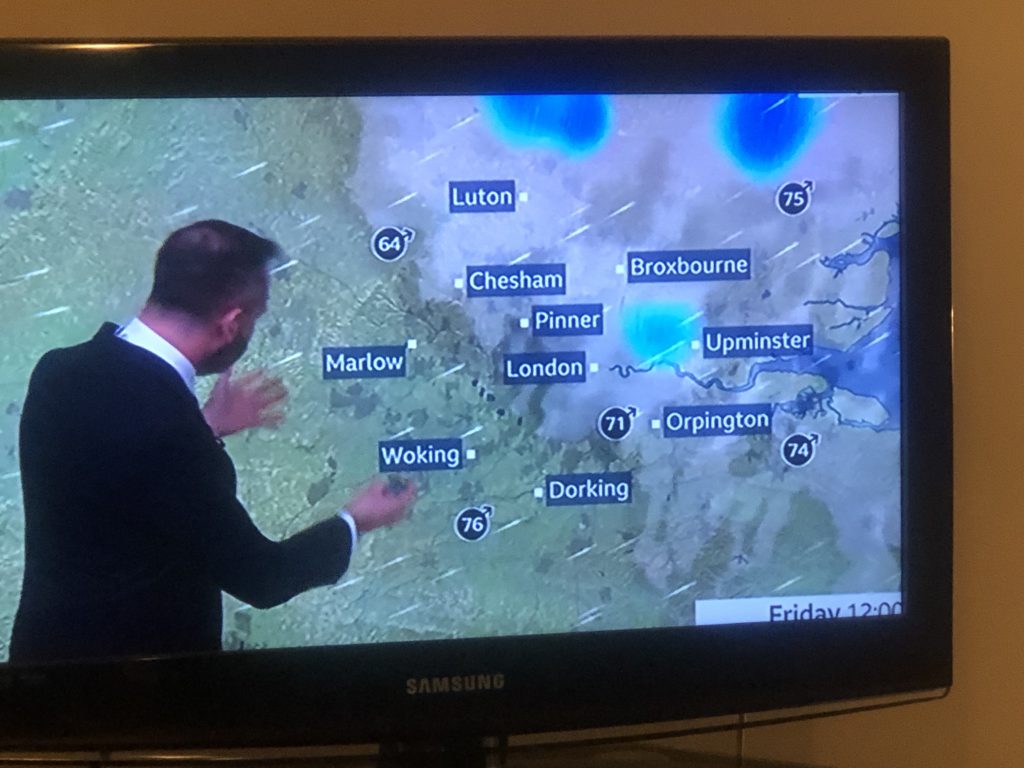
Screen shot of the forecast on Thursday 17th February for London and south Essex. Courtesy of BBC.
The first of two storms during the week ending Friday 18th were largely elsewhere, but the last originally had winds of 85 mph. By the time the forecast hardened up, it was a little less…
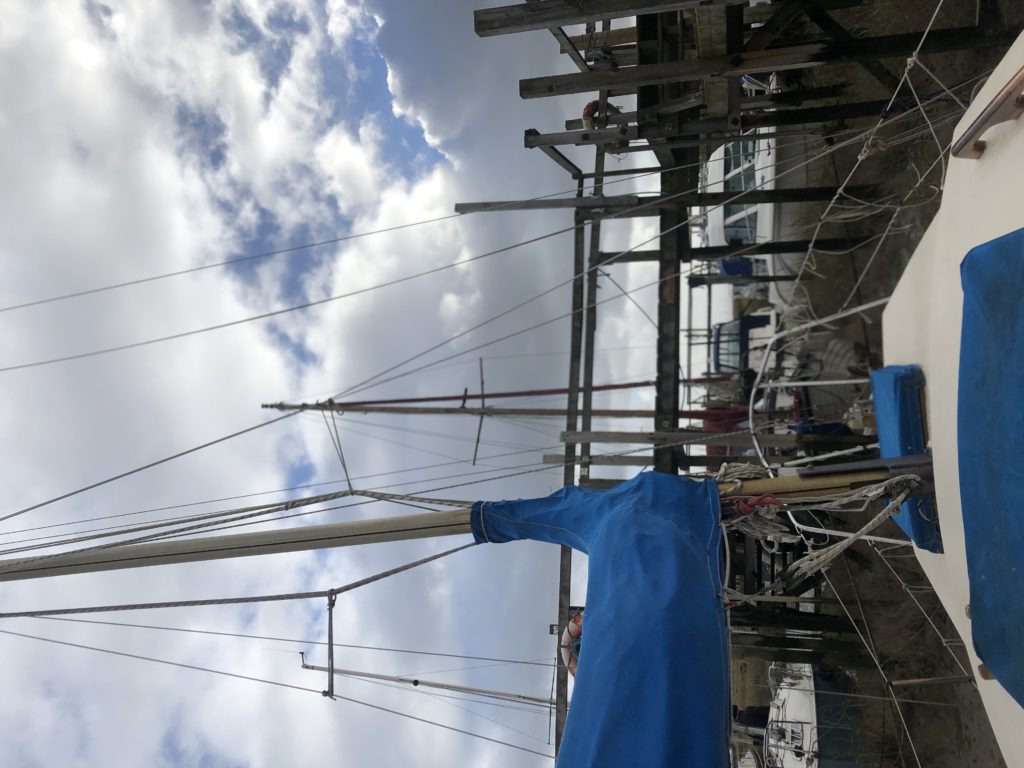
On the day, I visited the creek to check on Whimbrel and other vessels. All was well as the moorings were well protected from the wind’s direction. The tide too did not make and was nearly a metre below prediction.
Whimbrel, just afloat at high water on a mid range tide, less a metre, ‘sailing to the breeze’…
My wait for a sail continued…
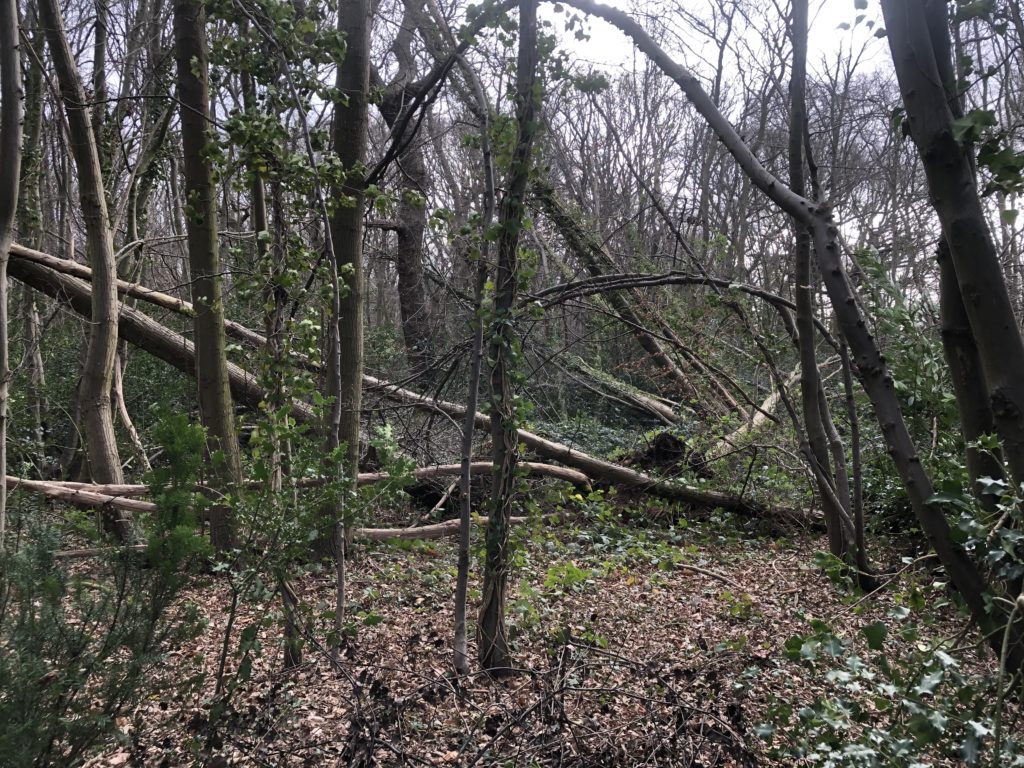
Some damage seen walking ‘our’ local woodland.
Finally, the wind looked as if it would ease sufficiently at the same time as there was a tide to get a sail.
Today, Monday 28th February, the wind abated. A southerly 4-5 was on the forecast, but it was much lighter and I set out with a gladdened heart for the creek, waving my good mate a sweet goodbye (off to London to meet an old college friend).
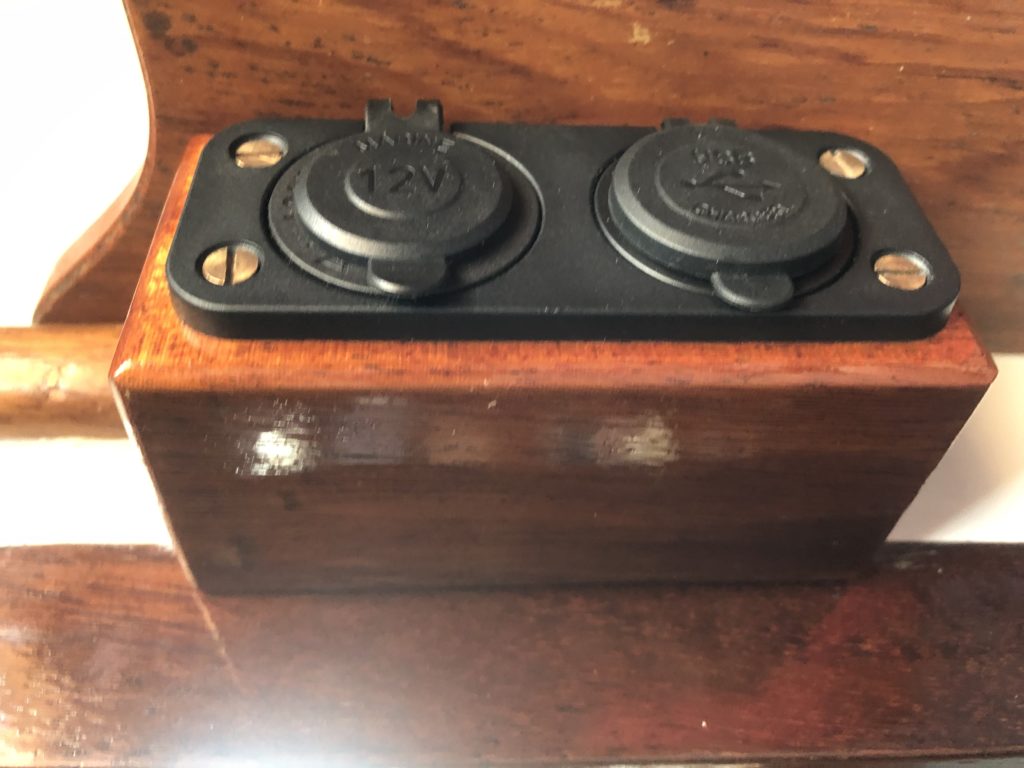
The tide was dawdling, clearly, as I stepped aboard, so after getting things ready, I fitted a new 12 volt socket with a double USB outlet. I had made this up over the previous weeks. It now graces the fore cabin, ready for my crews this summer!
New 12 volt sockets…
It was with a little butterfly bouncing around in side me that I eventually slipped out of our berth some 30 to 40 minutes later than usual for the tidal prediction. Later, I heard it was just over 30 cm shy.
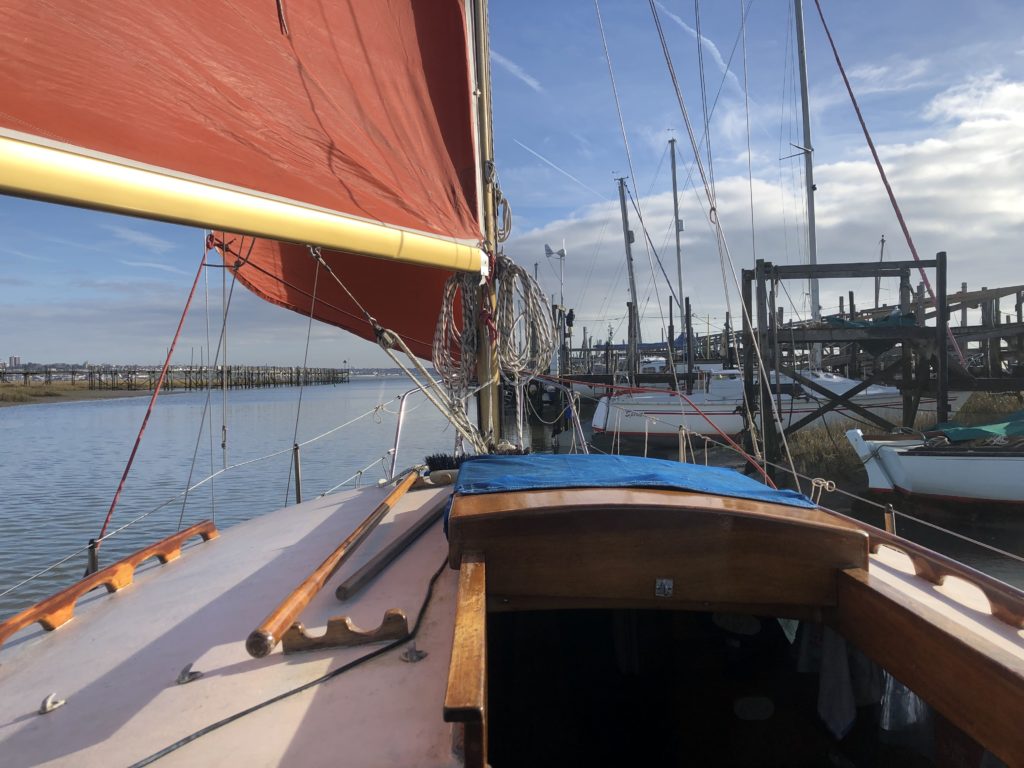
All sail set before slipping out, immediately stemming the flood…
Brent geese poked along the mud edges and amongst the cord grass as Whimbrel forged out over the flood. Curlews and oystercatchers announced their territorial presence too.
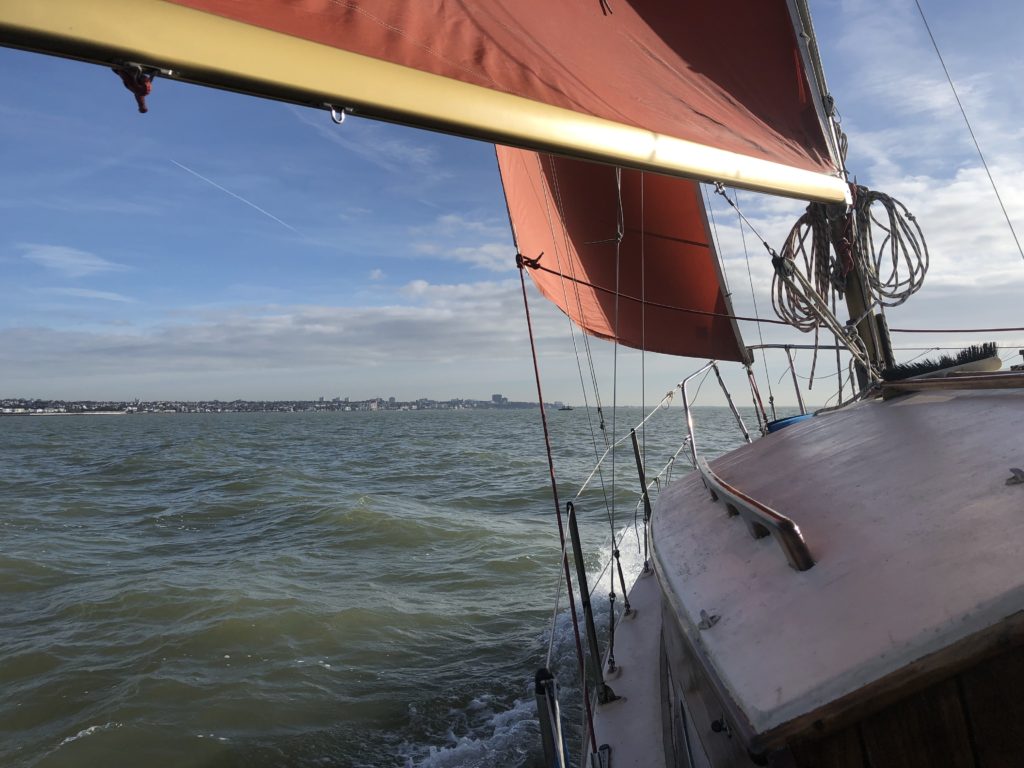
It was good to feel the boat lifting to the wavelets caused by a touch of east in the southerly wind. Clear of the creek with the tail of the point marsh astern, the boat revelled in it, going along at close to five knots over the tide.
Whimbrel cracking along…
There was no malice in the wind or any measurable sea either, just a ‘popple’ which ‘pinged’ inside the cabin from time to time. It was, however, enough to send up some spray from the bow setting up a foaming stream along the clinker lands.
I cracked on eastwards to off the Westcliff shore before turning to run along the shore to Leigh-on-Sea.
Running past the Essex Yacht Club.
Just before the Essex Yacht Club a group of sea swimmers were either in the water or preparing to enter. Mad!
Closing Bell Wharf, at Leigh-on-Sea, the depth began to be dicey, so I bore away for the Ray Channel, skirting the Leigh Flats – two turns of plate were too much!
Heading back into ‘deeper’ water…
I had not been up into Hadleigh Ray beyond the Old Salvation Army Jetty for some time. I used to sail ‘west’ up to the barrier frequently, but since the threats made to the boat and the verbal abuse to ourselves afloat during the earlier Covid-19 lockdown periods of 2020, sadly, I (we) have all but ceased going beyond a certain point upstream.
Passing along Two Tree Island, I looked north and waved at a friend who may have been watching from a window along the housing line on the hill above!
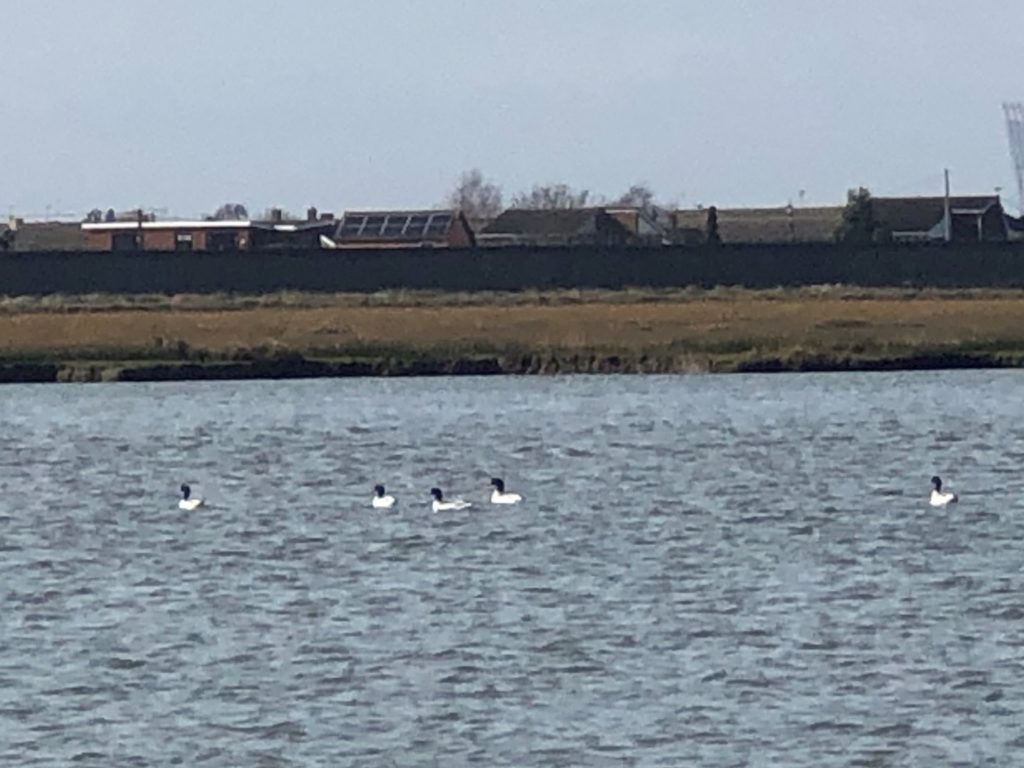
A group of shell duck.
The island of mud named Bird Island was just covered with a group of gulls semi-paddling on its top. A cormorant had no problem standing in the shallow water letting a meal slip down…
It was so lovely to slip along the edge of the saltings bathed in sunshine. Along the sea wall the odd walker stopped to stare. A couple of all-terrain cyclists went by whilst another sat resting upon a log seat. A seat which the mate and I have often used. The chap was holding his camera aloft, in a slow swing down stream. ‘Send me a shot…’ I felt like calling!
Sailing close by the saltings edge.
I heard the radio give the tide height for 1100, some fifteen minutes beyond high water. It was low … no time to dawdle on. It was time to head home!
Turning by a Benfleet YC racing buoy, below a creek chicane below the moorings, it was more of a hard reach back. A few tacks were needed along the run of Two Tree Island and to work south to the entrance to my creek, inside the eastern point.
The drifts and whirls of the wintering waders was largely missing. Numbers seemed to be low. Maybe next time…
Forging home…
After dropping the main, Whimbrel forged over the ebb, up the creek to her berth – the merest touch of engine was needed for the final manoeuvre…
During last summer we spent over a week bumbling around the River Deben with several nights in the Tidemill Marina.
We were conserving gas by reducing usage aboard to the minimum – the marina had not had a delivery of gas for 11 months the harbour master explained! I eventually solved this problem by changing to propane, ordering an exchange and a new regulator from Fox’s Marina chandlery. They were very helpful indeed…
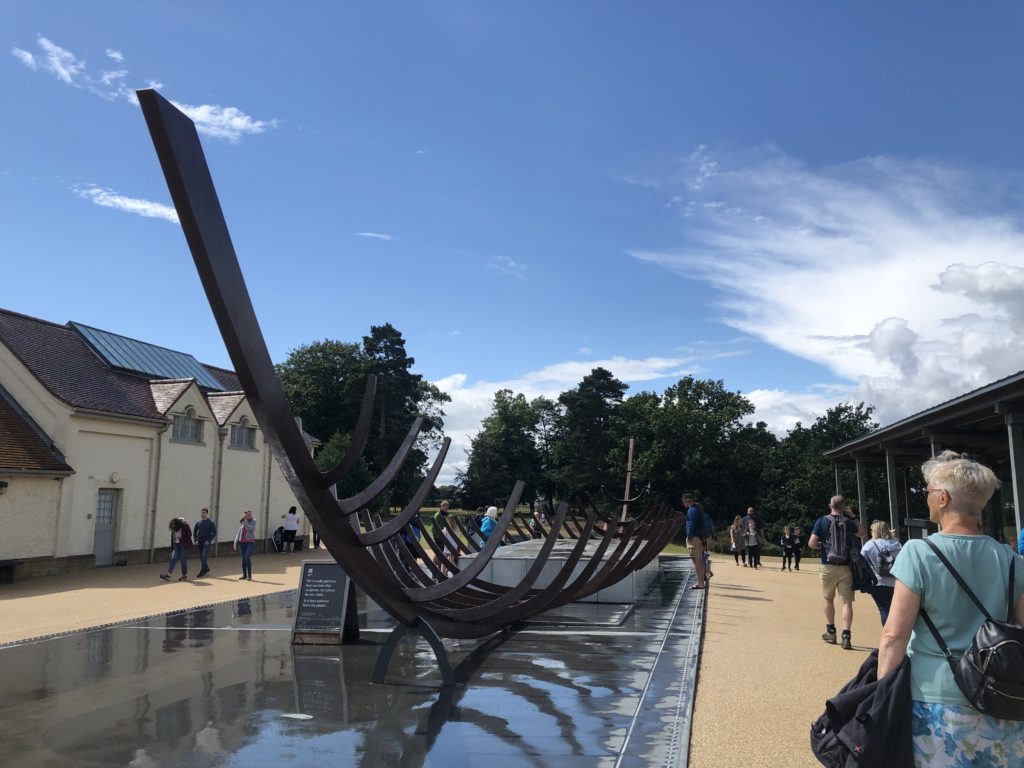
Anyway, we paid the Sutton Hoo Exhibition a fresh visit having learnt that it had been revamped. To our utter disgust, what we saw was not worth the entrance cost. It has been ‘dumbed down’ and turned into a IT visual experience, largely.
The mock up of the ship burial has gone. In its place is a ‘Whale backbone’ from which one is supposed to get and idea of what was buried…
The ship…
Quite frankly, we were both so appalled by the new set up that it is very unlikely we will ever return. The best place, now, to see the items and get a an idea of what and how the burial may have looked is at the British Museum, sadly!
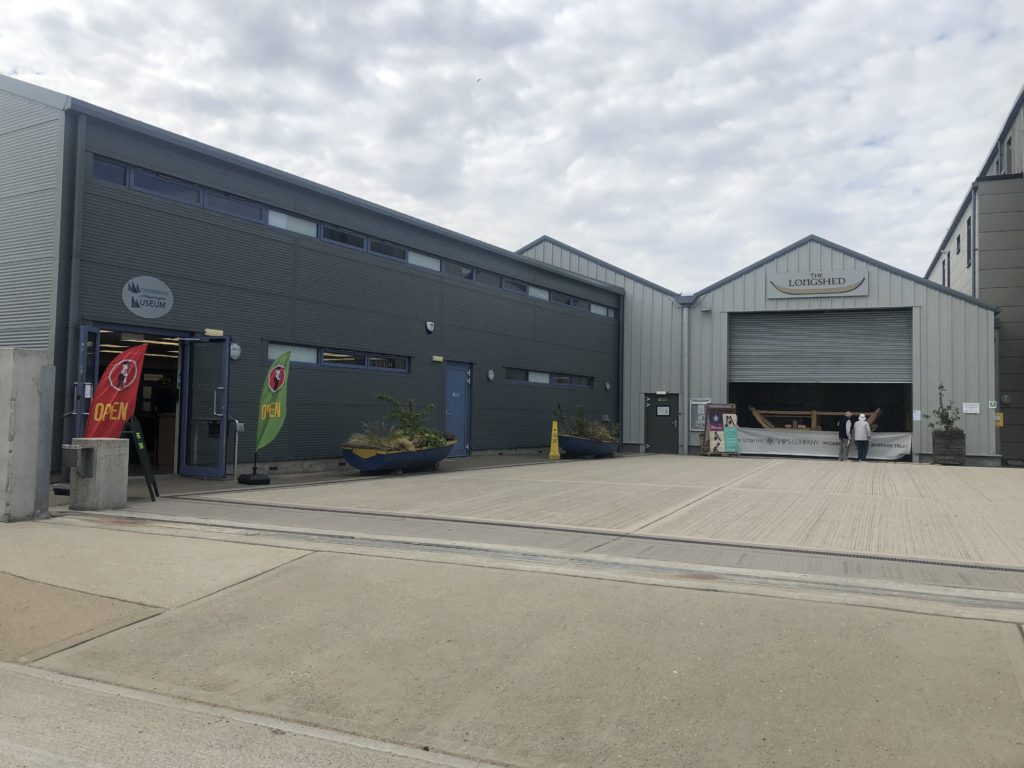
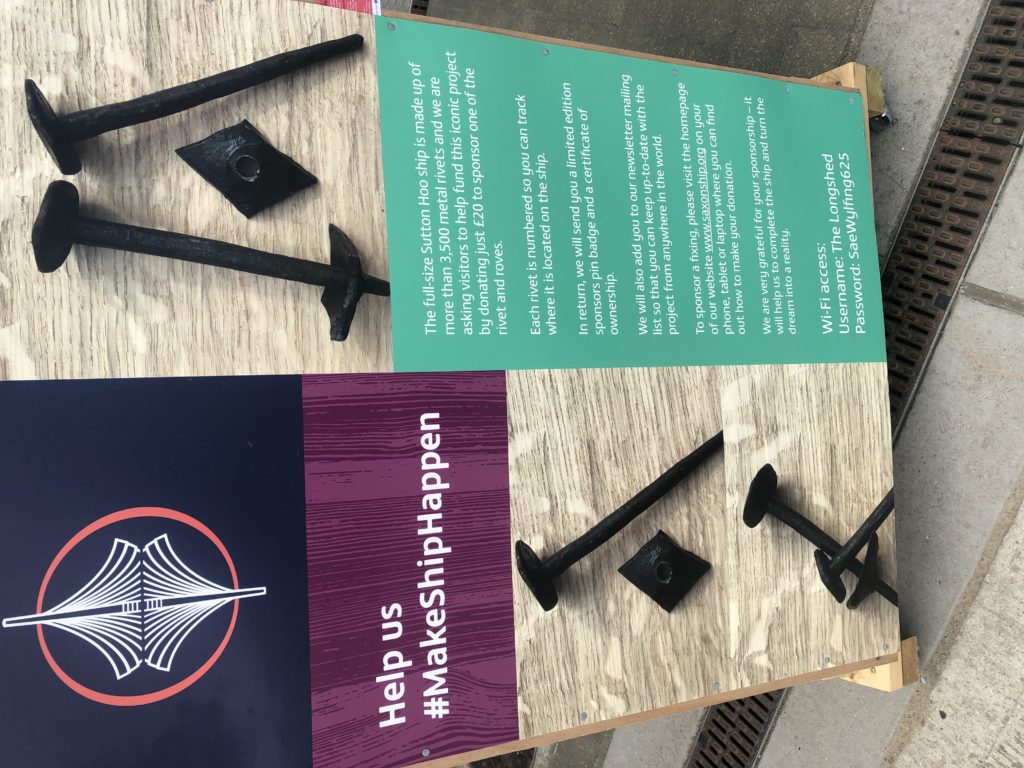
So, moving on. In one of the new large sheds on the site of the Woodbridge Boatyard, is the beginnings of a new long-ship. It is a replica of the outline drawn from the excavations of the Sutton Hoo Ship Burial in which it is firmly thought the body of the 7th century Anglo-Saxon ruler King Raedwald was interred.
I have added the link to the web site of the group carrying out this project for it covers more than I can tell here…
Near the open entrance to the shed was a mock up of the cross section of the vessel to be built.
In many resects her hull differs little from a ‘modern’ clinker or clench planked vessel.Note the wooden clamp in use.
Below are a couple of examples showing the wooden peg method of securing which lasted into the age of spritsail barge building with the use of treenails.
Wooden peg securing. Note the wedges…Close up of the clamp in use.
The November 2021 issue of Yachting Monthly had an excellent article within written by international maritime historian Bruce Stannard who has been part of the Endeavour project in Australia.
The article discusses thoughts on whether the Sutton Hoo Ship was a Royal barge, oared cargo carrier or sail/oar powered sea-going ship. All unknown factors…
All interesting stuff.
BBC News – Suffolk – carried a piece about the project too.
Leaving Woodbridge, I was able to catch a glimpse of a very much smaller version of the ship built some years ago. She was moored downstream of the Tide Mill off the sailing/yacht club bases.
The little ship…
The project is worth watching as progress is made…
On BBC Radio 4 this week, prostate cancer was the ‘talk of the day’ with discussions with Bill Turnbull who has a serious case – currently living with it and its treatment – and a chap from NHS England.
I have chopped a piece out of the media (Yahoo News) to help concentrate the minds of you men.
Ella Pickover, PA Media Health Correspondent, said:
‘Around 14,000 men in England could have undiagnosed prostate cancer and may be in need of urgent treatment, a charity has warned.
More than 58,000 men in England have begun treatment for prostate cancer since the start of the pandemic – 14,000 fewer than would have been expected in pre-pandemic numbers, according to Prostate Cancer UK.
The charity said it was concerned that the number of “missing” patients would continue to grow.’
Now, when I asked for my test I had not had any symptoms and hadn’t done any research – it was a BBC Radio 4 morning programme that alerted me.
The story can be tracked below. It will also form a part of my forthcoming book…
‘For many, symptoms do not appear until the disease has already spread, so the charity is urging men to use its risk assessment tool.
Those at higher risk are urged to contact their GP.
The charity said many men have felt reluctant to “bother” their GP during the pandemic.
Anyone who does experience symptoms, such as problems urinating or needing to go more often, should speak to their doctor to get checked.
The condition is treatable if caught early, which is why the charity, along with NHS England, are working to find the “missing” patients.’
The wonderful actor and raconteur, Stephen Fry was diagnosed with prostate cancer in 2017. His like mine was found after a routine health check, but I had to demand the test at the health check…
Television presenter Bill Turnbull, living with prostate cancer, has also backed the current campaign.
‘Stephen Fry said: “As you can imagine, I was pretty knocked back when I received a diagnosis of prostate cancer, particularly as I had no symptoms to indicate anything was wrong – something I later learned is very common. Thankfully it was caught early, making it more treatable.
“That’s why I’d urge you to check your risk and speak to your GP if you have any concerns – even if you feel completely well, as I did.
“Prostate Cancer UK’s risk checker can help you understand your risk and the next steps to take.”
Turnbull said: “So much has been done to raise awareness of prostate cancer in recent years, and it’s critical we don’t lose any more ground because of the Covid-19 pandemic.
“Prostate cancer is so much more treatable when it’s caught early, unfortunately mine wasn’t. So if you’re a man who’s at risk of the disease or worried about prostate cancer, don’t put off going to the doctor to talk about it.
“It’s understandable that people haven’t wanted to go to their GP during a pandemic, but the message is that the NHS is open and they want to see you. You can also find out more about your risk and what you can do about it by using the risk checker on Prostate Cancer UK’s website.”
Yes, right…
Ella’s piece continued:
‘Nicola Tallett, acting chief executive at Prostate Cancer UK, said: “Prostate cancer is the most common cancer in men, but the pandemic has meant thousands of men have not come forward for diagnosis and could be missing out on lifesaving treatment.”
“Although thousands of men are still being treated each month, if things don’t change soon, the number of men missing out will continue to grow.”
“Men have been telling us they haven’t wanted to ‘bother’ their GP during the pandemic – particularly if they don’t have any symptoms, which is the case for most men with early prostate cancer. This means men at higher risk of the disease are not having those vital conversations about their risk that can lead to a diagnosis.”
Professor Peter Johnson, national clinical director for cancer for NHS England, said: “I urge you to use the Prostate Cancer UK risk checker today – it is a quick and easy way to understand your risk of prostate cancer and how you can take further action if you are at risk.”
“That’s why we’re working with NHS England to raise awareness and encourage men to take our risk checker to find out more about their risk and what they can do about it.”
“The prognosis for the people we’re yet to see will be much better the earlier we see them but we do need to see them as soon as possible.”
“It’s important men understand prostate cancer often doesn’t show any symptoms at an early stage, so don’t delay – check your risk now. The simple check could be lifesaving.”…’
Thank you Ella for such an informative piece.
Now, what surprised me was that nothing was said about the fact that testing for men is available from the age of fifty. Some GP practices offer it, many don’t. Most don’t even (or didn’t) advertise the facts about the risks and that testing is available.
So, my message is: Call your doctor’s surgery and GET TESTED!
The earlier it is caught the higher the chances of a good outcome and a ‘normal’ life…
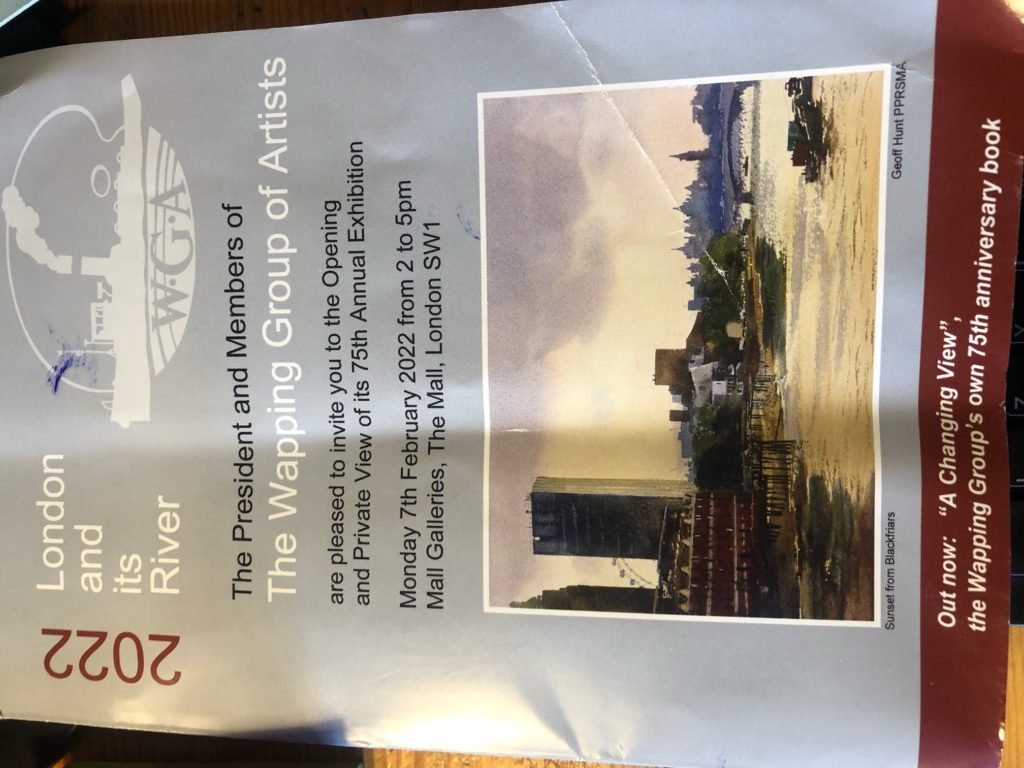
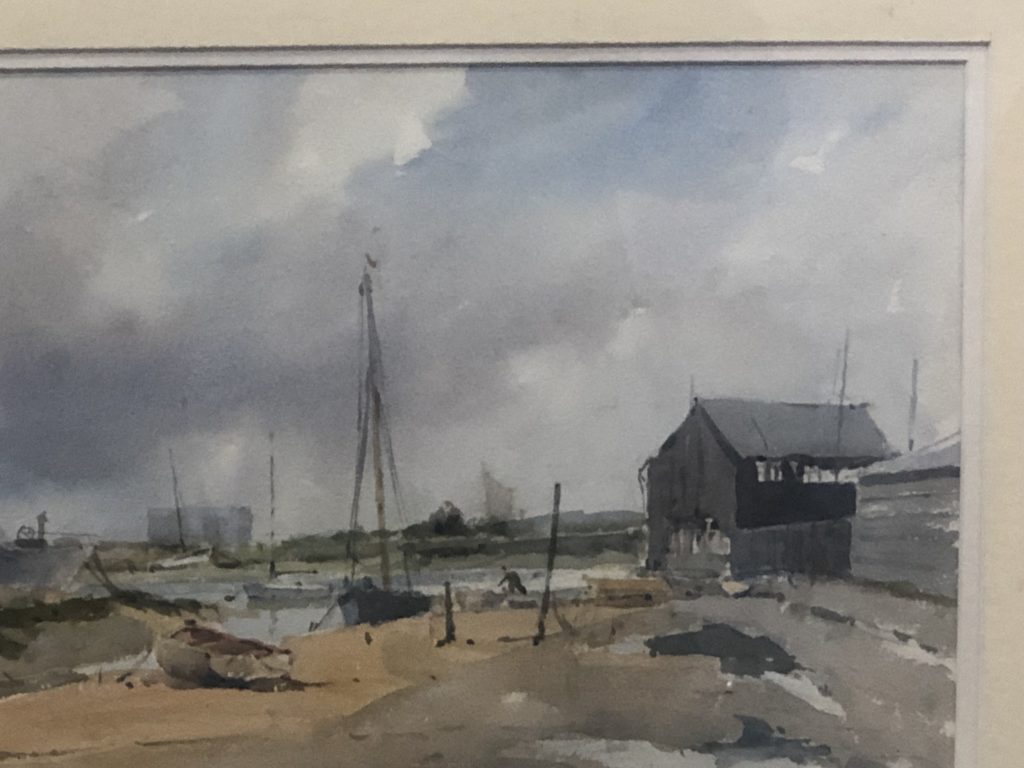
The exhibition is open until Sunday 13th February. It has a wonderful array of talented works with views up and down the River Thames and its furthermost estuarial environs.
Invitation front…
The slogan the group is operating under currently is: ‘A Changing View’ which is something right up my street with what I have been writing about – my last book, Rochester to Richmond, a Thames Estuary Sailor’s View, especially.
One of the things I did notice was that a number of the paintings are completed works from pieces clearly began some years before. There was one looking towards Maldon with the big old smack, Telegraph along the shore in the foreground. She was moved near to Heybridge Basin nearly a decade ago!
That said, the quality was fantastic.
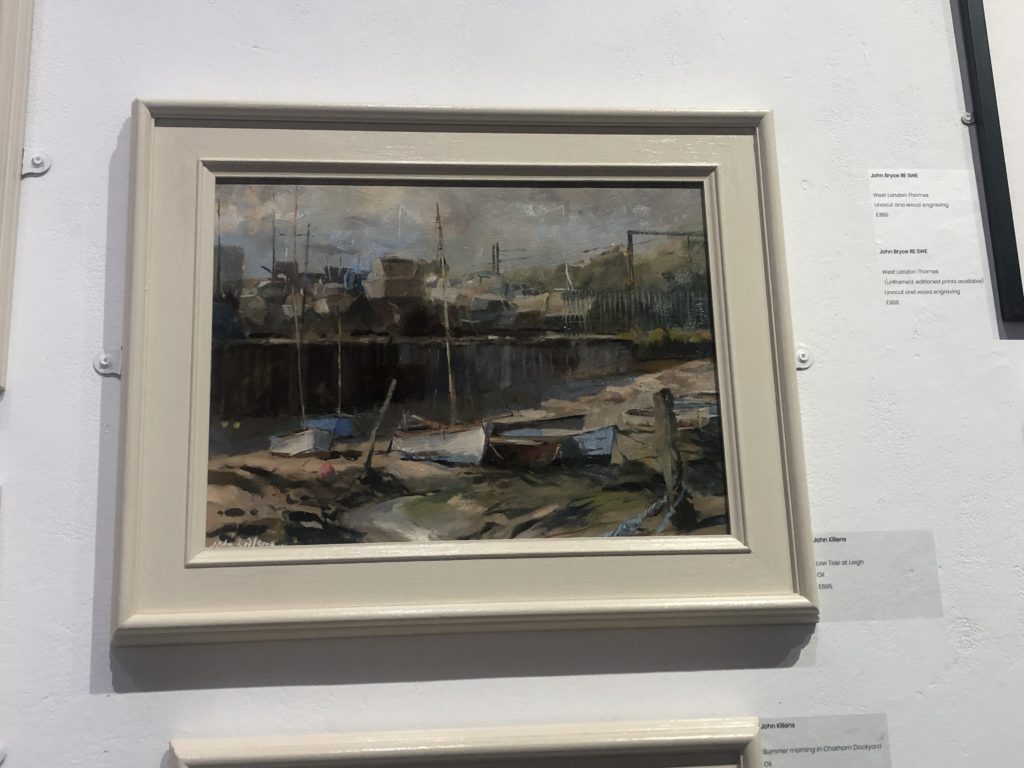
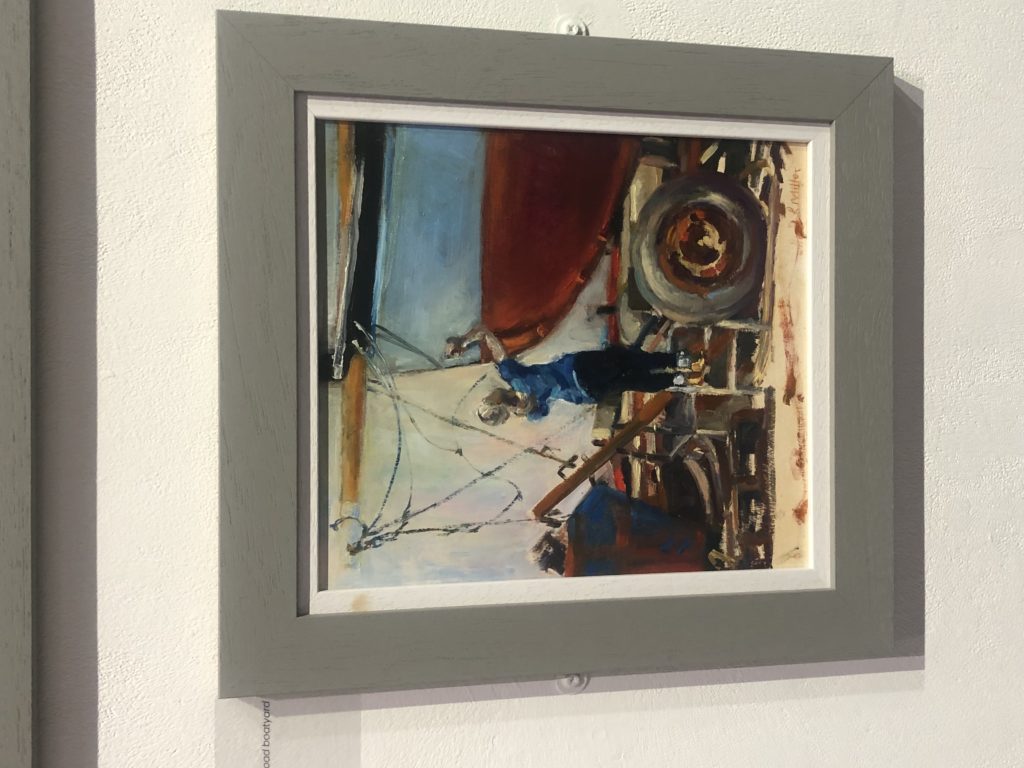
Low tide at Leigh – John Killens.Finishing touches, Downs Road Boatyard – Rosemary Miller.
The Downs Road Boatyard is always a place of wonder. The workmanship of the yard is brilliant and it is fascinating to watch a crafstman at work, if given a chance.
Knowing the yard owner helps, but always ask!
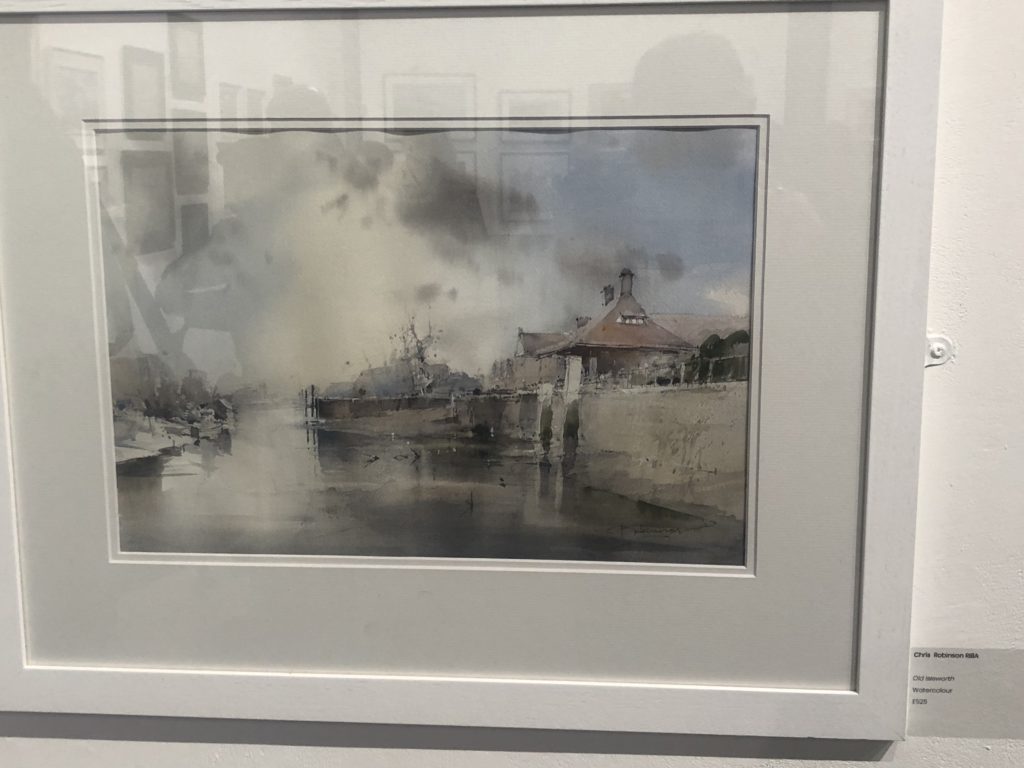
Downs Road Boatyard – Rosemary Miller.Old Isleworth – Chris Robinson.
I love it ‘up river’ along the banks of the Thames above the greater metropolis. A serenity and simplicity of a natural river can be seen in many places.
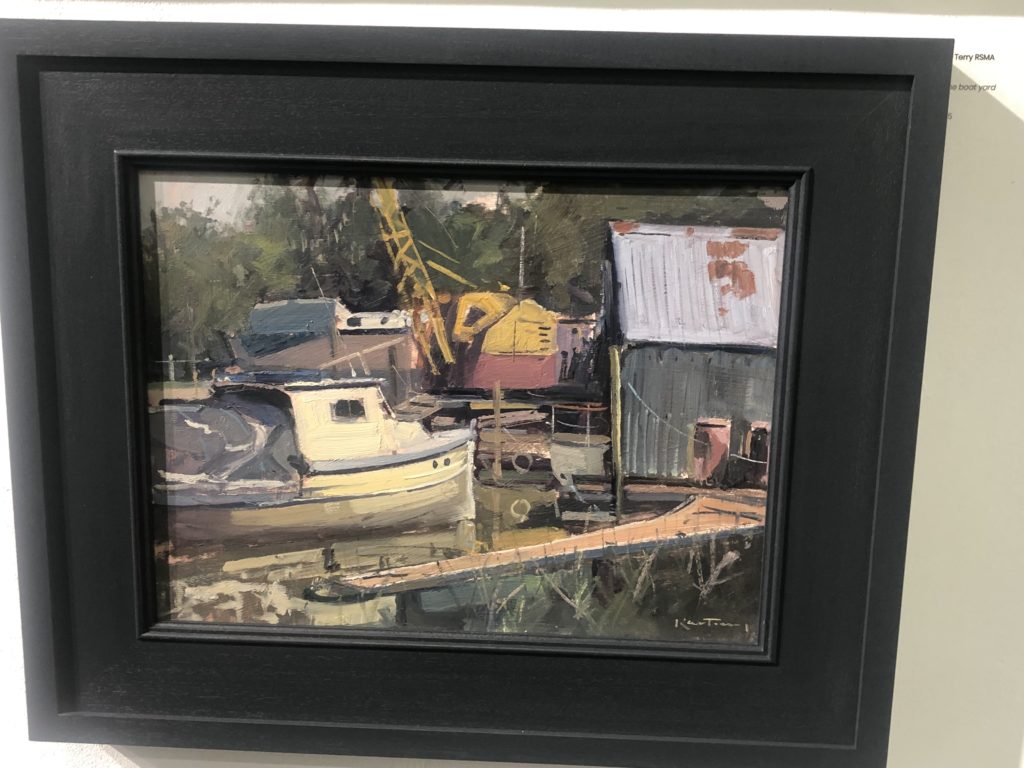
Below is a yard on Eel Pie Island.
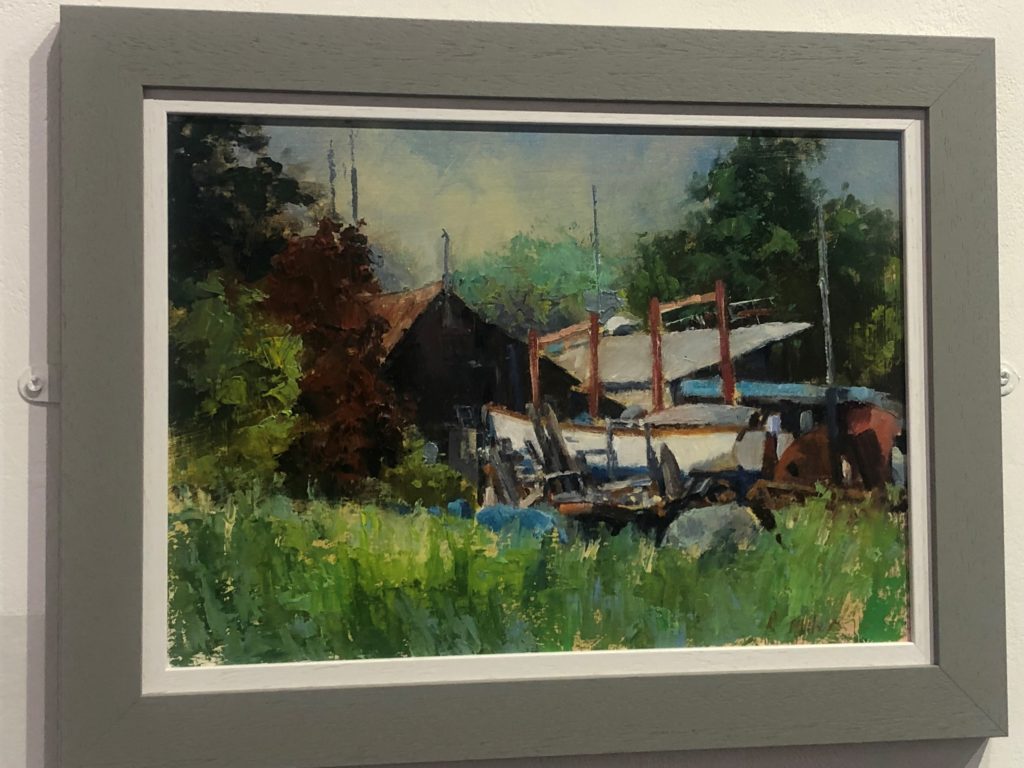
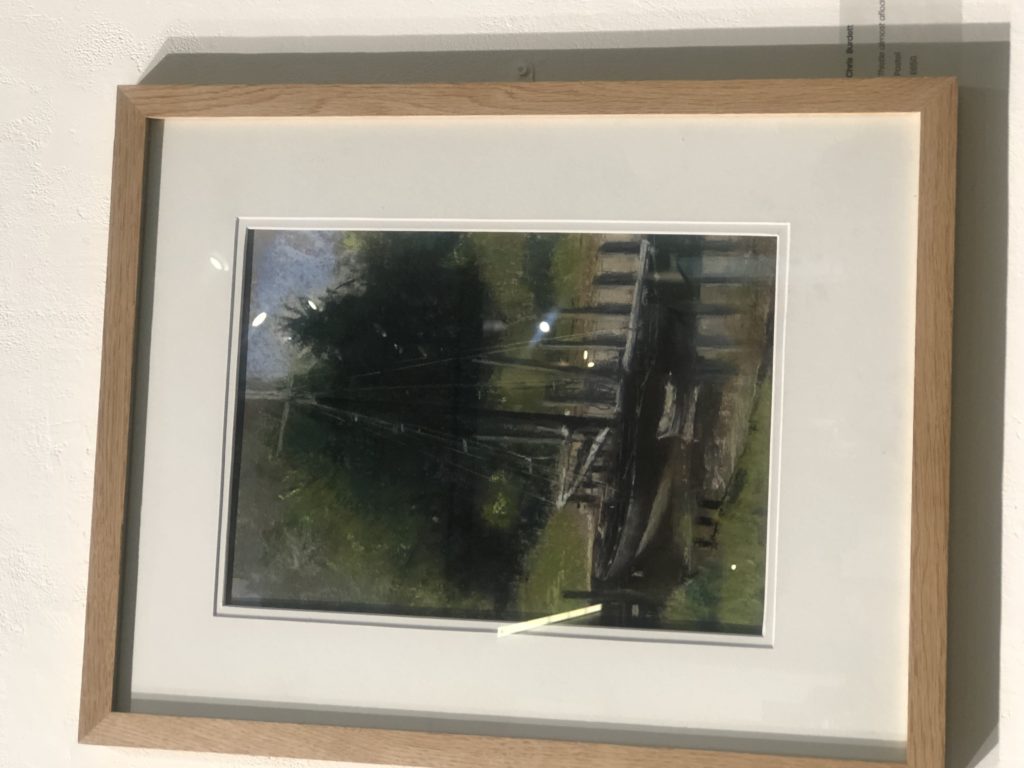
In the Boatyard – Karl Terry.Thistle, almost afloat, Halstow Creek – Chris Burdett.
The Thistle is now generally moored in Lower Halstow Dock and is part of the joint venture with the Edith May – see the Tiller & Wheel web site.
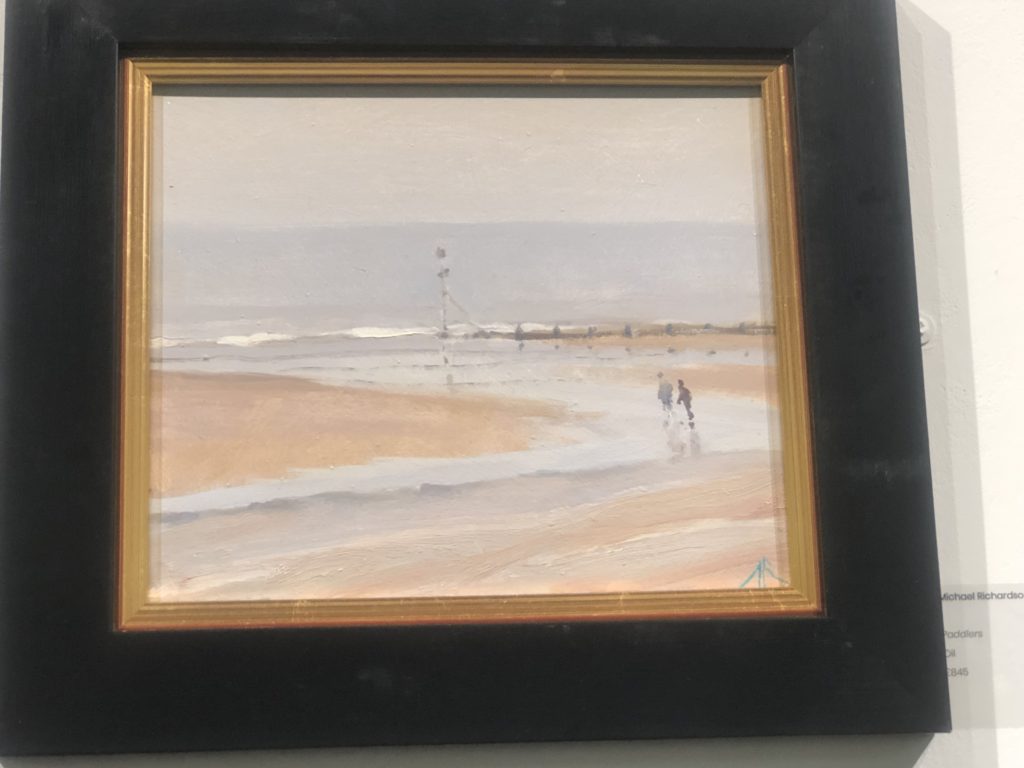
Below is a picture I would happily hang on the wall. Space however is not available unless a picture is dispensed with…
Paddlers – Michael Richardson.
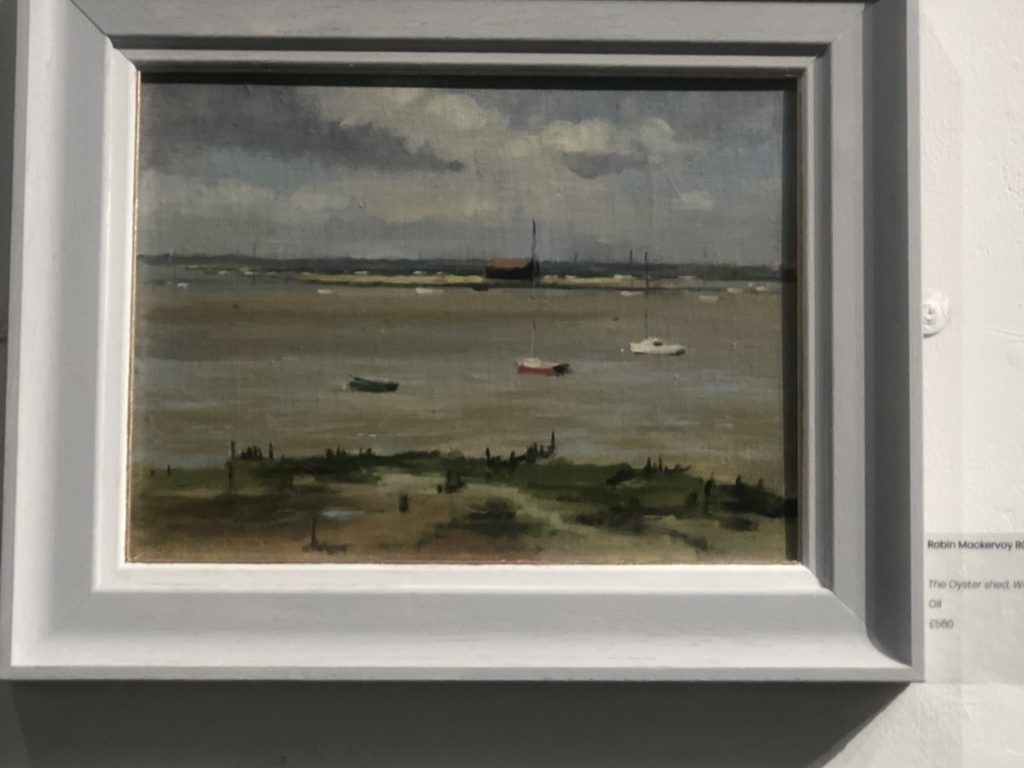
Below is another I liked…
It is a familiar scene in a loved anchorage (mooring) spot. The island – Packing Marsh – is under threat from the sea though. Yet again thousands of cubic metres of sand and shingle have been pumped onto its south-eastern end, also Cobb Marsh to the east.
Tidal rise is eating away at both. If they go, the anchorage would change drastically, being open to strong easterlies from which great protection is still given.
Oyster shed, West Mersea – Robin Mackervoy.
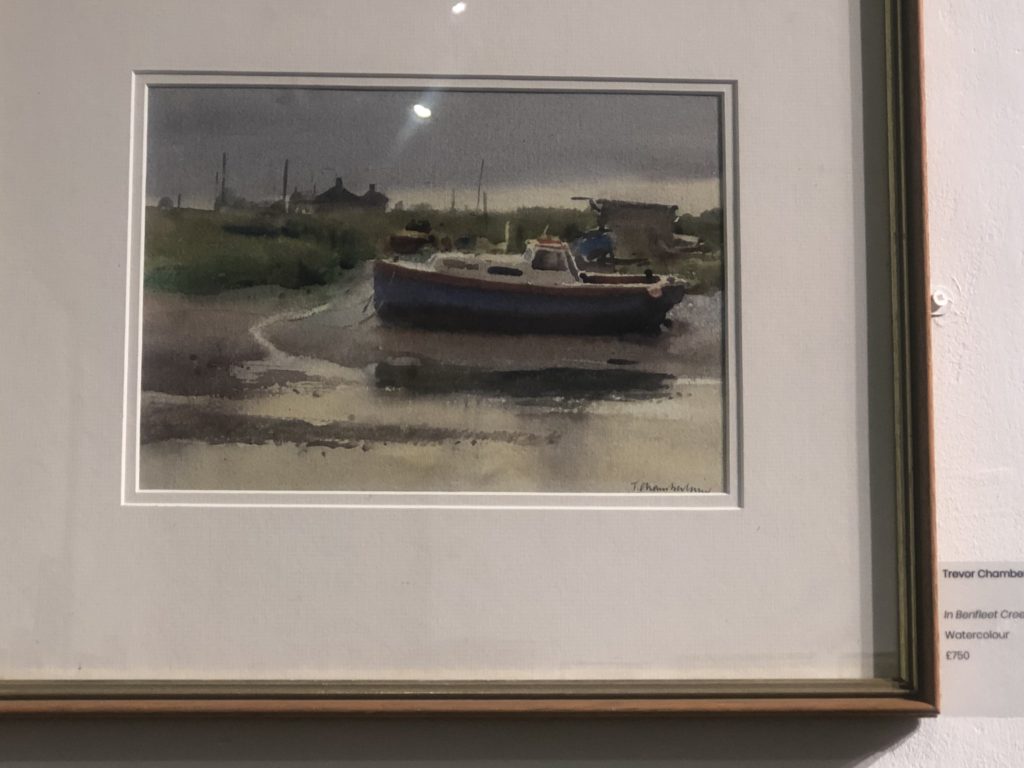
Below is a small piece of Benfleet Creek. The boat, however, hasn’t been there for years!
In Benfleet Creek – Trevor Chamberlain.
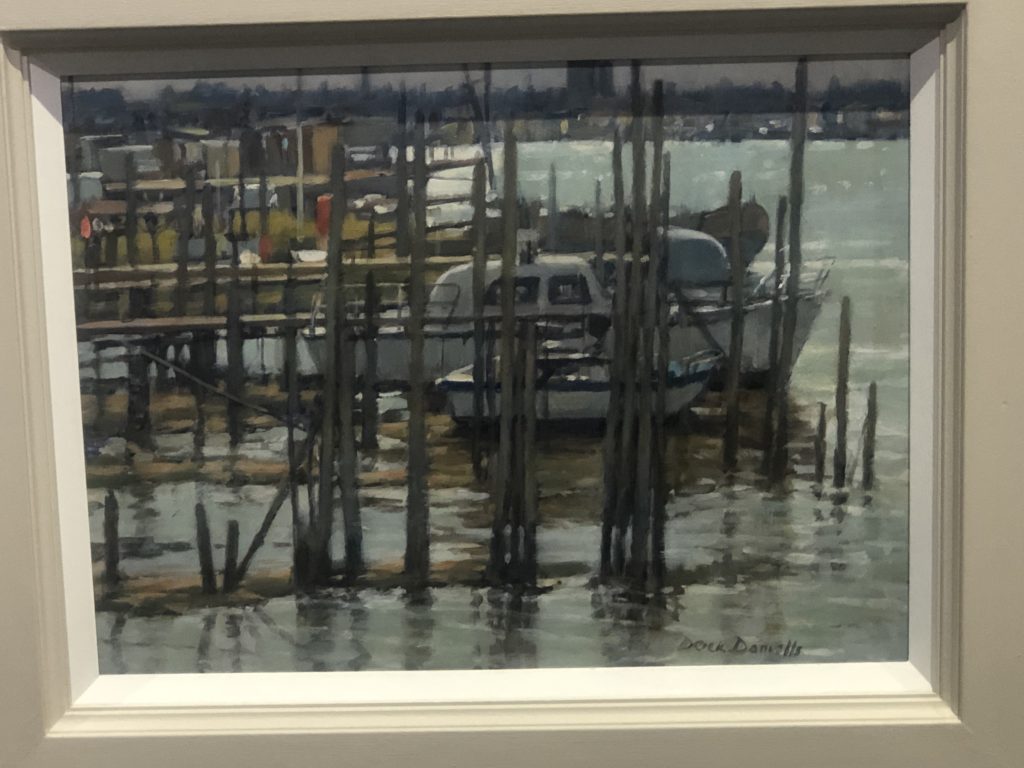
These moorings sit just upstream of Erith Yacht Club and access is from a different gate, so is, I would say, incorrectly titled!
The structures so reminded me in a great rustic way to those of my own moorings, which, I hasten to add are in far better condition!
Erith Yacht Club – Derek Daniels..
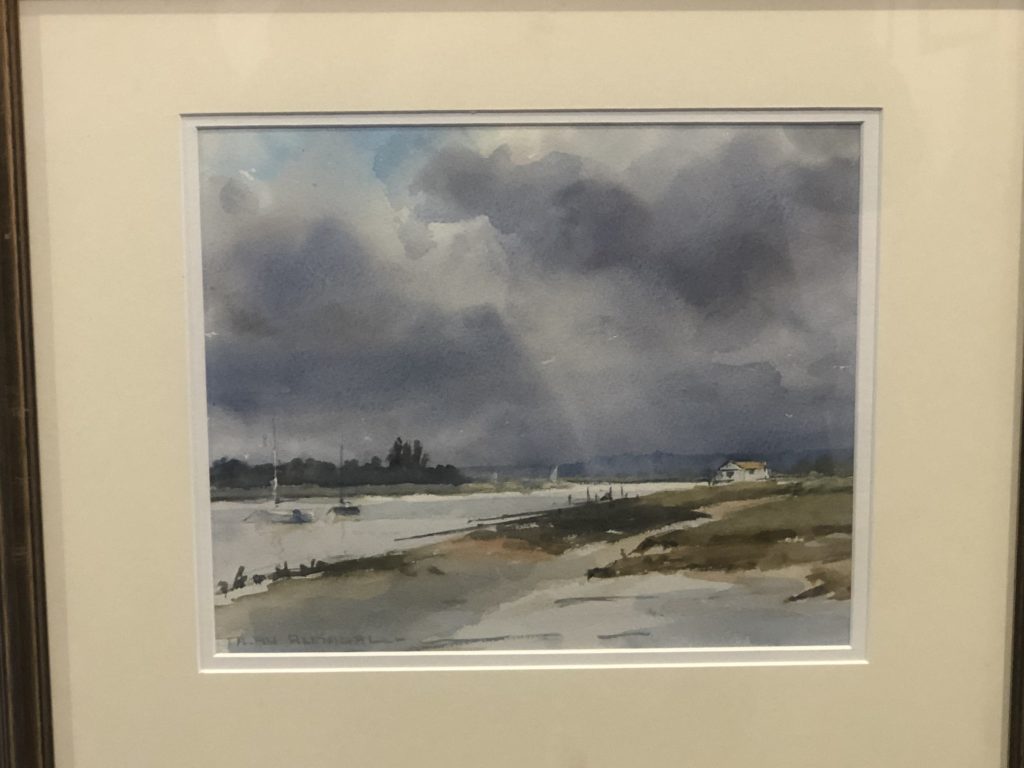
There now follows a run of paintings – all water colours – by Alan Runagall, a fellow resident of Hadleigh (Essex)
A break in the clouds – Alan Runagall.
Above is a view, I believe, looking up the River Crouch, from the quay at North Fambridge, with the old wildfowlers cottage on the edge of the saltings.
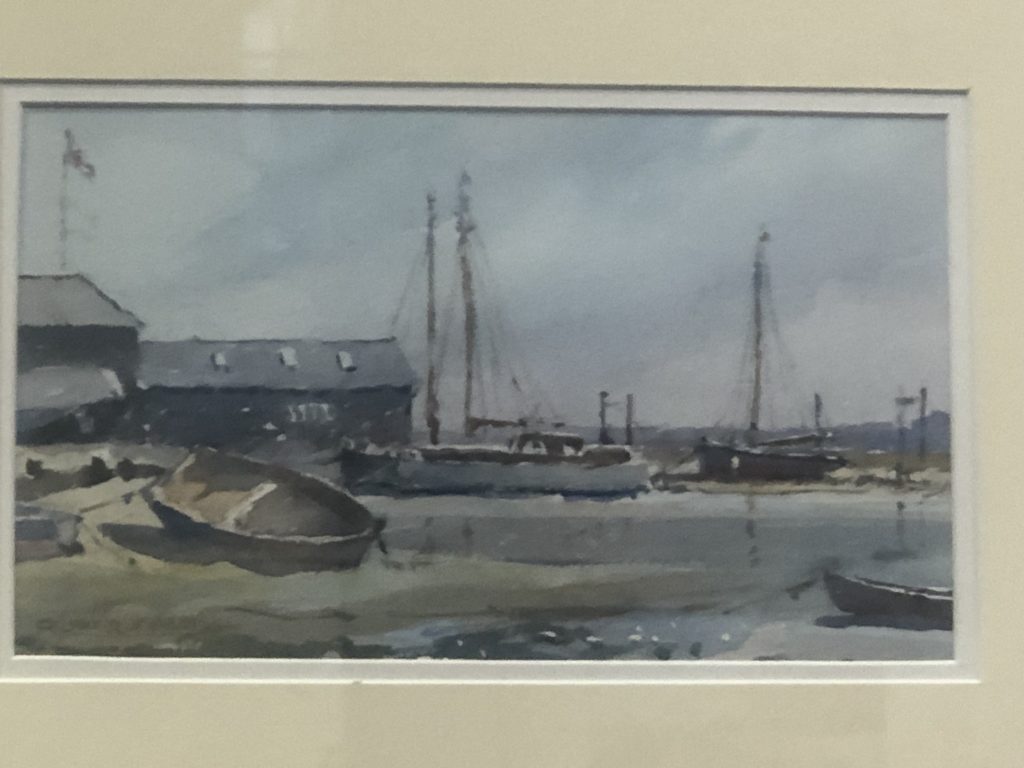
Afternoon light, West Mersea – Alan Runagall.
A familiar view above…
Love poking around the yard here.
Low water Tollesbury – Alan Runagall.
Ah, Tollesbury. Great place to drop into for a couple of days, with a butcher, baker and stores in the village.
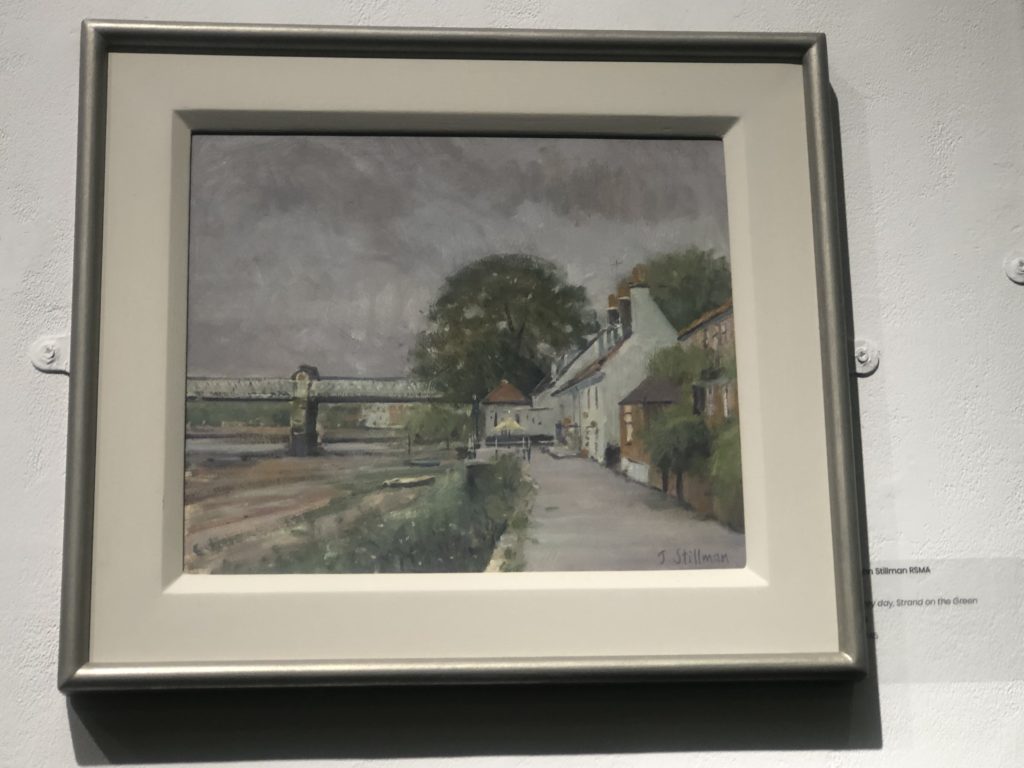
Grey day, Strand on the Green – John Stillman.
Just below the railway bridge, I believe…
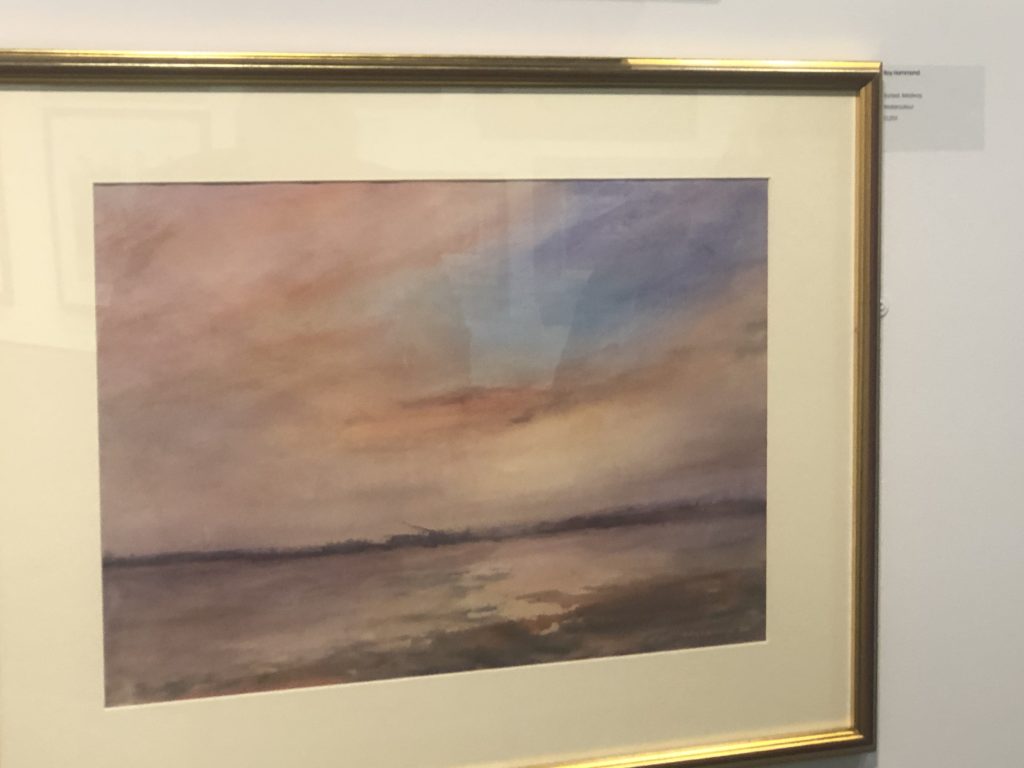
Sunset, Medway – Roy Hammond.
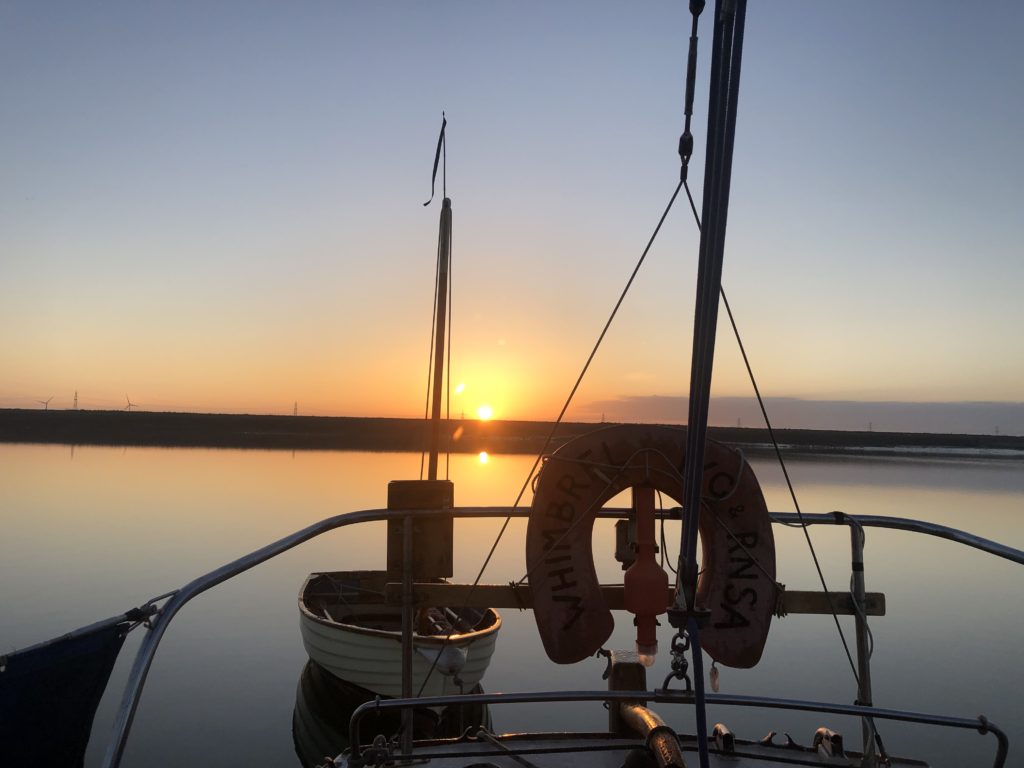
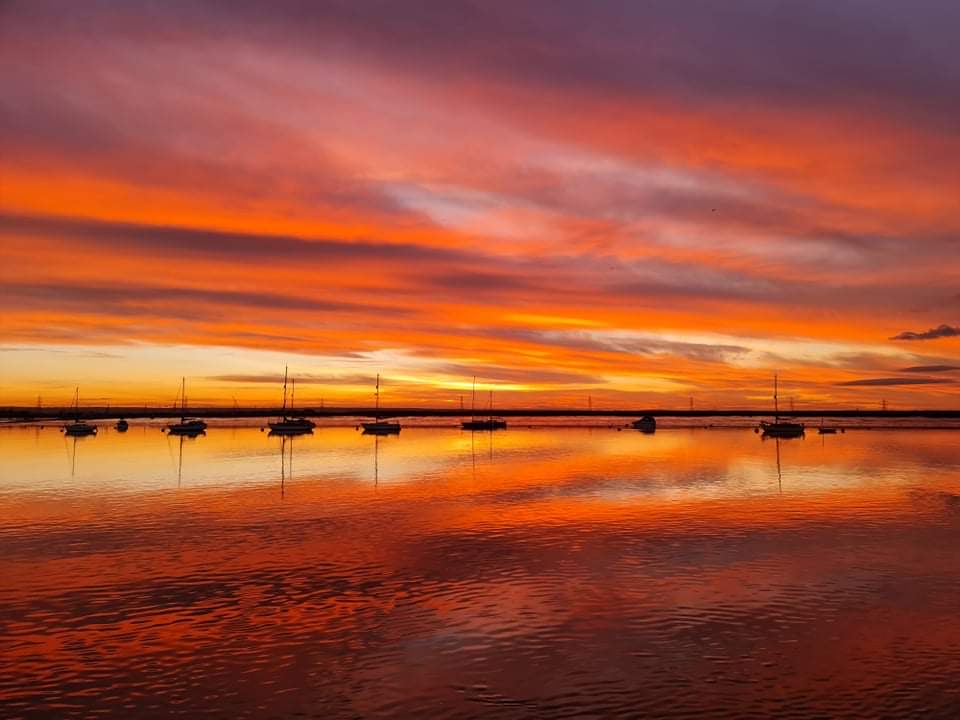
Two of the artists said to me that a sunset is the most difficult thing to paint. A photograph can though do it justice. The picture is from the shore at Queenborough. Whimbrel is to the right hand side, with dinghy astern.
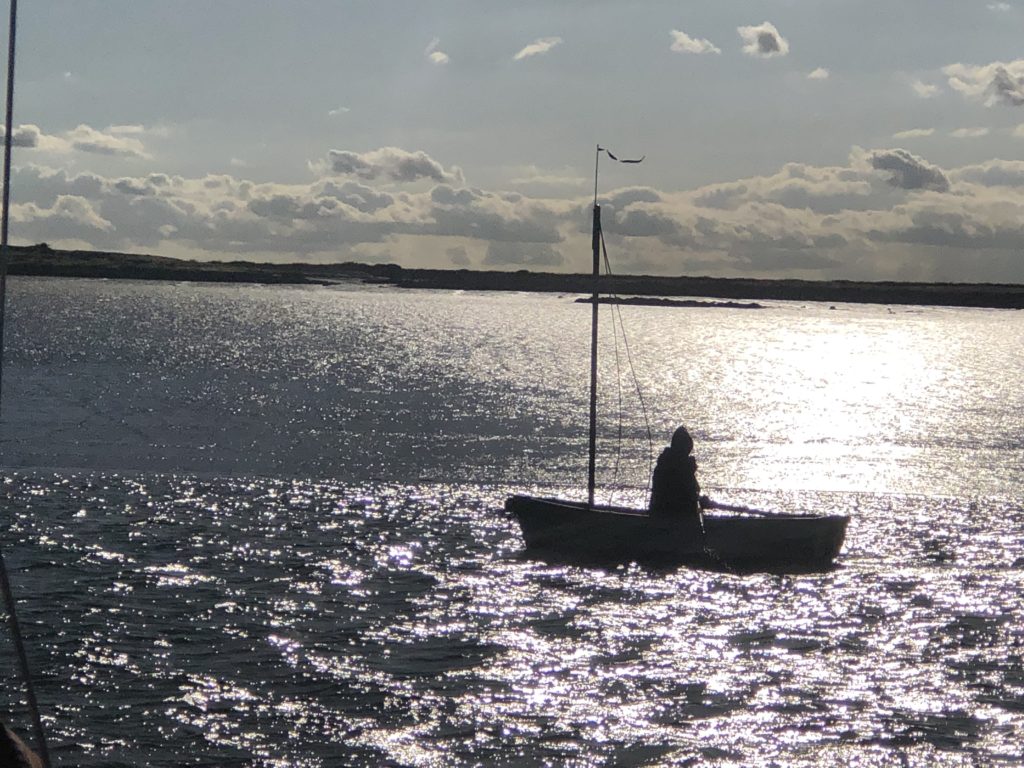
A photograph sent to me during a visit with my brother Graham last week. Harr Coughlan, QBHT boatman.
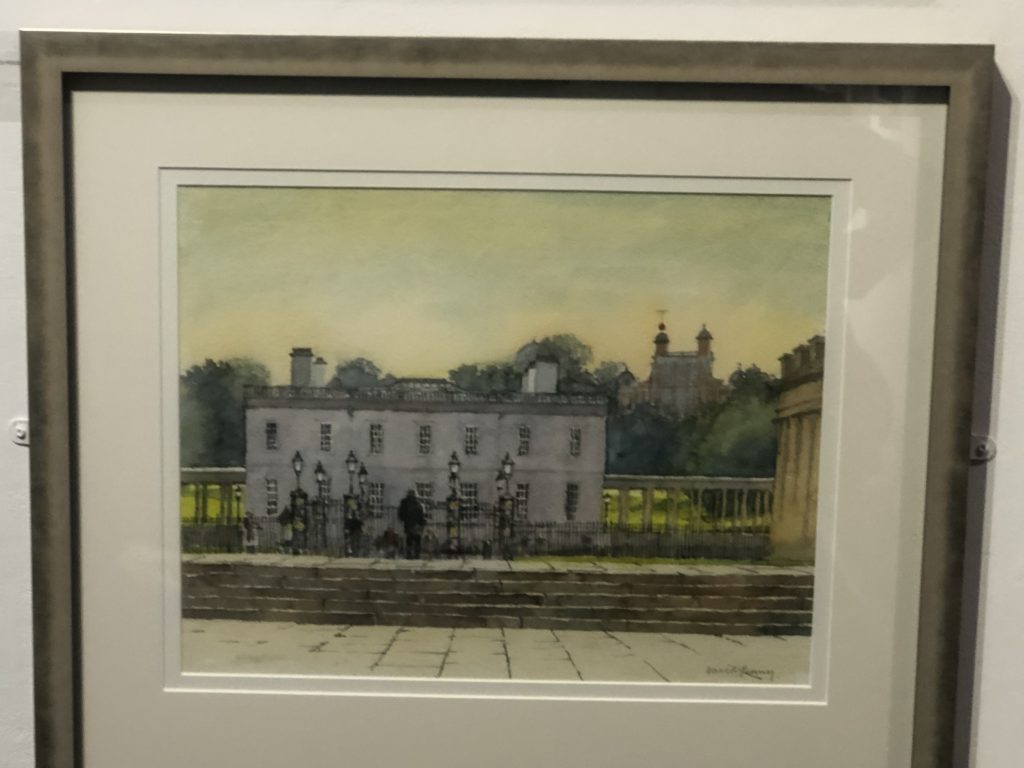
Ah, here is one the mate lusted after. She deliberately left her credit card at home – I offered, but she dragged me out!
September morning, the Queen’s House – David Penny.
Yes, it was good.
You have just a few days to get there and savour the works…