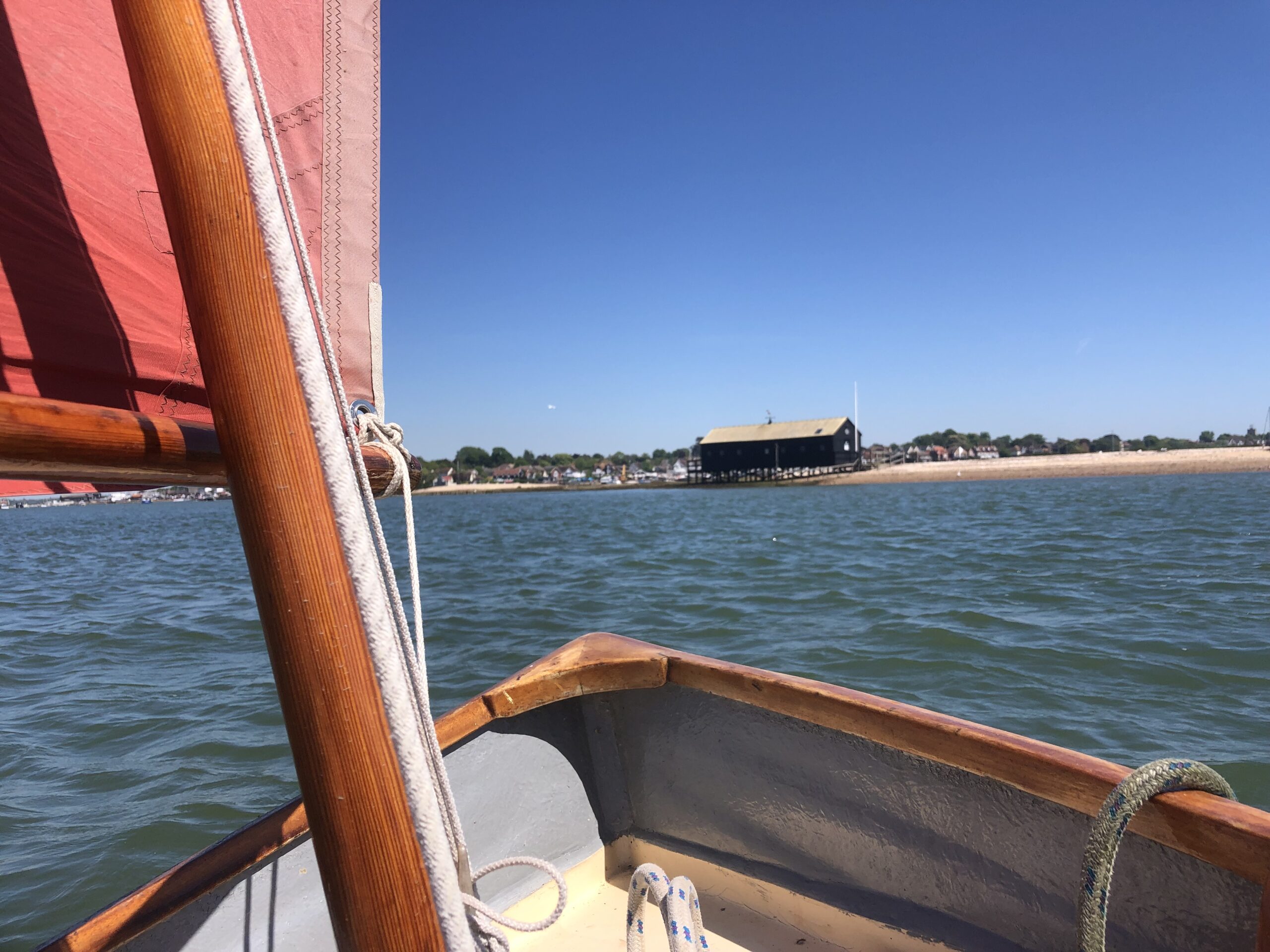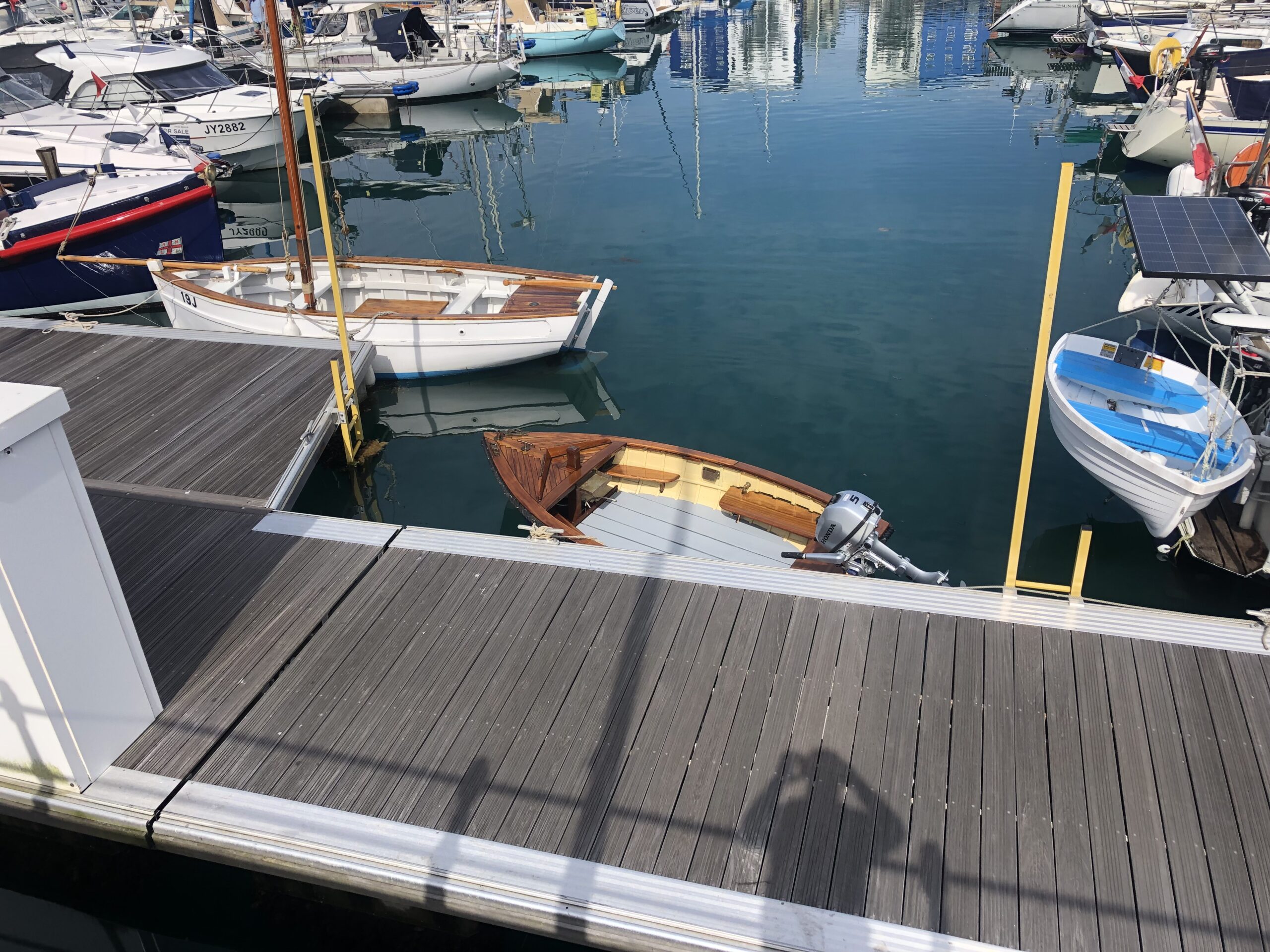
12/31/25

Ditch-crawler sums up 2025 and another Whimbrel year…

So, 2025, let’s have a wander back down the creek of time.

For me it marked a personal moment in my life: in June it was seventy years since my birth. During the year we have been having a ball – that is the boat, my mate and me – never mind stuff away from the waterfront for we’ve done all sorts during the year, but this piece only covers the sailing side of our lives.

It is now two and a half years since our move to The Blackwater Marina located at the head of Lawling Creek. It has been a blissful time after the turmoil we latterly experienced at the Island Yacht Club – something that we (me especially) are allowing to slip into the past. It has been a happy experience with the yard and in our uncluttered freedoms coming and going without fear.
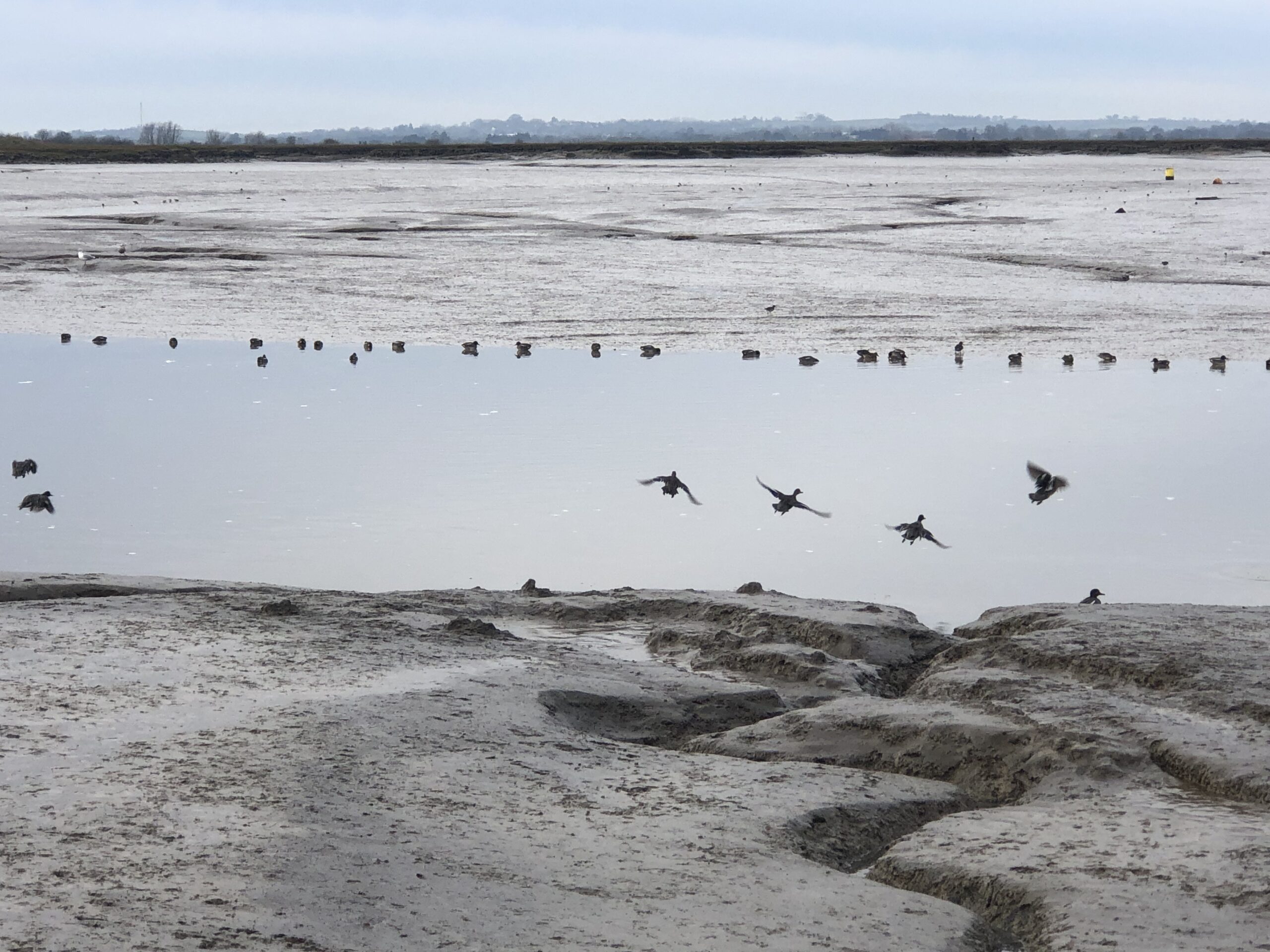
Bird life in the rill off the moorings at Maylandsea.

There is always a little bit of water in the creek just off the end of the Blackwater Marina moorings and during the winter a myriad of water fowl can be viewed at close quarters. The ‘mewing’ of Widgeon mingles with the calls of sandpipers and more distant curlews. Larger mallards dabble and egrets strut. Yes, it’s grand.

We ‘took’ Graham who lives in Canada for a virtual sail…

While out on the water during the winter (and at other times) we have called my eldest brother Graham in far off Newfoundland, where he is usually ‘snowed in, allowing him to enjoy a virtual sail. He, in his inimitable way, always proceeds to tell me where we are and what we are doing as if he, himself, was at the helm!
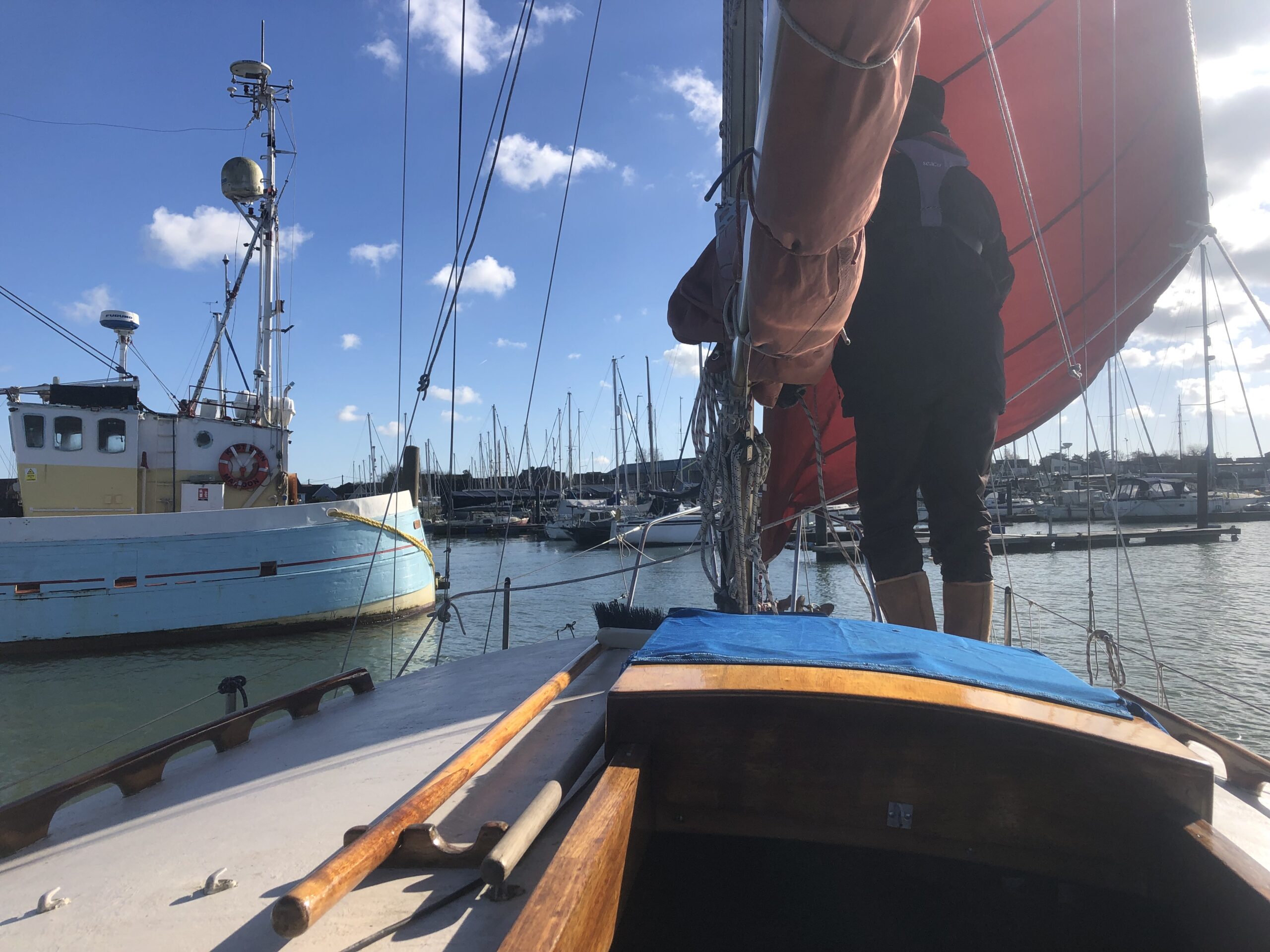
Sailing into our moorings – mate ready to drop headsail…

When conditions are right we now think nothing of sailing out of the marina and also sailing in, right into our berth. With a crew aboard, it helps for the headsail can be judiciously dropped to allow the boat’s way to forge inwards, but I have dropped onto our berth under full sail i light conditions.

Back in the time when we were berthed at ‘that club’ up Smallgains Creek, sailing in was a common procedure. If it isn’t necessary to use the diesel, then why do so, remains my motto.

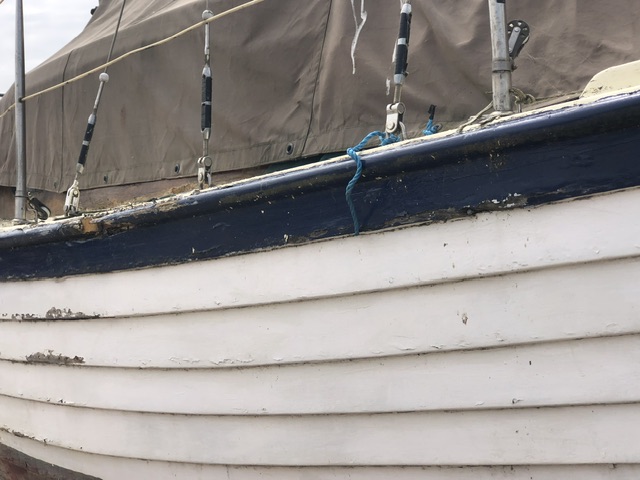
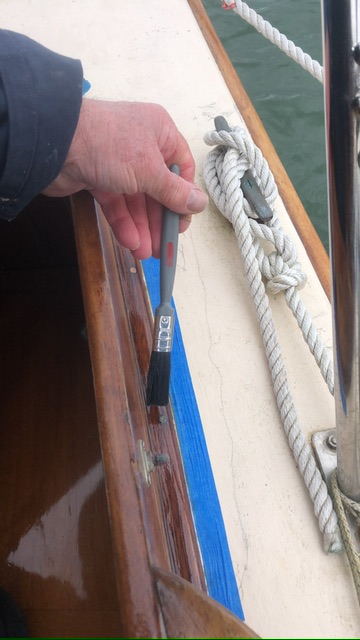
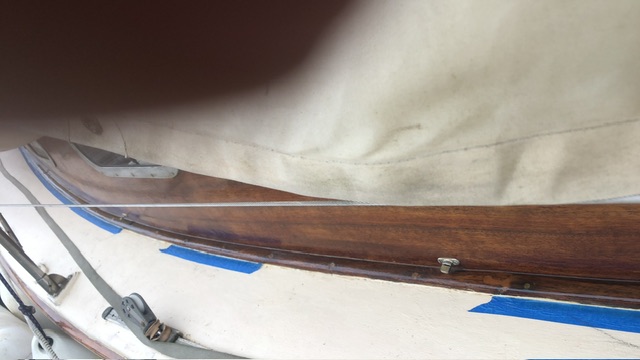
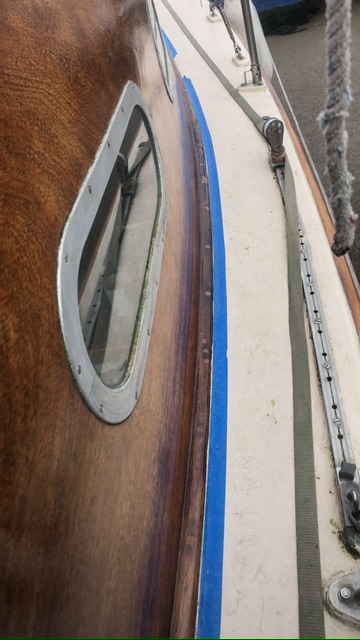
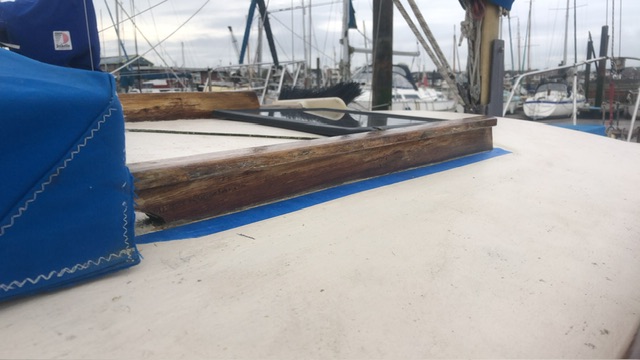
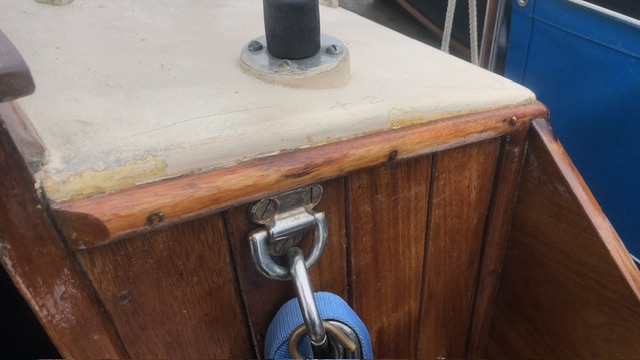
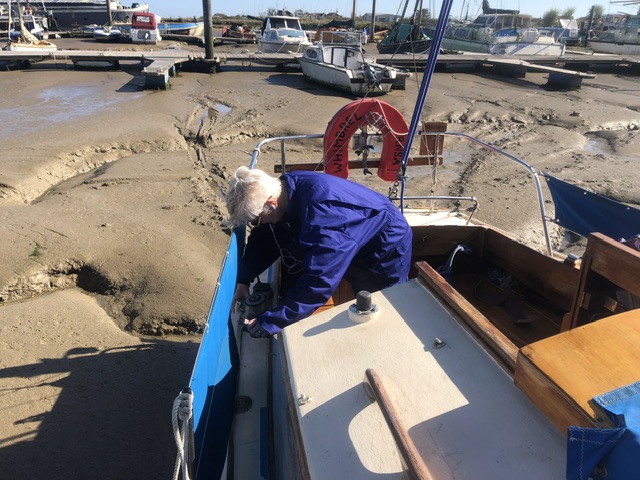
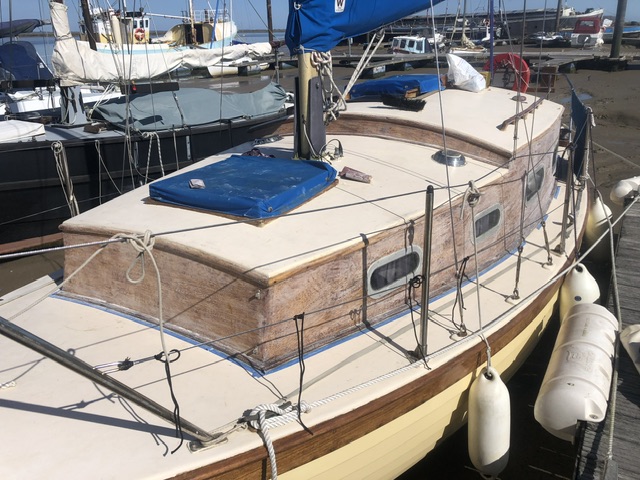
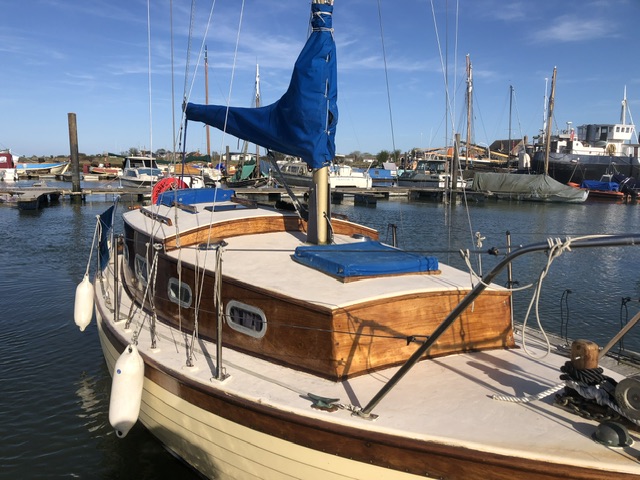
As is the way, when spring comes round, the usual touching up of broken or damaged varnish begins to be remedied in preparation for over-coating. Decks too are spot repaired. Below, the mate always has a thorough clean through of all surfaces and cleans out behind ribs, clearing out trapped verdigris.
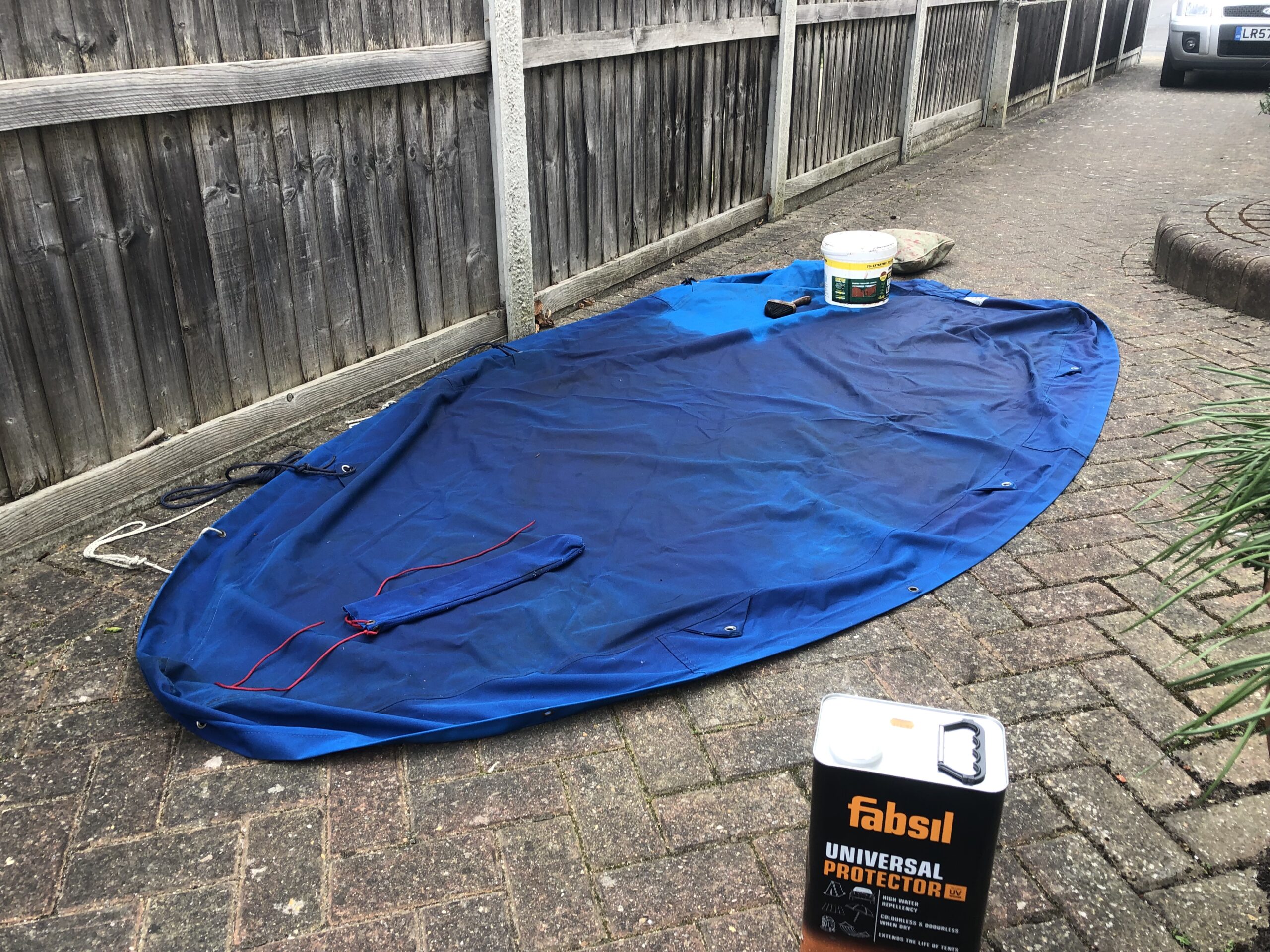
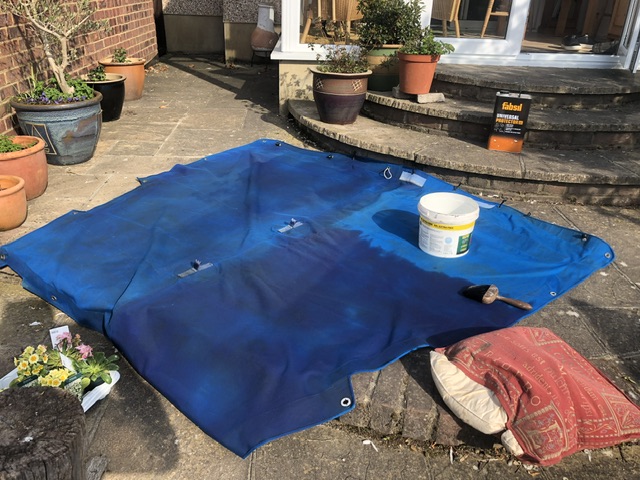
Dinghy cover having been cleaned it was reproofed.

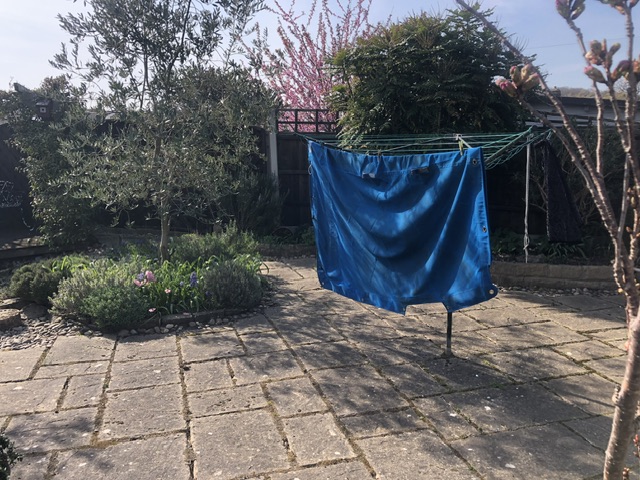
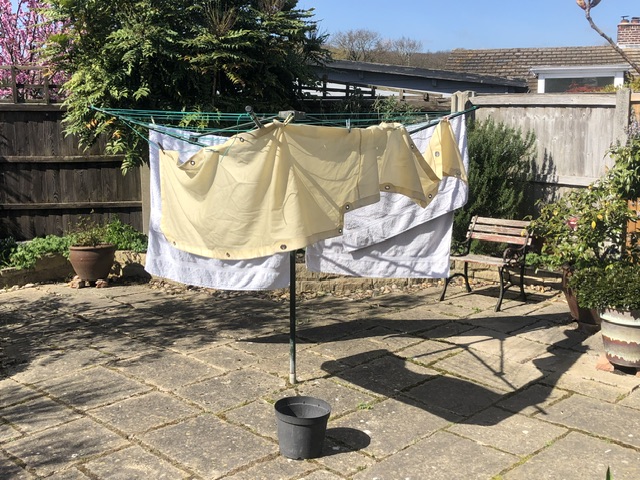
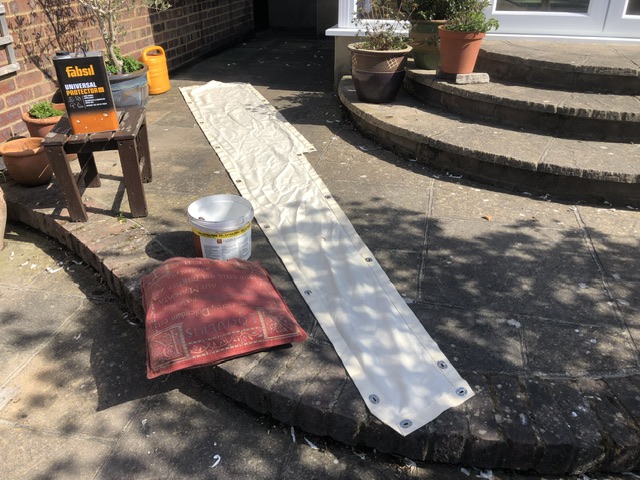
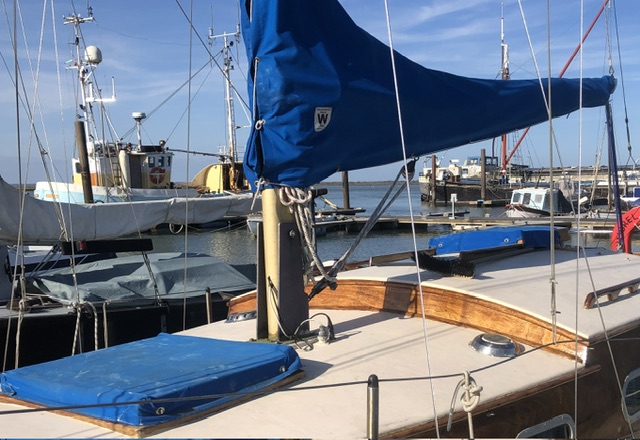
All the covers get a clean and coat of reproofing fluid.This greatly improves longevity – not an arduous job but a cost saving in the long run.

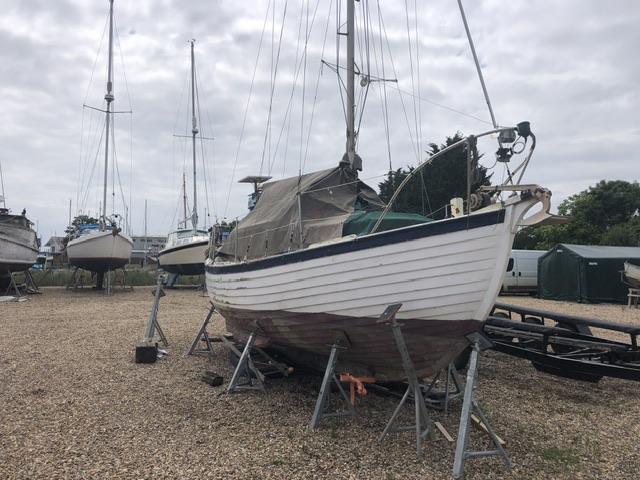
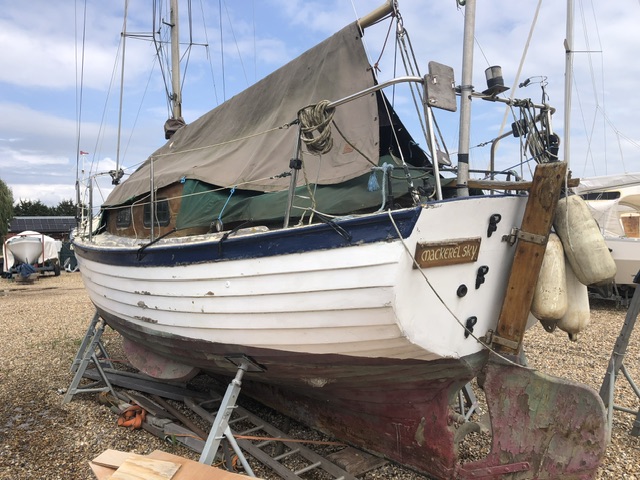
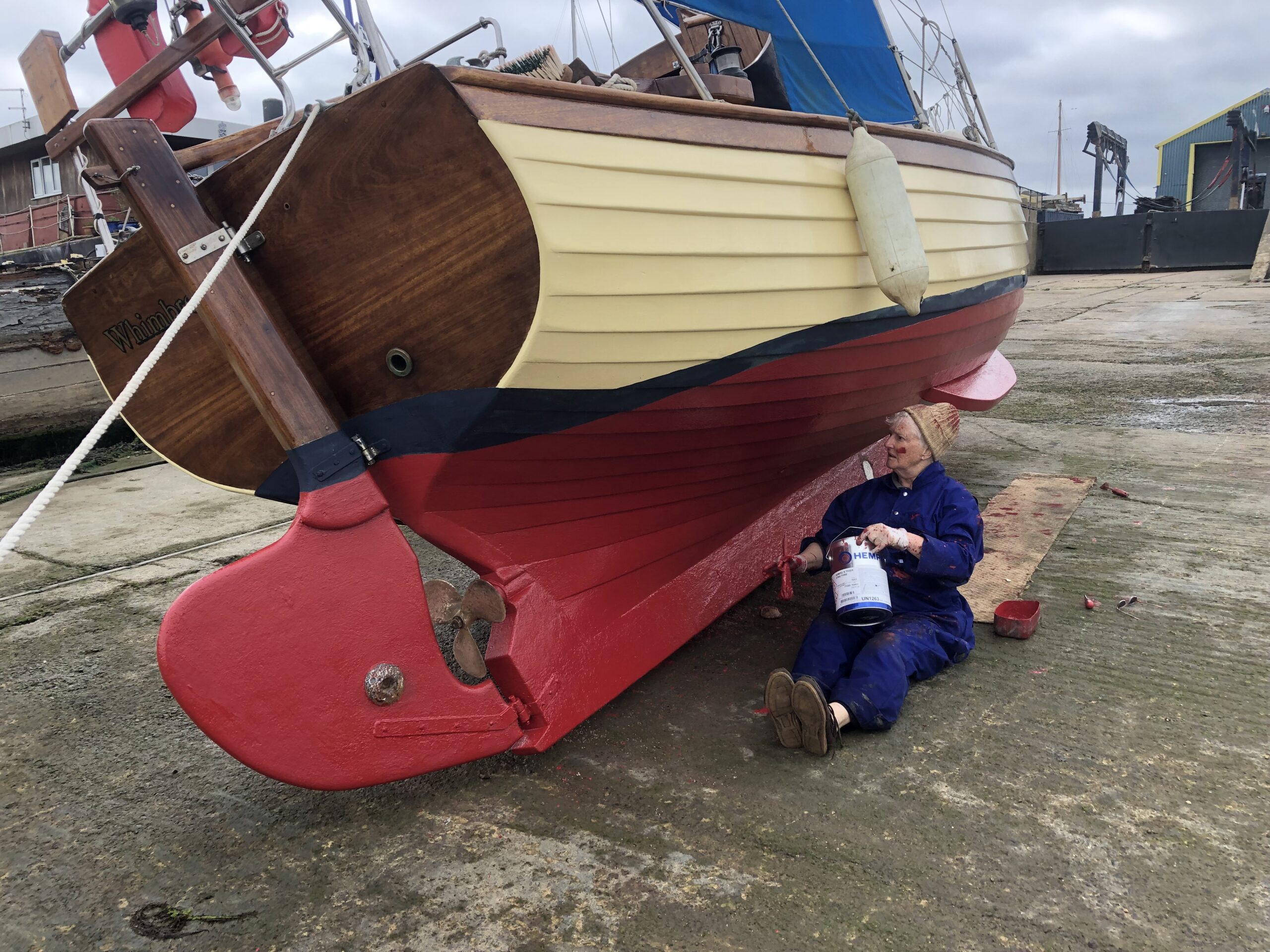
When the tides suit at a suitable late spring weekend, we are ‘free’ to use the yard’s hard to do the bottom scrubbing and antifouling. At that time the hull gets its going over and is touched up as required. The hull varnish work is sanded and recoated too.

This seems onerous, but it isn’t really. The exercise is good (knackering) and we always make it as fun as we can. We usually enjoy fish and chips for supper after the ‘first’ bottom has been readied for painting – the down time allows for drying. The ‘longest’ bit is the early morning wait for boat to ground, pull her over and get at the bottom with pressure washer for I always let the boat ride down hard for the ‘second’ side, allowing an early departure on the subsequent afternoon tide…
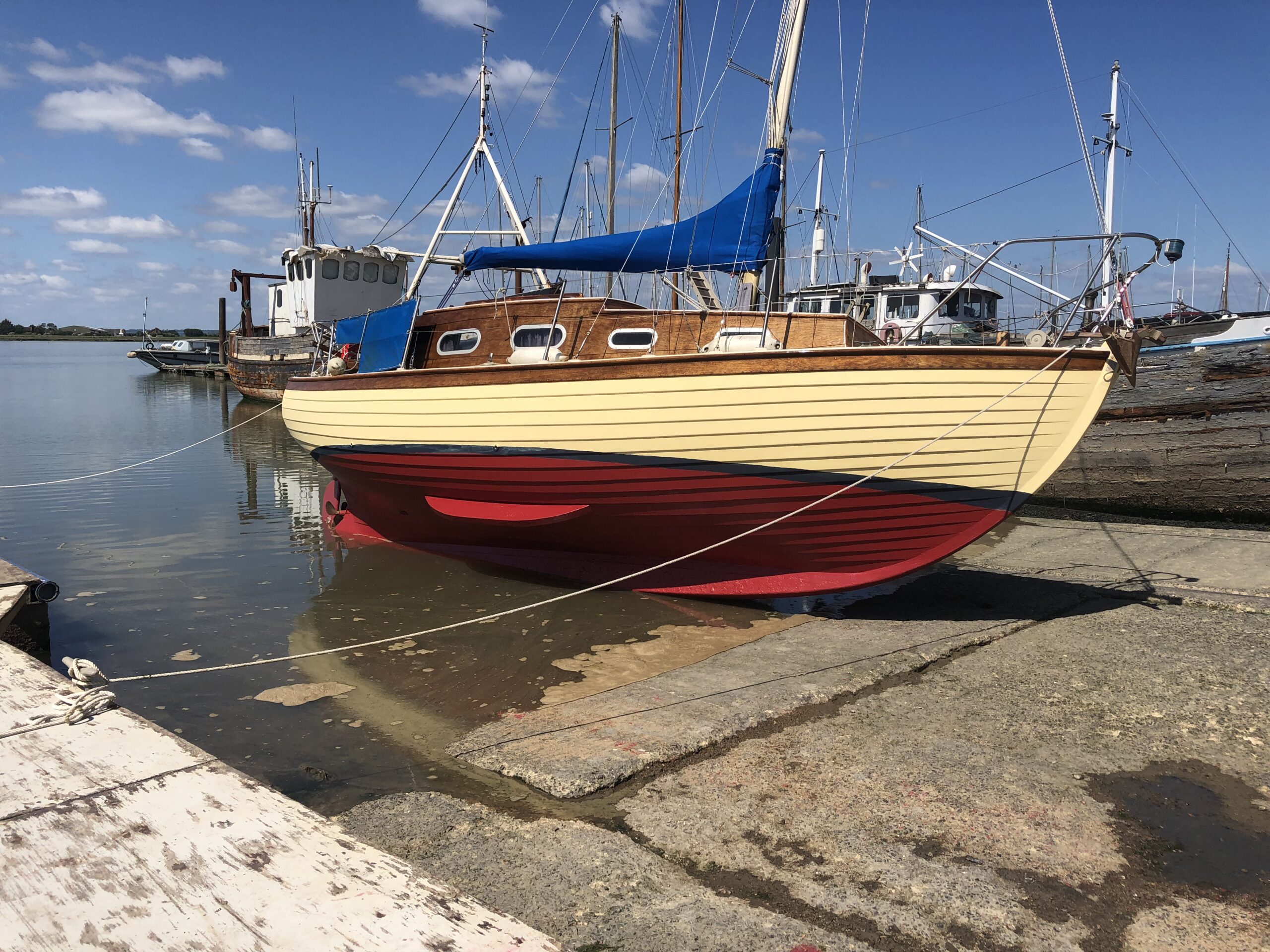
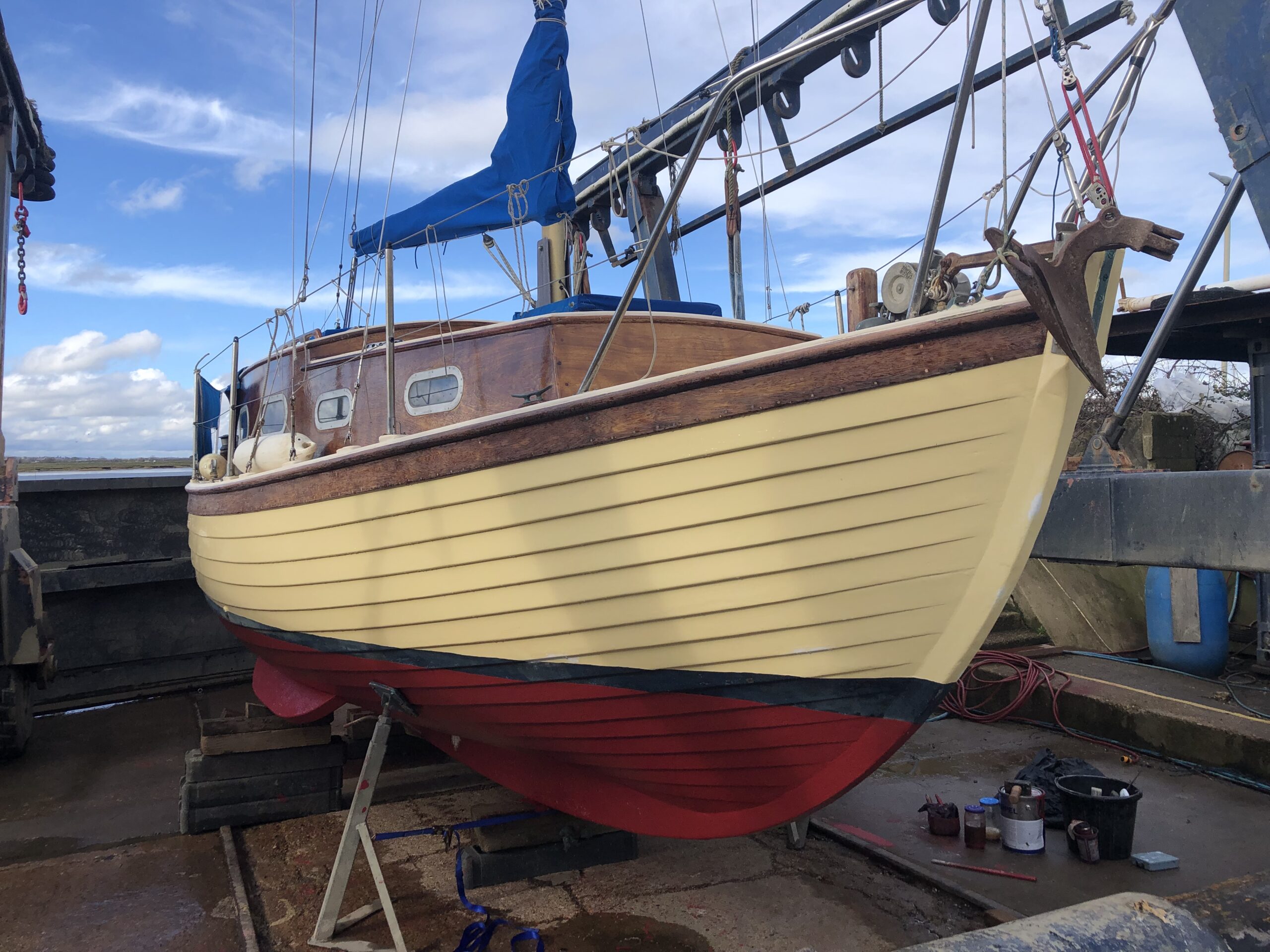
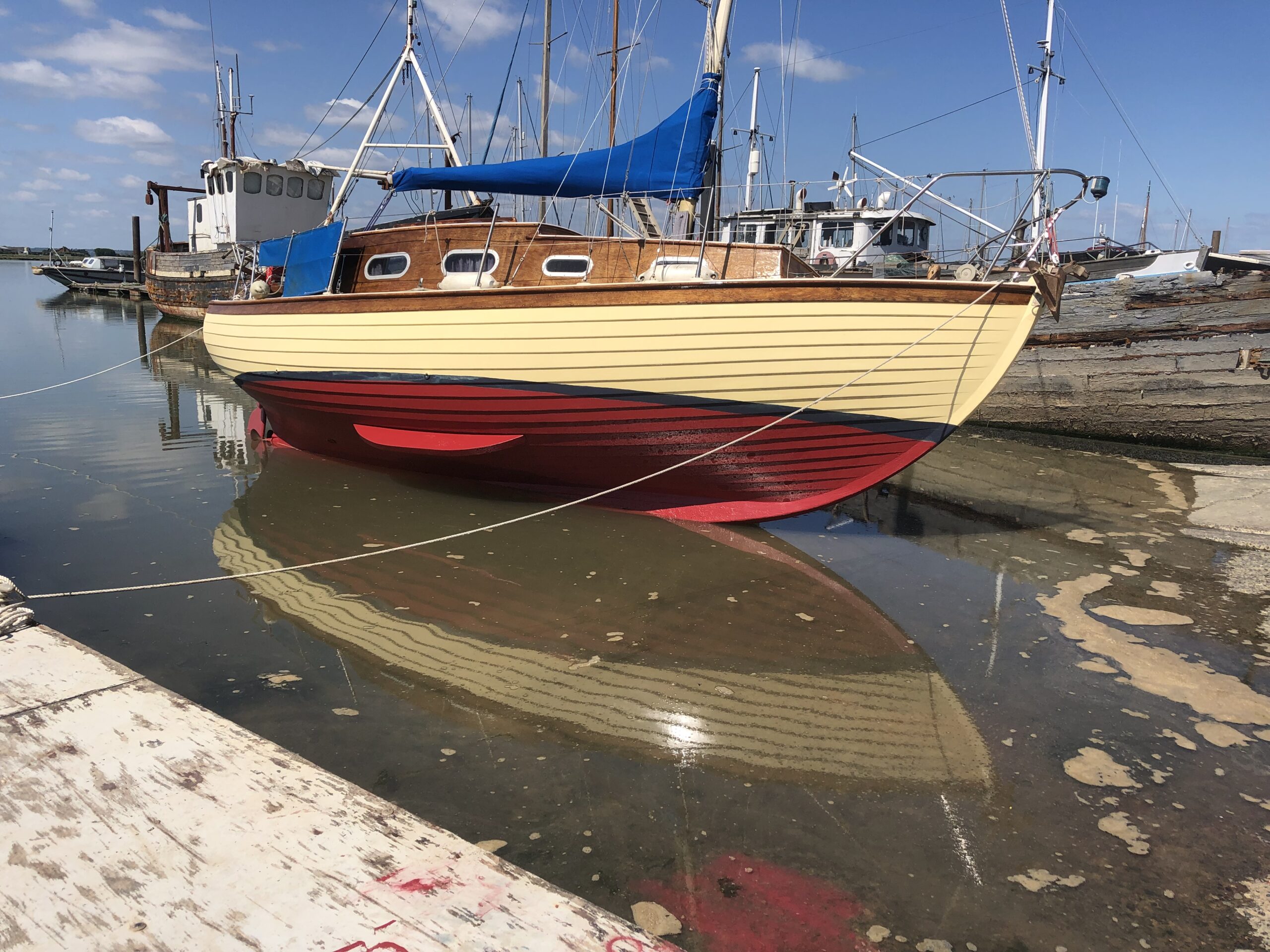
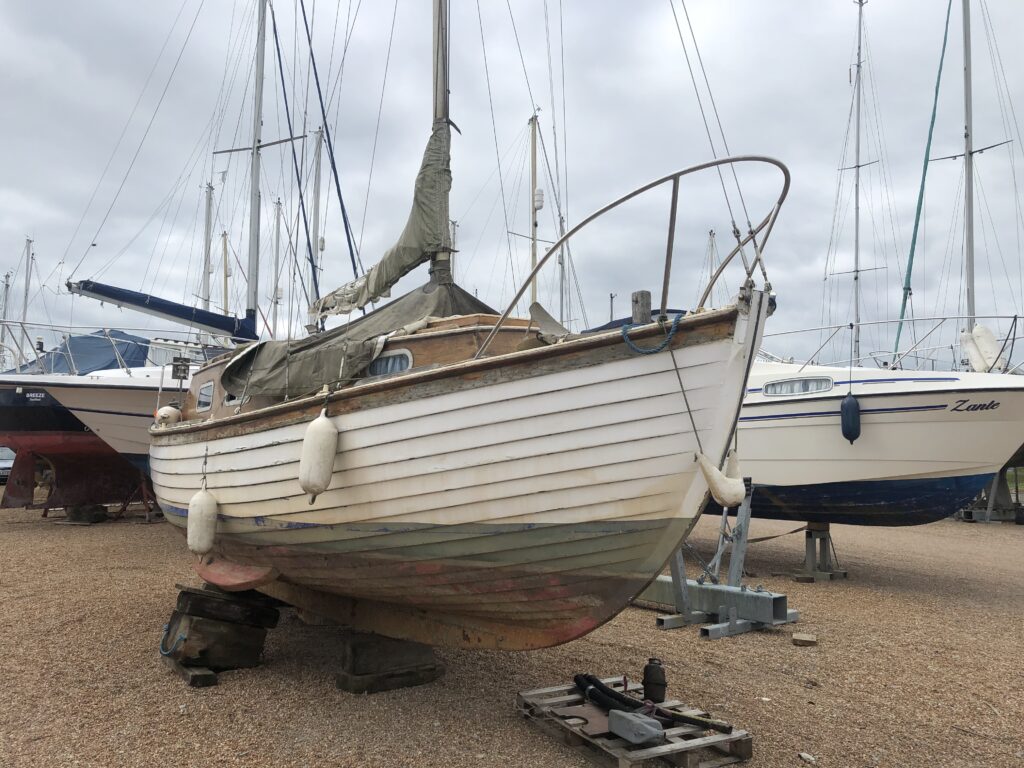
Whimbrel on the hard, scrubbed, antifouled and varnish recoated, with tide creeping up.

After a ten day holiday in Jersey and Guernsey from late May, we arrived home and were aboard Whimbrel within thirty-six hours … unbeknown to us, our boy had boarded in our absence and decorated the inside of the boat with a 70th streamer. That wasn’t all for when the loo compartment was opened it was found to be choker with balloons, which tumbled out… They were strung up, adding to the jollities!

We came back fro the Channel Islands and found Whimbrel had been ‘attacked’…

Over my birthday we had an overnight visit to Maldon staying at the Shipways Yard which is now a separate entity from the chandlery. The yard’s manager (Adrian) and his son purchased the whole caboodle: chandlery is now leasing the shed… I had taken the precaution to prebook…

Adrian and his wife said that their taking over of the yard was a thought-through decision but was still rather frightening. A new office was under construction on the quay in the upstream outer corner a couple of months ago. There yard has a shower facility available too, off the lobby of the sailing school.
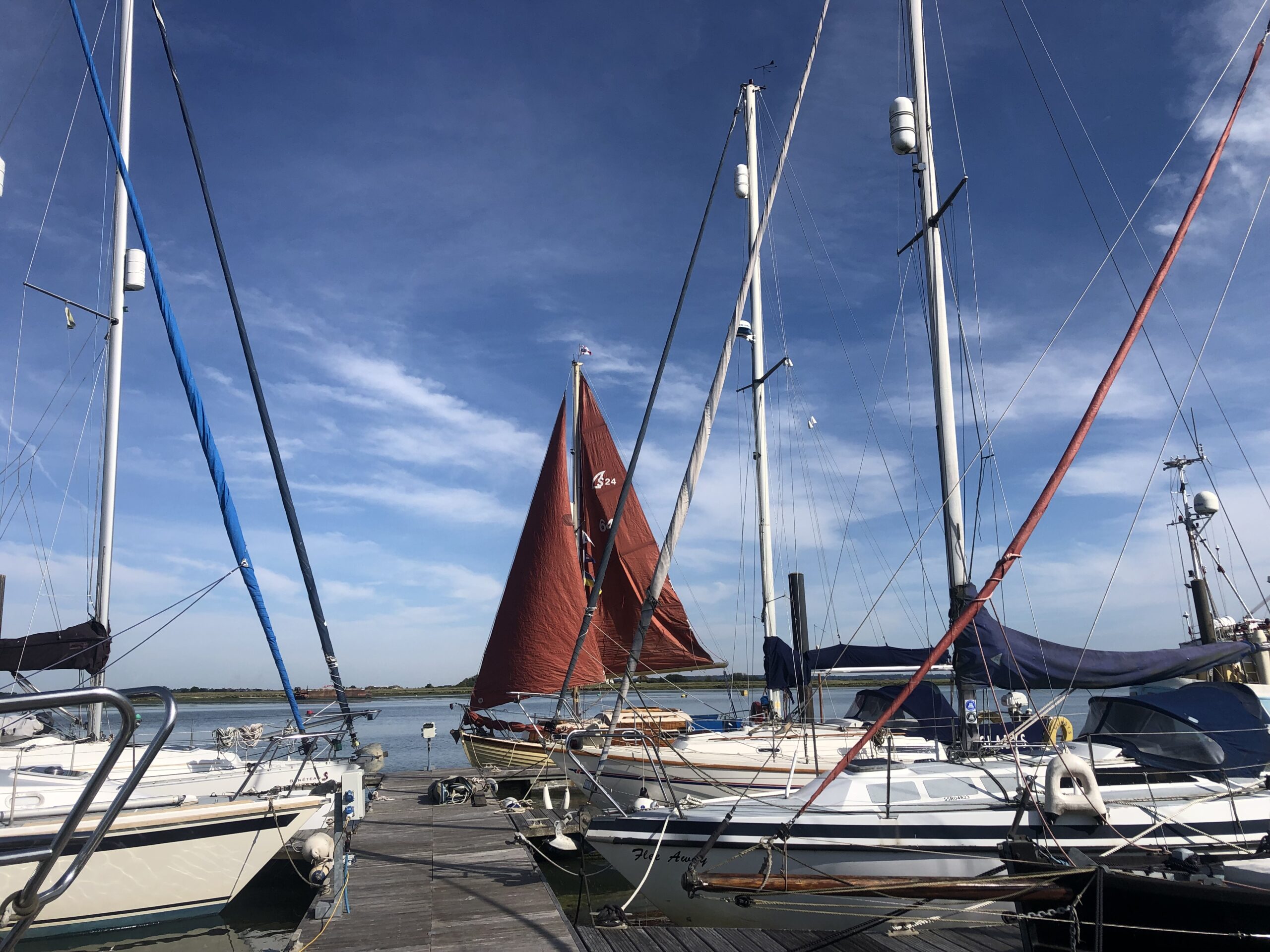
Roger and Andrew (Ardley) were joining: I moved Whimbrel to outer pontoon and got ready to leave…

The annual tie up with my youngest brother and a cousin, this year, meant an early Friday arrival for them due to tide times. To be sure, Whimbrel was moved onto a clear outer pontoon, ready to slip, on a falling tide. It was a grand weekend, with some lively sailing.

My brother provided us with some delight in the Mersea Quarters sailing Twitch in stiffish conditions. A lot of fun was being had we could see, but when he was on a return to base leg in the cut, off the floating pontoon, I said to my cousin, ‘Don’t gybe … don’t gybe…’ looking at the dinghy. A gybe took place with its resultant capsize and crew dunking … my brother was standing up to his waist bailing the dinghy when we slipped alongside on a rescue mission… It was all under control though but was for the best. The newly serviced and equipped lifejacket had inflated!

Twitch going well…

The turn of my sister and two friends came next after the mate and I had enjoyed some pottering on the Orwell and Stour. I’d planned for us to reach the navigable head of the R. Alde as well as a tour of the R. Deben. Objectives were achieved with slight change to some planned destinations due to weather. Early on the tide from the Butley River the crew sailed up to well above Iken Cliff, where after touching, we stopped for lunch. There wasn’t to be any digging out sagas this time…
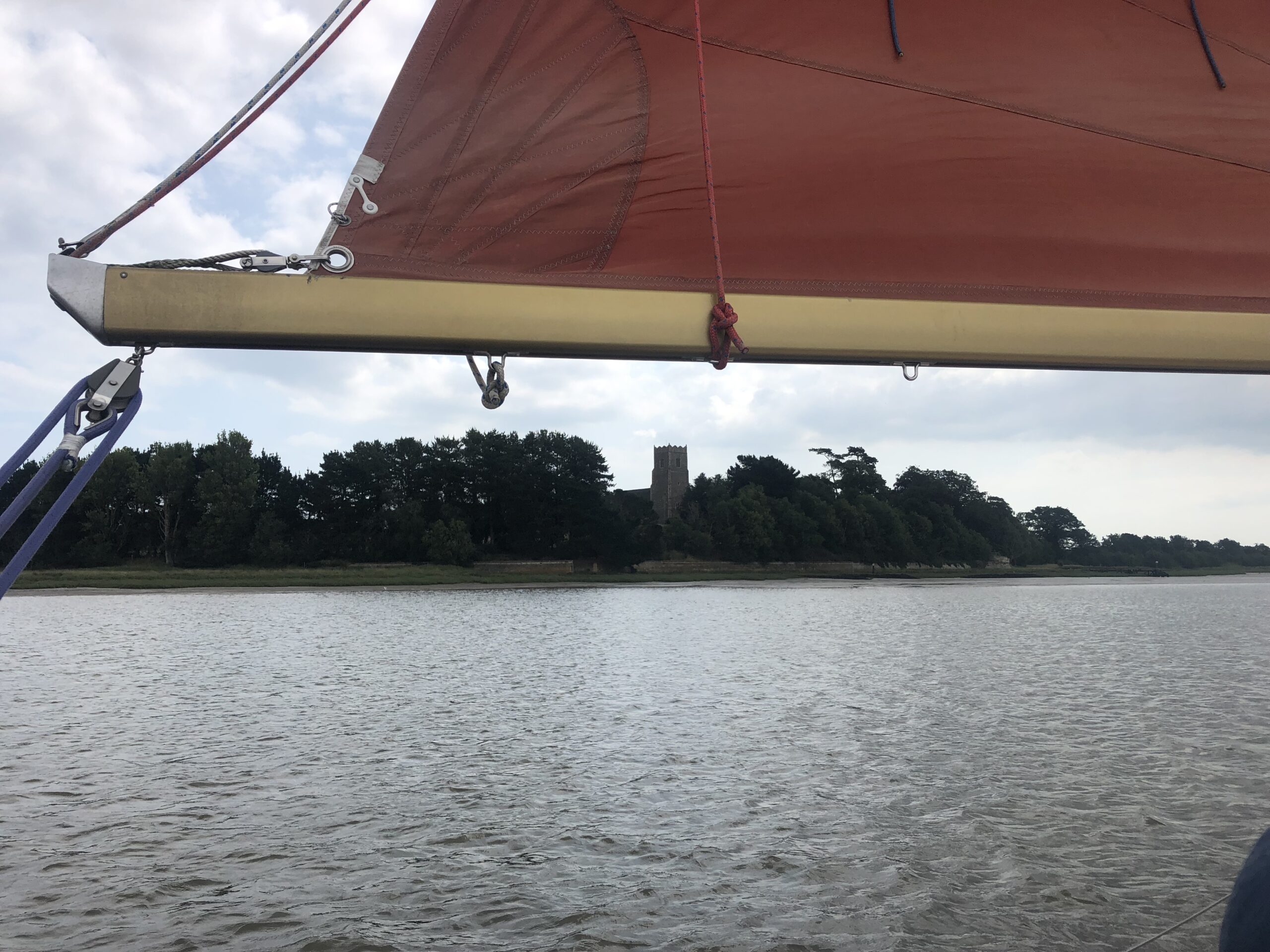
Passing Iken Church on the R. Alde.

We met a Dutch couple during the Snape trip and they came aboard two days later for a drink when we were both moored above Felixstowe Ferry ready to clear the river on the following morning.

The mate and I had an ‘interesting’ rest more or less in same spot a week or so later. Coming to one of a myriad of vacant moorings with trailing weedy lines, the ‘harbour master’ ferry man was passing and I nodded, he waved, I assumed we were cleared to moor. Later, I was asleep (!), with mate in cockpit reading/knitting the ferry man ranged close and gave her a rocketing for mooring without prior permission … he was extremely rude … he had passengers aboard too! Mate, although indignant, ignored him, especially when he said, ‘Do you understand me…’
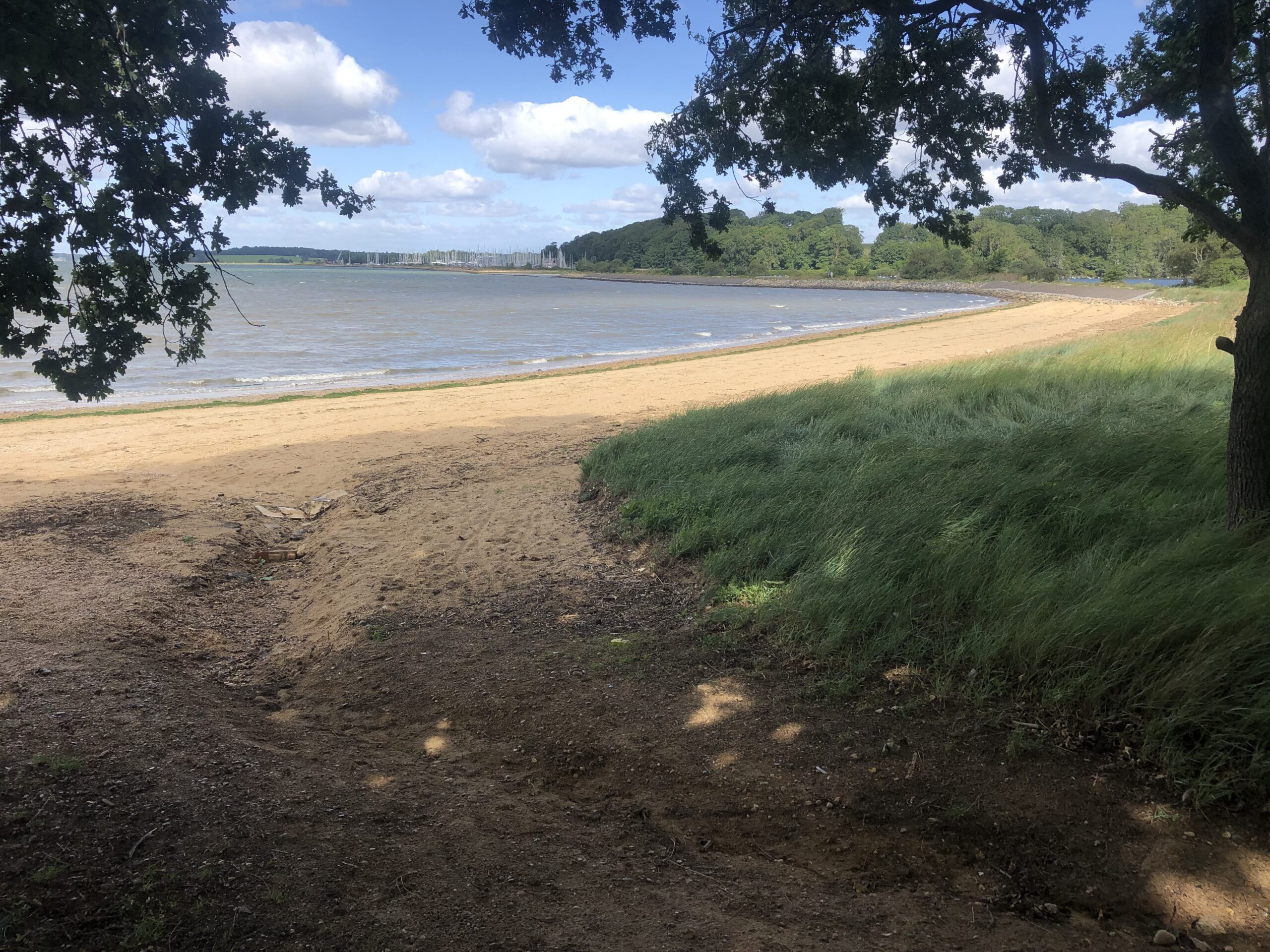
On a windy day in Suffolk Yacht Harbour, we went for a walk inland.

The summer was punctuated with a couple of windy sessions along the way and during these we made for shelter where ease of getting ashore was number one priority. Windy days make for good walking days, especially when sun is sparkling on the white overfalls on turbulent waters.

A little ‘funny’ – the laundry was strung up in the rigging at Suffolk Yacht Harbour and we returned from a walk to well aired dry washing … it was only later when I couldn’t find a pair of smart chino shorts … we realised they’d clearly escaped!

On the whole the summer weather was good, again. Towards the end of our cruising, we had a rather delightful sail up to Colchester Hythe with a gentle breeze wafting us along. The visitors berthing was all taken up by ‘abandoned’ and other craft, bar a short bit awash with saltings at the ‘town’ end. Later I found out that one alone was there by permission. So, judging short end not fit for purpose and in the grass, we about turned and powered down to Wivenhoe where the delightful sailing club welcomed us into a berth.
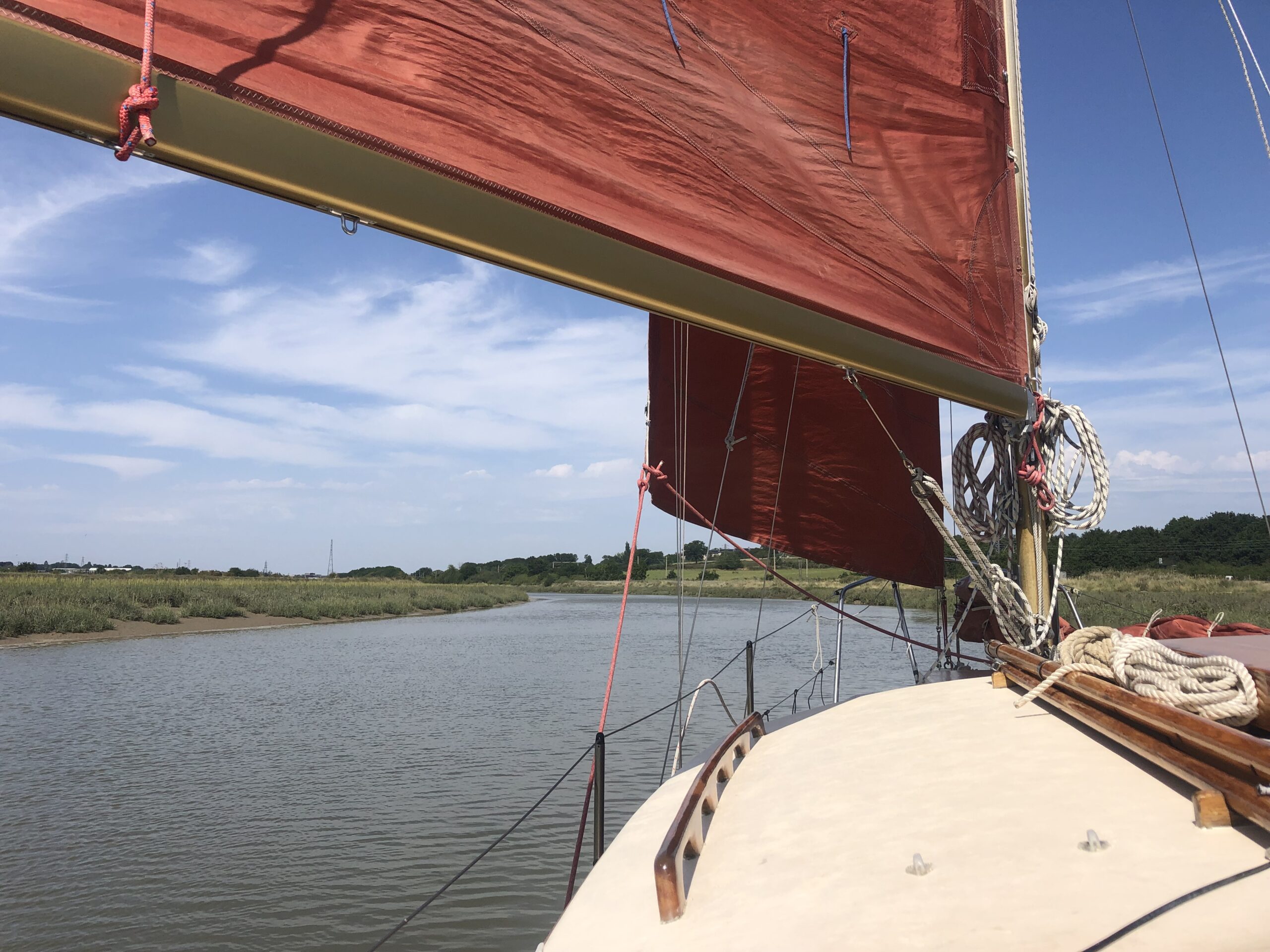
Sailing up the R. Colne to the Hythe.

After a discussion with Colchester Council, I was told that many changes were to take place along the Hythe to tidy it up, clear ‘dumped’ vessels, put in some control and keep the visitors pontoon clear for visitors…

I got a bit of flack from a disgruntled mooring holder who completely took the wrong line on a piece I gave to the Blackwater and Colne Users Group – apart from being branded an ‘incompetent’ she threatened court action! So, since then, I have stopped adding stuff to the group as nothing was said. Facebook seems to have got a heck of a lot worse in recent times and group controllers are just not doing their jobs.
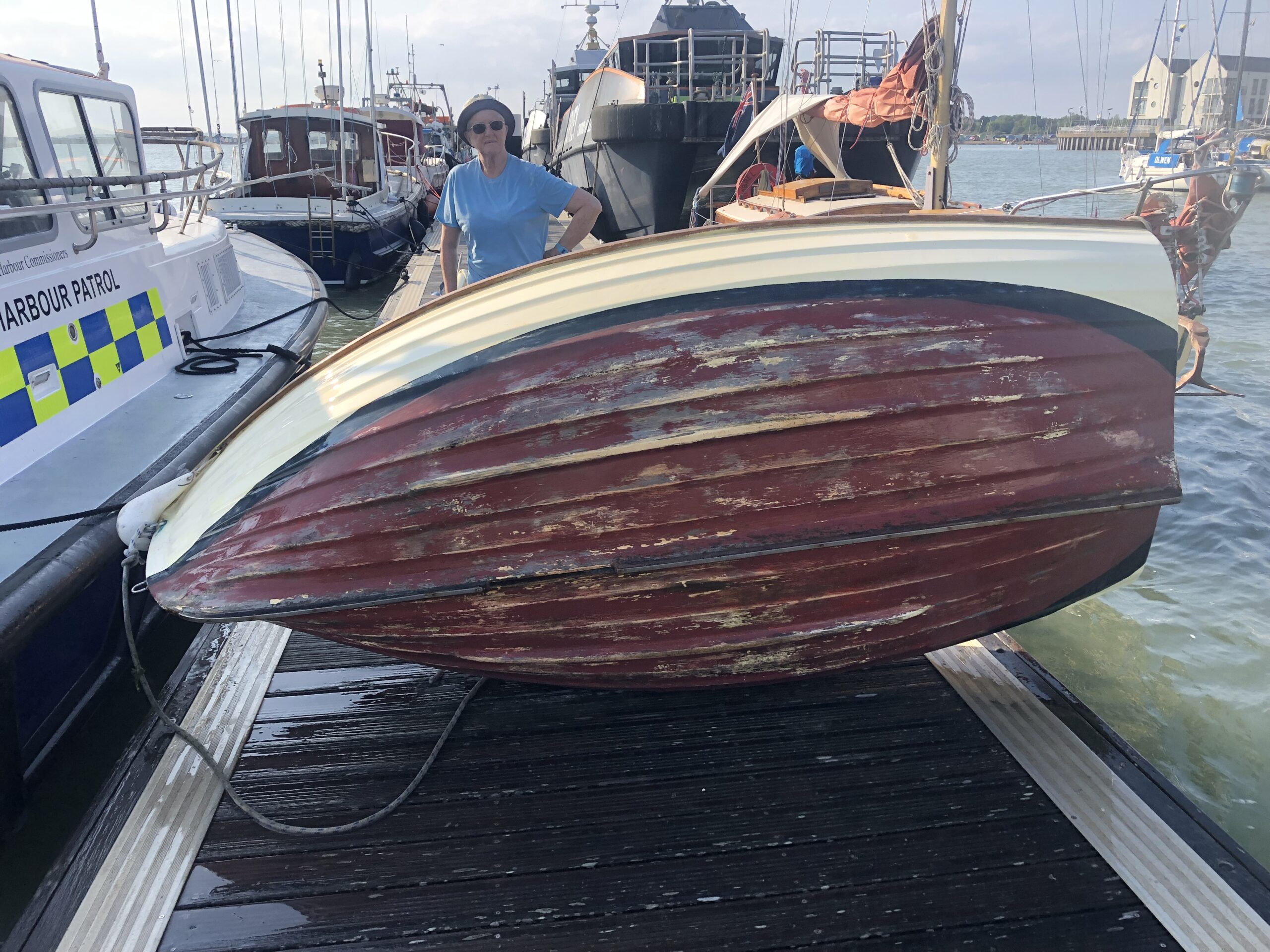
Scrubbing Twitch’s bottom.

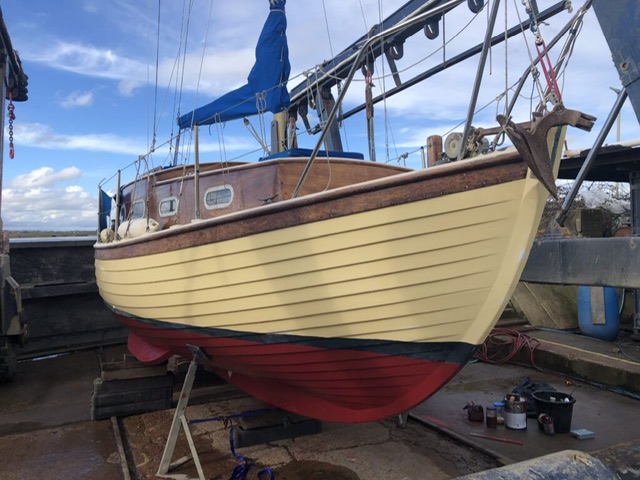
Twitch’s bottom had two scrubs this last season. Fouling wasn’t bad though. Lower down is a picture of her bottom anti-fouled ready for her next ducking…
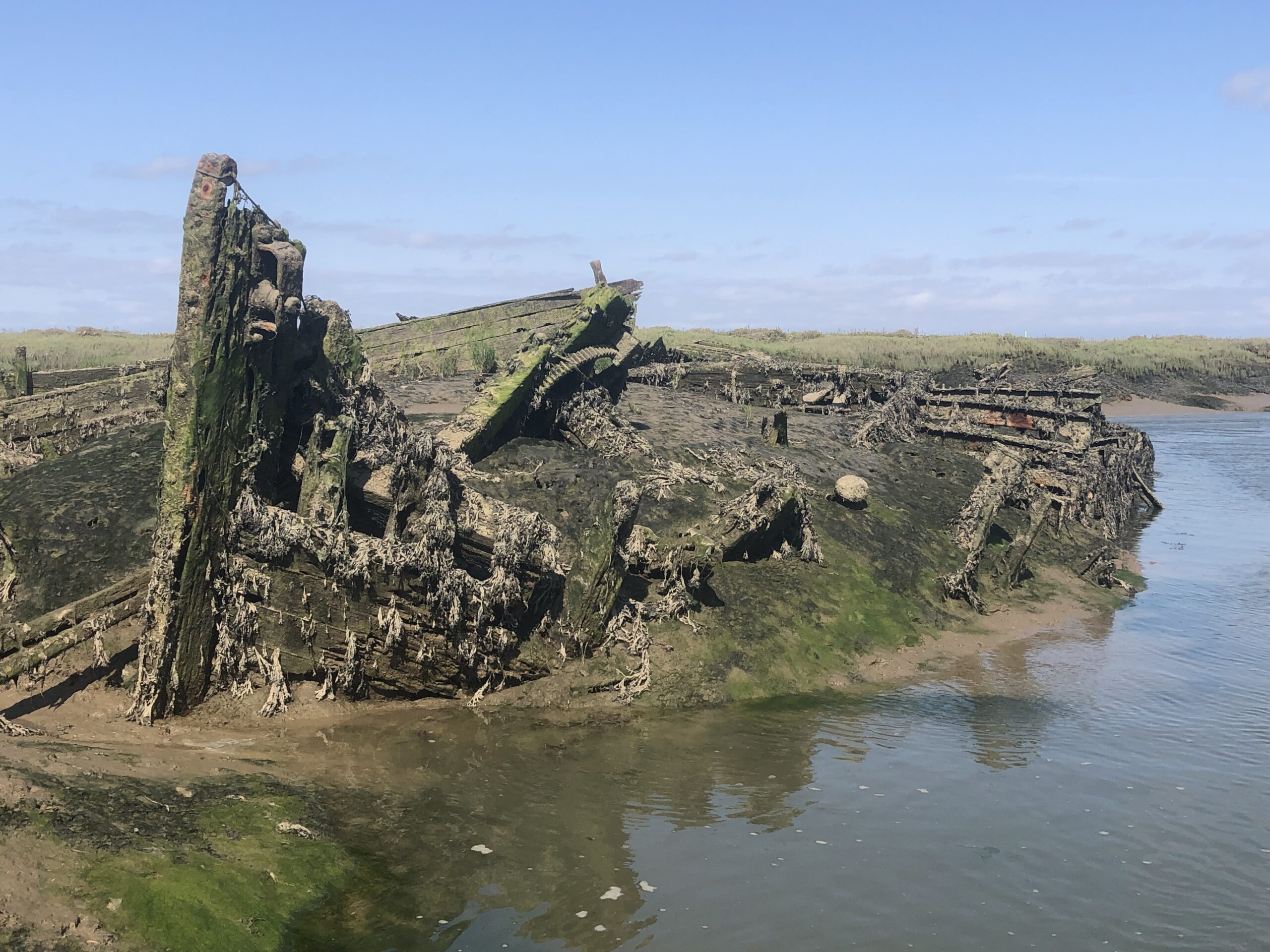
I crept into a gutway off Woodrolfe Creek to look at the remains of the Saltcote Belle.

Twitch took me into various little creeklets during the season, as is the way. One was a little gut of Woodrolfe Creek where the remains of the Saltcote Belle rest in decaying grandeur. It has been interesting watching her demise over the years – she was a barge from my childhood and was often met in our family sailing!

The Rally for Finesse craft was organised by Whimbrel’s crew this year, however, the weekend coincided with a rather torrid ‘summer blow’ – it cae as per forecast and if boats had travelled earlier in week, we could have had a grand time. Disappointingly, it was just us! Various owners came by road for chat and a evening chow at marina’s bistro bar.

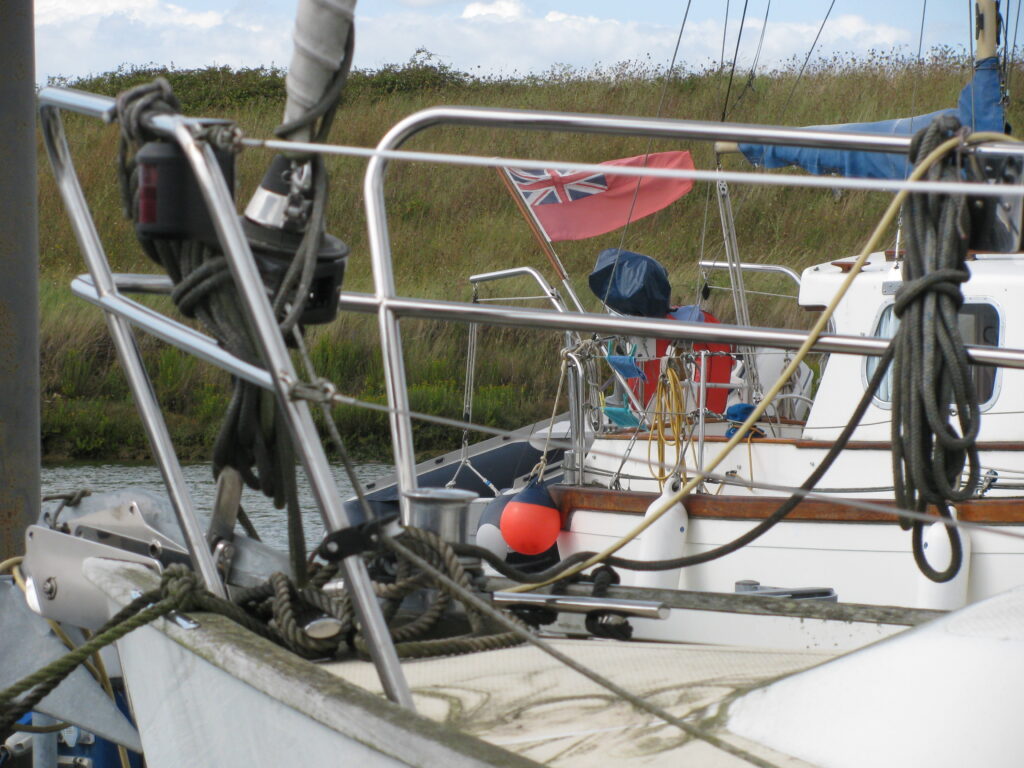
Whimbrel dressed for the Finesse Rally…

Autumn came upon us, as per usual, and we had a few trips down river taking in West Mersea and Brightlingsea. The Colne barge match weekend was a disaster but a few local barges and smacks braved the weather, which on the day, wasn’t as bad as predicted. We didn’t make it.
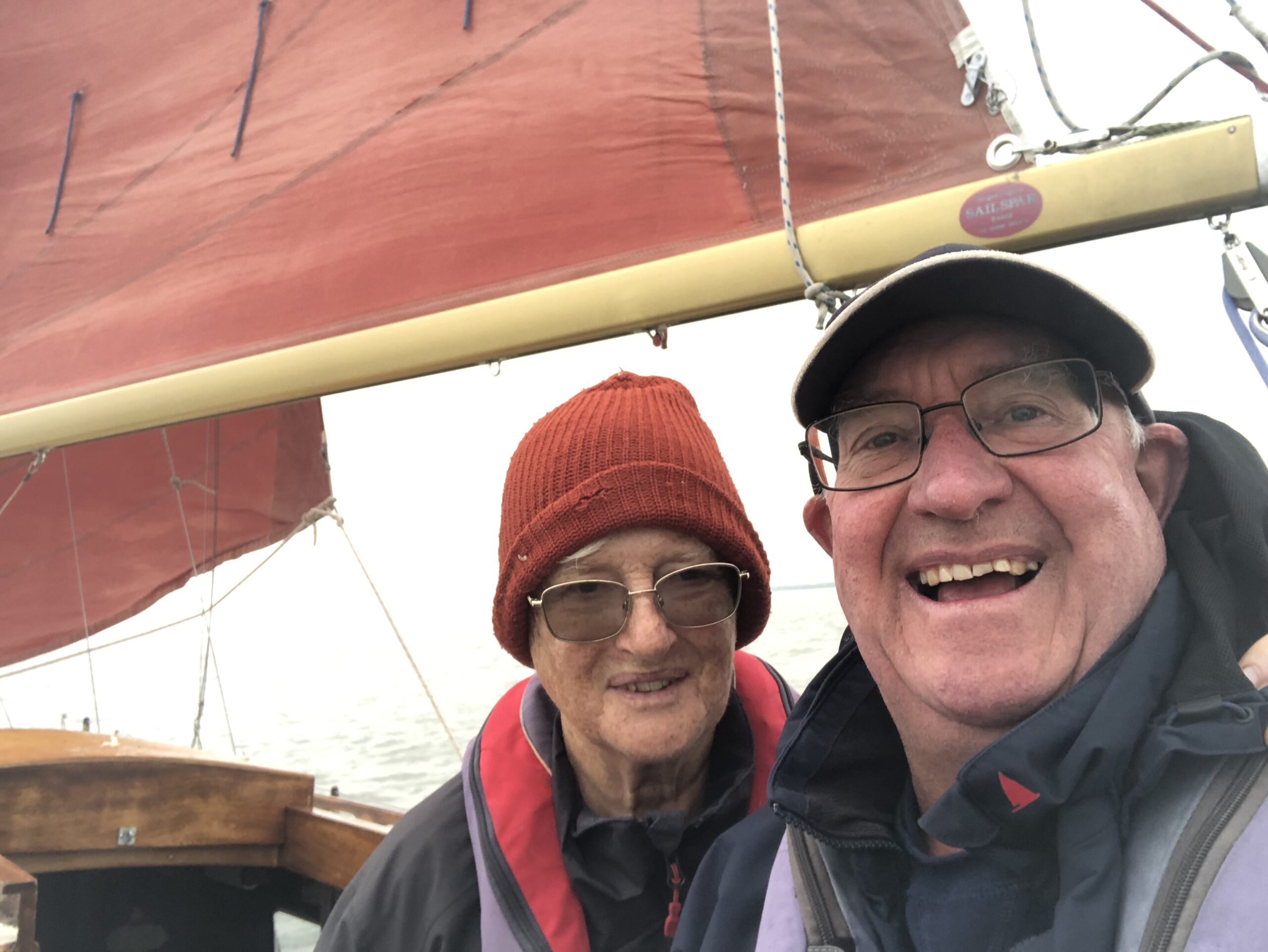
The crew, dressed for the autumn!

In fact, the mate came up with a rather grand idea, ‘why don’t we have a ‘dirty’ night away instead…’ she had a twinkle in her eye too … so I found a room at a delightful hotel in Lavenham for the Saturday night. We plan to go back. Food was grand too! Lavenham is in Suffolk, beyond the R. Stour.
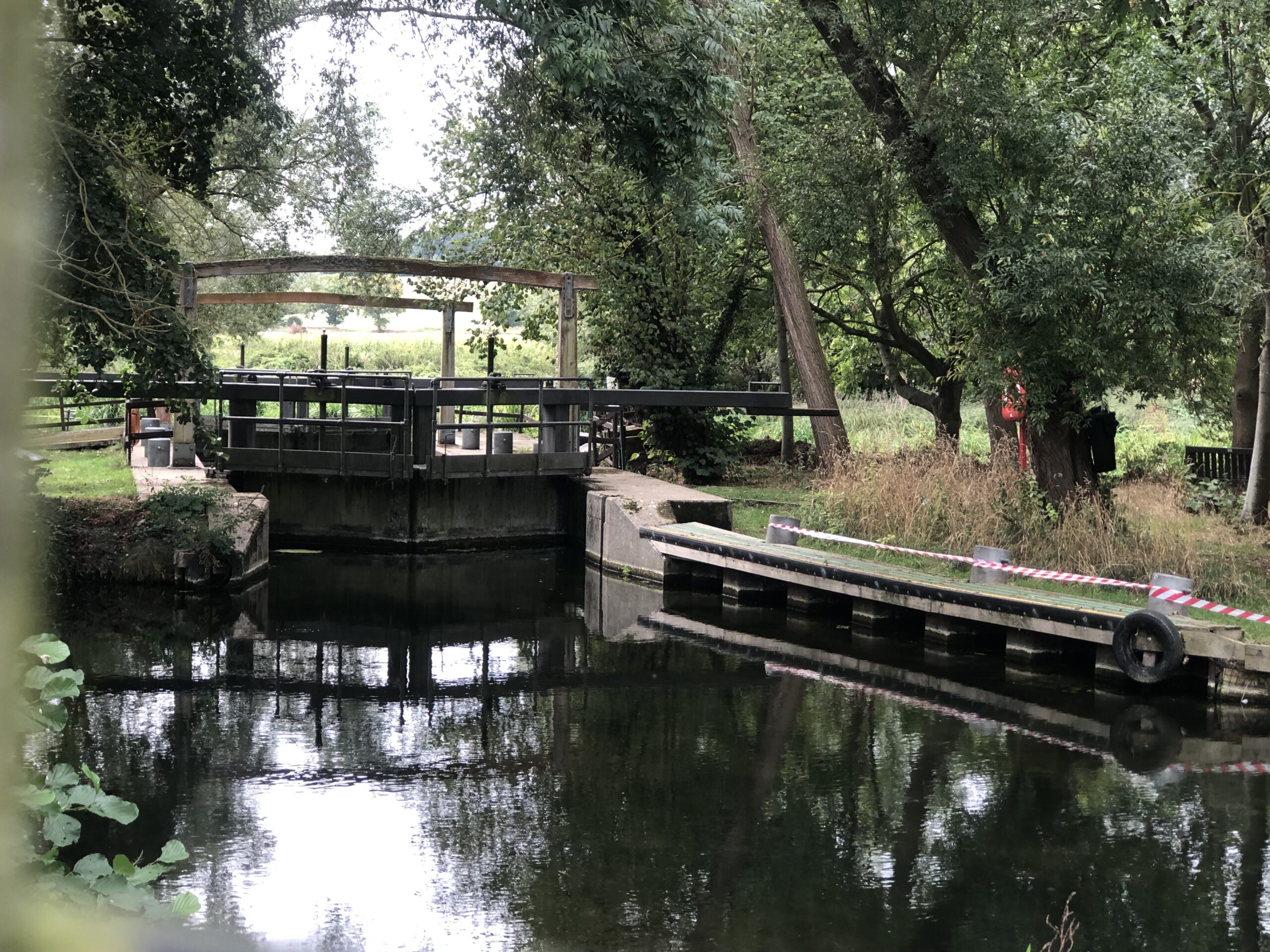
We stopped off in Sudbury and found water – the R. Stour!

On our last visit to brightlingsea, in ideal and delightful conditions, we were able to get away from the Heritage pontoon under sail with a clear slant – second time in the year – and was watched by a group of rowers.
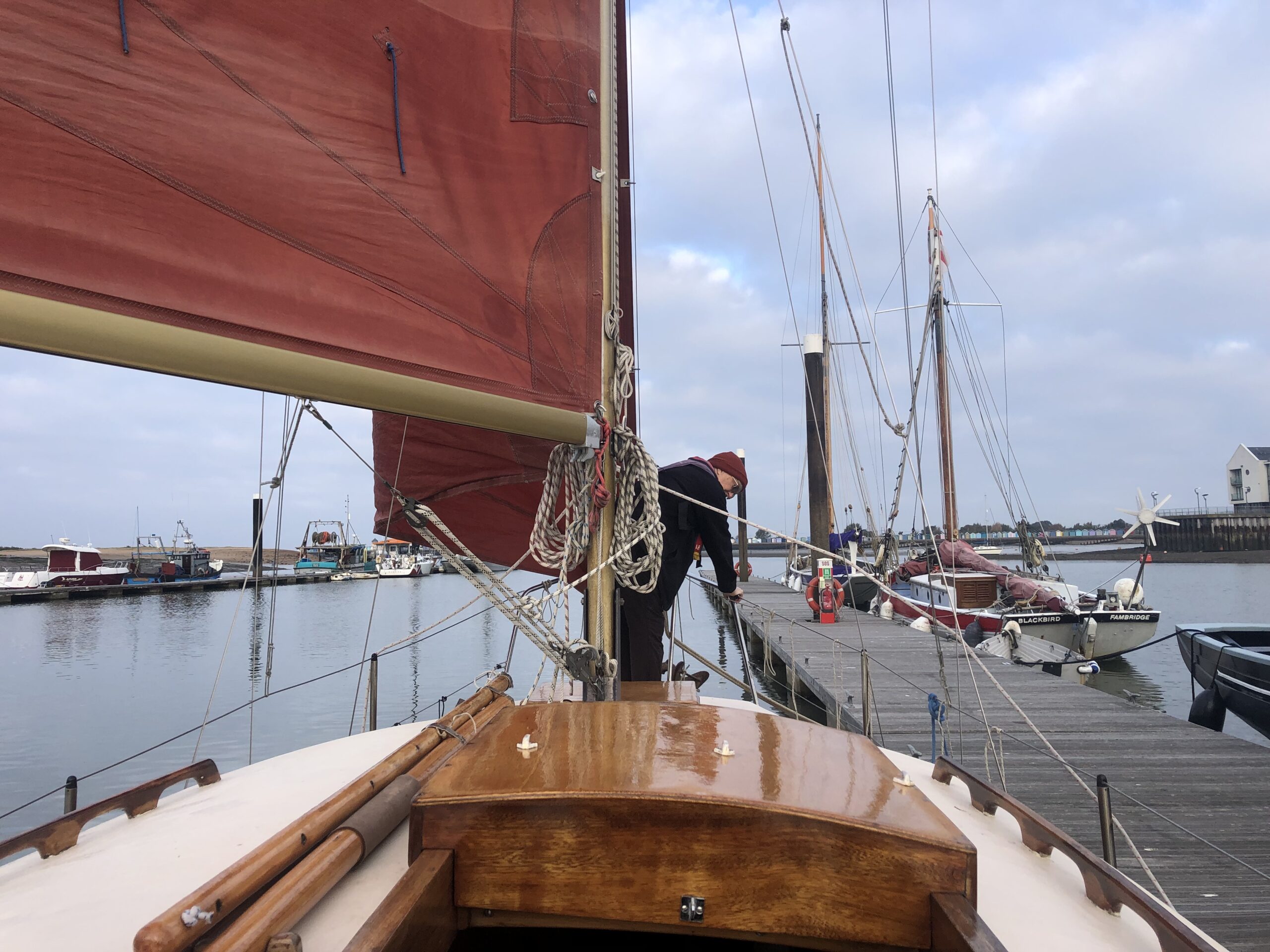
Mate looks back: she’s ready to slip from Heritage Pontoon, Brightlingsea.

By the first week of October our overnight sails were at an end. We had a cottage holiday in Derbyshire during the last week by which time November was nigh.
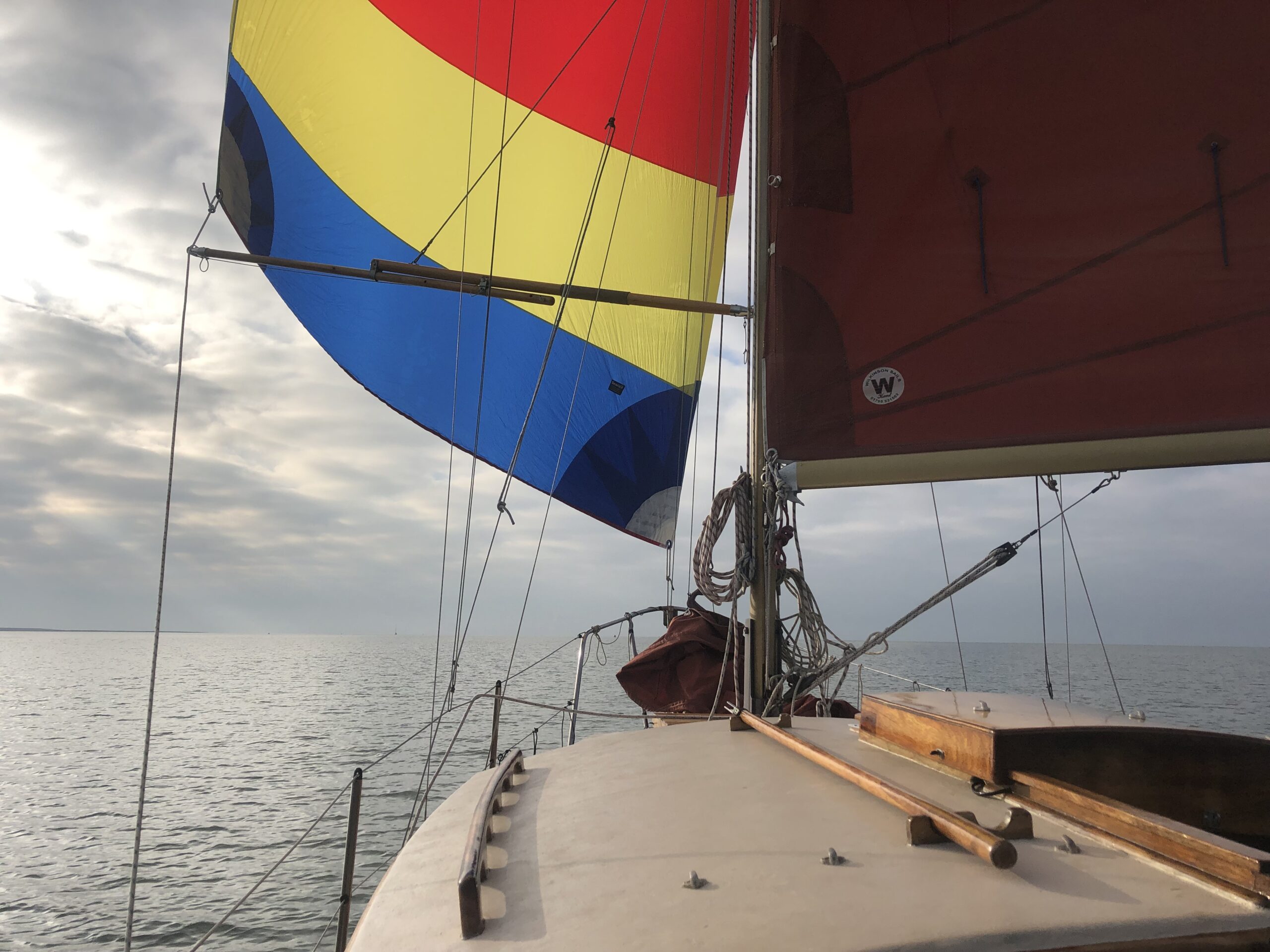
Cruising chute used while returning on our last weekend…

While the weather was still good enough, the dinghy had a varnish make-over ready for a full over coat in the spring and her bottom was done too.
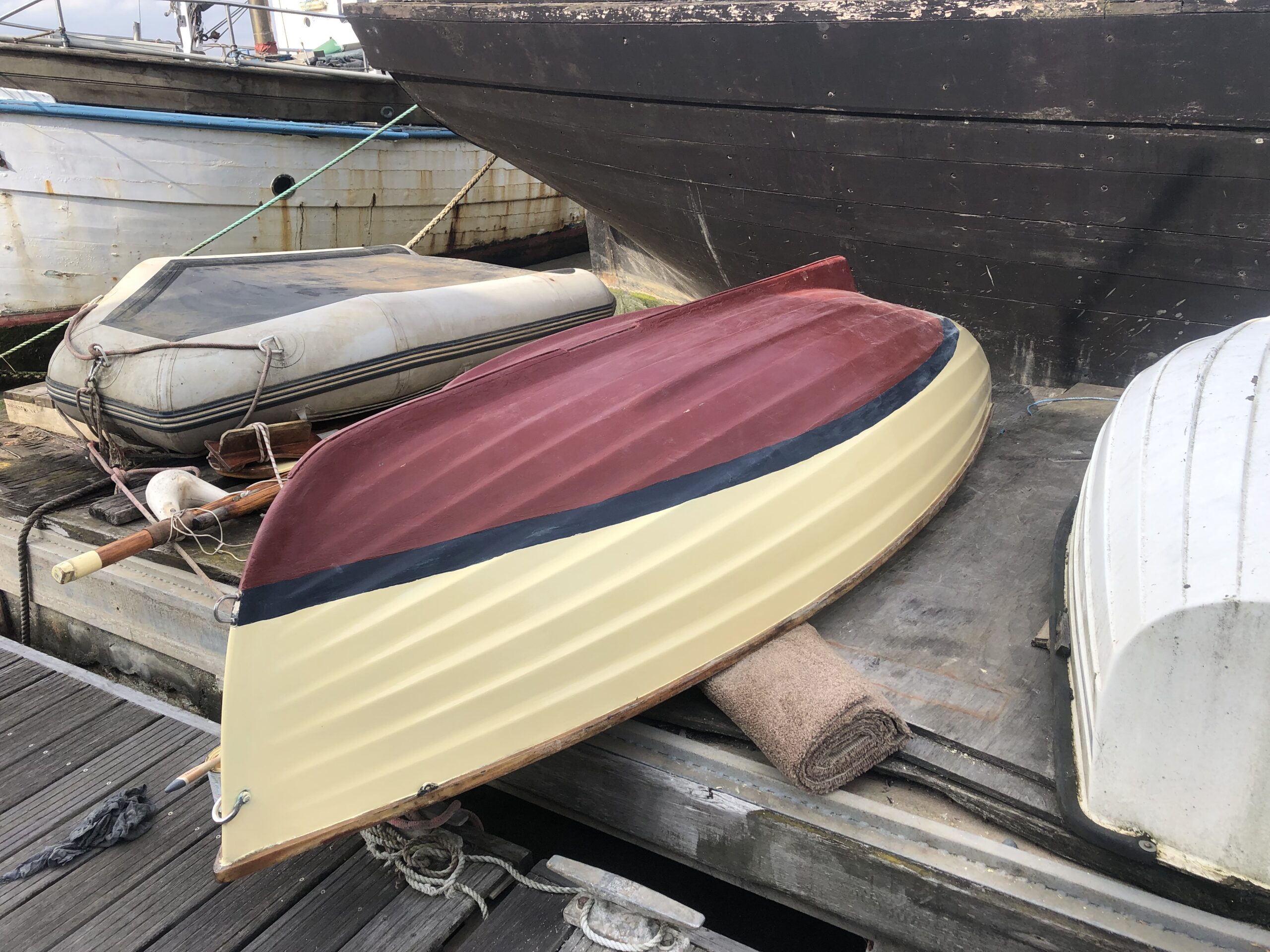
Twitch is prepared for the next season!

The autumn and early winter have dished out a lot of wind but continued joys came our way.

Yes, it has been a good year.

What many boaters miss are those wonderful coldish days when the sun shines. The air is clear and the colours are wonderful and reflective. I wouldn’t miss it for the world…
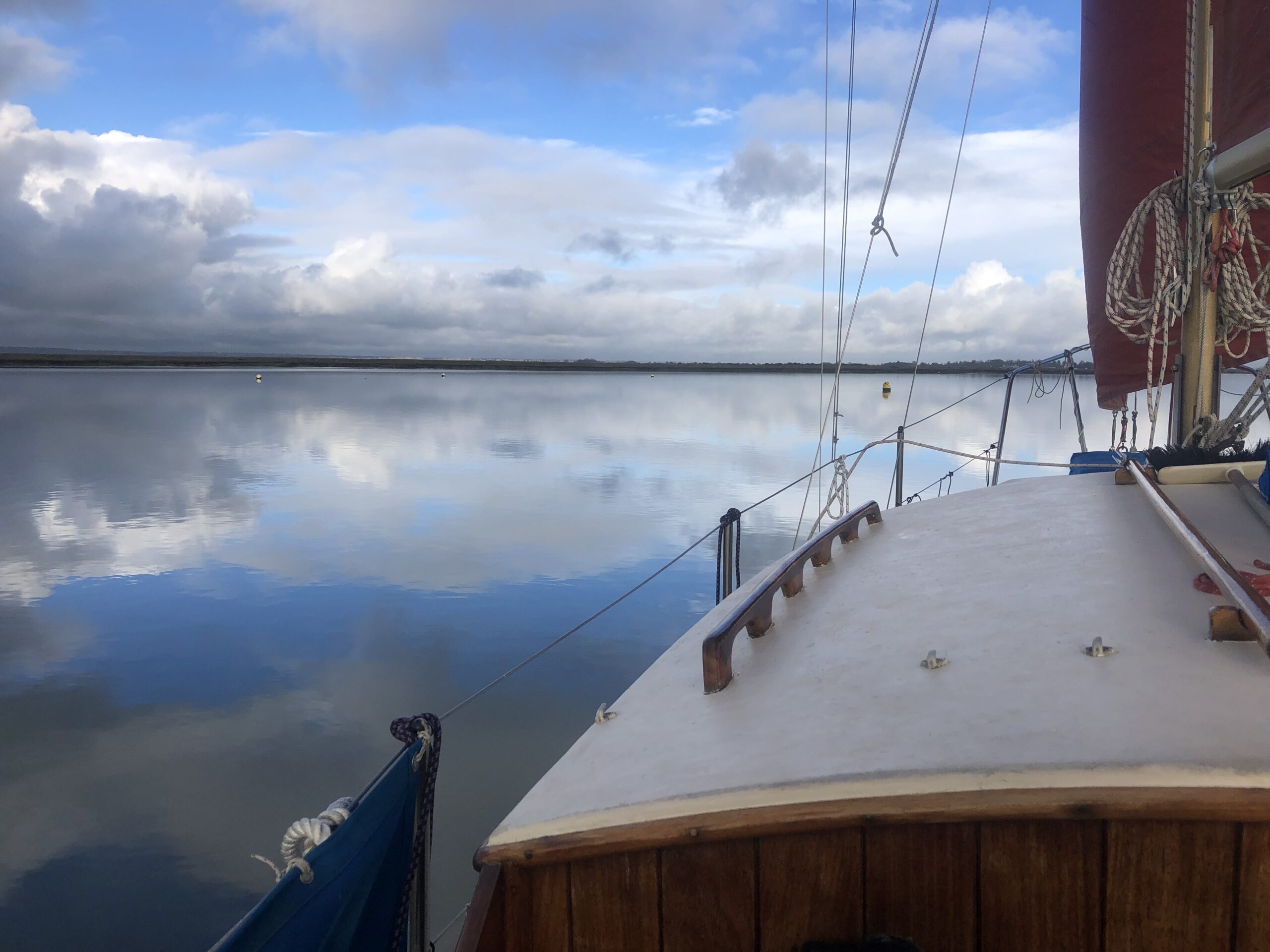
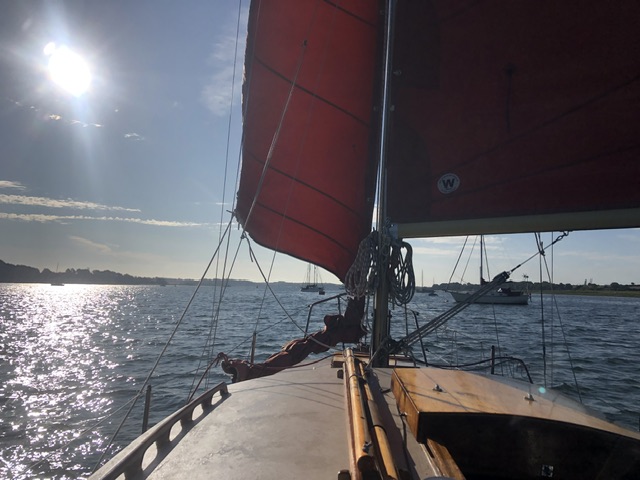
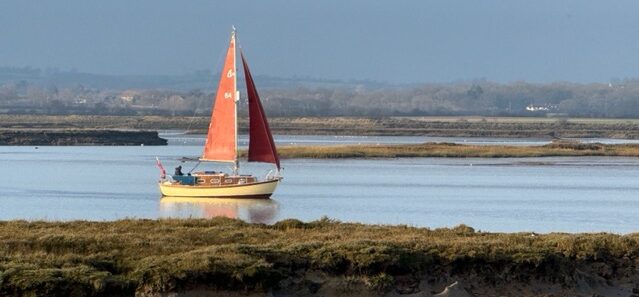
Whimbrel sailing in Lawling Creek on a painted sea creeping over the flood with barely a breeze.

12/23/25

Ditch-crawler advertises the Griffith’s classic ‘Idle Duck’ for sale…

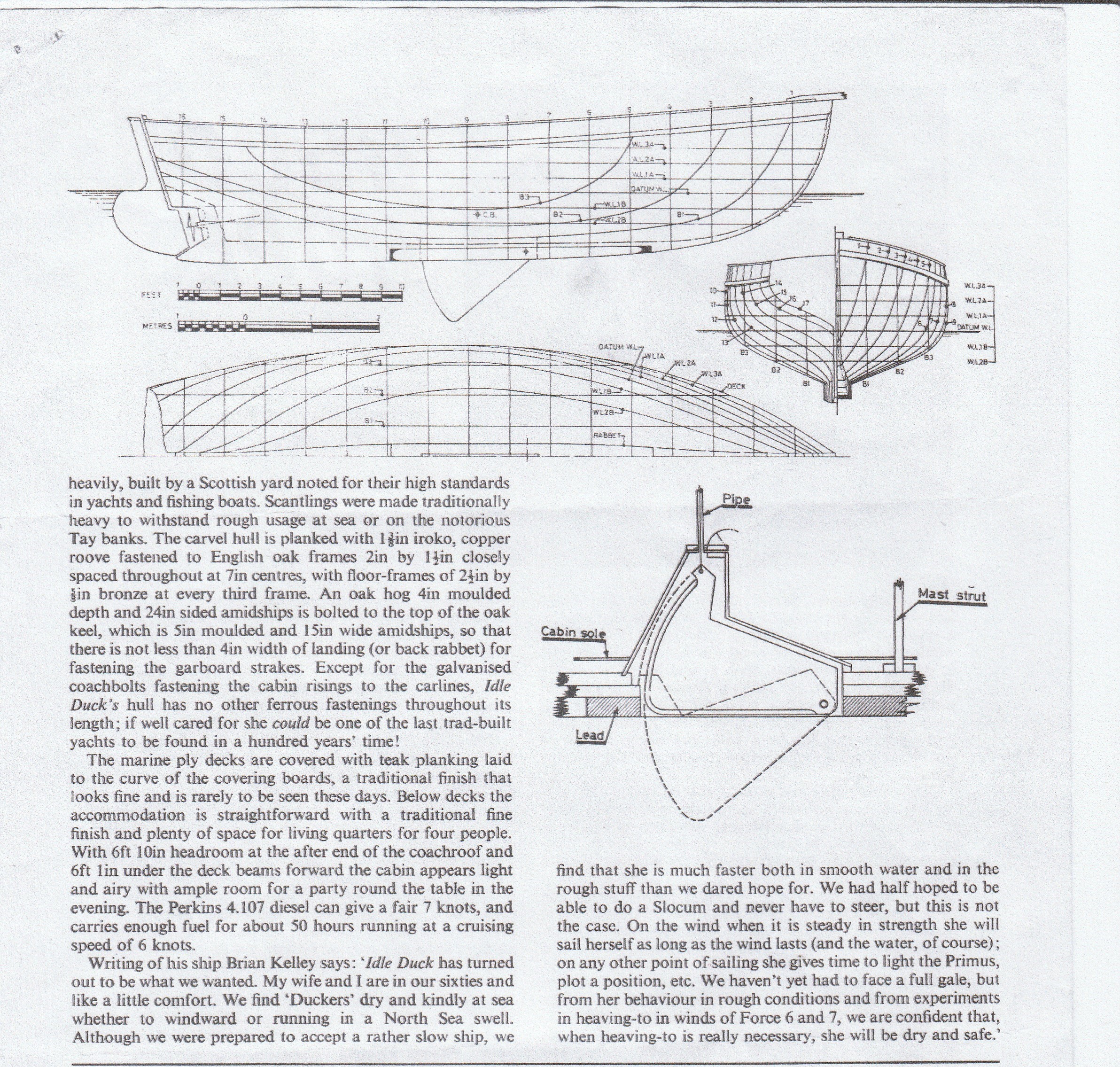
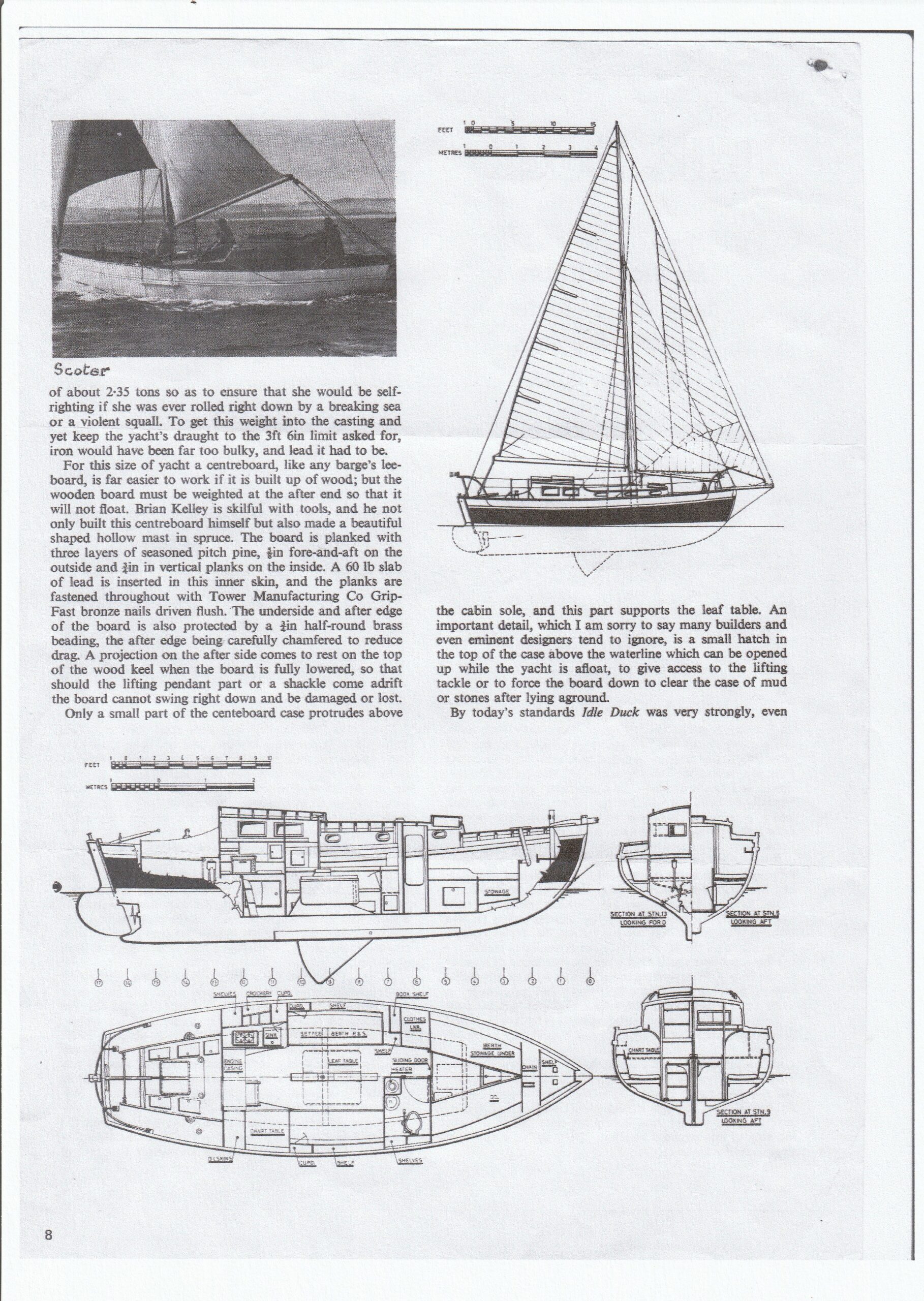
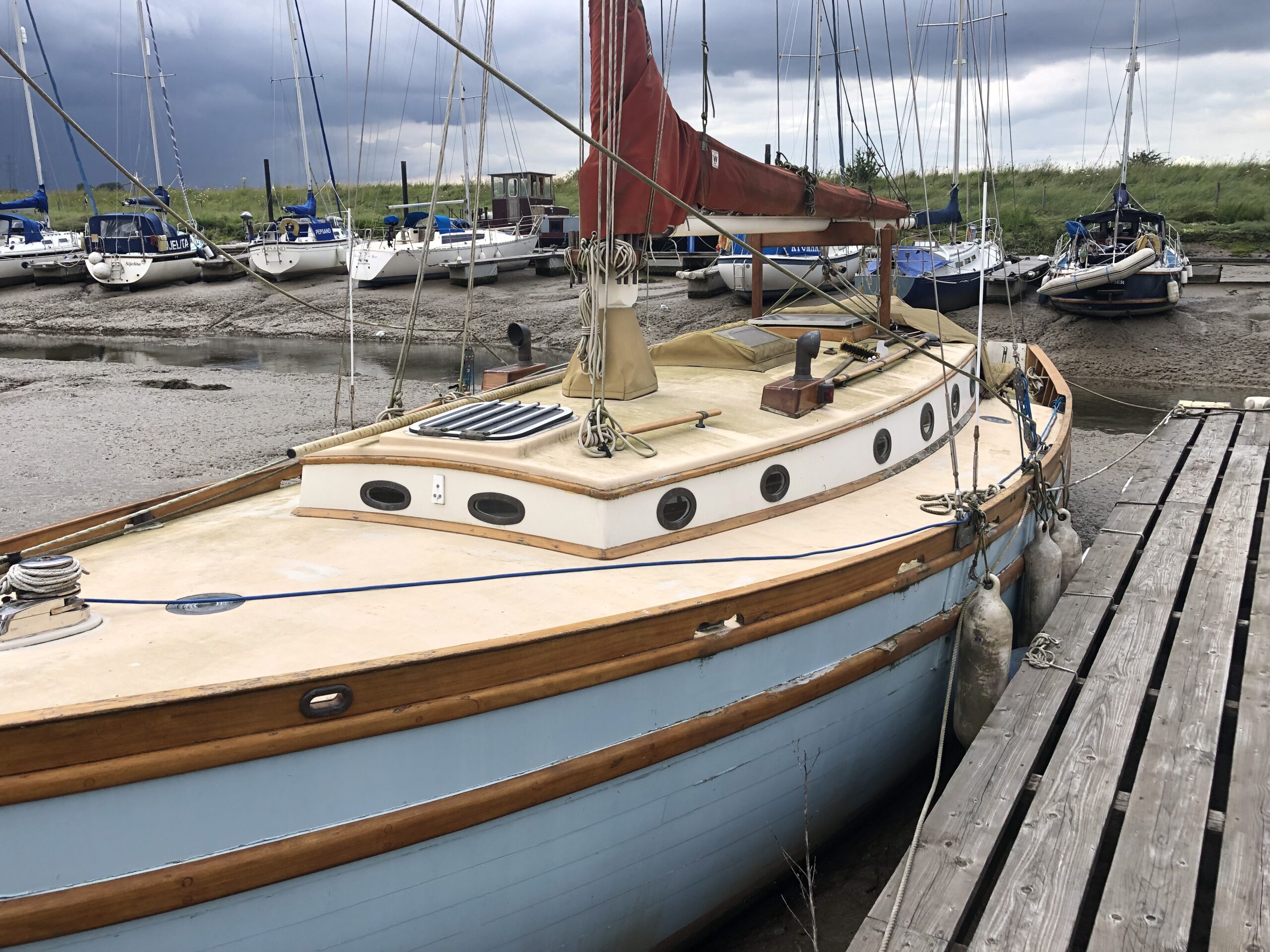
Idle Duck is a classic shoal draft centre boarder from the famous Maurice Griffith’s pen, built by Miller & Sons, St Monance on the R. Tay in Scotland, and launched in 1962. She was superbly built and has stood the test of time. The vessel is a ‘copy’ of an earlier shoal draft vessel built by Howard’s of Maldon in 1894 called Scoter. As far as I am aware that little ship is still sailing.

Idle Duck at her Swale Marina (Conyer) mooring seen during 2024. (Nick Ardley)

I looked over Idle Duck on a visit to Swale Marina during the summer of 2024, admiring her comely curves. She is of the ‘Bawley’ type like my own Finesse 24, Whimbrel, sharing a common Thames estuary heritage: Alan Platt was apprenticed with Parson’s of Leigh – builders of cockle boats and MG designed bawley yachts – before starting his own line of craft…

There follows some historical information from Yachting Monthly of July 1973 written by MG himself when editor. These are credited to Yachting Monthly.

Magazine pages courtesy of Yachting Monthly.

Idle Duck was given a thorough refit at Faversham not so very long ago, sadly however, the owner soon after became ill and passed to the elysian sea where one sails for ever… Over in Kent, an old Upchurch village friend, Les Long, has taken on the task of finding a new owner for the chap’s widow.

Les has been caring for the vessel as best he can (being a boat owner himself) and reports that the varnish work has begun to suffer. This is superficial and will be dealt with. (I have same ‘problems’ but that is life and is very much part of the enjoyment of owning a classic…). One needs to look beyond and get a feel for the boat as an entity in itself – cosmetics are well within the capabilities of an owner – one’s relationship follows…

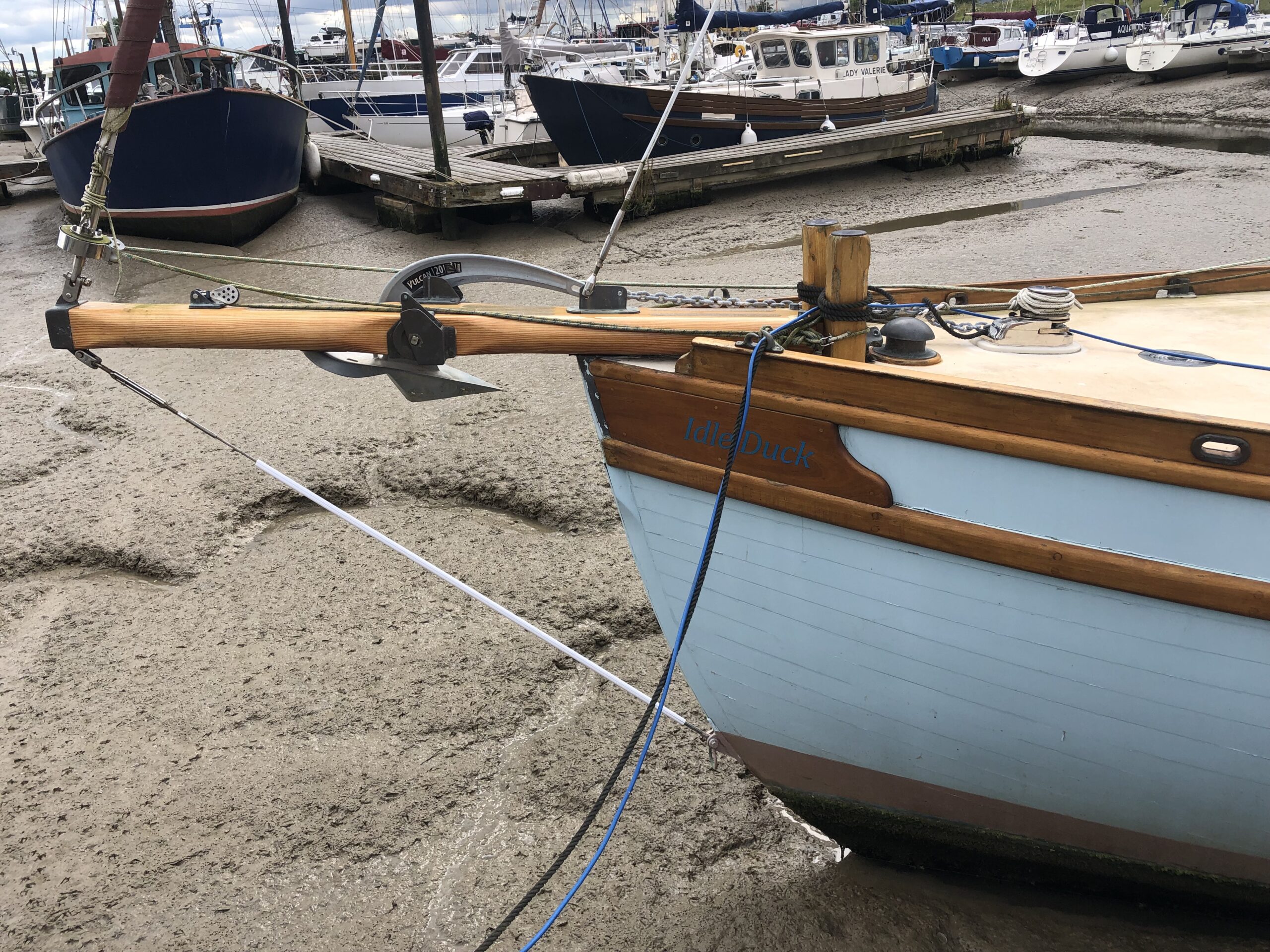
Bow of Idle Duck… (Nick Ardley)

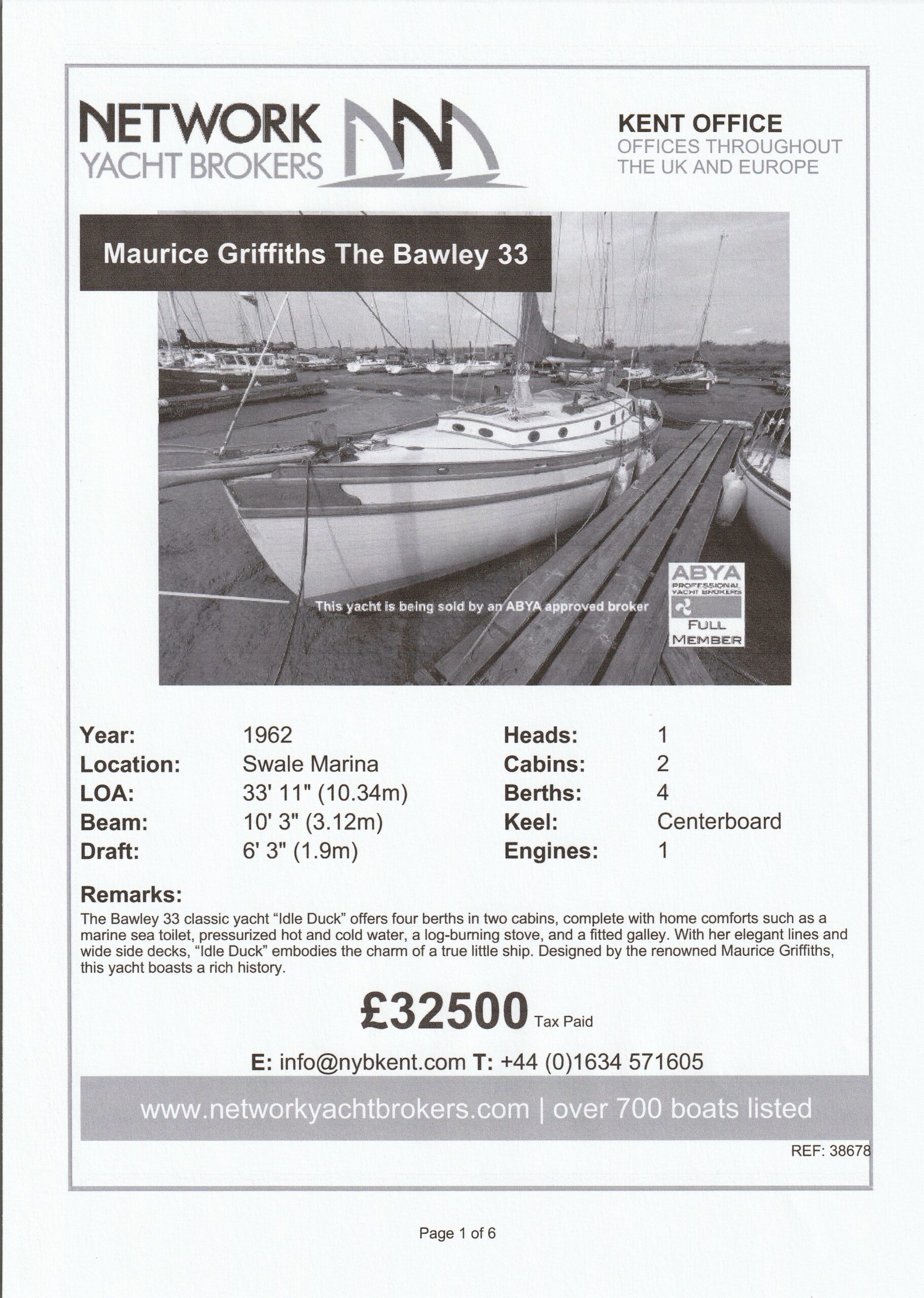
The vessel has been on the books of Network Yacht Brokers who have not been successful in the sale of this fine vessel. The market is difficult to say the least, stuffed with craft of every type, so boats will only move if price and a new owner feel right together…

Brochure information courtesy of Network Yacht Brokers and Les Long.

To my mind the price is probably ‘frightening’ people away. My advice would be to go in with a sensible offer.

Looking along the port side deck of Idle Duck – They are clear and uncluttered. (Nick Ardley)

Prospective owners interested in viewing this fine vessel should contact Les Long by email on: lml0454@gmail.com

12/14/25

Ditch-crawler wonders about the future of seamanship…

Two articles in the marine trade news forum (Marine Industry News) have struck a jarring note with me. One from a short while ago is within the link below.

Best to read before going further…

www.marineindustrynews.co.uk/no-legacy-constraints-how-navico-plans-to-reinvent-boating-with-ai

Now, I might be missing something within the article, but I feel I can’t possibly be alone in thinking, ‘Bloody Hell, whatever is going on…’

I read through the later article, skimming along nonchalantly before being brought up sharply. I then restarted reading very carefully, then the other.

Essentially a company is leading the development of AI technology that will take the ‘stress‘ out of berthing a boat and other manoeuvres.

Sailing Whimbrel into my Blackwater marina berth, alone, using experience and seamanship…

Now, from what I gleaned, it is currently only power boats that are being played with, but one can see the system being transferred to sailing craft. These are large craft too, certainly not the typical seven to ten metre sized vessel. Clearly thrusters are needed, fore and probably aft too.

The ideology behind the technology puts the ‘auto-captain’ in charge of the vessel’s manoeuvring, berthing, leaving and close quarters scenarios, working out how to deal with these situations without causing a collision. Food for thought.

Sailing off Brightlingsea Harbour’s Heritage Pontoon: crew ready to slip.

The technology used 360 deg camera views with tide (I assume as not stated) and wind conditions being collated, real time. Presumably like the human brain, but more accurately…

Clearly it has to be activated by the ‘skipper’…

The technology has been ‘imported’ from road vehicles.

So, everyone, this is the future.

Don’t worry about your seamanship anymore, AI will take care of it!

11/30/25

Ditch-crawler looks at Christmas art work by Barry Pearce, this Advent-tide…

Barry Pearce studied art in his youth but went on to becoming a shipwright and barge master during the 1960s. He has been a life-long barge ‘buff’ – historian – and chronicaller of the Thames Sailing Barge. I first met Barry in 1964 at Cooks Yard in Maldon when the May Flower, my childhood home, went on the blocks to have her port bow rebuilt.

I recently came across a couple of Christmas cards Barry had sent us a little while ago: we kept up a contact after he’d helped with some information back in early 2000s when I was writing, The May Flower, a barging childhood‘ published in 2007, (still in print). His once annual card had always a delight.

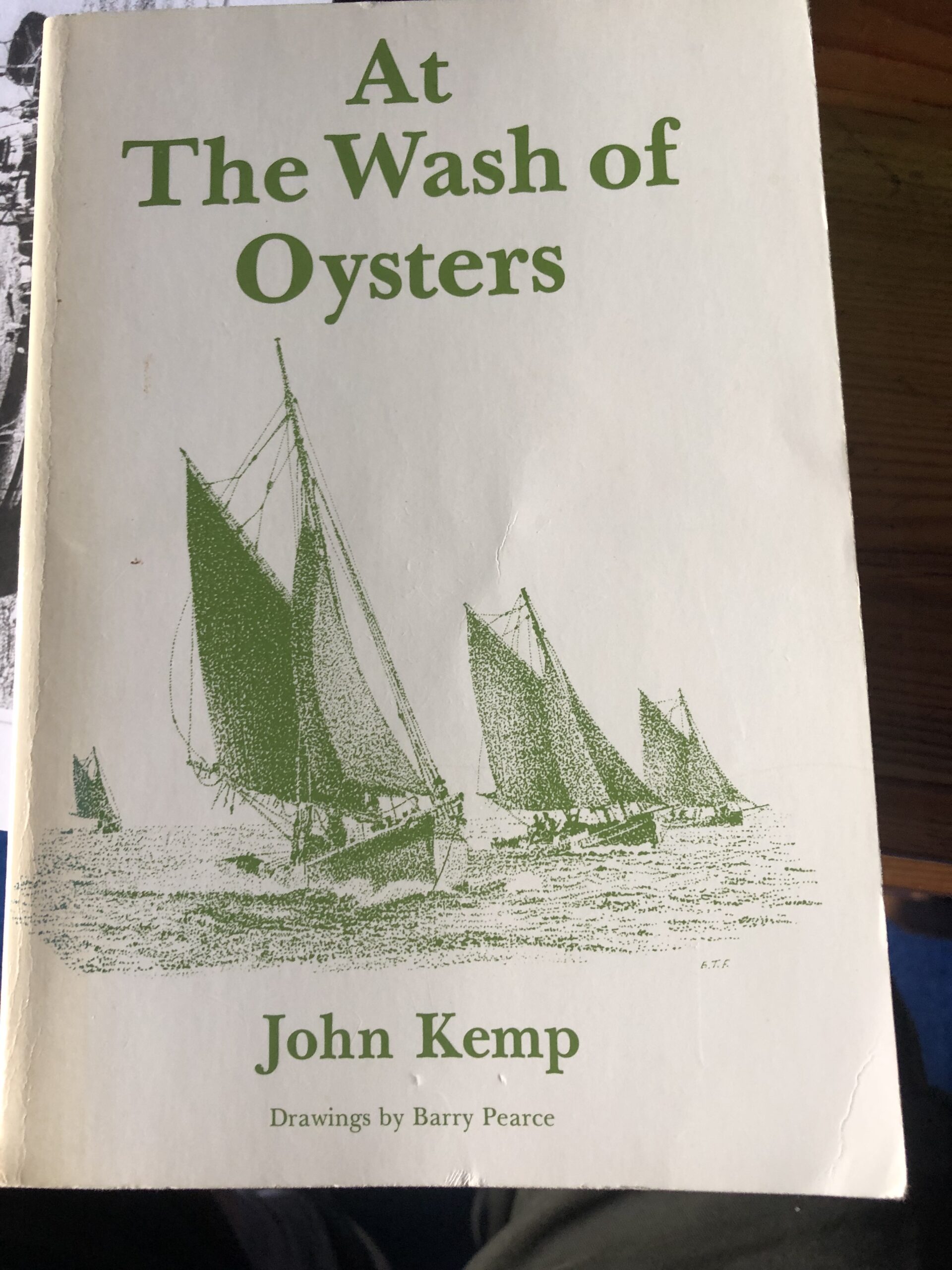
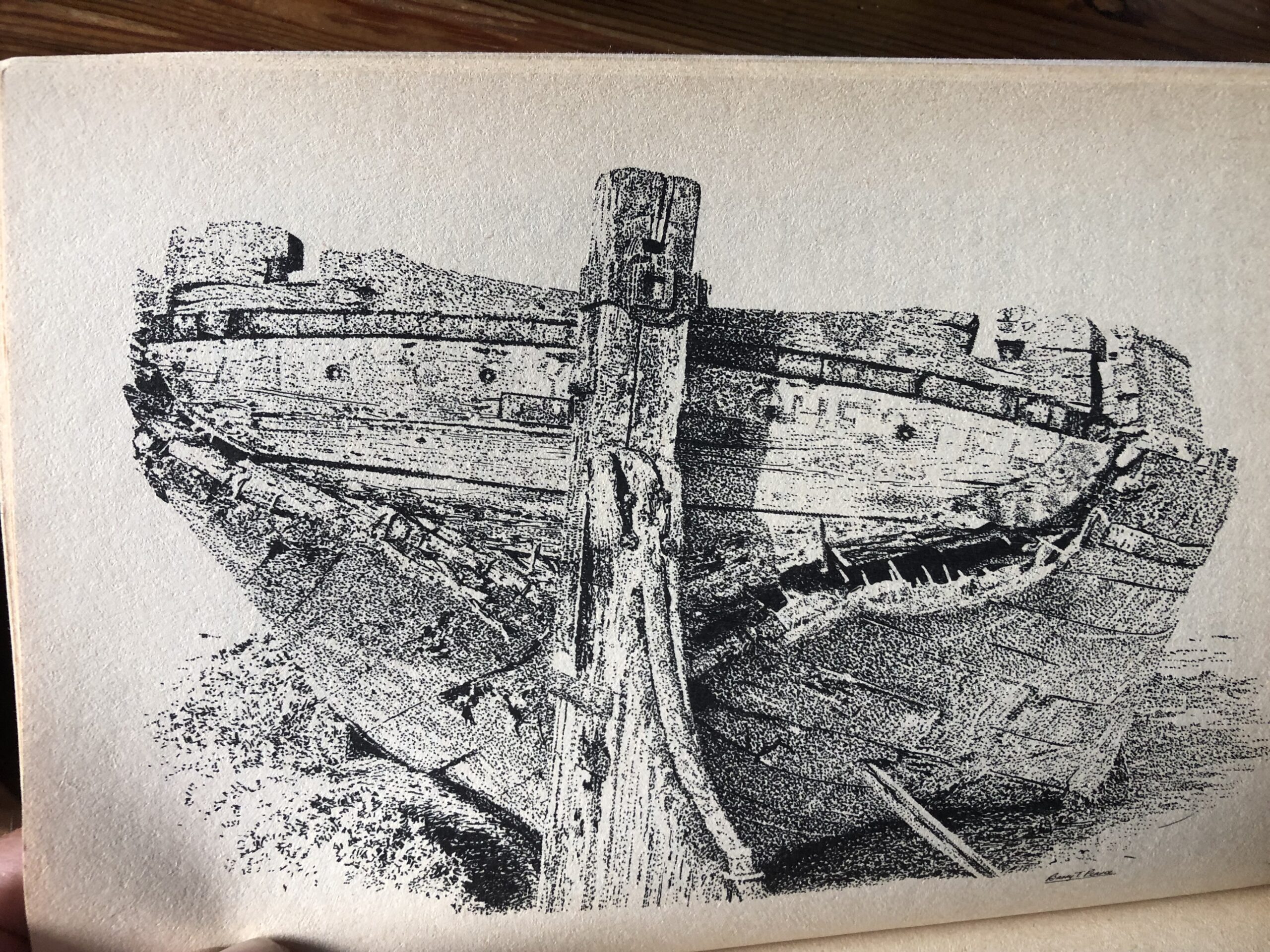
Another couple of cards were found inside the book by John Kemp featured below: Barry illustrated this book profusely with his line and ‘dot’ works of art.

I then did a search of all the books in my area of our book shelves for I often use birthday and Christmas cards as book marks. I eventually rounded up seven, there may be more not yet discovered.

Cover of book, ‘At The Wash of Oysters’ illustrated by Barry Pearce.

Now that we are into Advent and on the run up to Christmas, I thought it would be nice to share what I have…

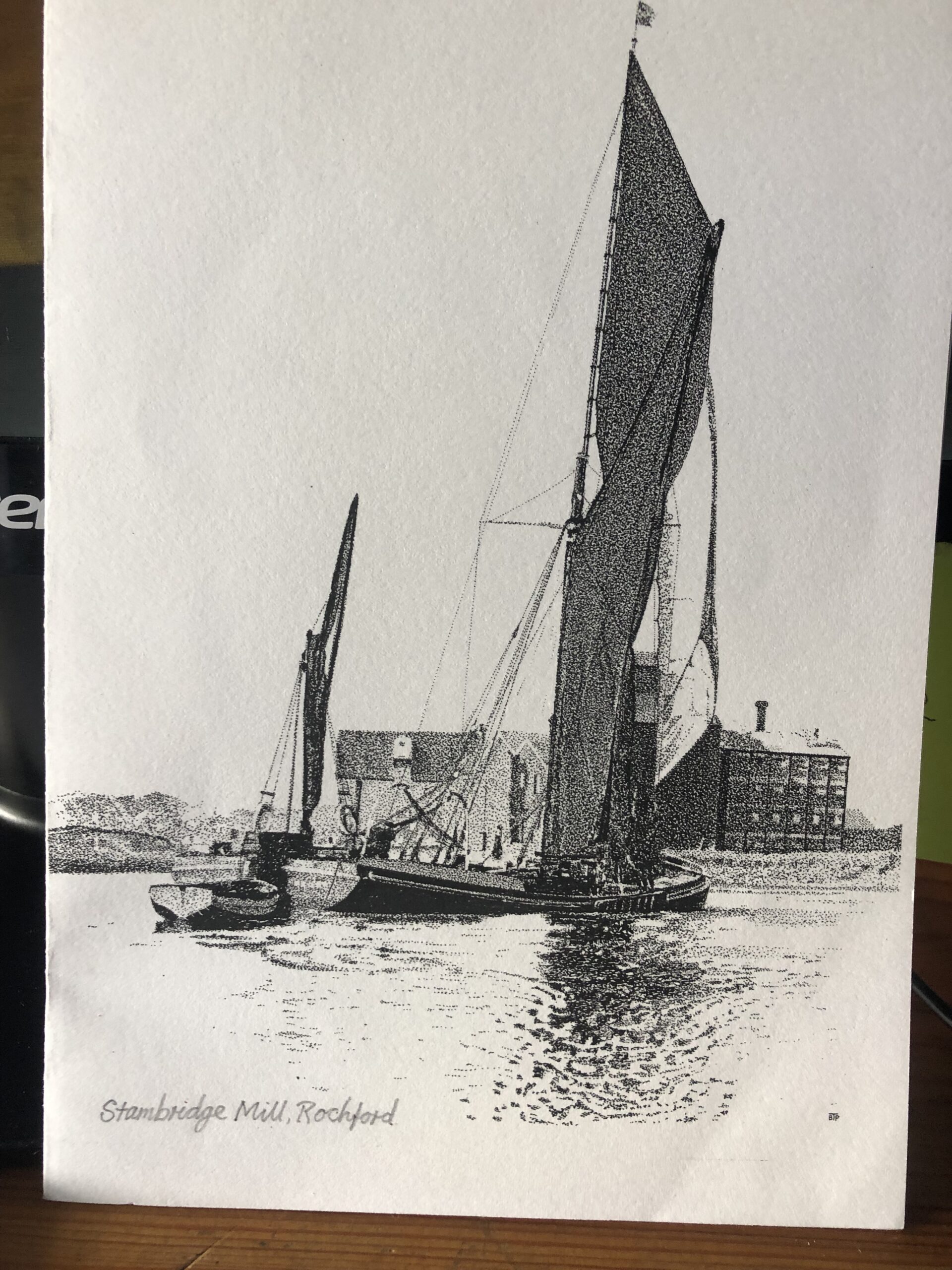
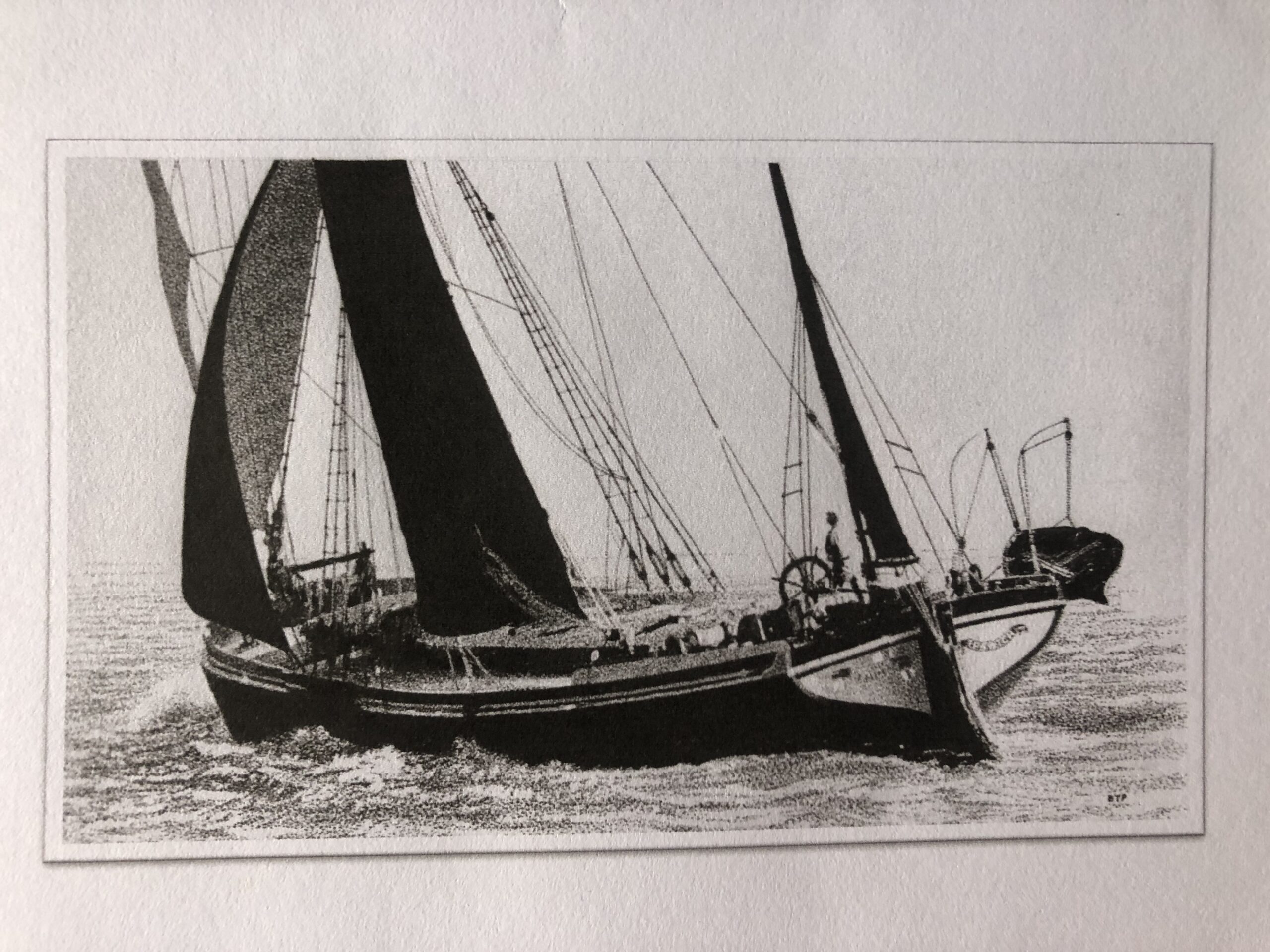
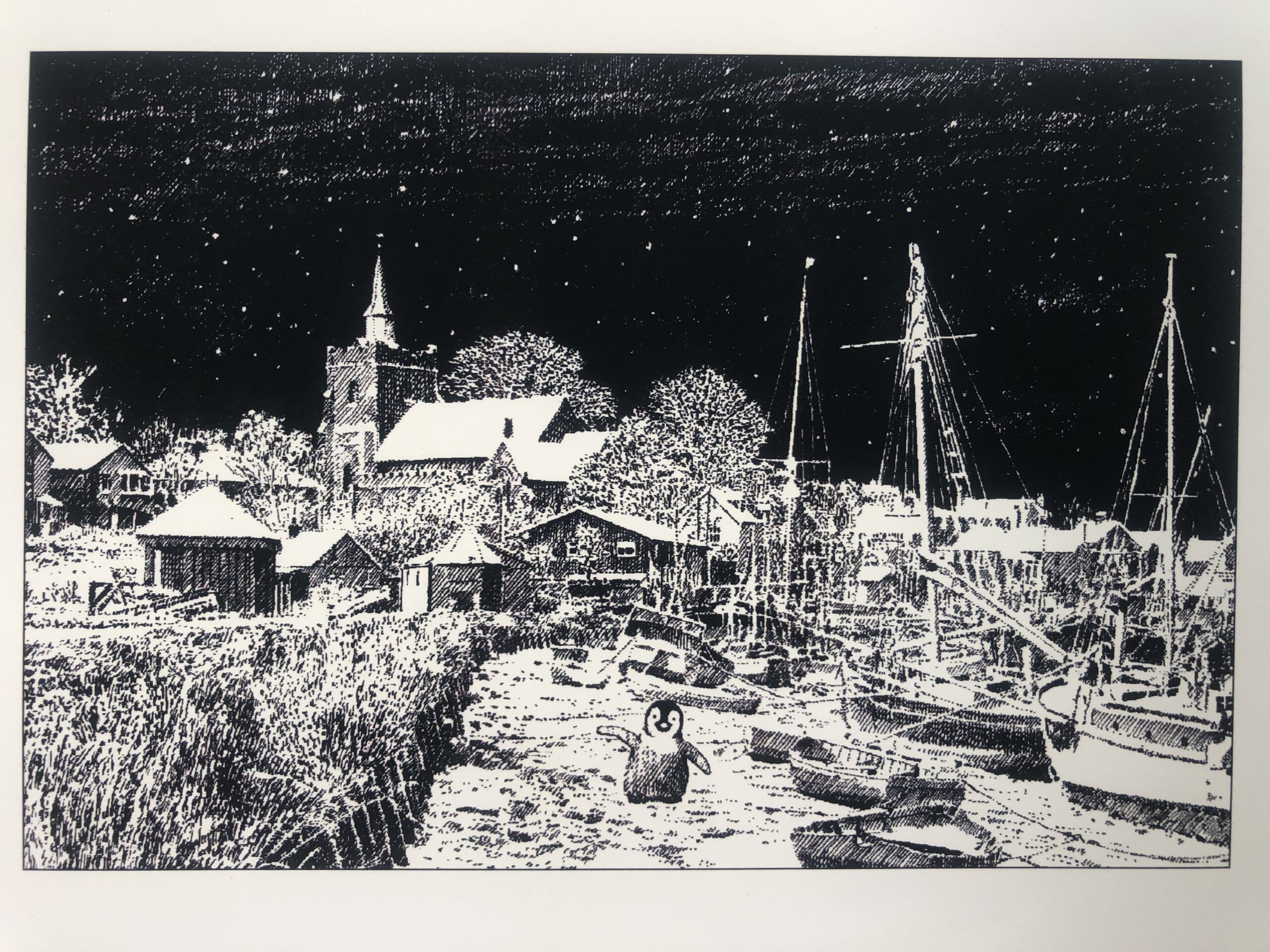
A number of Barry’s Christmas cards are featured below.

This one depicts a loaded barge heading round last bend before Stambridge Mills at Rochford.

Above is a depiction of the shapely Memory, now a ruin in the saltings off Woodrolfe Creek, Tollesbury.

Here, above, is the recognisable shapely Cambria captured during the last decade of her trading life.

The Xylonite with a bone in her teeth surging past a buoy. Is it ‘down’ the Swin, who knows…

Above, again Xylonite. She’s either just brought up to anchor or about to sail…

Few of Barry’s cards were dated but we have a card from 2021, which I believe was the last he sent: his health has been failing. The one above is dated 2014. We must have had many others … perhaps not all have been saved!

Clearly this is a winter depiction of Maldon and the ‘bargemen’s church’ up on its hill above the Hythe.

A shapely old girl in a breeze…

The card shown above is the 2021, sent during the Covid Pandemic. Barry comments: ‘I think I will mutate!’ Typical of his sense of humour…

I have added a couple of illustrations from ‘At The Wash of Oysters’ by John Kemp. The book is a lovely read and if you know the River Blackwater and Dengie peninsular much will be familiar.

An old farm waggon being over grown with briars – today it could be an old tractor of plough…

The book’s artwork is varied in style and covers a wonderful cross section of subjects to illustrate the stories within, all based around the Blackwater and Dengie – the land between the rivers Crouch and Blackwater – an enchanting area.

A tired old girl with sprung planks and gnarled woodwork…

So, on this Advent Sunday, when traditionally Christmas cards are written and readied for the post, the Mate, Christobel, and I wish you all a happy Advent and our good wishes for this coming Christmas.

11/29/25

Ditch-crawler and Prostate Cancer…

Left to the vagaries of chance and having or noticing ‘rare’ symptoms on the pathway to being diagnosed with Prostate Cancer by the NHS, I would now be dead.

I wrote about it in my book, ‘Sailing through life…‘ Now, unfortunately out of print, but I do have some copies.

The extraordinary decision not to begin a National Prostate Cancer Screening Programme is quite frankly bizarre and very sad for the prospects for many men.

Bowel Cancer is screened for on a two-yearly basis for men and women over sixty.

Women are screened for Cervical and Breast Cancer.

Men are allowed to die. This of course is beneficial for those paying our pensions: it saves them a huge amount of money.

What the media screen and air time did not go on to explain yesterday was that men over the age of fifty are entitled to ask for a Prostate Cancer PSA test.

So, if you are an ethnic black African or Caribbean man, it is common sense: you are at greatest risk. Get a test done.

If you are one of the many other ethnicities there is a lesser chance, ‘they’ say, however, go to your GP Surgery and get it done.

Do not be put off by the soothe-sayers spouting ‘more harm is done’ for if you’re positive and treatment is deemed necessary, catching it early is far, far better…

It saved my life…

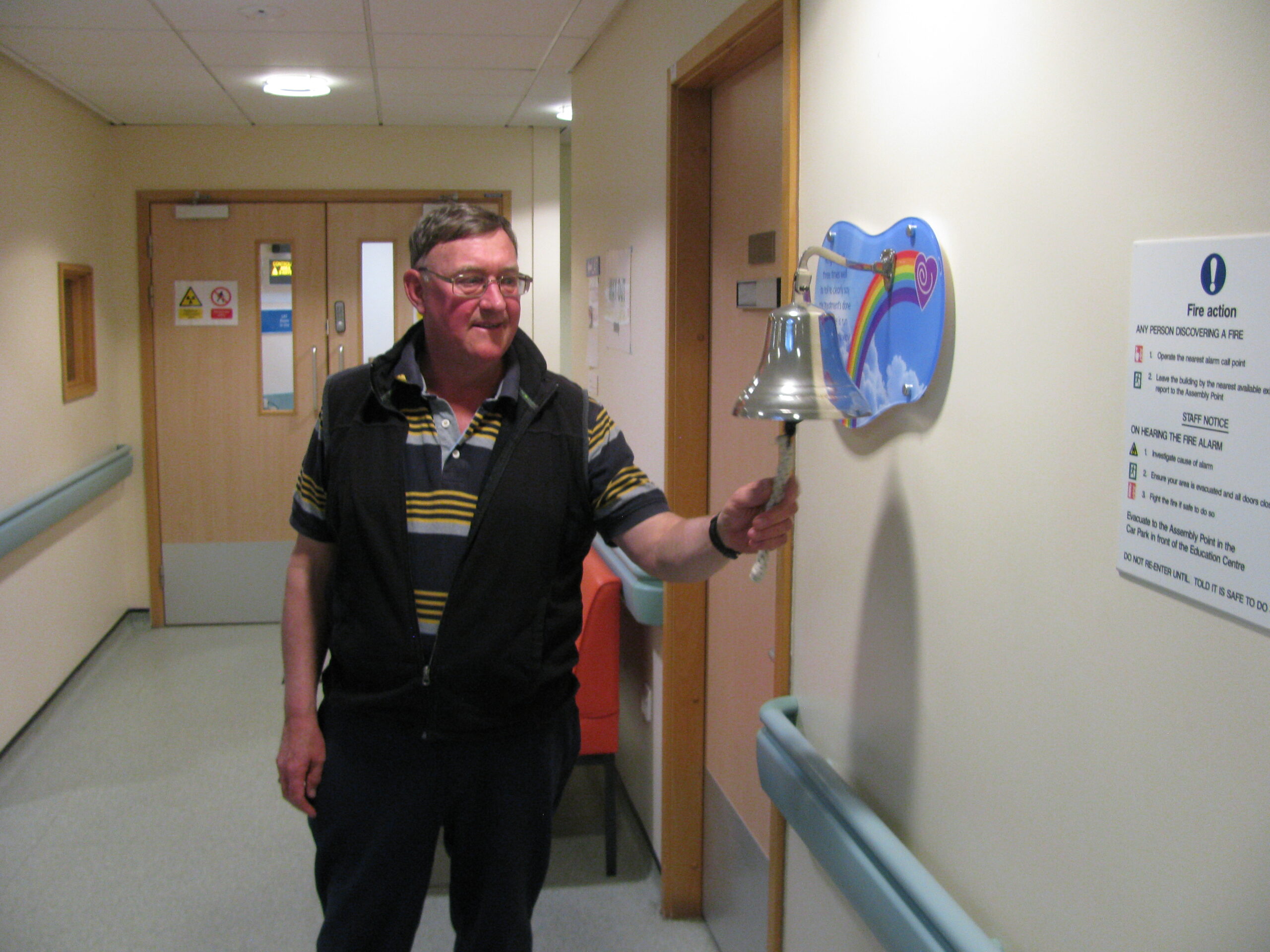
Ringing the Bell after my radiotherapy treatment ended.

11/15/25

Ditch-crawler reflects on ‘The Sailor’s Coast’ by John Leather…

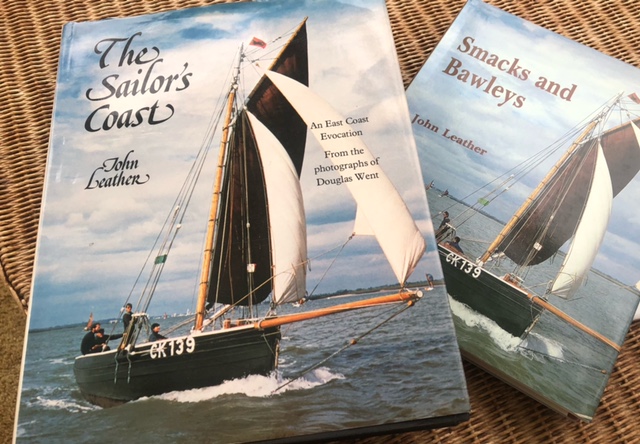
I came across John Leather’s 1979 book, ‘The Sailor’s Coast’ in a second hand book shop in Leigh-on-Sea recently. It was published by Barrie & Jenkins (No longer around).

The book is described in a forward by the author as a tour of the ‘East Coast’ through the lens of Douglass Went, photographer extraordinaire from Brightlingsea, Essex. Douglass Went was born in 1887 and died in 1970. He had a studio in Brightlingsea and spent a good part of his adult life recording vessels he saw in evocative black and white photography.

Sitting looking at the book’s cover, my memory told me that I had seen the cover picture before. Crumbs, not same book thoughts stirred, so I roamed my holdings. I soon alighted on another Leather book, ‘Smacks and Bawleys’ published by Lavenham Press in 1991.

The two book covers!

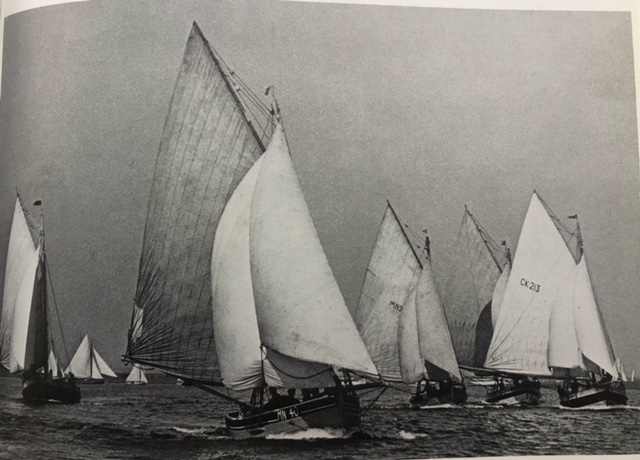
The pictures aren’t the same, in that the photographers are different, however, they must have been taken at same time (almost). The former was a Janet Harber picture. Janet, if you’re not aware is one of Jack Coote’s daughters. The latter is ascribed to Jack Coote. The background is not the Mersea Quarters, as I first thought. It can be seen that the other yachts are the same vessels in both frames! Janet, herself, contacted and corrected my assumption. The picture is from the R. Crouch during a race from Paglesham where Jack Coote was then keeping his yacht Blue Shoal. Janet and her husband were crewing.

The smack is Kate CK 139, which was then owned by Tim Balfour Janet tells me and was in the same race.

Janet was herself an accomplished photographer following her father’s passion (after boats and the east coast). Jack Coote, as many know, was the editor of the famous East Coast Rivers pilot book.

The John Leather book ostensibly covers the ‘East Coast’ however, there are many ‘missing’ places, especially south side of R. Blackwater (except Maldon). Douglass Went operated from Brightlingsea, where his studio and home were situated and with all the other places he got to, I found it surprising, however, this may have just been the whim of John Leather. Now, we shall never know! Went’s pictures feature in other books about the area in the days towards the ending of the ‘old ways’ on the waterfront.

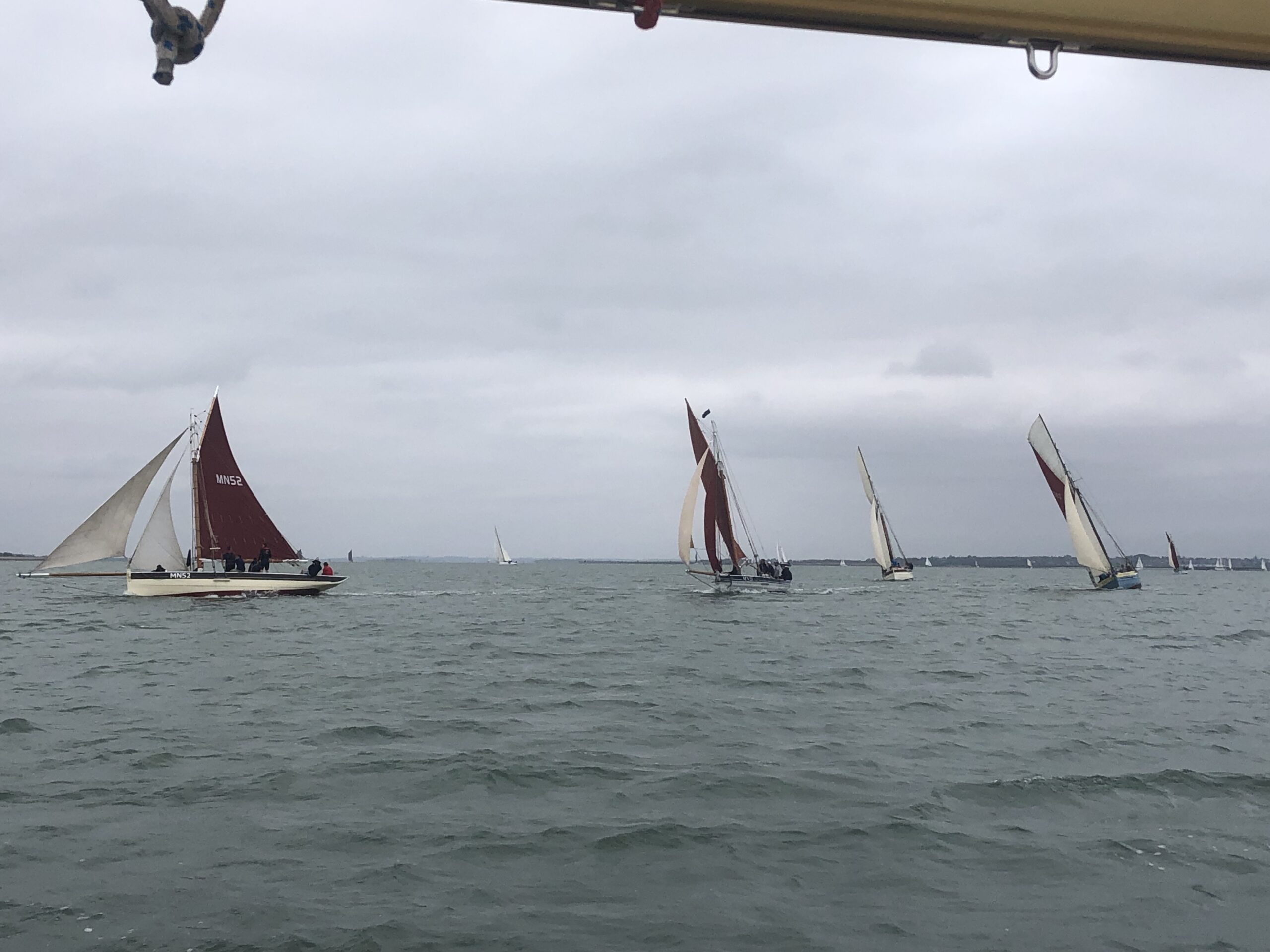
Below are two views of smacks racing out of the Mersea Quarters. Went’s view was captured during the 1930 Regatta week. My view was taken during the Regatta week of 2025, nearly one-hundred years later! We were heading inbound from Brightlingsea and saw the smacks in the distance coming towards us. I spotted an orange buoy and luffed up to pass clear thus giving room for the old girls (we had right of way!) and I did not want to impede unnecessarily.

These two pictures of racing smacks are taken ninety-five years apart!

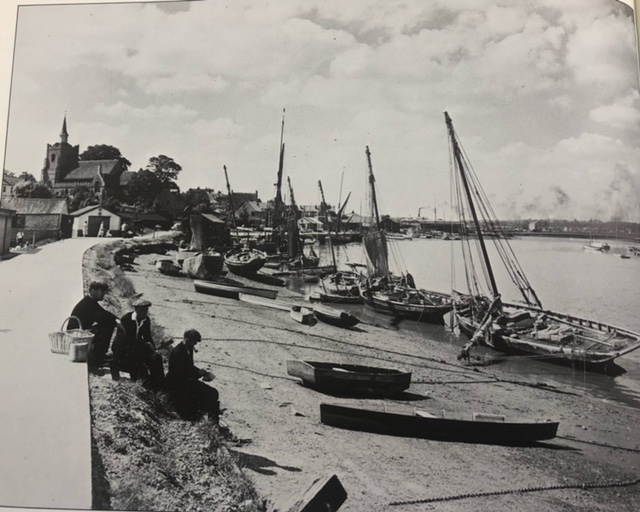
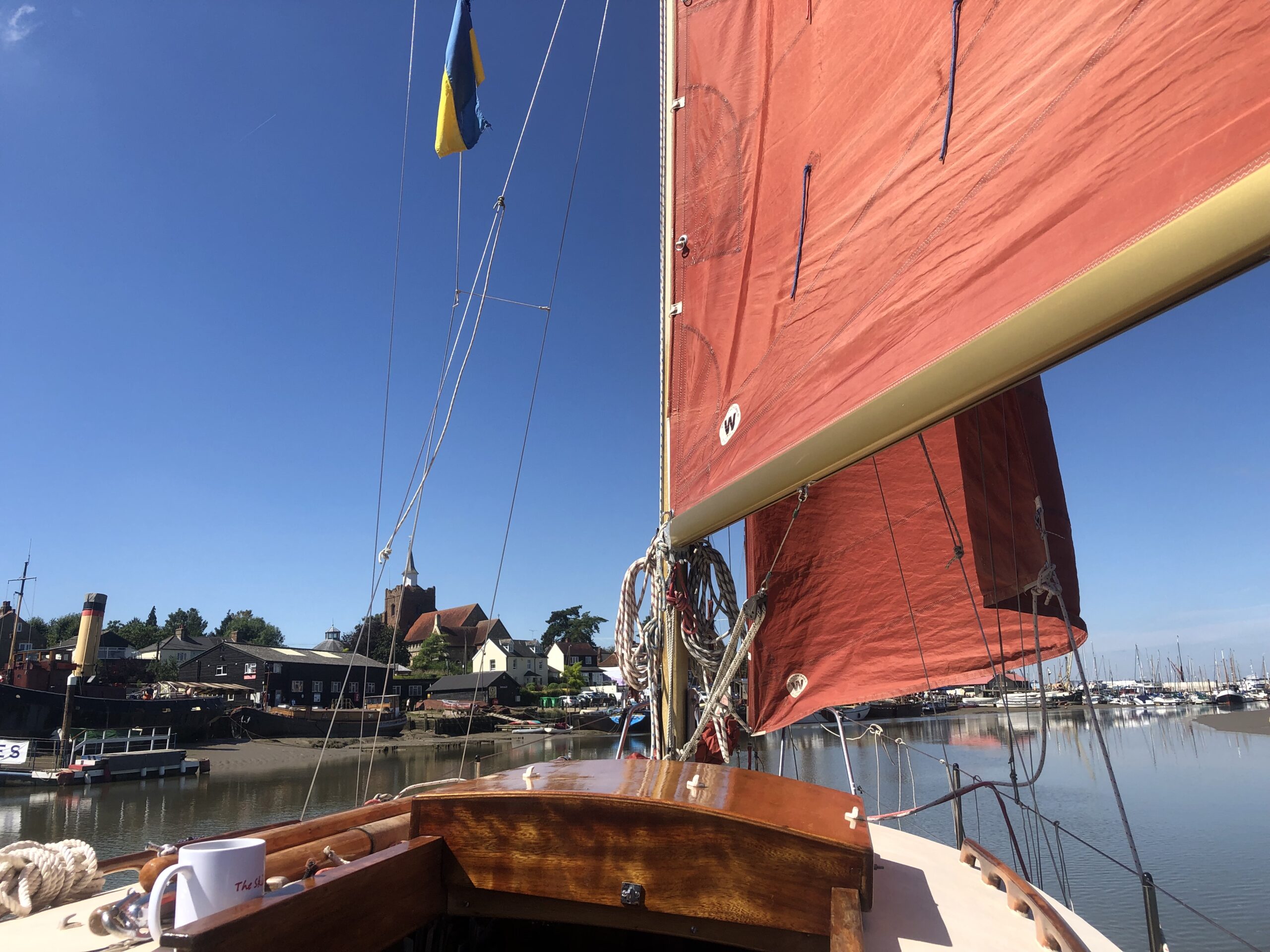
I have pictures of Maldon’s Hythe from the promenade (with its flood wall) but I have used a water view for comparison. The clean beach with its myriad of dinghies, punts and smacks has become muddied through little or no use: vessels do not moor along the promenade anymore. Towards Cooks old yard, there is a tripper boat pier and a berth for the steam tug Brent (awaiting lottery money or other funding) and the old yards set of blocks. The blocks themselves are becoming less used as the spritties largely use a drydock for annual antifouling sessions.

As photographed by Douglass Went in 1957.

As seen from water during 2025 – there are no smacks or working boats along the promenade now.

The last smack to lie along the promenade, the Telegraph, now sits upstream of Heybridge Basin going to pieces. There are a few old ‘wrecks’ sitting in the mud with a few battered old GRP tenders tethered to mooring rings: all show little use.

Below, we are in Harwich Harbour…

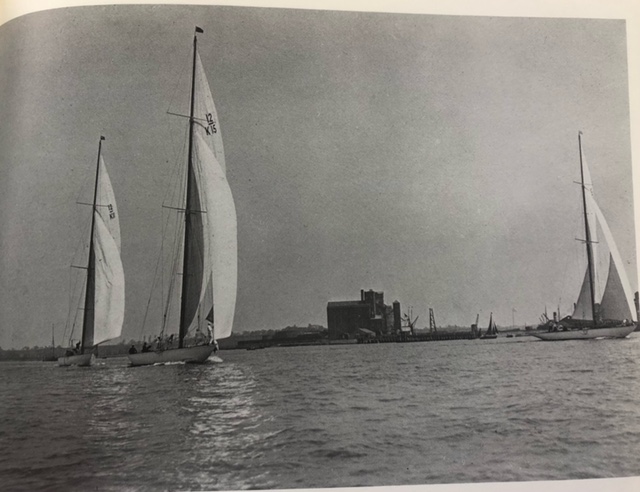
Twelve-metres racing out of Harwich during RHYC regatta of 1928.

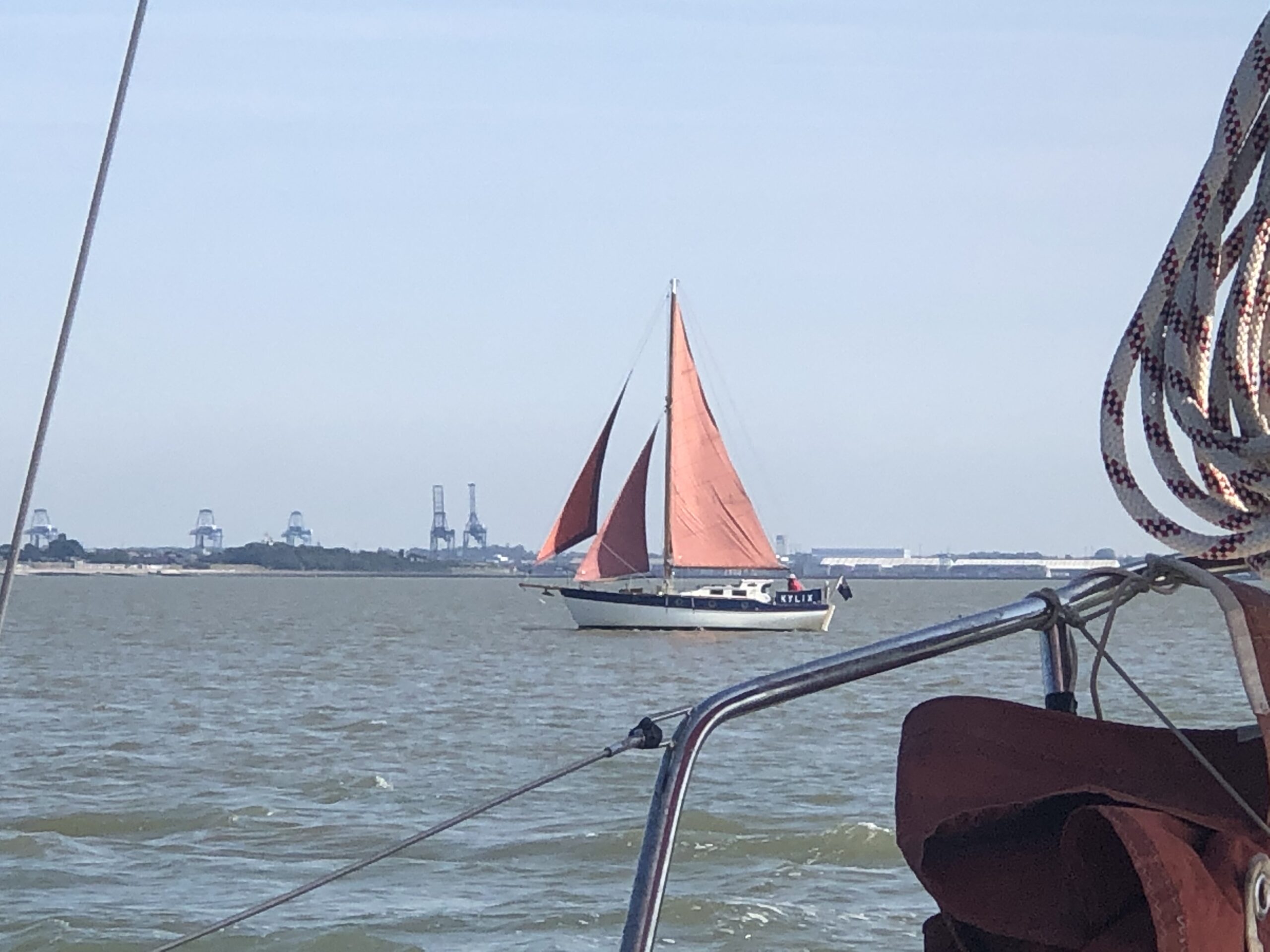
Sailing into Harwich alongside Kylix, a vessel designed by Maurice Griffiths for his own use. A number were built. They are very reminiscent of his earlier Lone Gull 1 and II classes.

Pictures show the same view. The recent one is as seen in 2020. The old dock with its buildings have long been filled over and levelled. It now forms a continuation of the major container wharfage. In the corner a RoRo facility and tug berthing exists with further container wharfage running down to Languard Point beach.

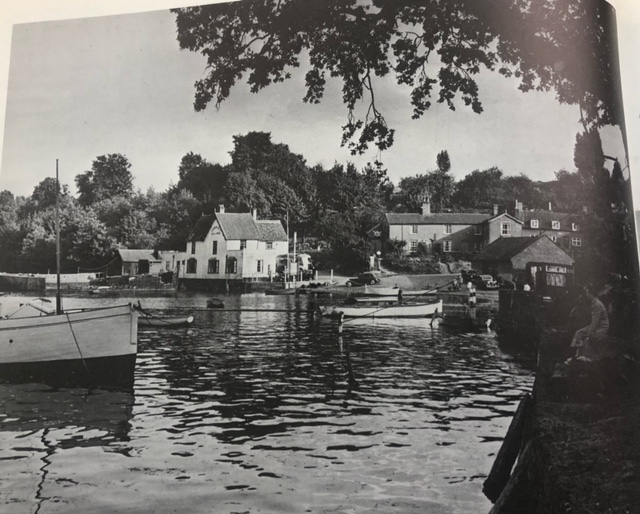
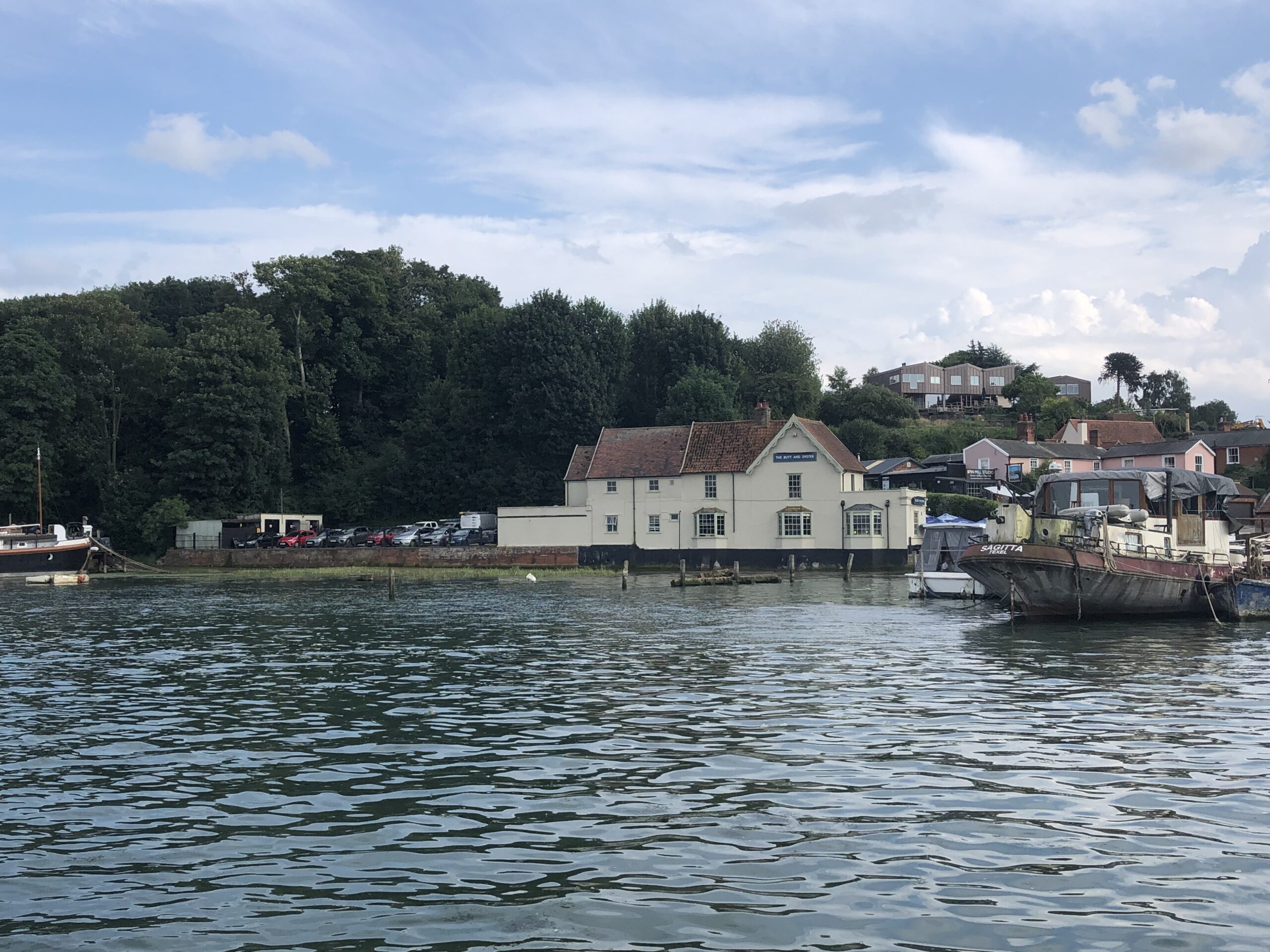
Up the coast and into the R. Orwell, we reach the scenic location of the Butt & Oyster waterside public house at Pin Mill.

Douglass Went’s 1939 view of the ‘Butt’ from, probably, the site of the Pin Mill SC.

2025 view of the ‘Butt’ taken low down from my sailing tender Twitch, capturing the afternoon light dappling the ripples.

Note that the ‘little’ pub has been extensively extended over the years It is an iconic view. further downstream, currently, there were berthed a couple of spritsail barges and, 2025, the barge-yacht Blackthorn. However, further is a melee of houseboats based on old ‘Dutchman’ and lighters to ‘floats’ falling into a mess of wrecks and detritus, which to most must cause a rubbing of the eyes…

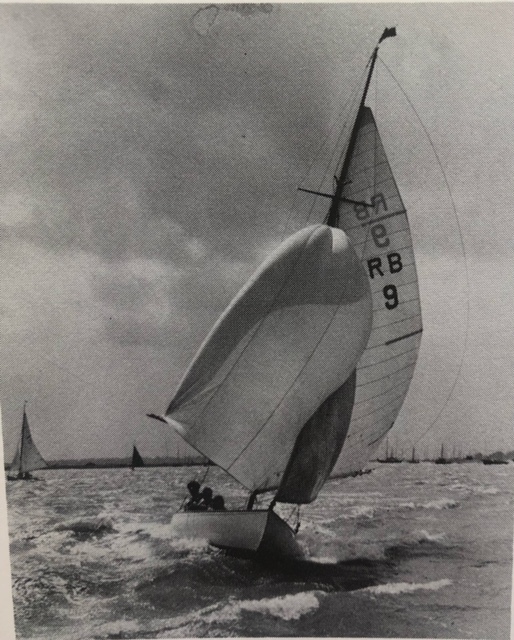
We now move to the Burnham River, said by many to be the epicentre of east coast yachting. There are two classes of older day sailer racing boats of similar design and size. The boats from the Royal Burnham and Corinthian clubs. The RBs were Dallimore designed of 20′ with 17’3″ WL length, 6’3″ beam and 3′ 3″ draft, with a transom stern. They are fine little ships. The Corinthian boats are similar but have a short counter.
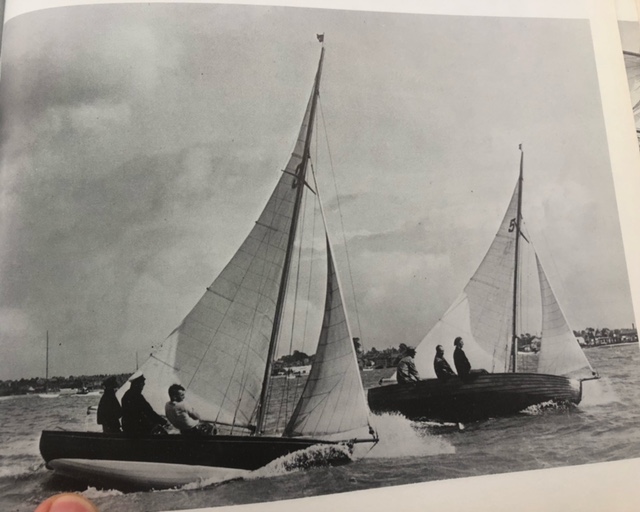
Royal Burnham One Design, No.9 roaring through the slight cross waves in a troubled Crouch flood below Burnham, out bound – dated late 1930s.

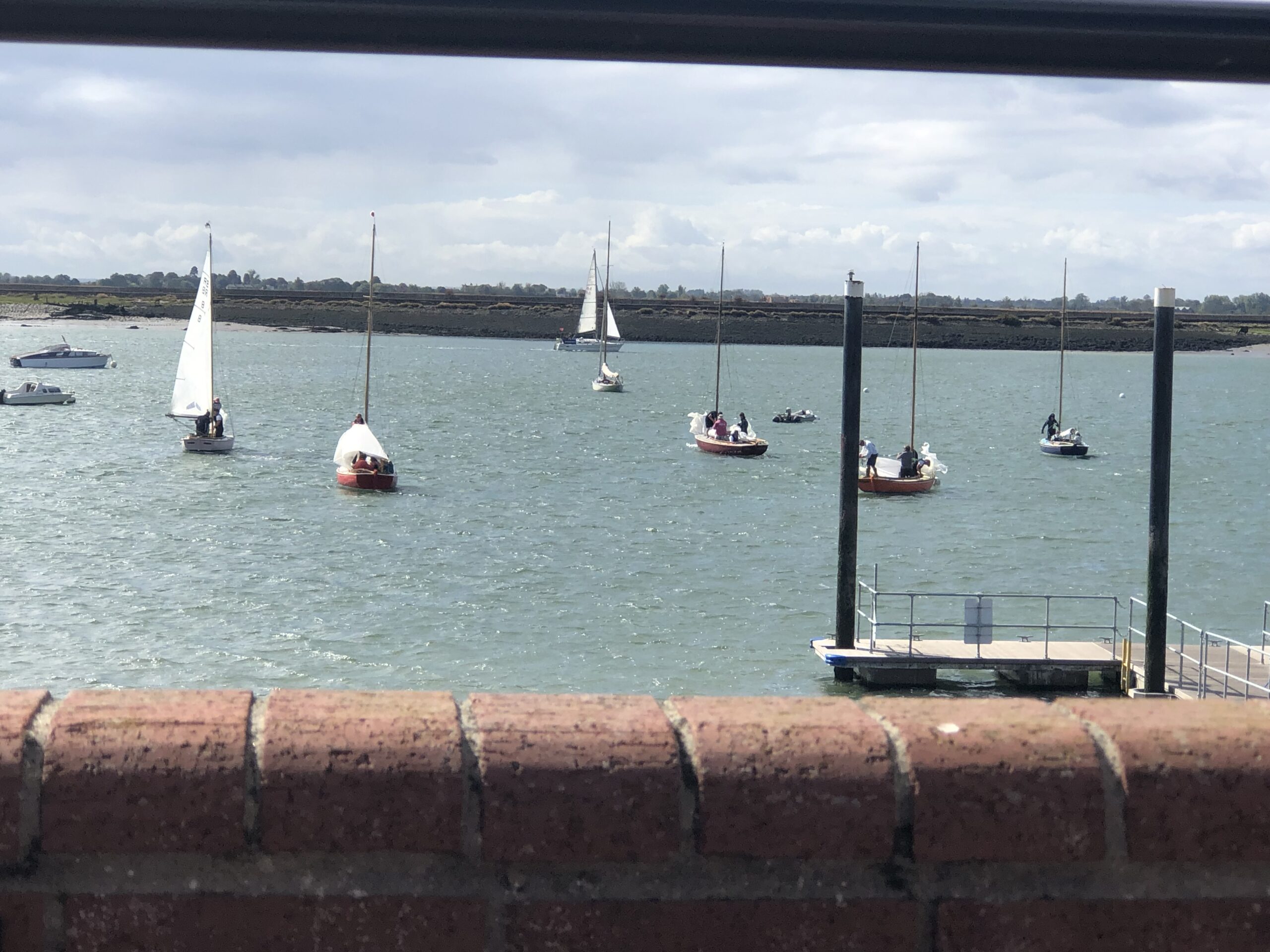
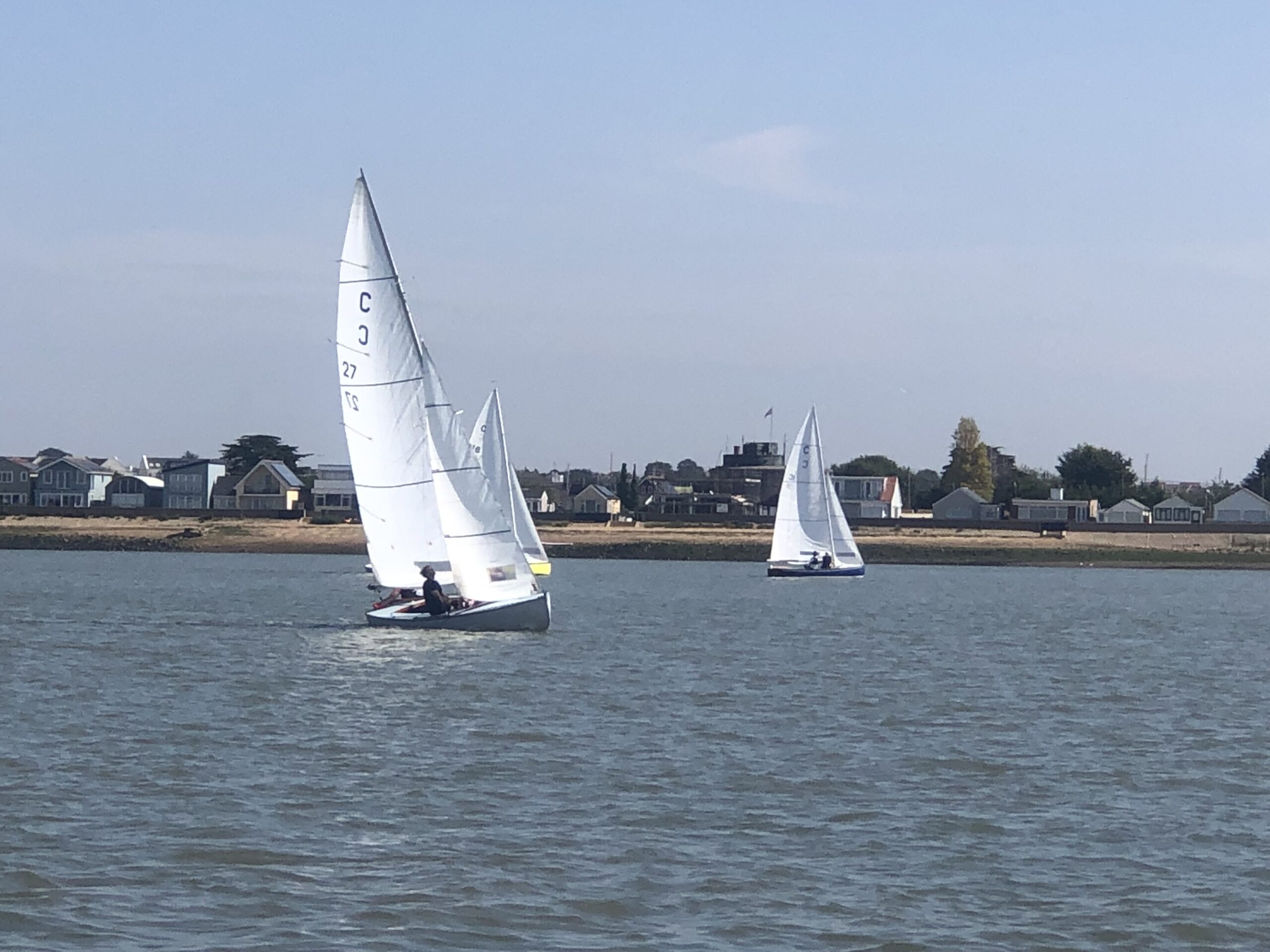
Above: The Royal Burnham One Design No.8 with sail set with others preparing to race on a windy Crouch at the end of August 2025.

Brightlingsea One Designs which were designed locally by Douglass Stone & Sons of Brightlingsea in 1927. Boats pictured are seen racing in blustery conditions during the 1930s. In foreground is No.3. Below, No.3 is again in foreground, photographed racing during summer of 2025.

Note that the short bowsprit has been ditched in favour of stem head sail set up. There are still a large number of these sailing at Brightlingsea.

There is something about a black and white photograph but, colour, does more, surely to tell the story. I found the pictures of great interest, especially where a river view could be picked out allowing the decades of change to be seen. There are pictures of the Wivenhoe shipyards above the village where now des-res waterfront housing fronting the water way quaysides with no where for visiting craft to stop. That I have always found so sad.

The book is likely to be in public libraries, however, probably in reference sections. get a look if you can.

Fascinating.

11/10/25

Ditch-crawler reminded of the first boat owned…

Soon after the mate and I married we found our first boat to own. Christobel’s experience at this time was a week on a Thames hire motor boat, a weekend on a 28 foot ketch and a rowing boat on the Serpentine…

I came home on leave from a ship in 1980 and Christobel said that there were a couple of boats for sale at the Leigh-on-Sea SC. One was a ply-wood constructed Yachting World Peoples Boat, seen below.

After a trial sail and a look at the boat aground on the foreshore off Chalkwell Station, we decided to purchase he boat. Her name was Blue Tail, sail number PB4.

The story of these boats is told in my book, ‘The Jottings of a Thames Estuary Ditch-crawler‘ which is still in print. The boats were born out of a Yachting World Magazine challenge soon after the end of world war two. The aim was to get designers, professional or amateur, to come up with a ‘simple’ boat that could kick start affordable yachting.

Blue Tail with a new (blue) jib.

For us, the boat proved a useful trial to see if I would be able to instill some salt into my mate’s veins: she was still relatively fresh out of the English Midlands! I succeeded and we decided to look for another boat.

A trial sail on a GRP Steadfast 24 down on the Solent was interesting but the type was not for us. We looked at other craft before a visit to Alan & Shirley Platt’s Daws Heath boat yard to look at a Finesse 24. We were both immediately smitten!

The rest is history: we took the plunge and our new build boat soon became a part of the family.

While moored at Pin Mill this last summer and returning from the village (Chelmondiston) after a stores run via the back pathways I spotted a boat at the back of the boat yard close by a fence. It had the look of a Peoples Boat but with a deeper keel.
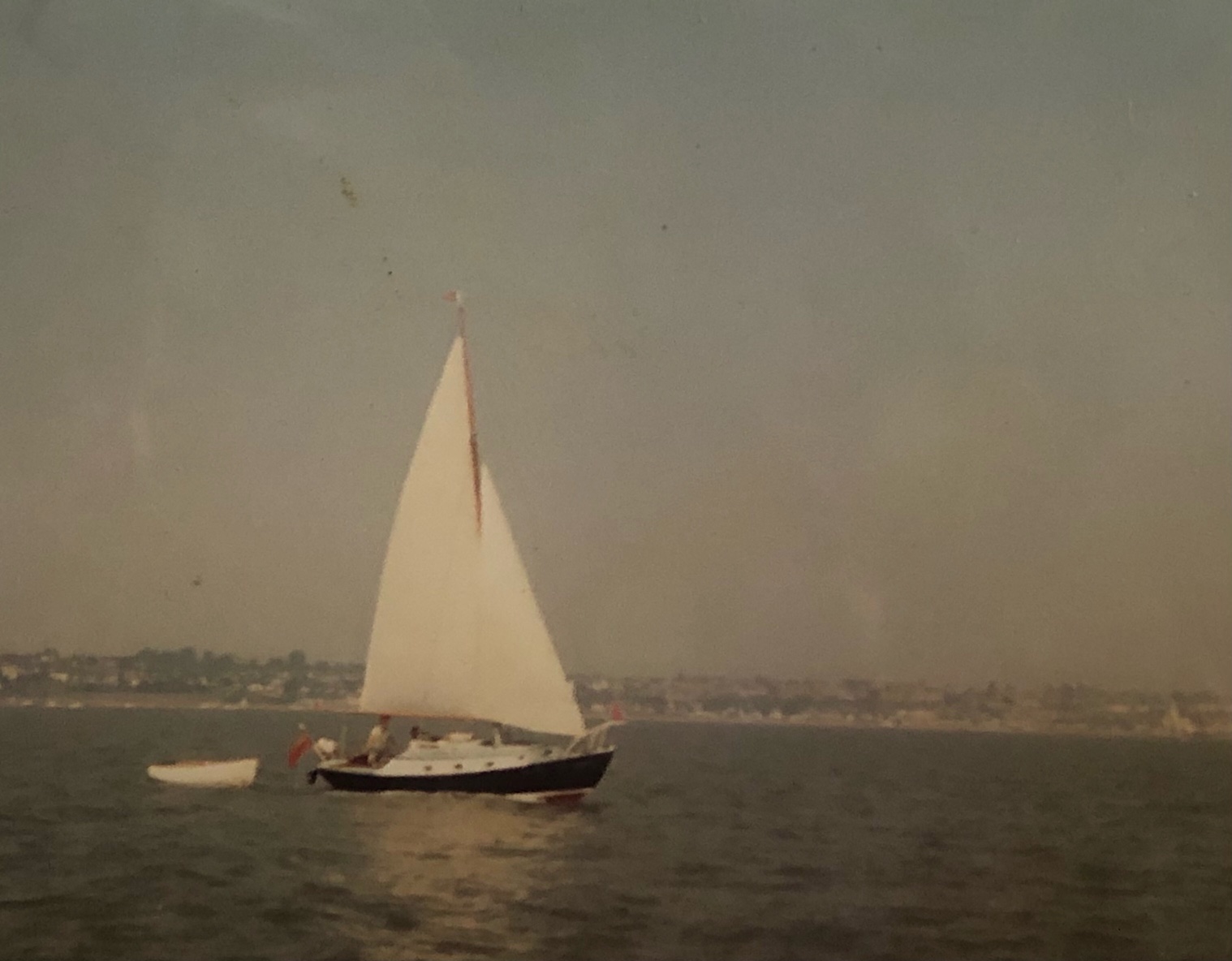
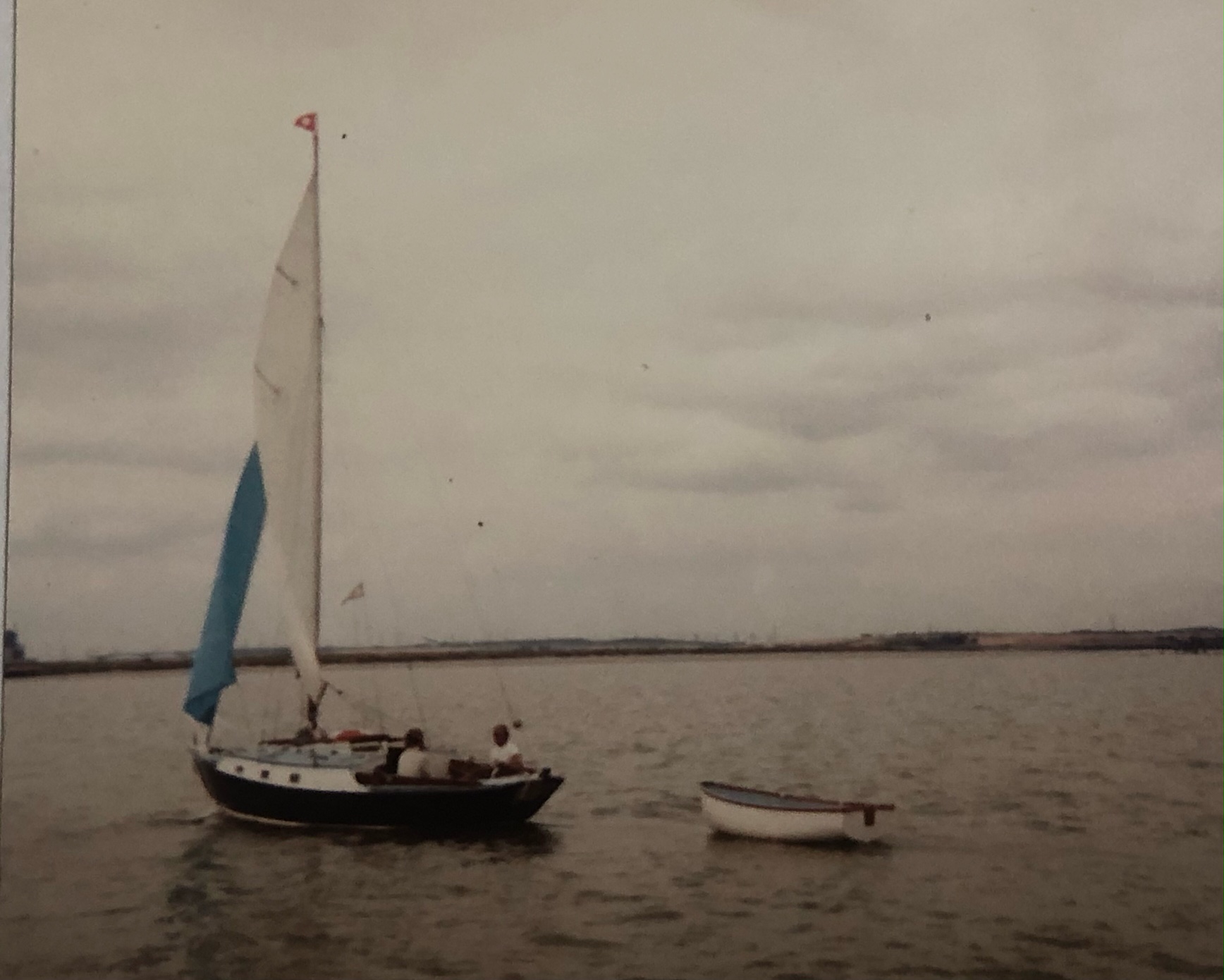
The fence petered out and in we went … yes, the poor old thing was a Peoples Boat. I knew that there were some built with deeper draft whilst the one we had was fitted with a centre plate. She was painted in the same blue that we had too. Our upperworks were white painted though.
The Peoples Boat found in a yard at Pin Mill. her name plate was still afixed, read: Naiad

The Pin Mill boat has clearly been ashore uncovered for some while and her days could well soon expire. If she was built in the 1950s then she would be around seventy years old. A cursory look round told me that there didn’t seem to be a lot wrong with the old girl.

Peeling varnish adorned Naiads’s upper works.

Below is a picture of Blue Tail out of the water back in 1982 (with Christobel posing in front…). The boats are virtually identical with differing details such as the deck edge rails.

Christobel remembered me once scarphing a new piece of wood into the top of Blue Tail’s mast. I also replaced one side of the centre board case too. The biggest project undertaken was the fitting of a new Vire petrol engine to replace a vacant space once taken by a Stewart Turner. A lack of headroom within the boat was its biggest shortcoming… Our old boat was purchased by a Burnham ‘big yacht’ crew member and went away to the R. Crouch. We never came across her again.

It was an interesting find, not only for the memories…

Note: The Yachting World Peoples Boat and Finesse stories are related in ‘The Jottings of a Thames Estuary Ditch-crawler‘ published by Amberley. The book remains in publication.

11/2/25

Ditch-crawler reflects on the boatyard industry – the future…

The future of wooden boat building and boatbuilding in general has been discussed within the industry press for a some while. There is an ongoing skills shortage. A greater number of young women are apparently training or in yards already – I have met a few – but is this enough to make up a male shortfall?

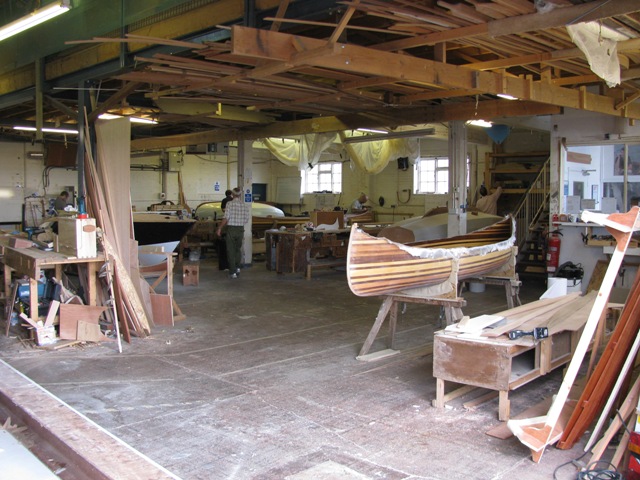
After the closure of The Lowestoft Boat Building College (IBTC) this has become an even hotter issue. A smaller college based in Lyme Regis remains operational, but it is very small by comparison and I saw no large vessels being worked on when I visited some years ago, they were launches, dinghies and canoes, essentially.

A peak inside the Lyme Regis College workshop during 2013.

The article that caught my eye is below:

Marine Skills Crisis: The future of boatbuilding

It makes for an interesting and thought provoking read.

Setting up for a new build at the lowestoft IBTC – credits: College & Practical Boat Owner – this has all gone.

Around the Thames estuary, boat owners are relatively lucky, of wooden ones especially. Heritage Marine in Maldon (Essex) has an active yard with a good team which includes apprentices. The Pioneer Trust in Brightlingsea has a working yard too and over in Faversham, Kent, Alan Staley, has a yard constantly busy with repairs and refurbishments as well as spar making. Alan has just turned eighty…

Other yards around the UK have training facilities, or train on the job, but it is a tenuous business. Stirling & Son of Plymouth have just completed the rebuild of a large gaff ketch but they are almost alone in this field. Trawling the web, there are yards out there.

Essex, fortunately, also has an active Thames sailing barge yard at Maldon too with a very small pool of skilled craftspeople. Another shipwright freelances. One thing is clear: all are aging.

GRP building in the UK is all but dead other than small craft and top of the range brands that are well beyond the means of the ‘ordinary man’ but there are hundreds of thousands of GRP boat owners who from time to time need specialist repairs. A cousin of mine needed the removal of his boat’s rudder due to ‘falling over’ damage. It was quite a job to find a facility in his part of the Scottish west coast to get a repair.

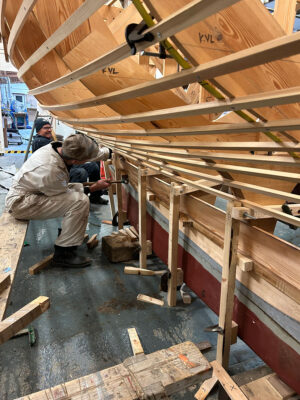
Rebuilding the aft deck of the TSB Cabby at Maylandsea (Blackwater Marina) during 2025 – currently the barge is having her entire starboard side replanked with some new frames – the shipwright is in his early sixties…

The building side of the industry is one issue, however, there has been another flagged up and it is one many observant yotty folk may well be aware of – that is the demographics we see around the yards.

Take a good look at the age of the staff within your home yard. How close are they to retirement, or, are they actually well past retirement age? How many are youngsters on the learning pathway?

In the yard where we now keep Whimbrel, the demographics are reasonably spread. The manager is under sixty, the deputy is around thirty and there is a youngster on the bottom of his learning curve. A ‘metal’ man is edging towards the retirement age and there is another operative heading towards that bracket too.

Once you have a boat and a base for it, be it at a marina, boatyard or local ‘self-help’ club, the issue of annual maintenance and a lift out is about all that bothers you.

Maybe you prefer to get the yard to do anti-fouling, small repairs, hull polishing and varnish work – how old are the skilled staff doing these jobs. It is highly likely that a couple of skilled staff not only carry out repairs but chock boats too.

A few questions:

Do you ever give a thought about who lifts and chocks up your vessel?

Do you attend?

Do you help or offer advice?

Do you do all your own maintenance?

If the answer to these questions is: ‘I leave it to the yard’, then perhaps a rethink is required.

My experience of being at a self-help club/yard is that the owner is expected to assist and direct the chocking up. The owner is certainly expected to be present.

I continue to take a proactive approach at my current base and direct the setting down and chocking: with over forty years of experience with same boat, I know what I want.

There are such issues as gap for centre plate, ensuring main chocks are spaced under the ballast keel and not hardening up on the bilge stub supports until boat has settled.

In the view below, the yard placed the steel frame support under the bilge forward of the keel stub blocks – a position that I haven’t place anything ever! The two port & stb’d supports took no weight and ‘just got in the way’ of the mate when antifouling…

Whimbrel chocked up during early 2024 at Blackwater Marina.

The boat had three sets of keel chocks. If out for a while and moving about deck, I add a bow support. The bilge stubs lightly support the bilge – wedges are not ‘hammered’ home, just enough to support and steady her.

Below is a look around other yards…

A large bawley set up ashore in a Pin Mill yard.

The vessel above is set in keel blocks as well as props to maintain her upright composure. Very often these days keel boats are placed in custom frames or a set provided by a yard.

The Cirdan Trust’s Duet out for an emergency leak repair at Fox’s Marina in August 2025 – note she is not chocked but fully supported in slings and just touched down.

Interestingly, I chatted to the two crew (not in picture) and neither were particularly interested in the procedure taking place – recaulking, leading and fitting of a light batten over a seam. The young mate, a wisp of a girl looked astonished at a comment I made about careening on a bank to do the job – I said, ‘Well you might have had to…’ As the skipper smiled wryly! These are jobs that boat owners should have knowledge of.

A large motor-sailor chocked up at Suffolk Yacht Harbour.

Youngsters are not being attracted into the industry for whatever reason. May be the mind set of today is wrongly wired. Expectations are too high. That dirty job is not for me syndrome, and so on…

One thing is certain, the situation is likely to progressively worsen as time goes by.

Food for thought, eh…

10/29/25

Ditch-crawler has a good look at Sutton Hoo ship at Woodbridge…

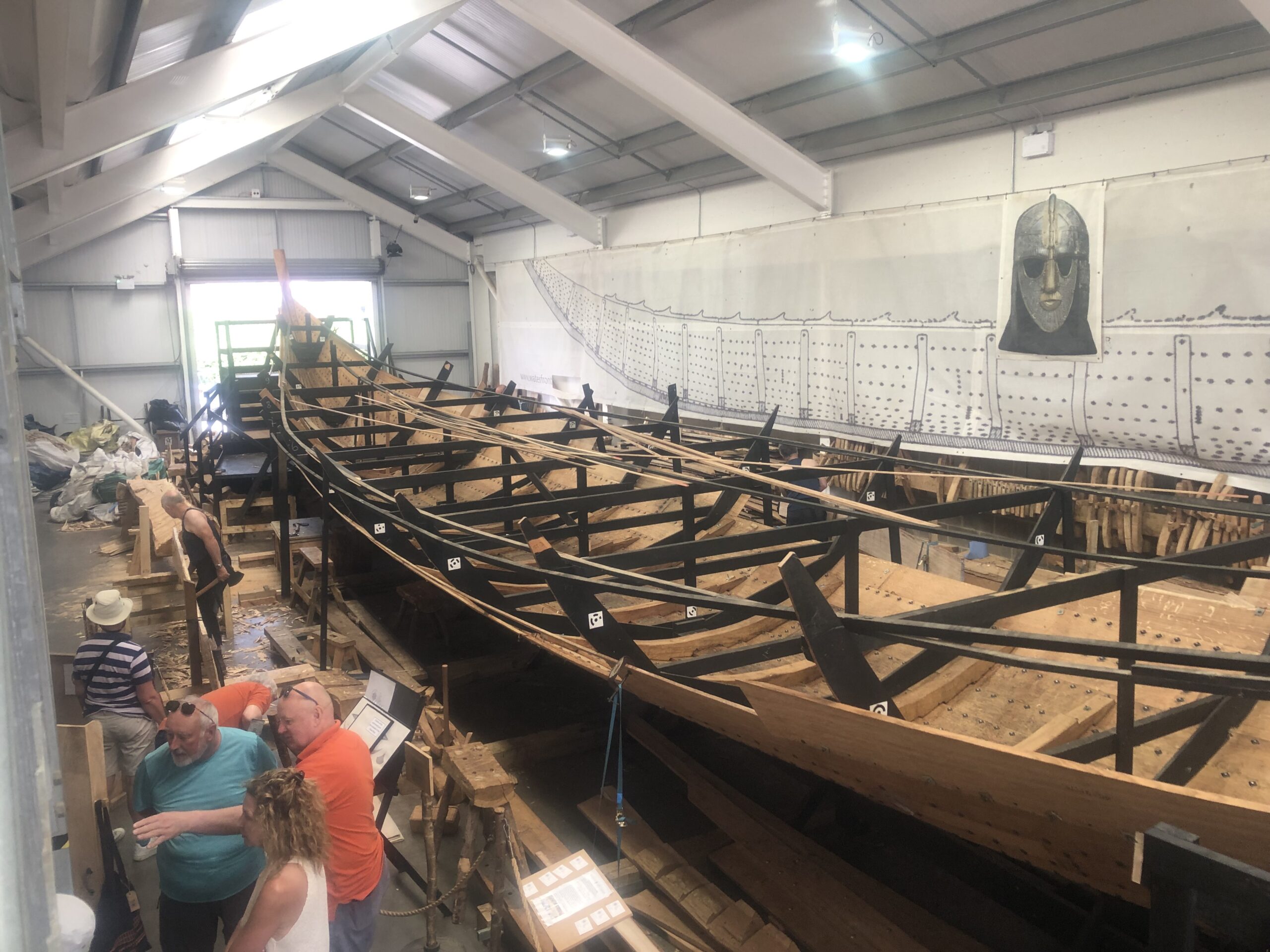
While berthed at the Tide Mill Yacht Harbour in Woodbridge this summer, I took the opportunity to have a look at the archaeological replica of the ship found at Sutton Hoo on the cusp of World War Two. The ship is as near as it can be to the original, however, apart from iron rivets there was only the ship’s imprint left.

Interestingly, there is to be (possibly started) a new dig on the site to open it up for a ‘modern’ look at what was covered over after the excavations that took place at the end of WW2.

I visited the yard where the new ship is being constructed in the summer of 2022. At that time the team were building a midship section as a construction trial.

Earlier post from 2022.

The vessel is in a shed on the site of Whisstocks Yard close by the Tide Mill where there are now eateries, cocktail lounges, ice cream parlours and an open space commemorating the yard. But, one shed was reserved for some form of waterfront activity and this is where the Sutton Hoo Ship’s Company was set up some years ago.

Above is a general view of the ship under construction.

While I was in the shed an archaeological shipwright was using a faring axe to fine down a plank which had been split from a log a few days previously.

I chatted to a chap who was either sweeping shavings or ensuring visitors kept within their allotted space – I said that the construction was unchanged in its main essentials to this day: my own vessel was of clinker construction. Chap said that wasn’t possibly the case … I tried to explain, but got no further, moving on muttering quietly…

I then chatted to another member of the day’s team and that person understood!

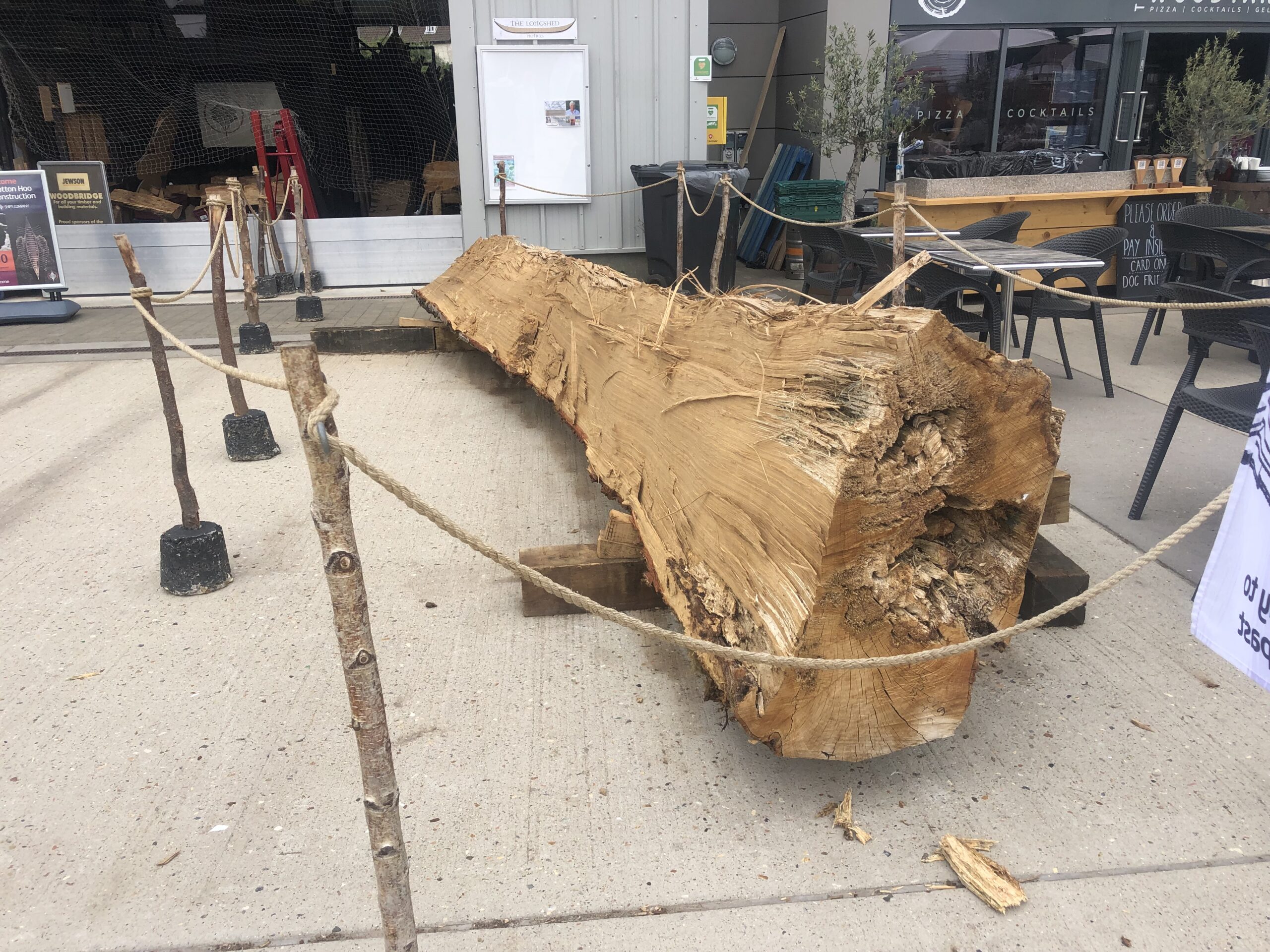
Log outside the build shed which was being used to split off planks.

There has been a raft of articles in the yachting press about the project and one, I remember, had a discussion about whether or not the vessel had a mast all those hundreds of years ago. Many of the experts believed not. Others believe she must have, which is where I fall: she would have been expected to travel long distances and what is the point of rowing when a fair wind and sail could do so at leisure. No signs of a mast were found at the initial dig.

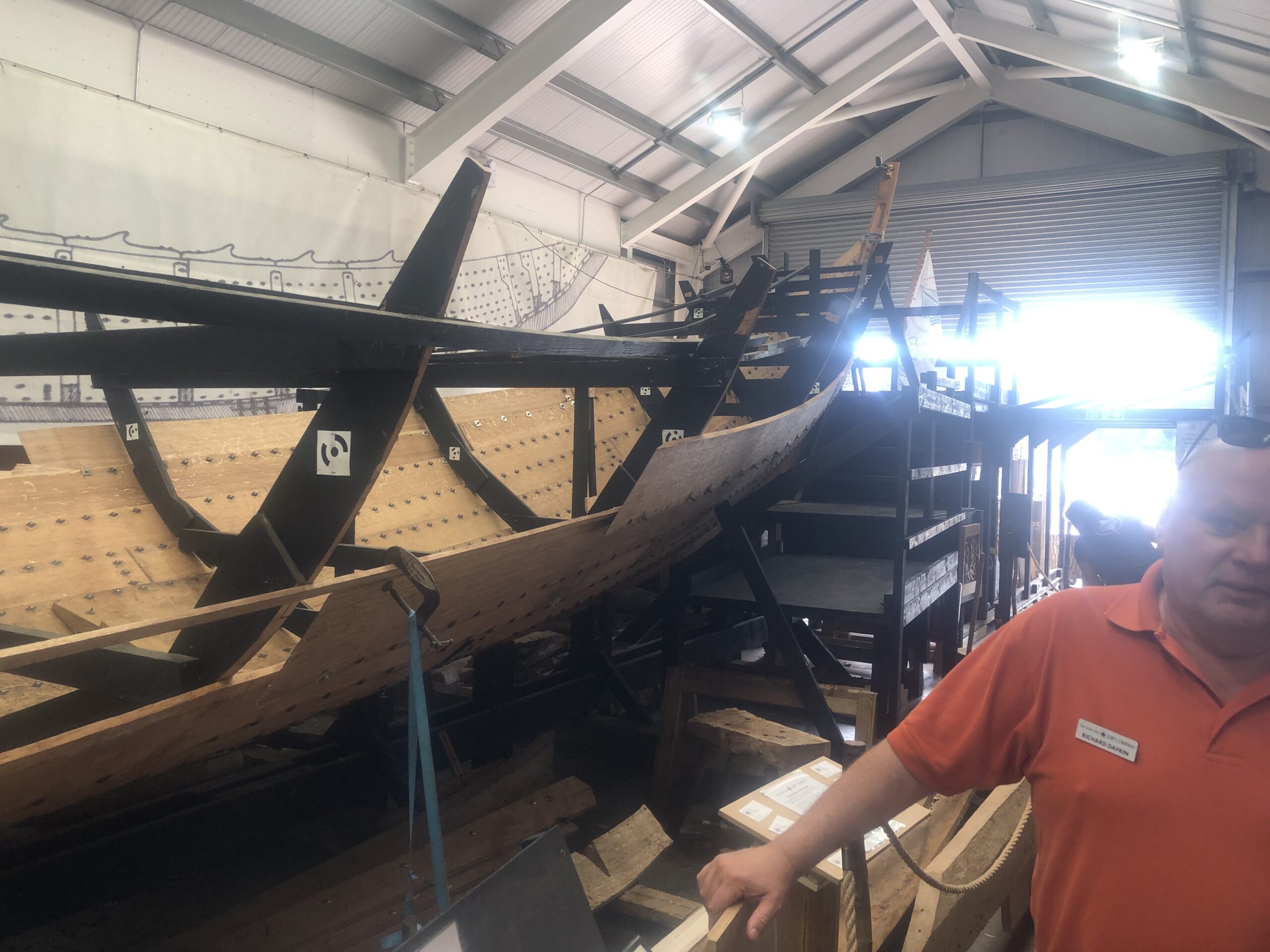
A closer look at the planking up. Note: although an archaeological construction, temporary fastenings were being used to secure planks until the iron nails and roves were fitted.

I found myself eventually talking to one of the more senior project team. I asked what the immediate post construction plans were for the vessel, I then asked what then, and, on into the future.

I was told that initially they would learn how to operate the ship under oars – I hope they talk to other such groups, gig rowers and even the Gloriana Royal Barge project (on the Thames).

As to the future, there seemed no definite plan: health & Safety precludes the taking out of ‘passengers’ and such.

Were they going to fit a mast? No definitive answer there either.

I shall follow this interesting project more closely as the build nears completion and will surely be on the River Deben again soon to see her.

I just hope that she doesn’t just end up as a statice exhibit, soaking up fresh rain water, setting rot to work away at her…

It was a fascinating visit and to watch precise work with tools that are still recognisable for what they are. I’ve used a ‘modern’ adze, chisels and spokeshaves. Those distant shipbuilders would recognise our tools for what they are – not sure about routers and electric planes!

Go and look before she is completed. Woodbridge is good for a day out!

10/14/25

Ditch-crawler was saddened about demise of barge-yacht Tiny Mite.

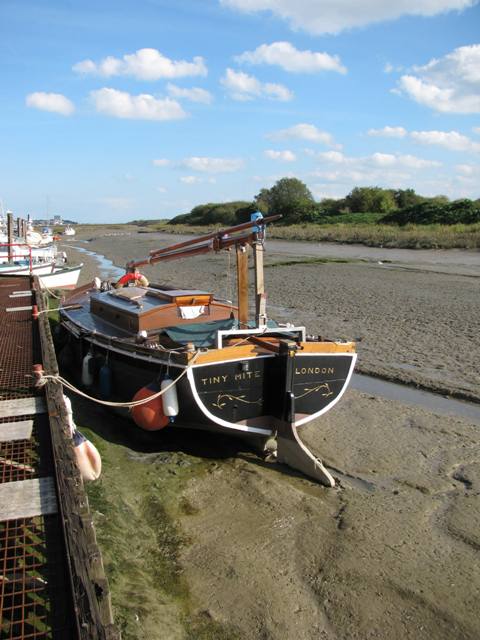
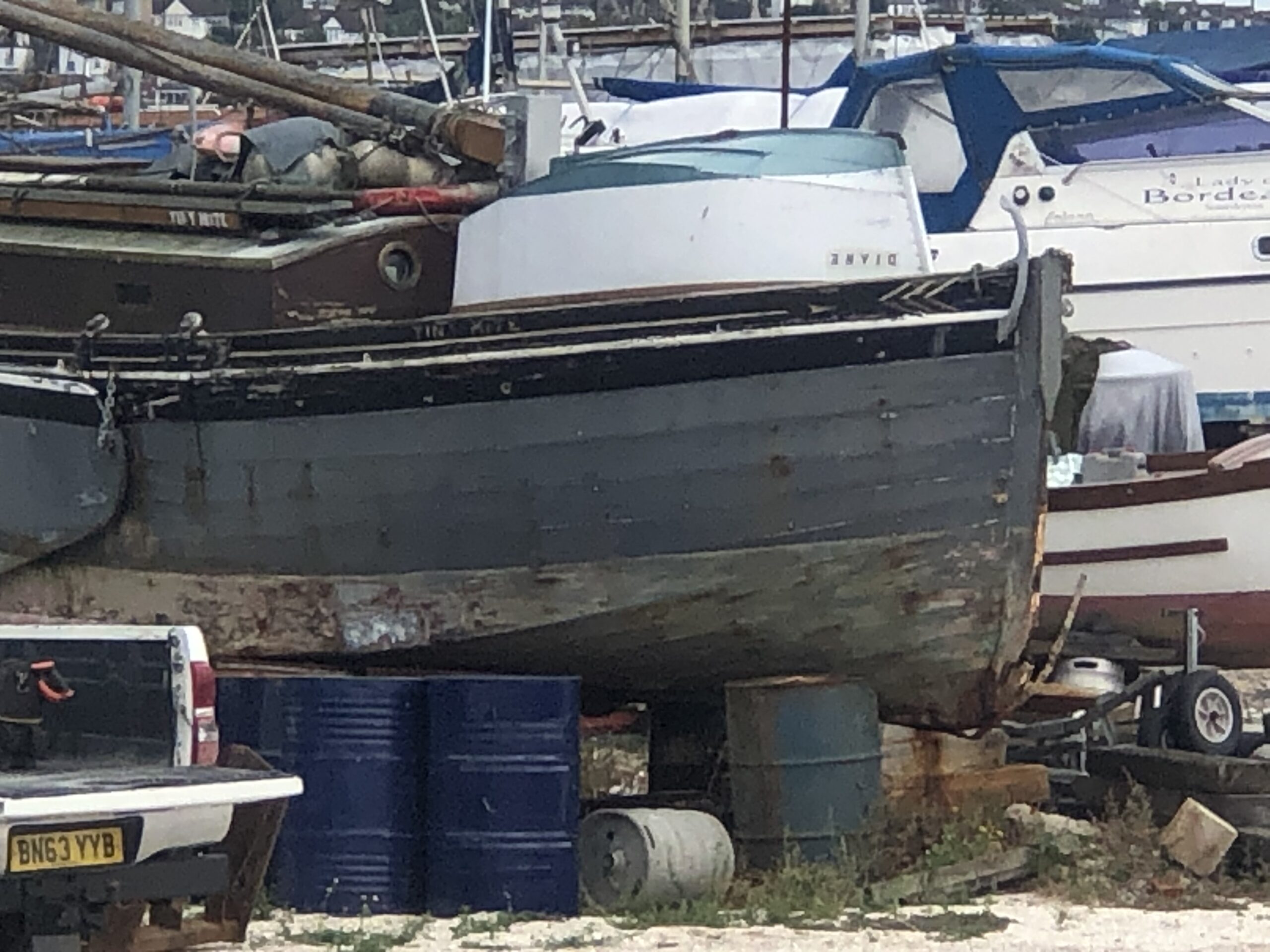
The barge-yacht Tiny Mite had been put on the market back in 2020 due to the then owner’s age related health issues. The old girl was out of the water a ‘jolly long time’ during a very long refit when she finally went back in. During 2021 Tiny Mite was lifted ashore by the Leigh Motor Boat club’s yard team as the poor thing was taking in water.

Soon after her relaunch and rigging out.

I was contacted by a friend of the owner about her sale and it was said that ‘they’ wanted her to go to a good home. My advice was to allow her to go to the highest bidder: the old girl needed attention. That advice was ‘pooh poohed’ However, look what happened…

Older post with links:

During walks along the downs and around the seawall bordering Two Tree Island I often stopped and looked at the gradually worsening state of the little barge. It was sad to see, but is something so often seen when a owner just doesn’t want to let their baby go. The time will face me at some point, but I have drilled myself for that day!

Picture from 2024.

During this summer I saw a huge number of similar craft, but whilst on an overnight stay at Halfpenny Pier, Harwich, the mate and I walked into Dovercourt for a few stores – where we found both poverty and a very nice top rate bistro-cafe and delicatessen which seemed completely out of synch with the world around it – be that as it may, Dovercourt waterfront is very different to the down at heel town’s high street.

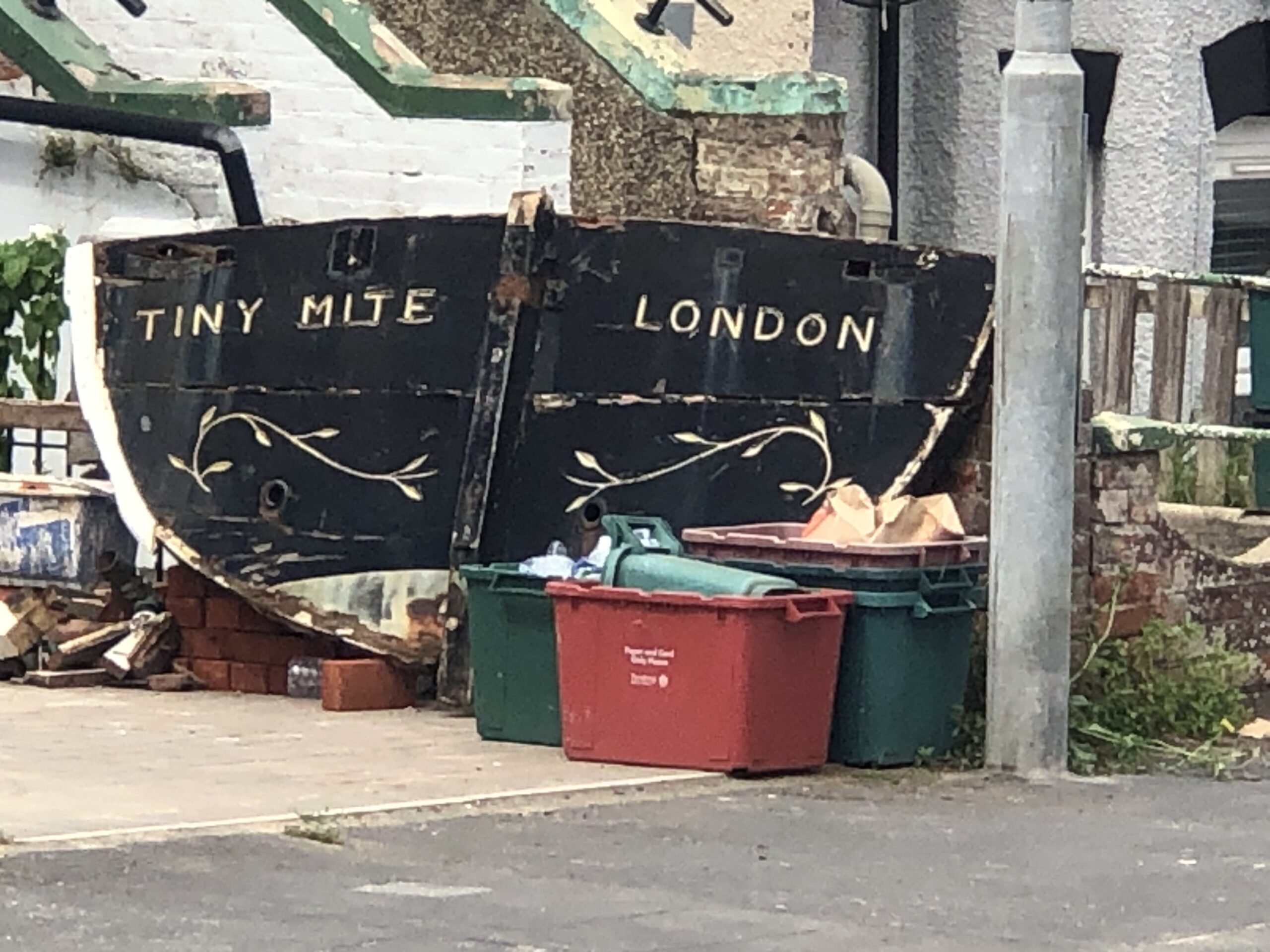
On the way back, I spotted the familiar sight of the Tiny Mite’s sawn off transom in the front garden of a property on the edge of Harwich town itself.

‘Bloody Hell,’I said to Christobel’s astonishment.

I pointed and she immediately recognised the object too.

Clearly the old girl had suffered the fate of a chain saw. A day or so later on a ‘barge’ facebook page an advert of bits of the Tiny Mite were shared from an ‘ebay’ page.

As seen on a front drive…

It was an extremely sad sight to see but nonetheless, it wasn’t completely unexpected for after a sale of the barge-yacht to a new owner, nothing, but nothing happened. Her bow opened up and there was a length of rot in her midships area near forward end of her starboard leeboard.

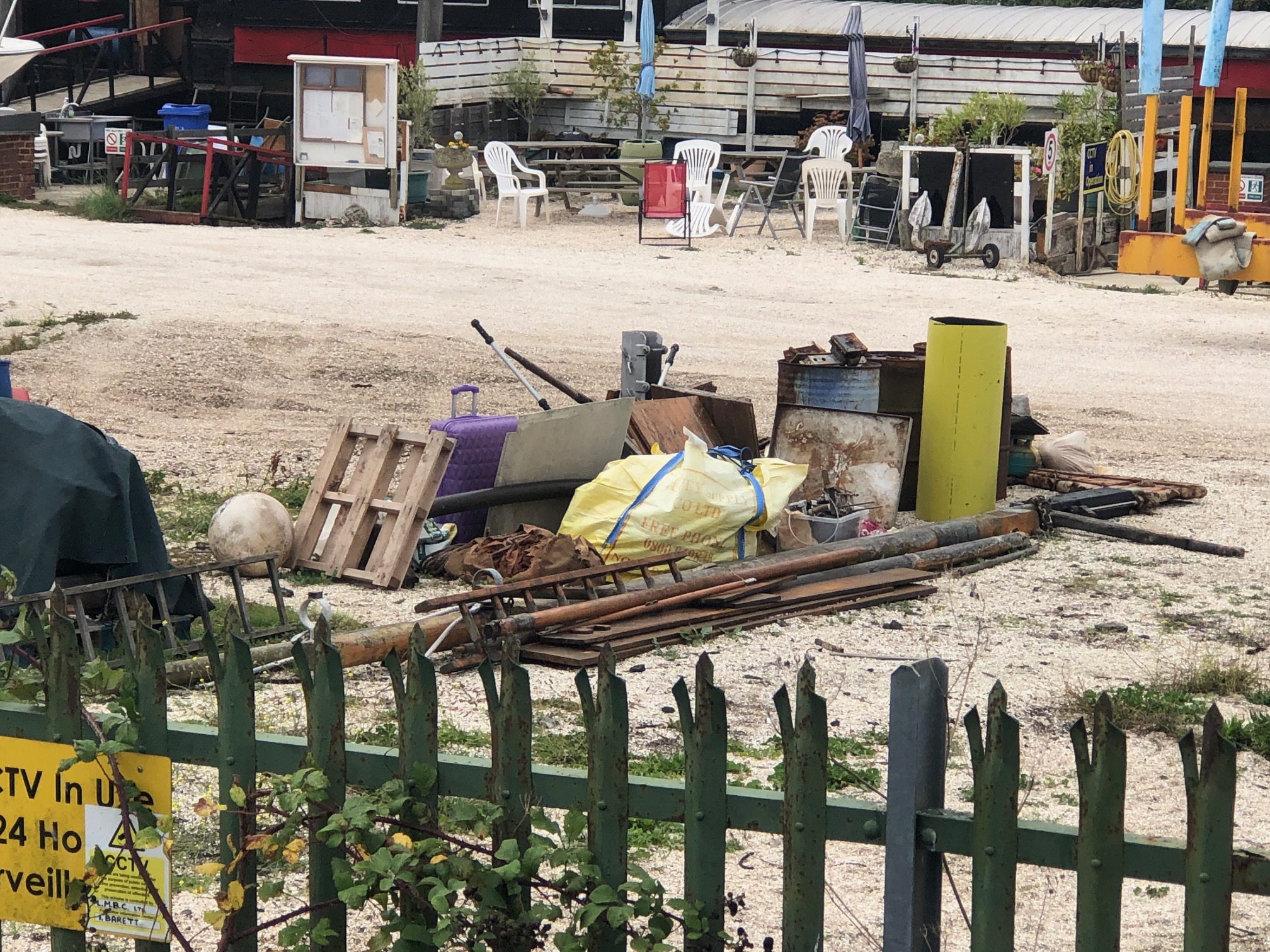
More recently, walking past the Leigh Motor Boat Club, I spotted her spars in a pile still sitting on the hard standing next to the chocks that once supported the Tiny Mite in her last berth.

Tiny Mite’s spars… Note the mast case too!

Those spars may have a use, but I suspect a bonfire beckons…

Christobel and I have an abiding memory of Tiny Mite coming down Hadleigh Ray from Benfleet one glorious Boxing Day. It was in the days of 35mm cameras and mine had been left at home so there is no pictorial record. The Tiny Mite had a bit of sail up but also a giant red ensign was flying too. It was glorious.

The event is recorded in my book, ‘Salt Marsh & Mud…’ in the last chapter, Festive Cheer.

We are both glad of that memory.

10/8/25

Ditch-crawler wanders around yard boat demolitions…

The subject of ‘end of life’ problems associated with pleasure craft has been in the news in recent times. I had an article in an East Coast magazine around fifteen years ago about what I perceived as a growing problem, especially around the dumping of unwanted little ships.

During the summer days of sailing, I often wander the yards to look at what boats are for sale, being worked on and those in the lay-up places awaiting their fates.

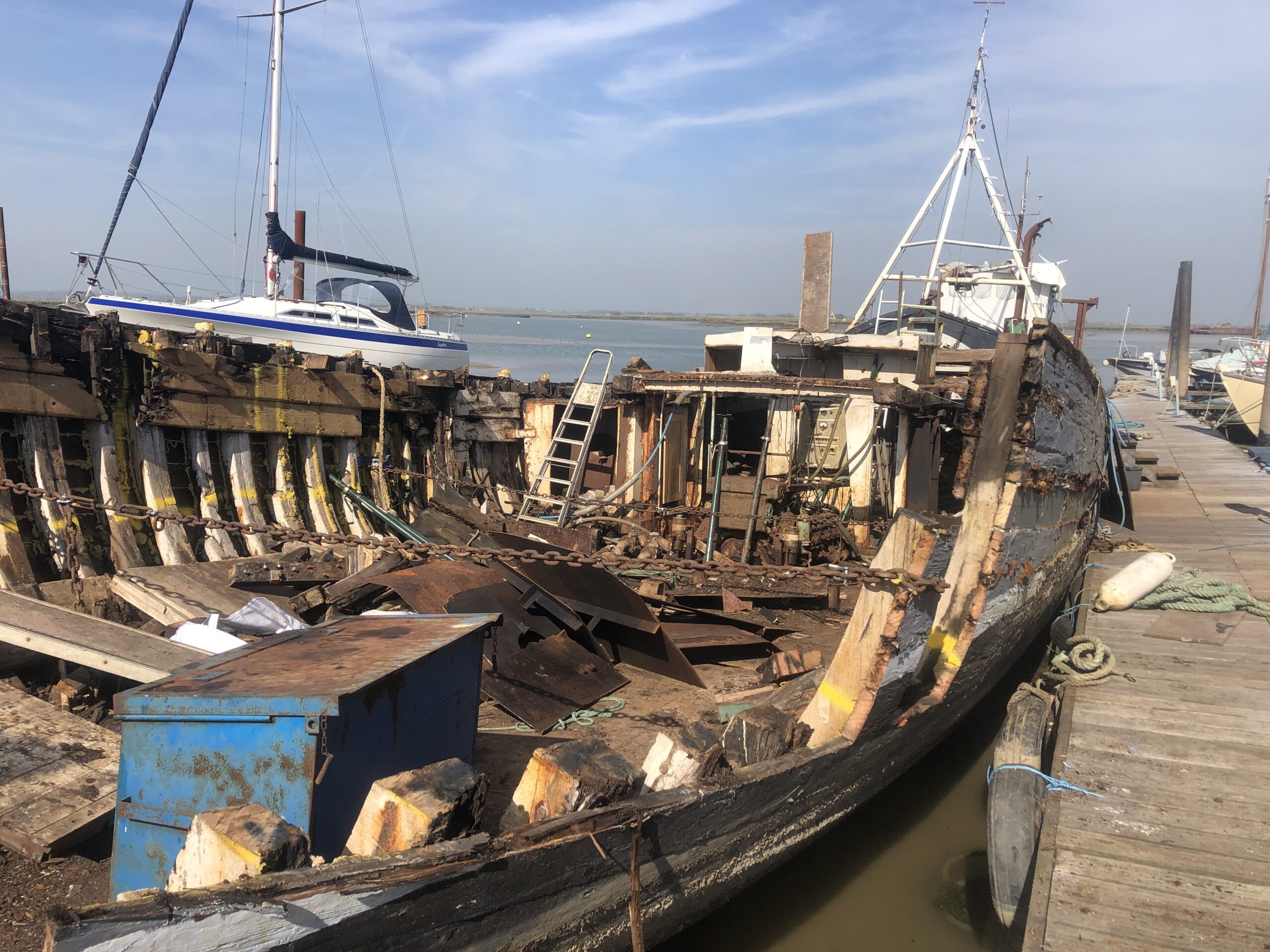
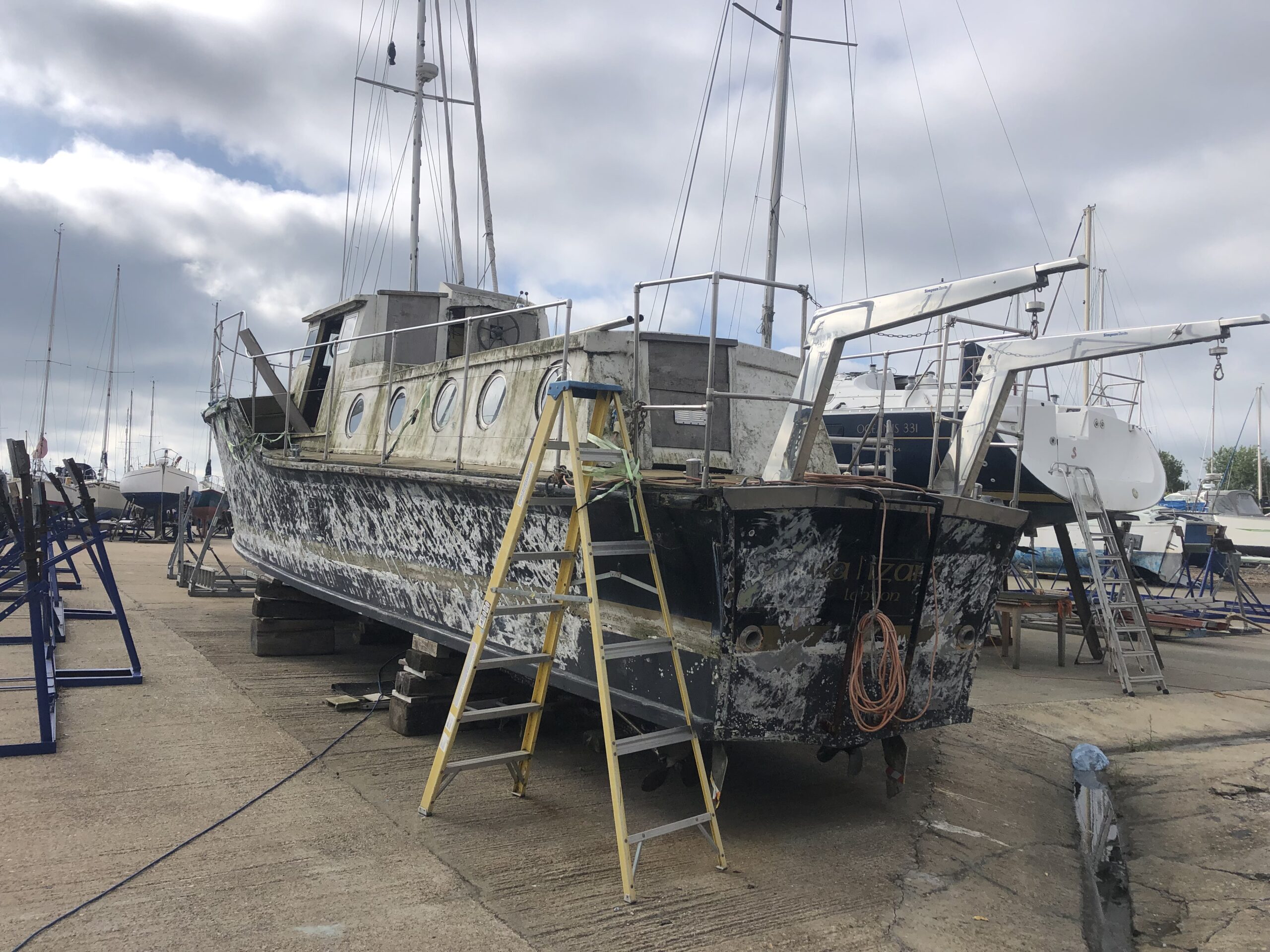
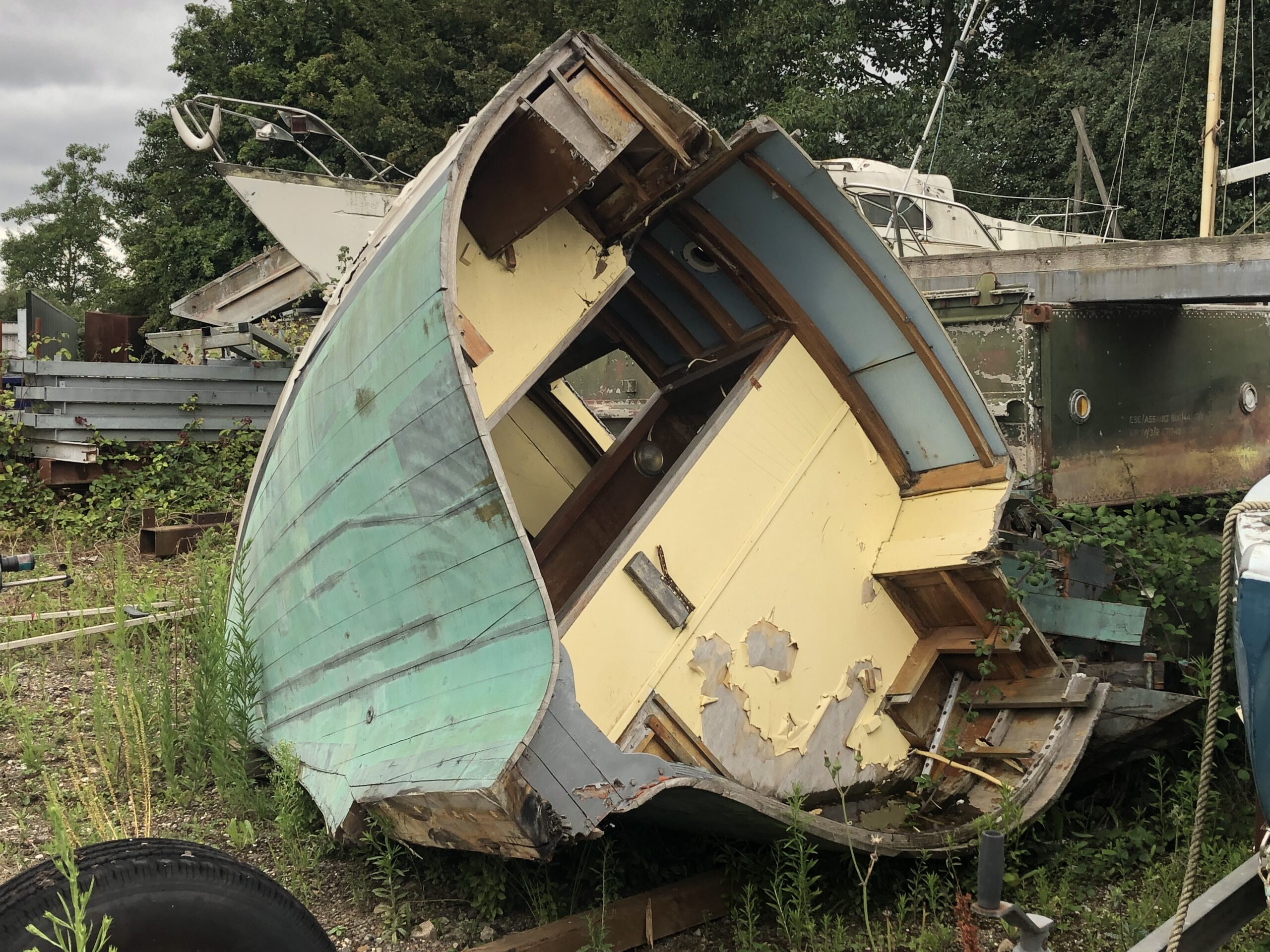
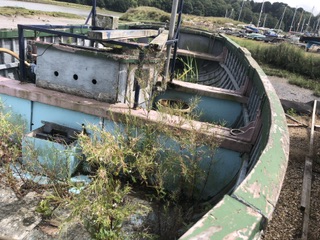
Above is a view into the inside of an old fishing vessel that had been used as a house-boat at West Mersea. The Maylandsea yard I am berthed in, gradually reduced her down towards the waterline then put her on the slip for final cutting up. Metalwork was recycled and much of her timbers were burnt. The yard has another awaiting same treatment. I was told that breakage costs for one of these was £20K!

Companies have tried various forms of recycling experiments from chopping up and mixing into a road surface mix to the complete chemical breakdown of components back to base ingredients. Some success in the laboratory was achieved but scaling up was stated to be a huge problem.

Meanwhile I have noticed a growing number of ‘clearances’ within that corner of so many yards were old boats linger.

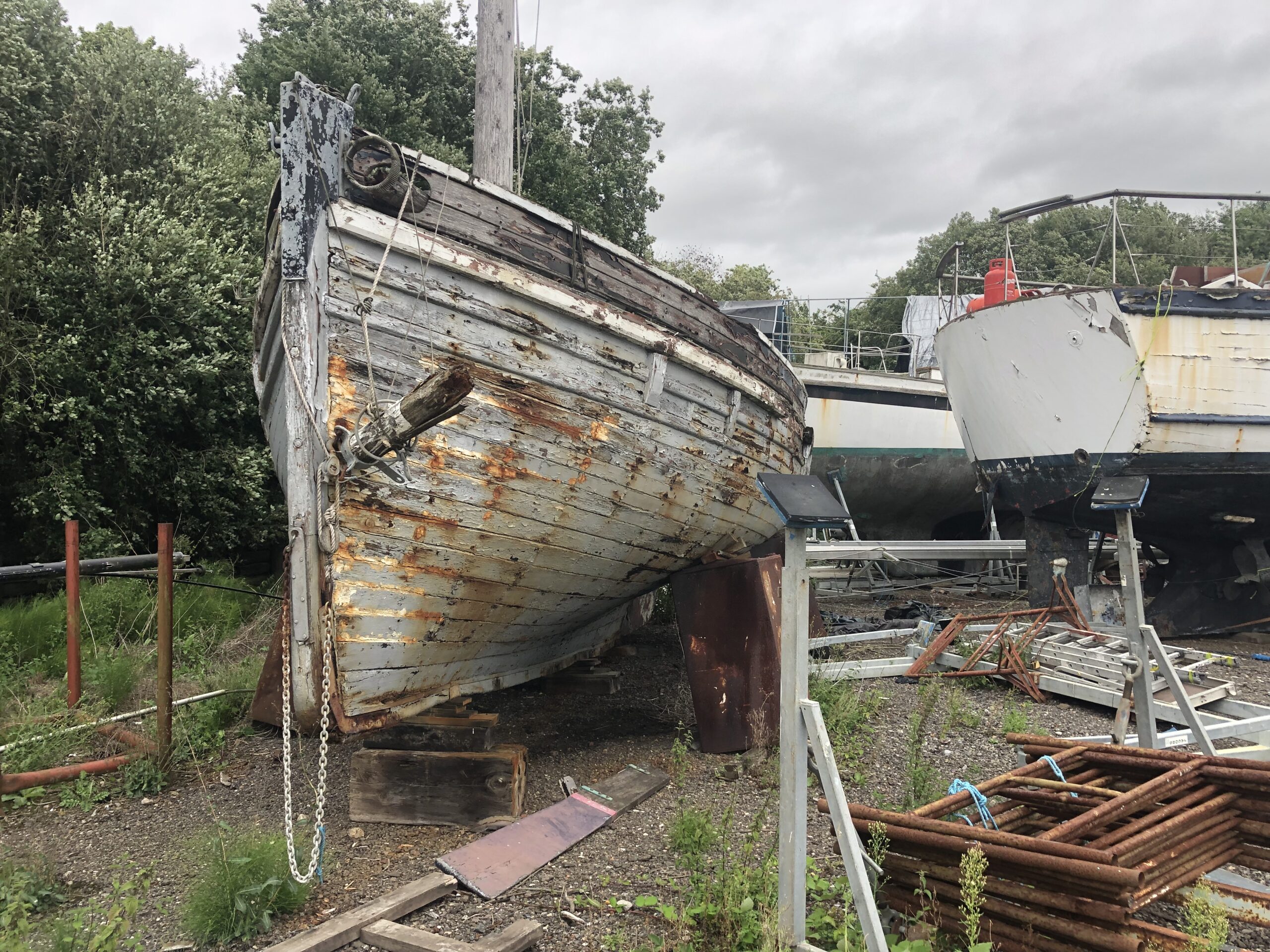
This old girl at Titchmarsh Marina had been hauled out and had her hull stripped back, however, on close inspection the hul was seen to be absolutely riddled with rot. She was clearly awaiting her final fate.

In many respects, old wooden craft can be sawn up and largely burnt.

What is certainly happening is that old boats are stripped of metal work and equipments which go into recycling.

I was recently told that to dismantle an old Thames sailing barge and transport waste to a special site where ‘tarred wood’ could be disposed of was calculated to cost around £67,000… Once upon a time these old girls were sat in the saltings and allowed to gradually decay. It was a good end for they provided a home for so much of natural life. as well as perches for bird life.

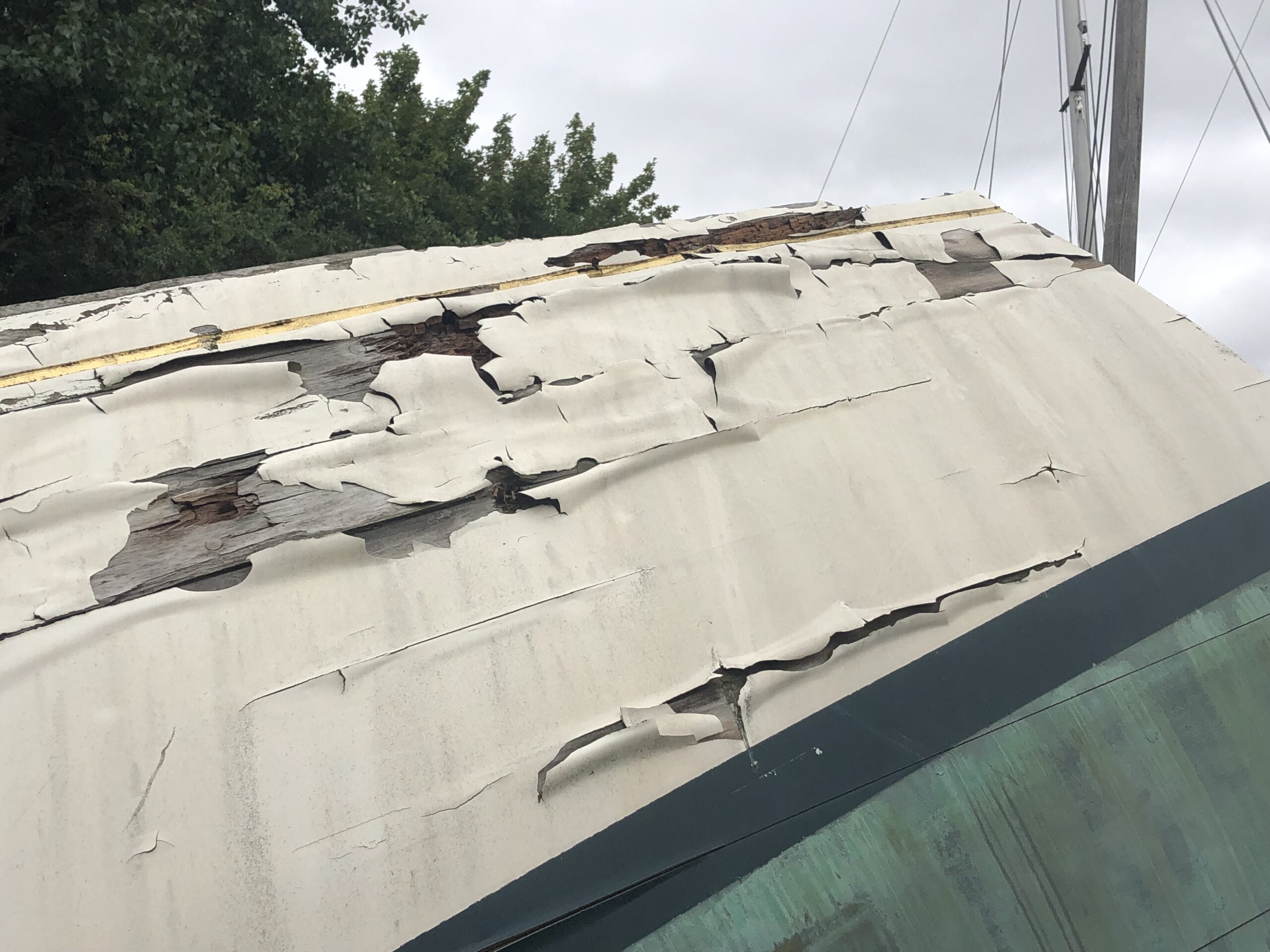
At the Suffolk Yacht Harbour I found a host of craft sitting awaiting an owners decision, it seemed, whilst others were in process of demolition. The old ‘Fifer’ above had a indented rotted keel unable to carry the vessel’s weight. Her planking was rot riddled, yet, her insides, looking through a hole, were in great homely condition!

Above, ballast keel removed and cutting up well advanced: there was no sign of the rest of her.

The problems… It was a wonder she stayed afloat. My finger went through the wood by waterline.

At Felixstowe Ferry an interesting use for an abandoned GRP yacht has been found. A sheltered seating area has been created, however, this is only a small step: eventually she’ll be chopped up as her major half has clearly been.

The waterfront at Wivenhoe is littered with abandoned craft rotting away at ‘their moorings’ and over the years I have watched the gradual degradation taking place. One has recently been removed to make way for a different vessel. There are several clinker yachts, one of which was a Brightlingsea built folkboat, pictured below. the other two are of similar design.

Abandoned vessels cannot just be dismantled for there will be an ownership somewhere and it could pop out of the woodwork at any moment. (excuse pun…) Various legal requirements have to be dealt with, but if money is owed, a lien on the vessel can be issued. The property is then transferred to recoup monetary loss, which could include removal…

Across Europe the problem is immense. It has been calculated that around one million disused craft are awaiting their fate. In N. America, the Federal administration made funding available for bodies to clear waterways of abandoned craft…

Meanwhile, whatever yards do, I just love to poke around these old girls…

It is something all boat owners may need to think about.

It is a problem. A growing one.

10/6/25

Ditch-crawler leaves Thames Sailing Barge Facebook Group due to ‘trolling’…

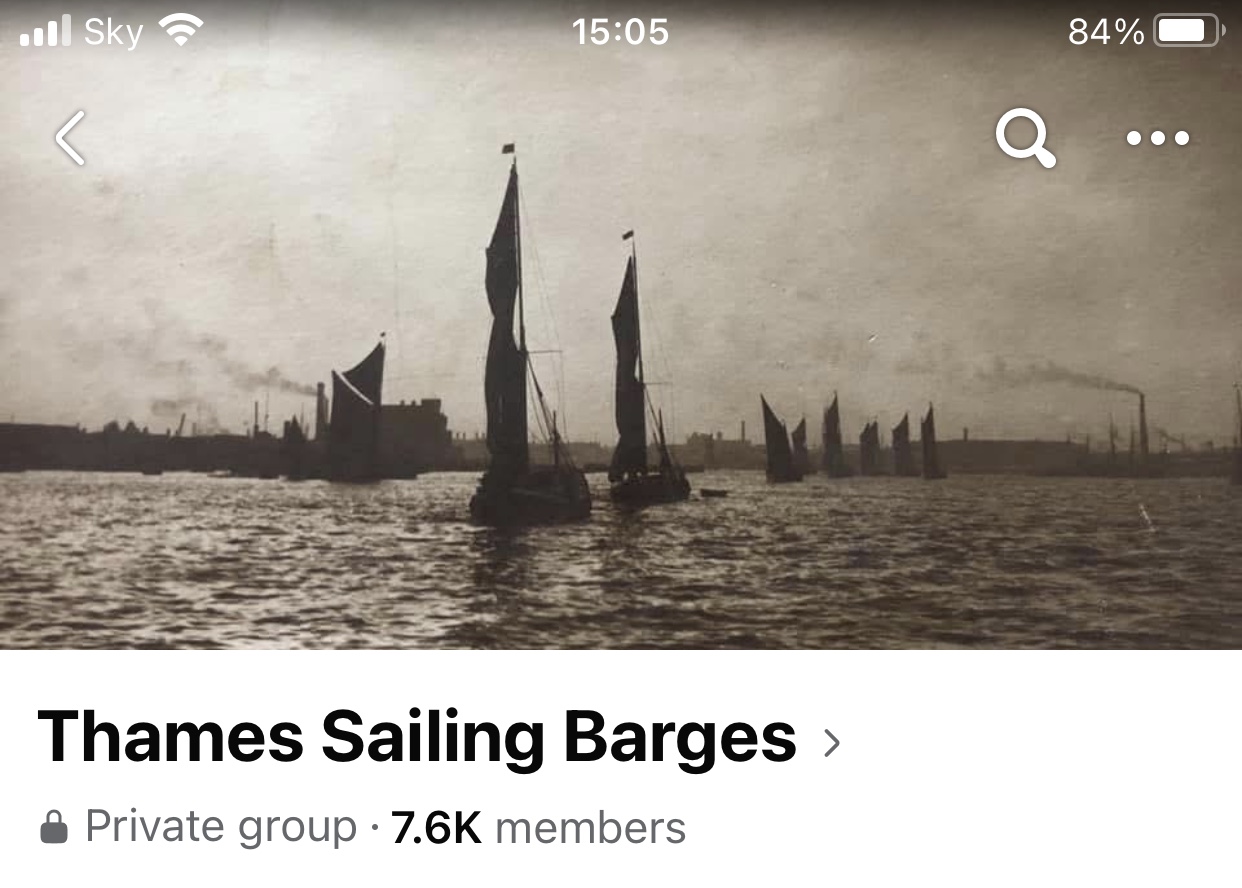
Screen shot of Thames Sailing Barge front page … beware there are some ‘nasties’ in there!

Social Media can be a good medium for sharing information and living history, however, as I have found out, not everyone shares one’s passion for disseminating that information. Jealousy or something akin to it causes people to ridicule those that can be bothered.

Well, last week, this happened to me.

I received a series of messenger messages from a ‘representative’ with an increasing level of criticism and ridicule over a ‘few’ comments (tongue in cheek ones when I looked back) I had made. There was no ‘well done for all the fantastic pictures and information spread over around 130 posts during previous two years or so – absolutely none.

I was to correct myself: a cohort of ‘east coast bargemen’ were becoming fed up with my on line space.

Now, surely, if those people whoever they are have anything interesting to post, they are at complete liberty to do so…

Tied in with this I was ‘ordered’ to ‘support all barge organisations and not just one’ – this was after saying that I would not pay to go on one site as I (and Christobel) gave a not insignificant amount annually to a particular charity. This was personal and it hurt, deeply. It was the straw that broke the camel’s back…

I messaged one of the site’s moderators and got a ‘I am sorry about that…’ response. Not what I expected, so after a couple of days thought I took myself off.

Before I did that though, I trawled my posts and deleted some 110 informative ones but left anything I had posted about the Sea Change Sailing Trust.

I knew that if I submitted a post about leaving it would probably be blocked, so I found a short one still in my account to edit…

Original post was one I sent in about my mother’s tool box which came my way, it was full of barge sail repair stuff and other bits from the past.

So, this is what I added, with minor edits to read properly:

Due to the fact that a ‘cohort of east coast bargemen’ find my comments and posts bumptious, overbearing and just too many, and that I’m too averse to nit-picking, I have been reviewing my future here.

Also, I ‘must not’ post anything I see as it could cause ‘damage’ to another’s posts on completely separate site, I have been further considering my pathway ahead.

That was a blatant attempt to censor me. Note: this is against the ethos of the said group.

I was also told that I should support all barges, which I do (pretty obvious from my posts), however my point was that I had stated that I was not willing to fund other groups when I and my wife already support one to a steady and not insignificant amount.

For those that don’t know – we have both supported the Sea Change Sailing Trust financially, for a little short of two decades.

We are not rich.

We both enjoy giving this support, not just because of the barge alone, but for the work they do.

That last point really upset me, badly. (Christobel was furious)

The group which was the Cohort Mouth Piece’s specific concern, unknown to him, had had my utmost moral, written and financial support (trips), and too of my family, for many years during Edith May’s rebuild and afterwards on paid trips. I admire immensely what Tiller & Wheel have achieved from those early days.

Even then, I was still supporting another financially with occasional donations at the time. Plus being a ‘Barge Club’ member – now stopped for a few years.

So: what to do.

Ignore it . No.

After a couple of sleepless nights, I decided to leave the group.

I can only hope that amongst the ‘experts’ out there, there is someone who has the balls to challenge incorrect historical points: on facebook, they become fact.

Thank you to those that have corrected me in the past – especially to the lady with her ‘wreck’ info providing updates to my knowledge.

Following on, I deleted around one hundred and ten (110) posts of barges under sail, film clips, renovations, barge remains in the saltings and out on lonely mud flats and more besides.

A large number of my comments were also removed.

FAREWELL…

P.S. the tool box was given to the Sea-change Sailing Trust.

Do you know, after five days, I found I haven’t missed it and am again relaxed.

09/28/25

Ditch-crawler fits a new solar panel…

During the summer I flatted Whimbrel’s battery after leaving the nav lights on during a passage that began in the dark. The boat runs on only one battery of 85 Amps. It is backed up with a battery booster engine start module which is maintained in a state of charge. The supplier was very helpful with my pre ordering questions too. (Advanced Battery supplies of Stockport)

The old battery was two years beyond its guarantee date and was a standard marine/caravan multi-use type commonly found at chandleries The new one is also multi-use but has a stated five year guarantee. We’ll see.

I discovered too, around the same time, that our plus twenty-five year old solar panel appeared to be non functional. I checked its output on a sunny day – nothing, it had failed!

A new battery was ordered, received and fitted at the end of August. Investigations into a new solar panel opened an Aladdin’s cave of wonders to choose from.

I alighted on a unit sold by Seasolutions of Chichester (sold by others too) as a unit stated to be fitted for marine use and could be fixed to the cabin top – it being a semi-flexible unit.

The solar panel kit.

After a run of clarification questions, it was ordered.

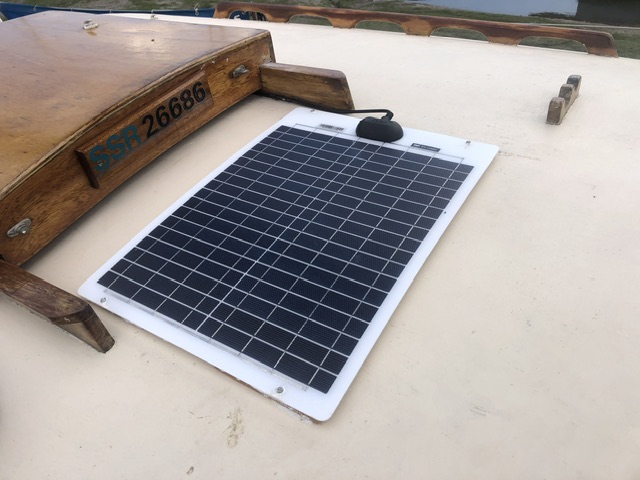
The unit has a 20 W output and comes with a regulator to protect battery from over charge. It is from the low output end of the range. We now have two additional green led’s (one winking) lighting up the main cabin. A piece of tape will be called for. Why is it they are so bright?

A cable run and location for the regulator were worked out after some thought, rather than a cable snaking across the cabin top. Once done, I measured what length of flashing was needed to hide cable – my home stock was dry, so I searched for some angled batten which was ordered – not quite what I wanted, but it worked! Its stated use was for floor edgings to skirting boards… Once varnished, the colour proved to be a good match.

Note the angled flashing to cabin side corners of structure.

Above is an end of flashing and the cover for junction terminals.

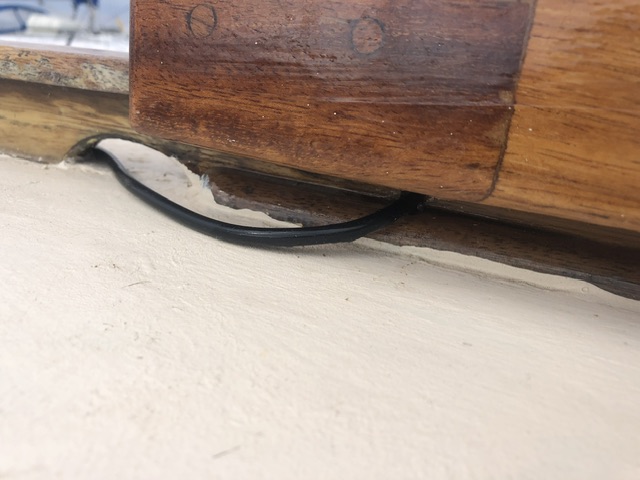
The cable was brought through the hatch runner and sealed.

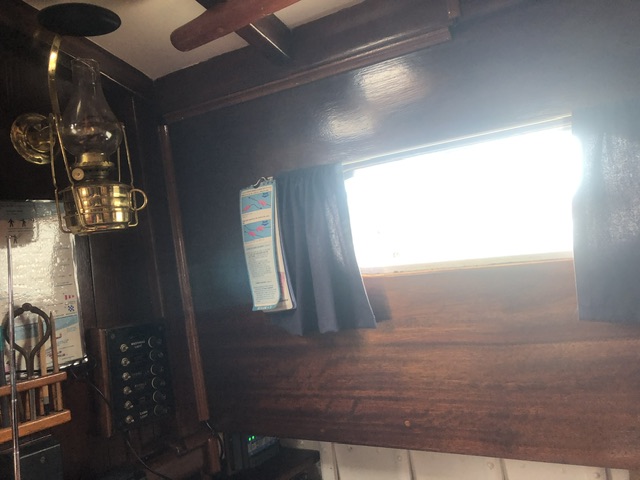
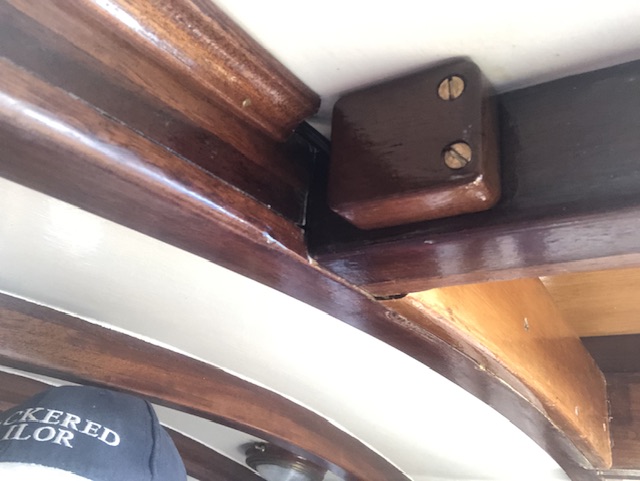
The cable was fed through a drilled way in hatchway beam and the u-loop covered by a cap, leaving everything neat and tidy.

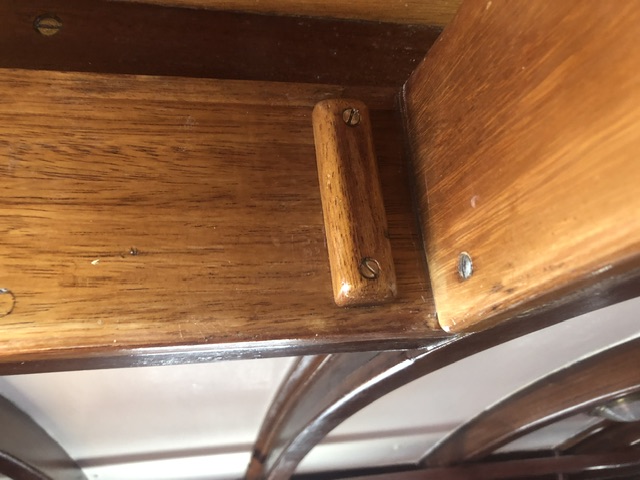
The capping now also acts as a hatch stop as. This arrangement has avoided a cable passage through the actual cabin top. The capping will likely have to be removed when I next wish to remove the hatch.

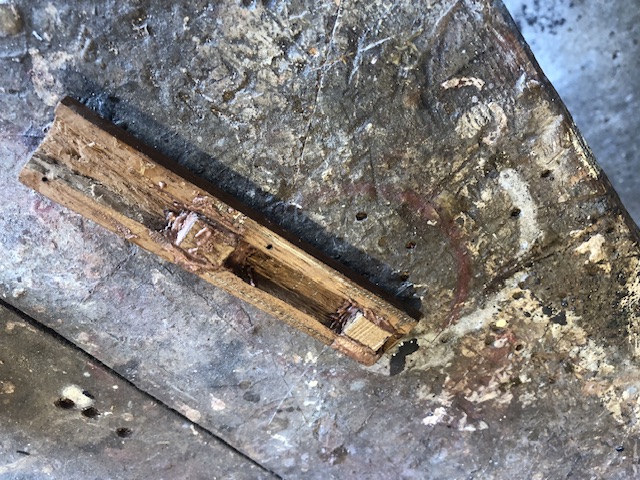
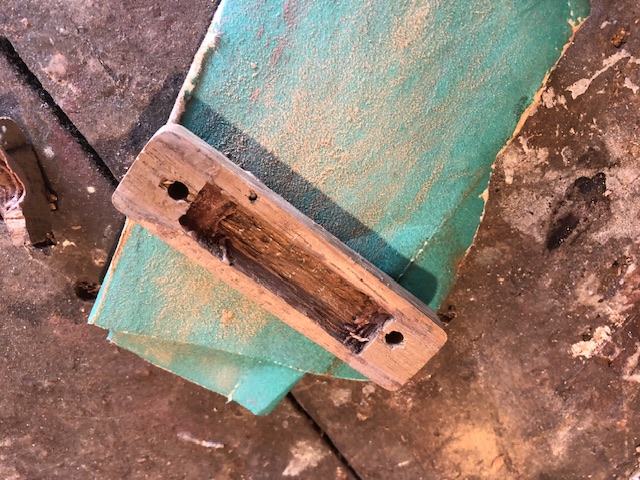
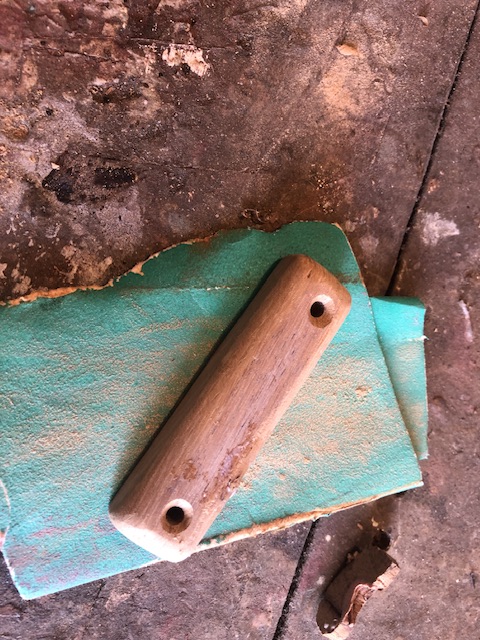
For interest, the capping was made from a piece of scrap iroko (as junction cover was). Follow the evolution below!

Ends glued in ready for shaping up, sanding and finished with several coats of varnish.

I rarely if ever throw away a bit of ‘useful’ wood. The piece was once was a cable cover to our long defunct Pilot Gas Detectors – very expensive units against common household carbon monoxide alarms available which have an internal battery and lasts seven years. The gas alarm is a ‘caravan’ unit costing a third of a ‘Pilot’ and is standing the test of time!

Although the unit fitting instructions allowed deck contact on a curved seating, I sat it down on 6 mm thick cork strips set in the fixing compound supplied. The instructions with a ‘plan’ stated that an air gap was preferred to allow heat dissipation. I decided to peg the outer ends with screws. (Info said unit was pre drilled, but wasn’t!) but a wide edge clear of the solar works was available, as seen.

The panel info said it is able to be stood on and has a non slip surface… I shall avoid – boat crews note!

The new battery is now sitting at 12.8 volts on cabin indicator on my last visit to Whimbrel.

Oh yes, the two sailing lights have also been fitted with led lamps, greatly reducing the power demand too – not worried about masthead as engine would be on if on. These were obtained from ‘Boatlamps’ on line – correct type lamps for bi-colour and stern lights must be fitted as advised.

Gota just remember to switch off!

Gereat!!

09/11/25

Ditch-crawler finds good and bad service whilst afloat…

The Good.

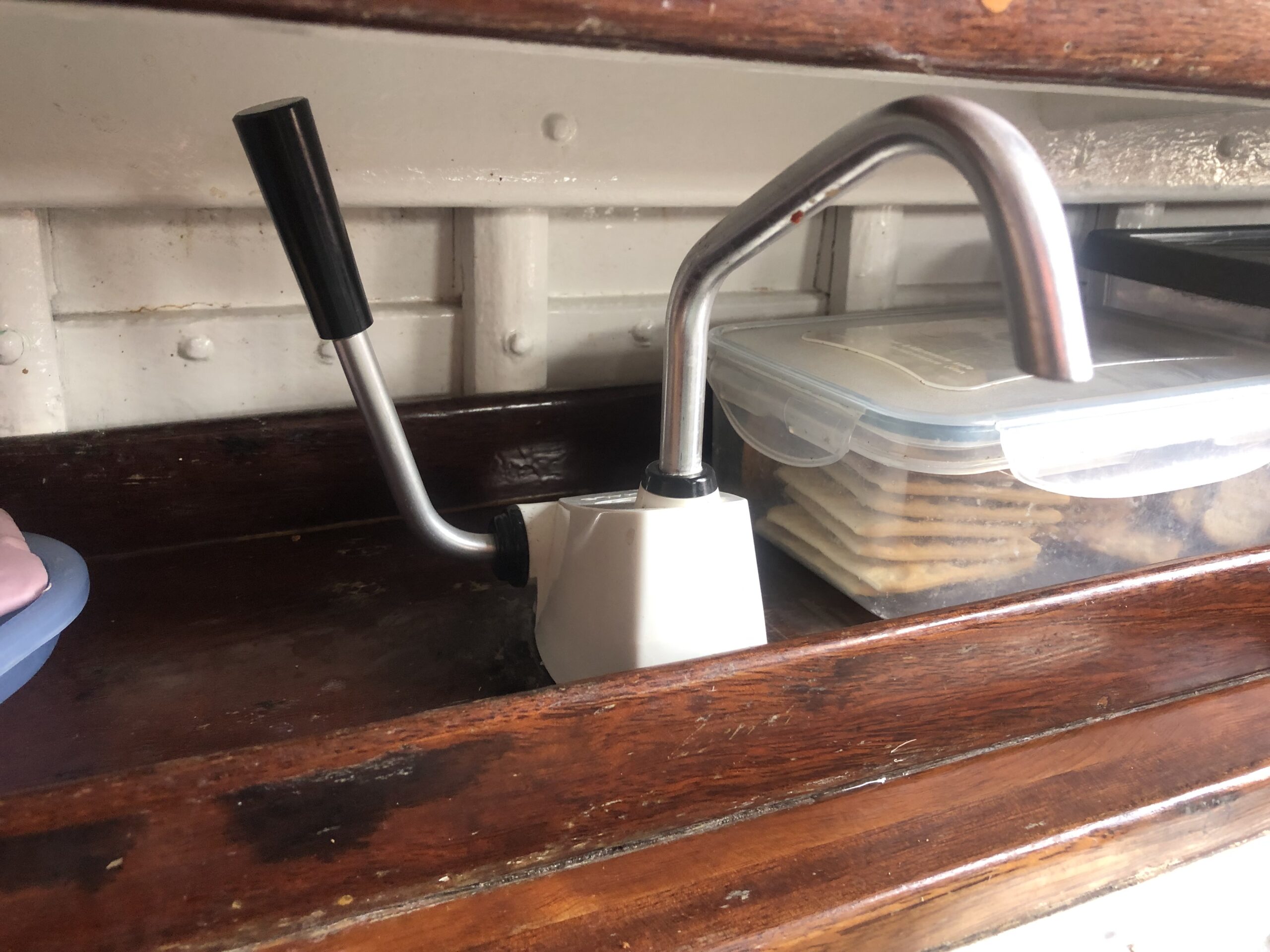
Aboard Whimbrel, we have a Whale Flipper manual fresh water pump serving our domestic tap. The first pump fitted in 1983-4 lasted absolutely years. The next less so and so on. Yes, Whimbrel is used more in a year during last two decades than in her first ten years or so (I was away at sea), but problems reached a head a few years ago.

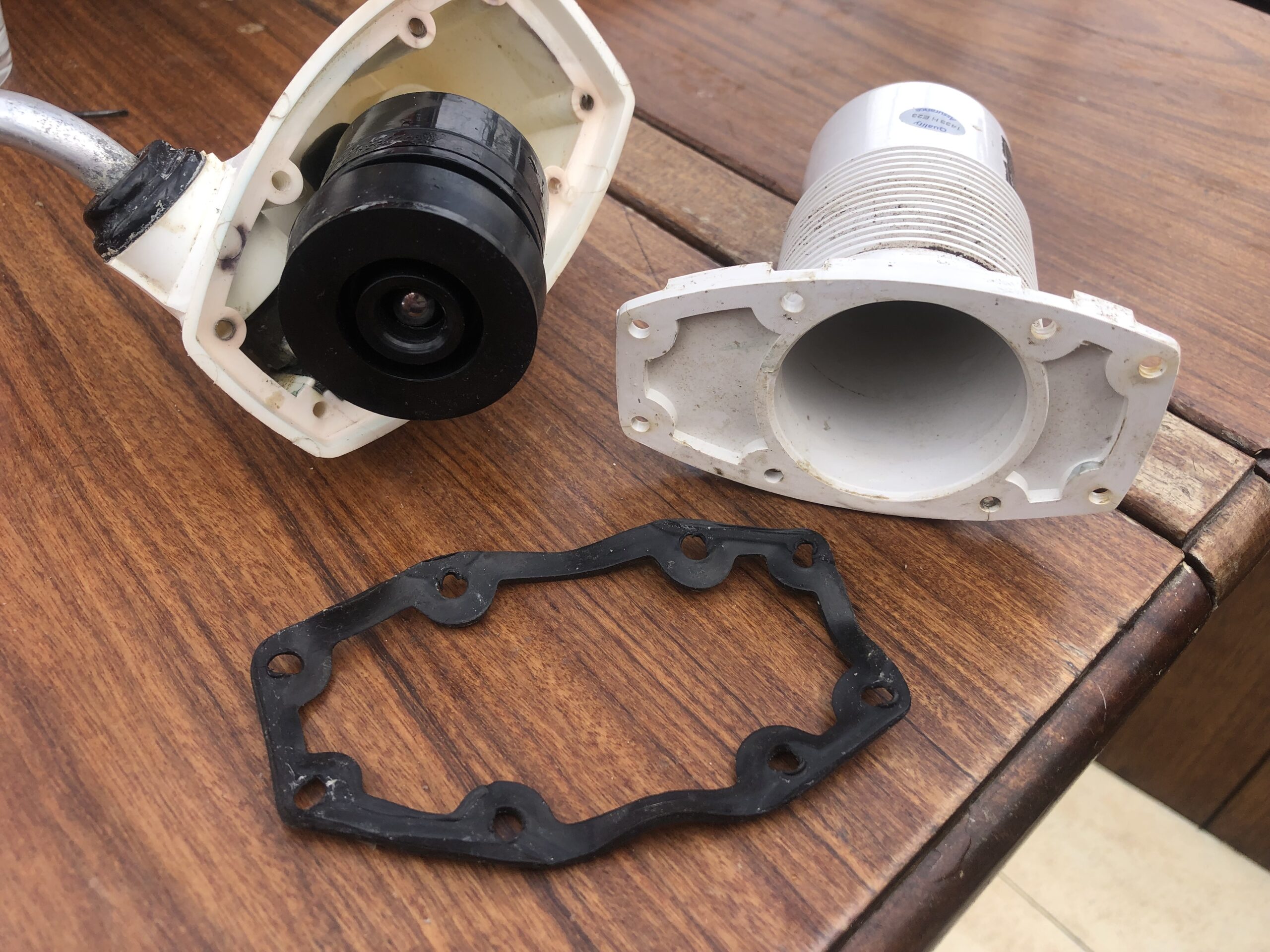
I fitted a new pump complete and it leaked. Strangely, not from the base seal, but apparently from the casing. I took the pump off and opened it up. There was a hair-line crack.

I took the pump back to the chandlery that supplied it – they told me to take a jump: I had opened it up…

I jumped up and down and got no where. The chandlery did not receive my custom for over five years, however, after a change of staff, I have gone back and one person ( a nice chap) who was in store that day is always attentive!

I bought a new one elsewhere.

However, after a failure of the base seal on a new pump last year, I resealed it with some sealant. The seal had been nipped in assembly. We were away sailing so had no choice. I managed to get a pump from Faversham Chandlery during our travels. That repair lasted a year, more or less.

Why the seals fail can only be because of the very narrow sealing faces, whether the manufacturing process has been pared back, I don’t know.

The other problem with the pump is the operating handle/shindle – it is made of aluminium and it corrodes/wears around its body seal. The corrosion can be seen in the picture below.

Anyway, this year I wrote to the manufacturers in Bangor, N. I.

Blimey, I got a positive response.

I sent pictures and receipt details (kept in new pump bag aboard boat and other from file when I got home) – chap could see pump was not in a bad condition. (I have never had to renew the innards of these pumps)

The upshot was I got an apology for the ‘troubles’ and a thanks for informing, but best of all, I received a bag of assorted seals and most importantly a number of body seals.

A GOOD end to a little saga, but I do feel Whale need to look at their manufacturing quality … why can’t the operating lever be stainless steel? I asked the question.

Another good while away…

While away I was aware after leaving the navigation lights on all day that Whimbrel’s battery was not so good. I also discovered that our solar battery charger ahd failed – new ordered, received and preps in hand to fit.

I tried French Marine for a battery – semi can’t do attitude emanated from a response inquiry, so I went on line and found a supplier with same amp hour/size with a five year guarantee. I ordered it and it arrive at home in three days – could of had delivered to Brittlesea Harbour! Anyway, the old one held up… if volts dropped, I made sure to use the engine!!

The company, Advance Battery Supplies, of Stockport, were very helpful with my queries. Thank you very much indeed…

The Bad!

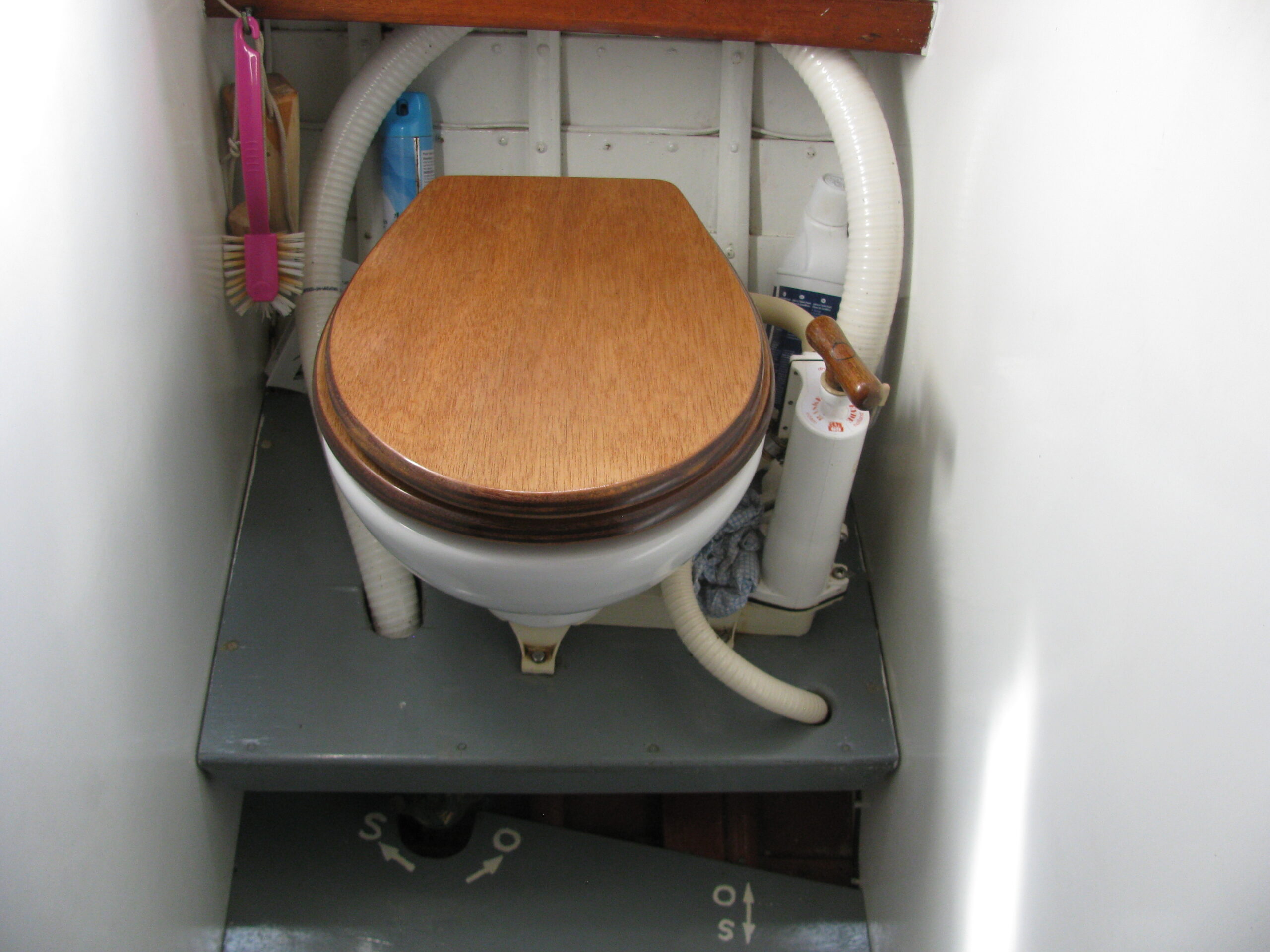
Whimbrel is fitted with an ‘RM’ manual toilet, pictured below with the seat and lid I manufactured during the first Covid lockdown..

Over the years it has proved to be reliable and easy to maintain.

Over the past few years, I had to re-seal the bowl base and I renewed the pump complete, as the sum of various parts was around twice the price! Last year I had to renew the pump spindle top seal due to leakage. The spindle appeared to be okay.

Early this year, I did the same repair but couldn’t see anything wrong with the spindle. The seal failed quickly – these are ofthe ‘Gako’ lip seals with a helical spring.

I gave the spindle another (good) look with a bright light. Aha; there was a bit of crevis corrosion in the surface in just one little spot. This was clearly enough to destroy the seal…

Now, years ago, I never had to renew a spindle. I used to purchase new pump plungers and O-seals and renew the pump base seal and non-return rubber. as the years have dribbled by, there has been a noticeable falling away of the standard of spare parts and with my ‘pump complete’ – it is difficult to make out where these are made, but one could take a wild guess…

While in Suffolk Yacht Harbour in early August during a ‘bit of a blow’ we enjoyed a walk out towards The Trimleys from the marina. Low and behold I spotted Seamark Nunn (Chandlers) passing along the high road in Trimley St Martin. I have used them for around a decade and a half for the RM toilet spares and considered their service to be good.

We went in and they had a pump spindle complete and a seal in stock. Theses were purchased and I ordered two additional seals: I had a butchered overhaul kit aboard.

I received an email the next day telling me that the parts would be delivered (to home address) in two weeks. I emailed that it would be fine.

We got home. NO SEALS!

I emailed. No Response.

I emailed again, AND AGAIN!!

My faith by then was utterly destroyed. It was six weeks since ordering. And worst of all a total silence from this firm who like to boast of their superb record.

Then, yesterday, after sending that last email (un-acknowledged, as all have been) in which I laid out my thoughts in non complicated language, a Post Office email informs me that a parcel was to be delivered today. Can’t be larger than a jiffy bag for two ten pence piece diameter 6 mm thick seals… (postage was as much as one seal!).

They arrived. No explanatory note inside.

I sent off an email explaining that good manners forbade me from not thanking them but at the very least I had expected some sort of apology…

I am not holding my breath.

Another supplier will be sought in future.

So, be warned, customer loyalty has no value whatsoever, shop around, but most of all, if you get bad service tell the buggers.

Don’t use Seamark Nunn.

07/23/25

Ditch-crawler is clinkered in Woodbridge…

Wandering around Robertson’s Yard above the Tide Mill Yacht Harbour I met a bevvy of clinker craft that for sure have seen better days.

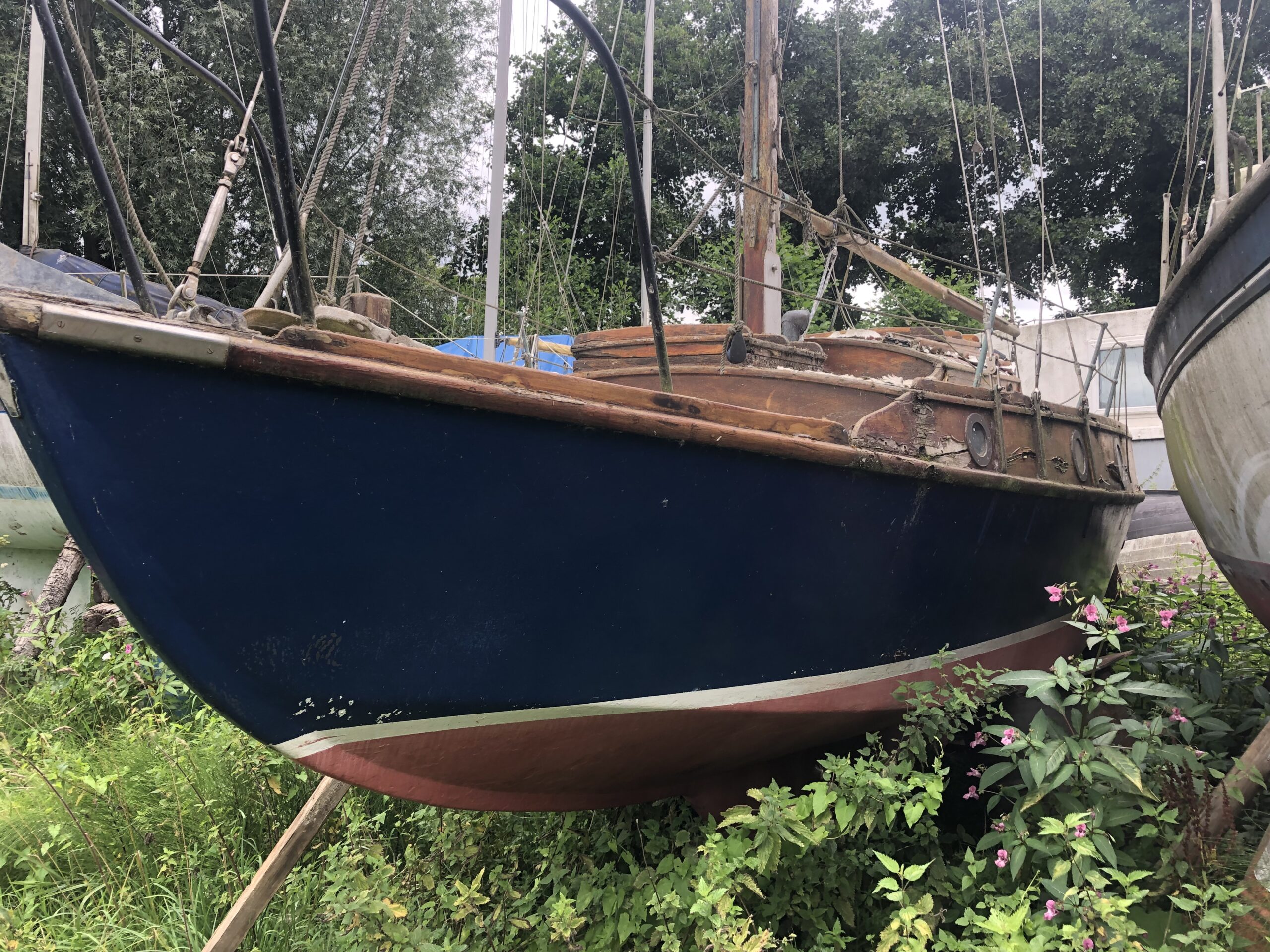
Sadly, I know one of the vessels, a Finesse 24, last seen several years ago in a mud berth in the yard. The yard has undergone some development and modernisation since that visit: the mud berths, in amongst an area of budding saltings with rotting old mooring stagings, are now hard standing.

Robertson’s was very much a ‘boat-owners’ yard, perhaps it still is but the office is now a swish modern affair much removed from its predecessor!

I spotted a Kestrel first.

The poor old girl was clearly brought ashore for a refit, a refit that died a death, something this boat is dicing with.

The old bird is no longer the flyer she was…

Close by sat two vessels side by side, gloomily overlooking the coming and going of the tides.

One, an open boat, clearly has limited time left.

Within, a veritable wild garden grows…

It’s neighbour sits neglected and unloved but could be rescued.

Closer inspection shows the ravages of time and lack of proper maintenance, but…

Above are two views of a once sweet little gaff cutter.

The last of the group I visited was a Finesse 24, a boat class close to my heart (as readers will likely know). As said, I last saw this boat around three years ago, maybe longer, but I have known her for very much longer and watched her gradual decline. She has probably had several owners during that time.

Two general views…

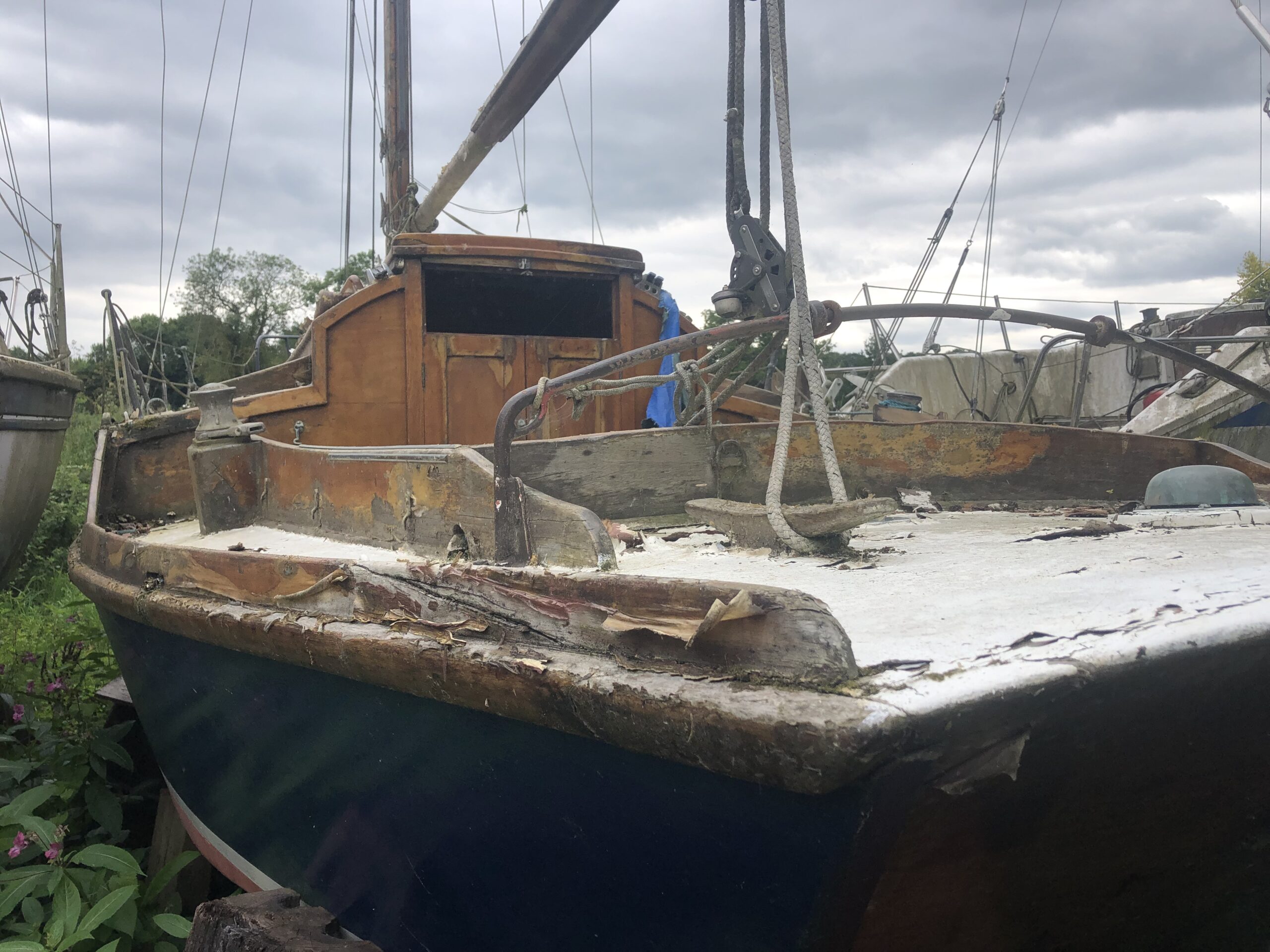
The general views say, ‘not so bad…’ but when I looked closer, I loosed a huge shudder…

I shuddered hugely…

The area focussed in on was typical of the numerous failed and failing areas around the boat’s exterior.

Leaving the yard, I spotted the office door ajar so popped in. It was manned by a svelte young lady who smilingly listened to an ‘old buffer’…

I intimated that I thought the boat may have changed hands, but no: the lady said a name I recognised as the owner. My thoughts were, ‘what the hoody heck is going on…’

I was told the owner visits and does things. I was lost for words, thanked her for the information and bid the lady adieu…

Sad, so very sad.

07/9/25

Ditch-crawler gets away…

It has been some while since Whimbrel has ventured north beyond the Blackwater estuary apart from a ‘raid visit’ to Harwich with my eldest brother when I’ve in England from Canada last year.

Last year we went south and up the R. Thames to St Katherine Docks. We had a fabulous time spinning around the lower waters that we know so well.

Our first two years – how time flys by – has been very happy indeed. I know we’re paying for services (not that we weren’t before) but it really has been problem free and totally without stress. We treat the yard, it’s staff and facilities in a manner we wish for ourselves: the manager Beccs said to us – you care… people I have chatted to don’t really have much in their complaints boxes!

A case in point was the rapidity of our ‘emergency’ lift out last year for prop key renewal. Our first on the hard antifouling session was also trouble free with no hassle.

Any way, we got away, first with a cousin and my youngest brother, departing from Maylandsea an hour after high water. Thus was a ‘delivery cruise’ up the coast to Harwich areas.

At West Mersea, my youngest brother enjoyed a sail in Twitch before a capsize in shallow water – he was smiling and baling when we brought Whimbrel along…

The saga provided entertainment for a number of boaters. A good start!
The weather for the weekend was a little ‘iffy’ initially for a gander up the Wallet, however, forecast improved giving a SW 4-5. It made for a great sail and fast passage from West Mersea where we’d moored overnight to Harwich’s Halfpenny Pier.

The Alma was booked for our supper.

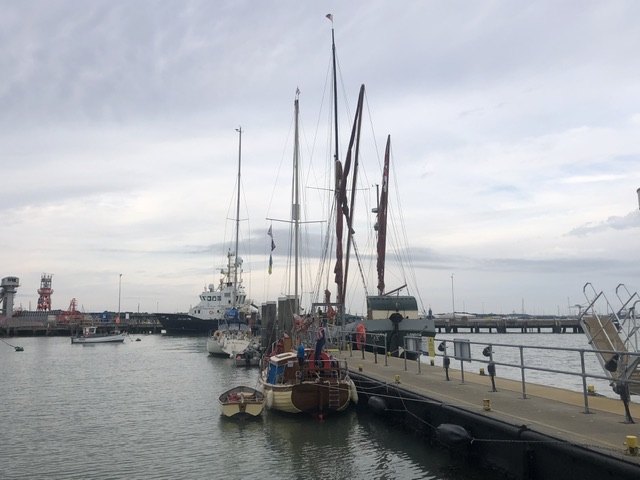
Whimbrel was joined by the ironpot Thistle on Halfpenny Pier.

Our last day was a short hop to the Walton Backwaters to meet The Mate at Titchmarsh Marina.

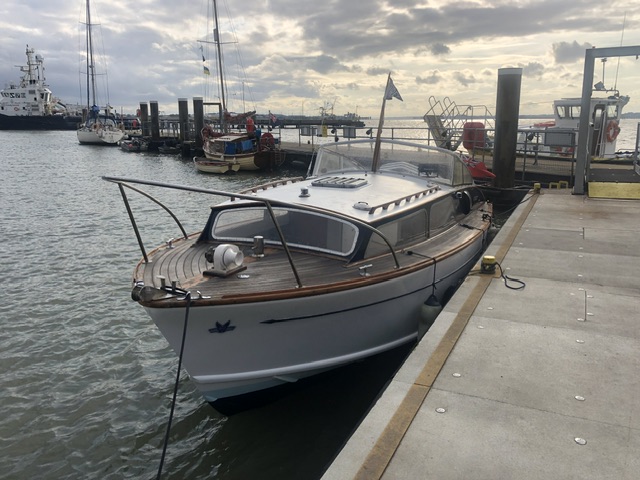
Interestingly, at Halfpenny Pier, a lovely old motor boat came in – a classic from around 1962, a Fairy Huntsman. The owner told us that it had first been owned by a chap who led the Council of Europe in late 1960s. He had a ‘spying’ job during WW2 and Ian Fleming based James Bond on the chap – the boat was used in a Bond film…

The boat, Europa II still had letters for the House of Commons YC…

So, now that the mate is back aboard we are pootling around between Pin Mill, R. Stour and Backwaters having a bit of fun and togetherness.

Next weekend, Whimbrel hosts another family group comprising of my sister and two good friends. Christobel goes home with a week of days out planned. She’ll soon be back.

Down the early morning sun leaving Pin Mill.
It is great to spread Whimbrel around the family, but that is how it should be…

06/29/25

Ditch-crawler’s season is well established…

My site crashed for a while, well, it wasn’t the hosting but the WordPress element. Probably my fault for not updating as and when I should! Anyway, it is fixed – so I’m back.

Although I say our season is well established, those that know us will be aware that we don’t have a sailing season as the whole year is used, thus enjoying those glorious days outside of the summer period giving in many respects greater satisfaction.

A sail off the mooring on a sunny but chilly winter’s day with the sun playing with the wavelets kicked up by the breeze is just lovely. Then, on our return, the yards Bistro serves tummy warming tasty soups to drive off any chills…

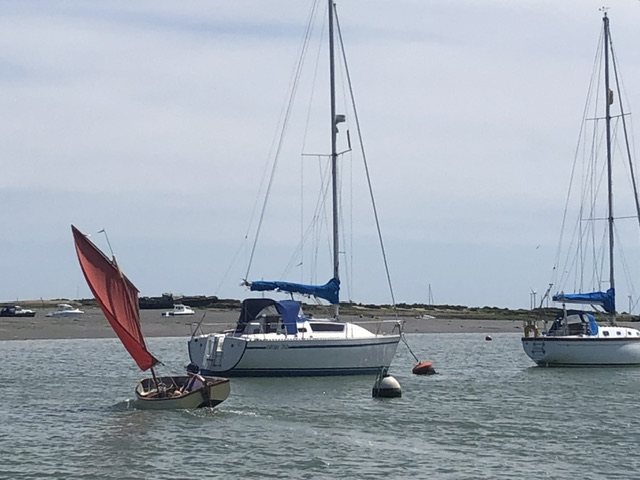
Early May sailing Twitch, Whimbrel's tender in the Mersea Quarters off Packing Marsh Island.

We had a couple of ‘weekends’ out in May before getting down to the antifouling and varnishing of transom, rudder and shearstrakes. The picture above shows me sailing Twitch in the Mersea Quarters on a glorious early May day.

Christobel checking over her superbly executed work… Note the gleaming varnish!

Tide creeping up…

My seventieth birthday was approaching and I had booked for us both to spend nearly two weeks visiting Jersey and Guernsey. Within 36 hours of our return we were away for a few days aboard Whimbrel.

Even in Jersey there was some varnish to look at!

Thinking about a place nice to eat on my birthday, we booked a berth at Shipways Yard in Maldon. For the rest of the time we pottered to West Mersea and Brightlingsea where two friends invited us to a very pleasant evening supper in their lovely home at the eastern end of Brightlingsea – Hurst Green. Thank you again!

I received this card from our hosts… x

Now, with Whimbrel stored with basic foodstuff and other sundries, she is ready for the first of her family visitors. A cousin and my youngest brother are due for a weekend shortly, with an end destination in the Walaton Backwaters. Following that, another comprising my sister and two great shipmates, Hannah and Steve. The Mate returns in between and after for our prolonged gandering.

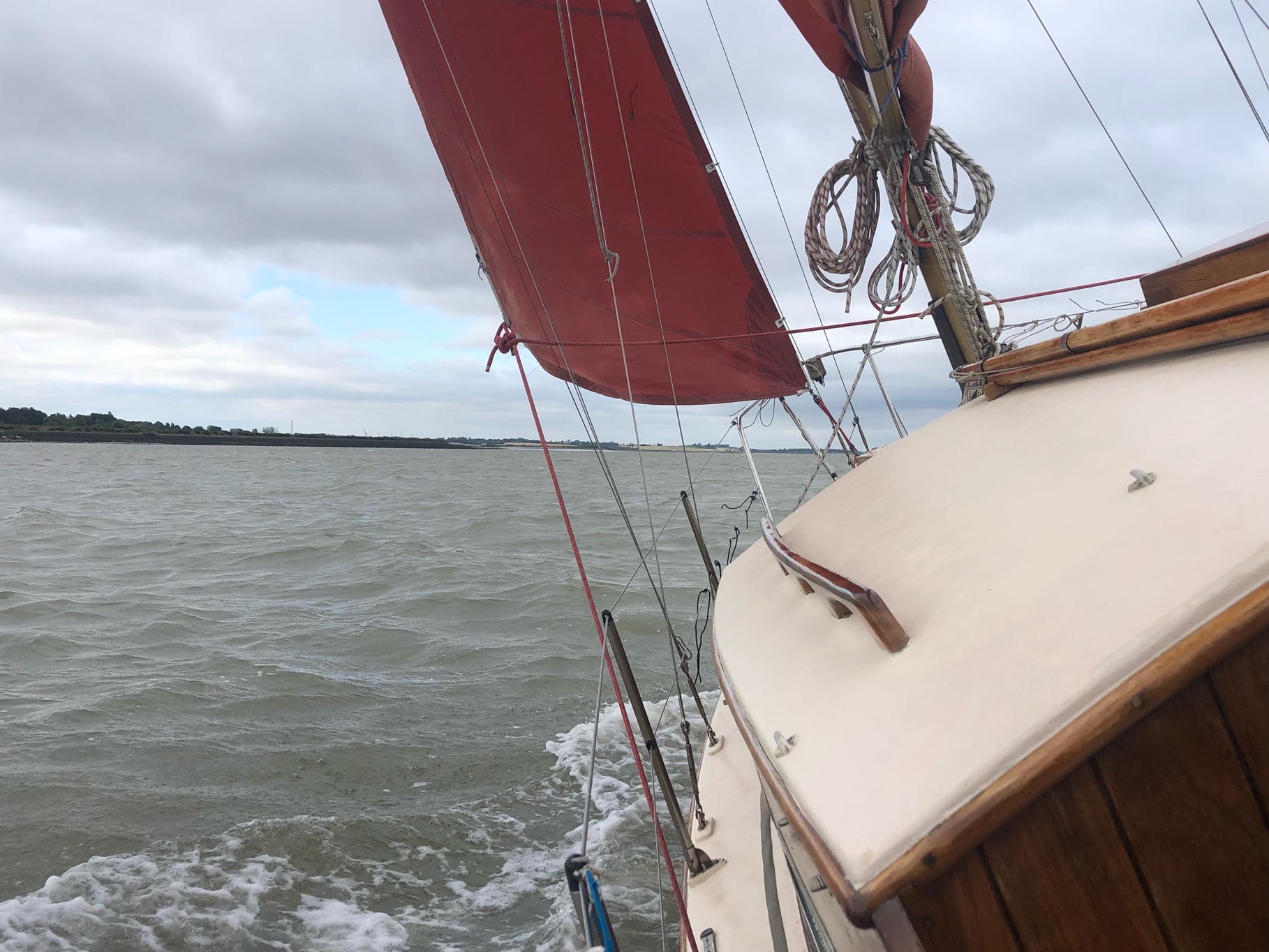
The weather has been up and down, dry on the whole – in fact too dry for the good of the ground! – with either too little wind or almost too much. On our most recent short cruise, we began by motoring, yes, burning diesel from Maylandsea to Bradwell before a breeze filled in from the east. Ths really got up giving us a romp across to Pyefleet.

Our return thrash from the Mersea Quarters (yesterday). It was chilly-ish out on the water but as we entered Lawling Creek, th heat and sultriness hit.

Roll on for warm and pleasant sailing over the coming months…

To all you other yachting folk alike, whether motor boaters, dinghy sailors or sailing cruisers, I hope you’re all in the groove too.

P.S. I’m still getting my head around this new WordPress system – on my iphone, I couldn’t get into the edit feature. It’ll gel, eventually!

05/1/25

Ditch-crawler comments on life jackets…

Every spring for as long as I can remember, I have brought our life jackets home from Whimbrel for a clean and service.

Mate Christobel comfortably clad in her life jacket.

We keep two spares for people coming aboard for day sails or for longer.

I wipe the outer covers using a scourer and cloth using a spot of lemon surface cleaner and anti-bacterial type fluid mixed together.

The gas cylinders are inspected along with the actuator units. The latter, I was told by an ‘expert’, will last a year beyond date safely. Sometimes the change by date falls in the year!

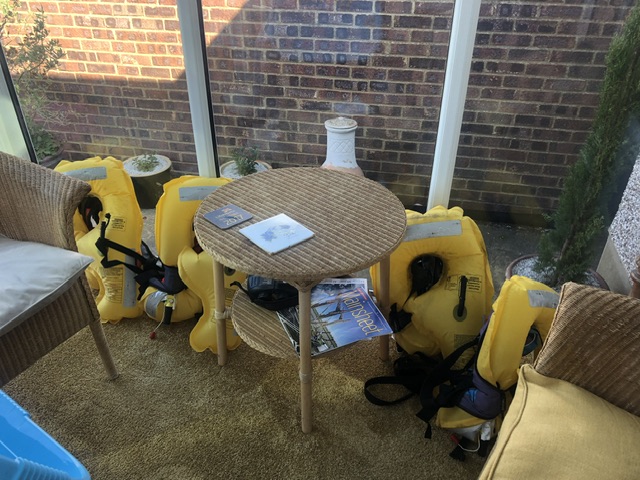
Inflated lifejackets sitting to attention!

The jackets are inflated by filling via mouth piece and left for twenty-four hours. Rarely have I had one that loses air of any consequence.

The seams, webbing and whistles are inspected before the fun of squeezing all the air out takes place.

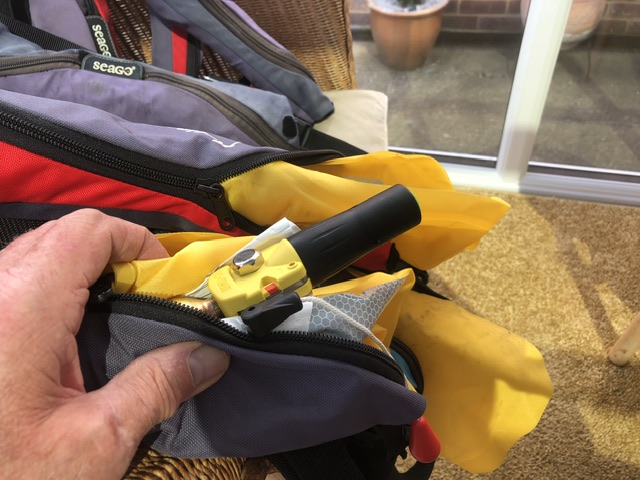
The actuator on the self inflating type we currently have.

This year two of the actuators were in need of replacement.

I have purchased these from chandlers in the past, not always being satisfied with the life time left on them. Going on line was interesting with dozens of chandleries and other on line outlets offering replacements.

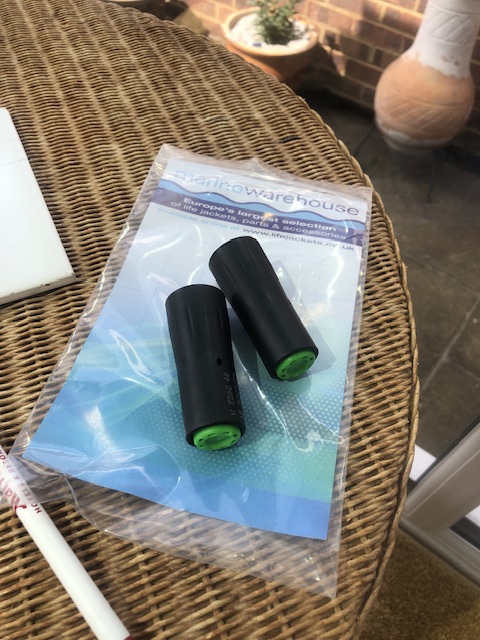
Two new actuators with a 2029 date…

Trawling through I came across Marine Warehouse of Swansea. They had a raft of offers, depending on the stated/stamped life left on the device.

See: www.lifejackets.co.uk

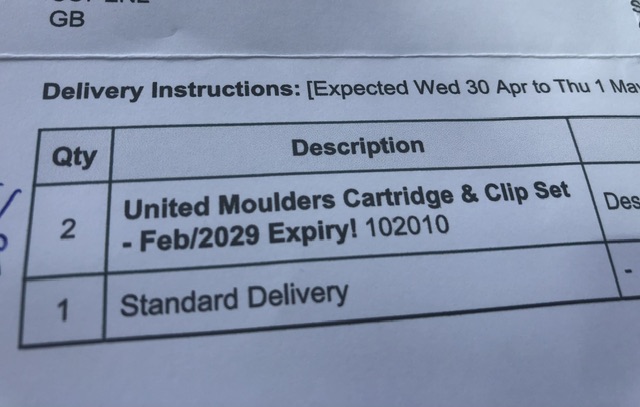
For around six quid a unit with at least a year could be chosen, and so on, up to units that must have recently been manufactured. These were stated to be February 2029!stamped.

I ordered two in a jiffy…

A few days later they duly turned up, in a Jiffy Bag!

Info on the invoice…


Now, I wonder how many of us check the time on items being bought.

Some while ago when purchasing new lifejackets, I asked for updated actuators as the fitted ones barely had eighteen months of life!

As I say, I have purchased an older unit, but I was stuffed, having a life jacket that had self inflated and an immediate need for new cylinder and actuator kit…

Marine Warehouse seemed to be the only supplier giving life dates of items being purchased by us, the consumer!

Perhaps chandleries need to be more honest about this aspect…

04/11/25

Ditch-crawler gives Whimbrel’s covers a spring clean…

How many sailors clean or wash and reproof their boat’s covers?

Looking at craft seen around me and on my yearly travels, I have say that it’s likely to be not many, but I may be wrong…

Let’s face it, cockpit covers, sail covers, other sundry covers and sun protectors all cost money.

Proofing the cockpit cover.

Modern washing machines have low temperature washes, well below maximum that cover material can cope with. Also, there are gentle wash solutions available. I used a proprietary hand wash liquid soap in the machine.

Drying after proofing.

The cockpit cover easily fitted into the machines cavernous drum and a 30 deg C wash selected. The same operation was carried out for the sail cover and cabin side protection cover.

Cabin side cover washed and hung out to dry.
Proofing the cabin side sun protector.

Proofing fluid can be obtained from camping type outlets or on line. It is a very ‘thin’ fluid and spreads as it penetrates the canvass. Once recoated, I hang items on the washing line to dry.

Sail cover after its return to Whimbrel.

In the view below taken in a popular east coast marina, the ropes on the boat in foreground can be seen to be ingrained with green algae and the cover on a mizzen beyond can be seen to be similarly weathered. No care has been extended to either of these craft in this respect.

Ropes are made of the ‘same stuff’ as a lady’s undies and hosiery … they go in the washing machine, so why not a boat’s ropes?

Note: it would be best to thread the rope through metal eyes and tie off for a smashed glass door would invite some wifely wrath!

What appertains to covers is good for all those ropes too…

Every couple of years, Whimbrel’s halyards are run out using spare old ones and put through a wash, two if needed. I have just done the main sheet and end for ended it.

Covers at the end of their tether!

In the view above, the poor old boat (a Finesse 24) had been abandoned for a number of years but the state her covers are seen to be in, can witnessed around a yard or marina any time…

As said, these items are not sundries: they cost and by lavishing some love and care upon them their life expectancy rises greatly.

03/31/25

Ditch-crawler makes use of recent fair weather…

With the fair weather experienced in Essex at least, I was able to begin dealing with repairs to Whimbrel’s varnish work. Repairs were only needed to areas of cabin side beadings.

The flat surfaces have stood up to the winter very well and continue to look good. So, overall, I have been happy with my new coatings of Le Tonkinois varnish, first applied after our complete stripping off of forty years of coatings of urethane.

Applying one of eight repair coats.

Although the autumn and winter in the Essex area has not been as wet as elsewhere, it has been damp with many overcast days, this is damaging to varnish and areas suffered.

Beading repairs along port cabin sides.

The dry weather allowed day after day coats and visit by visit sections were nearing completion as final repair areas were hit.

A lengthy section of cabin side to deck beading coating under repair.

Before I started I had ordered a batch of varnish from a different source from my usual supplier (UK distributor), but for unknown reasons I could not elicit a reply.

When the batch arrived it looked different. But that is another story. I ultimately obtained a batch from the normal UK supplier. The batch looked normal.

Hatch runner repairs.
Section of cabin top edge beading under repair.

The cockpit is being over coated this season but beforehand a few areas of repairs were needed. I had done some of this way back last September and have already recoated the cockpit seats. If the weather continues along a fair path, I’ll have this done too.

The mate hard at it coming round with fine grade…

On the final day of March we got ourselves over to the boat and got cracking, sanding, wiping and varnishing.

Sanded ready for a fresh water wipe.

We sanded with 180 followed by 260 grade before brushing down and water wiping with a touch of degreasing gloop (sugar soap) in it.

Looks good!

Christobel had a break during the varnishing process for she ‘cannot’ do it!

We can’t remember getting this far ahead with full overcoating of the cabin sides.

Next job: cockpit overcoating…