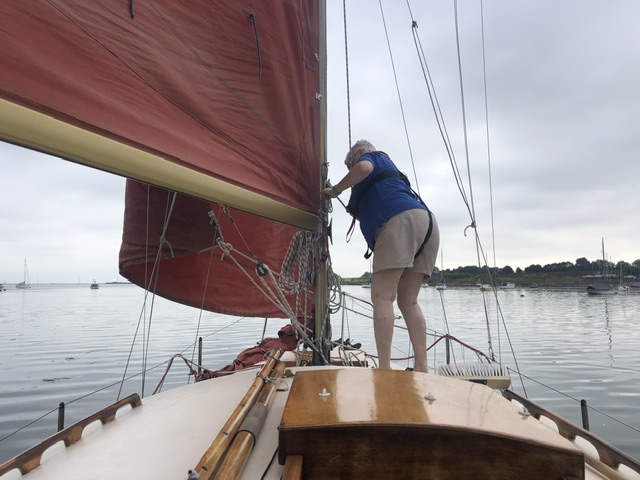
Every spring for as long as I can remember, I have brought our life jackets home from Whimbrel for a clean and service.
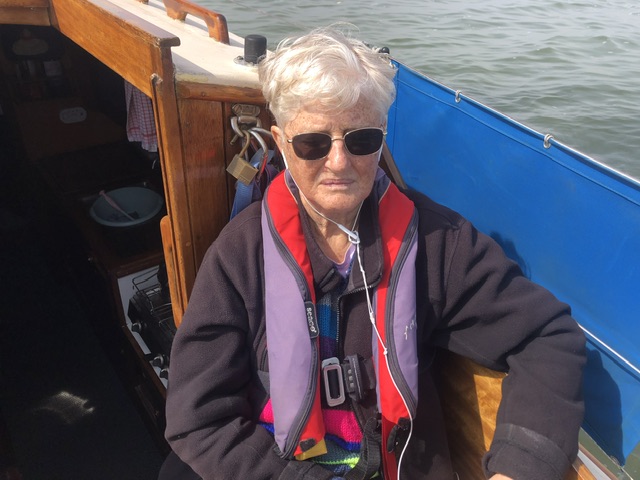
Mate Christobel comfortably clad in her life jacket.
We keep two spares for people coming aboard for day sails or for longer.
I wipe the outer covers using a scourer and cloth using a spot of lemon surface cleaner and anti-bacterial type fluid mixed together.
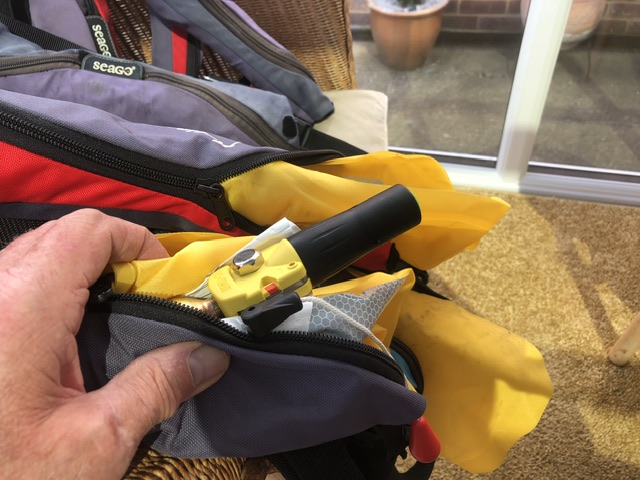
The gas cylinders are inspected along with the actuator units. The latter, I was told by an ‘expert’, will last a year beyond date safely. Sometimes the change by date falls in the year!
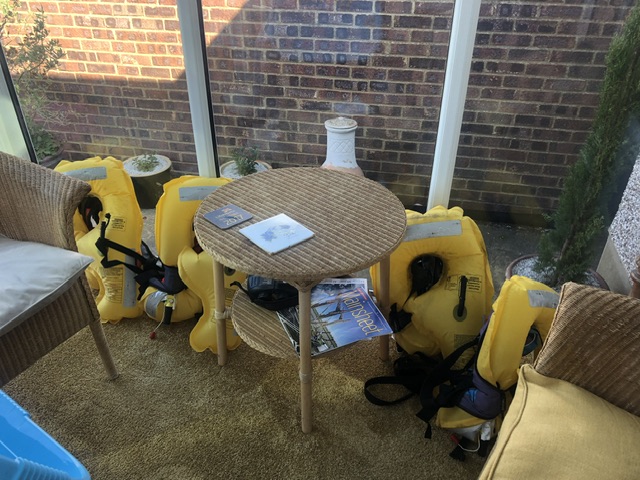
Inflated lifejackets sitting to attention!
The jackets are inflated by filling via mouth piece and left for twenty-four hours. Rarely have I had one that loses air of any consequence.
The seams, webbing and whistles are inspected before the fun of squeezing all the air out takes place.
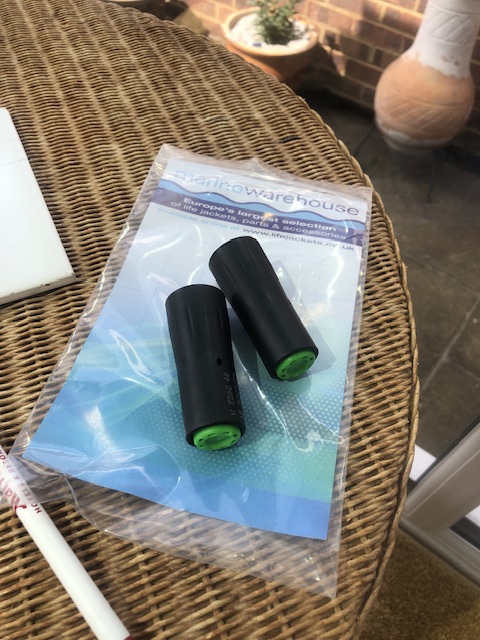
The actuator on the self inflating type we currently have.
This year two of the actuators were in need of replacement.
I have purchased these from chandlers in the past, not always being satisfied with the life time left on them. Going on line was interesting with dozens of chandleries and other on line outlets offering replacements.
Two new actuators with a 2029 date…
Trawling through I came across Marine Warehouse of Swansea. They had a raft of offers, depending on the stated/stamped life left on the device.
See: www.lifejackets.co.uk
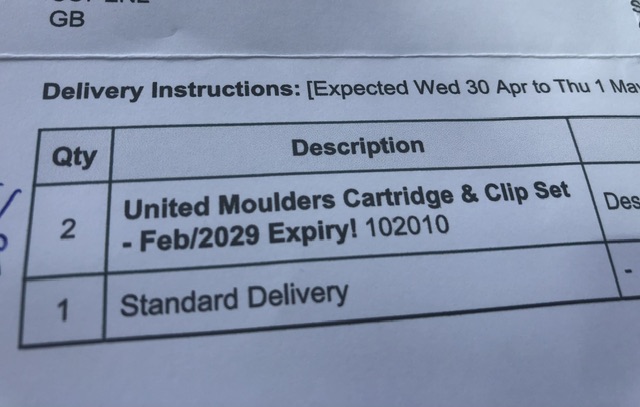
For around six quid a unit with at least a year could be chosen, and so on, up to units that must have recently been manufactured. These were stated to be February 2029!stamped.
I ordered two in a jiffy…
A few days later they duly turned up, in a Jiffy Bag!
Info on the invoice…
Now, I wonder how many of us check the time on items being bought.
Some while ago when purchasing new lifejackets, I asked for updated actuators as the fitted ones barely had eighteen months of life!
As I say, I have purchased an older unit, but I was stuffed, having a life jacket that had self inflated and an immediate need for new cylinder and actuator kit…
Marine Warehouse seemed to be the only supplier giving life dates of items being purchased by us, the consumer!
Perhaps chandleries need to be more honest about this aspect…
How many sailors clean or wash and reproof their boat’s covers?
Looking at craft seen around me and on my yearly travels, I have say that it’s likely to be not many, but I may be wrong…
Let’s face it, cockpit covers, sail covers, other sundry covers and sun protectors all cost money.
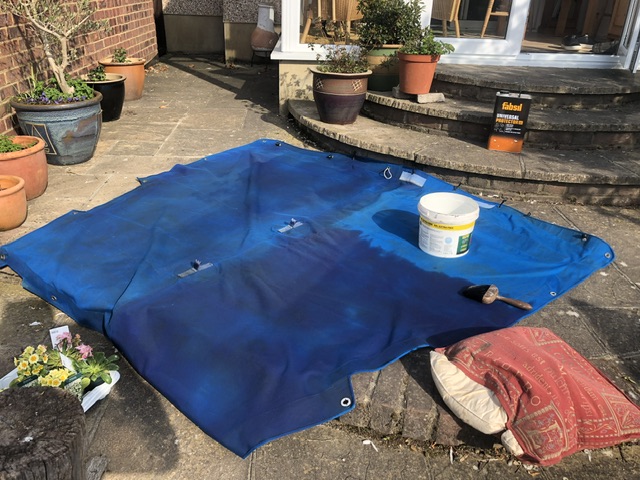
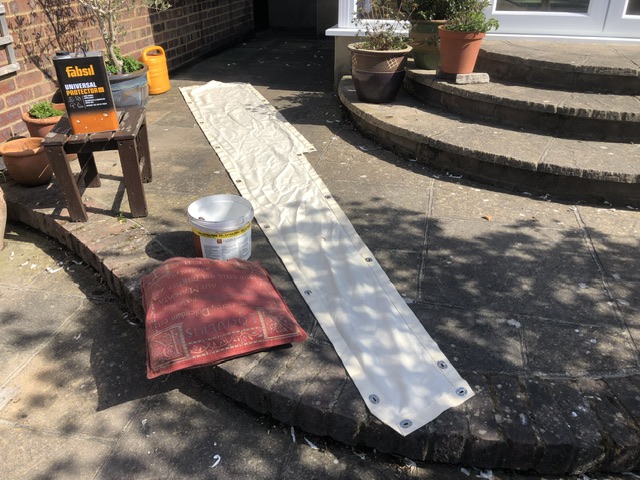
Proofing the cockpit cover.
Modern washing machines have low temperature washes, well below maximum that cover material can cope with. Also, there are gentle wash solutions available. I used a proprietary hand wash liquid soap in the machine.
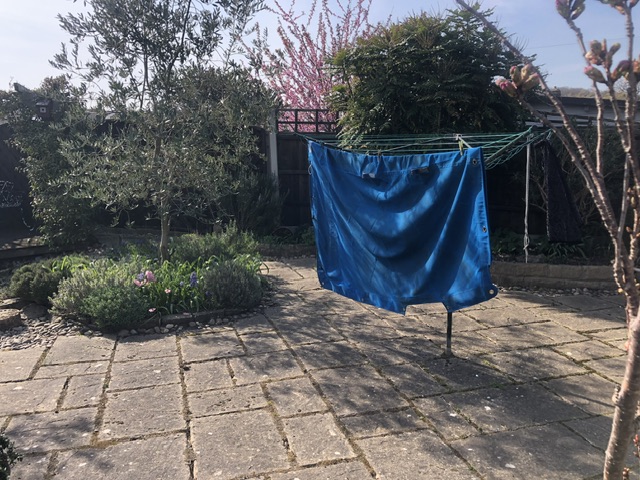
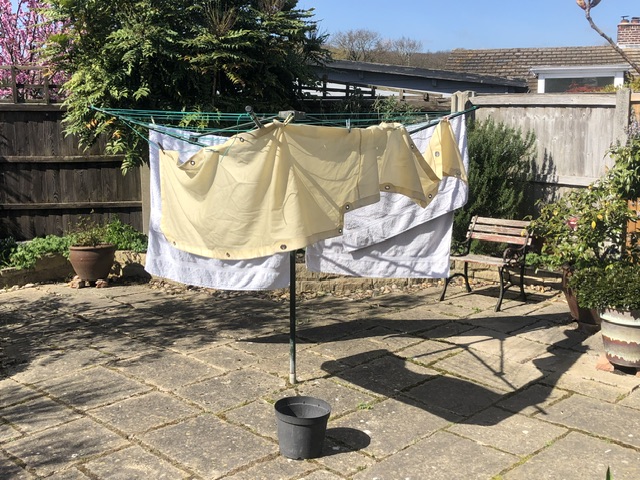
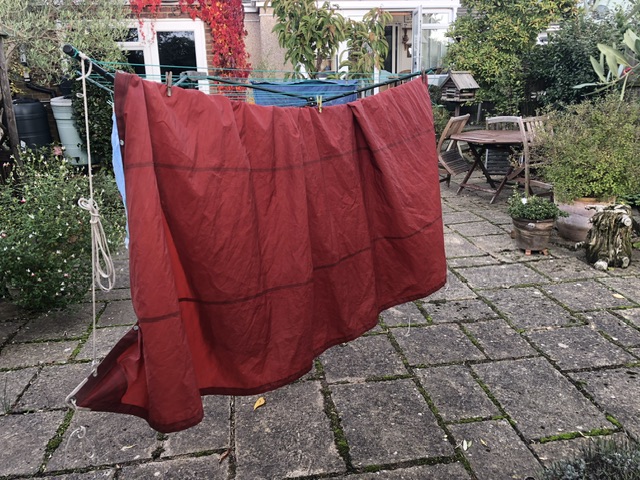
Drying after proofing.
The cockpit cover easily fitted into the machines cavernous drum and a 30 deg C wash selected. The same operation was carried out for the sail cover and cabin side protection cover.
Cabin side cover washed and hung out to dry.Proofing the cabin side sun protector.
Proofing fluid can be obtained from camping type outlets or on line. It is a very ‘thin’ fluid and spreads as it penetrates the canvass. Once recoated, I hang items on the washing line to dry.
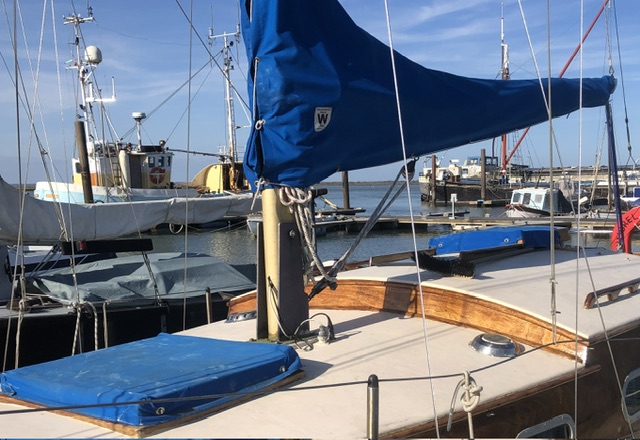
Sail cover after its return to Whimbrel.
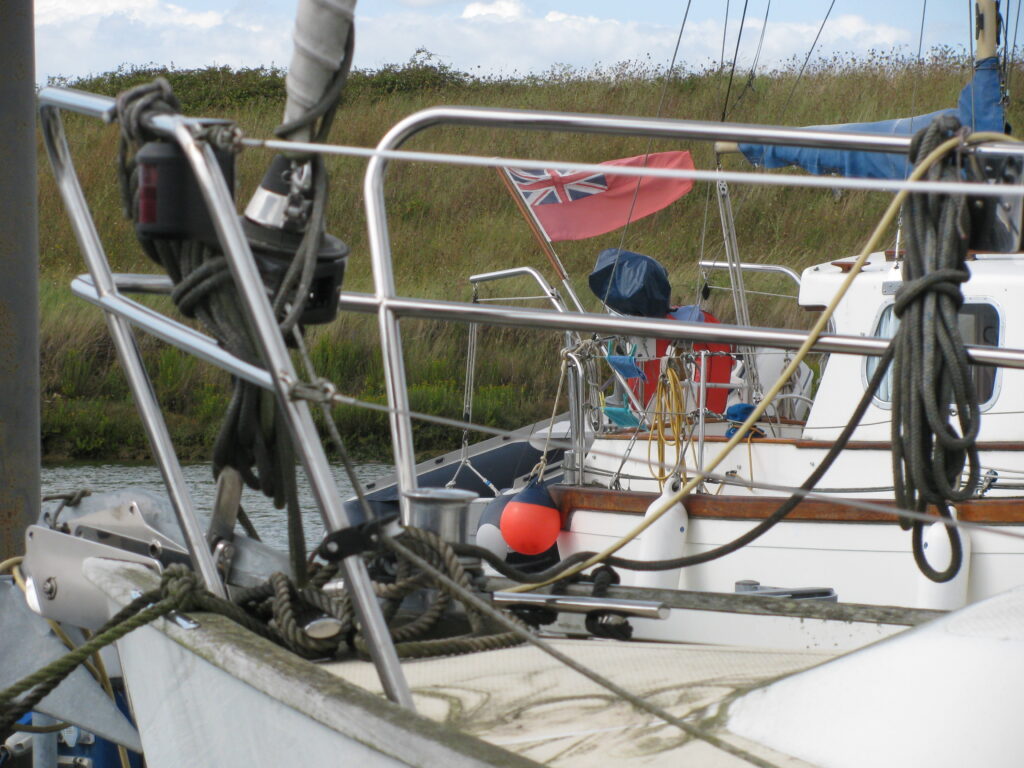
In the view below taken in a popular east coast marina, the ropes on the boat in foreground can be seen to be ingrained with green algae and the cover on a mizzen beyond can be seen to be similarly weathered. No care has been extended to either of these craft in this respect.
Ropes are made of the ‘same stuff’ as a lady’s undies and hosiery … they go in the washing machine, so why not a boat’s ropes?
Note: it would be best to thread the rope through metal eyes and tie off for a smashed glass door would invite some wifely wrath!
What appertains to covers is good for all those ropes too…
Every couple of years, Whimbrel’s halyards are run out using spare old ones and put through a wash, two if needed. I have just done the main sheet and end for ended it.
Covers at the end of their tether!
In the view above, the poor old boat (a Finesse 24) had been abandoned for a number of years but the state her covers are seen to be in, can witnessed around a yard or marina any time…
As said, these items are not sundries: they cost and by lavishing some love and care upon them their life expectancy rises greatly.
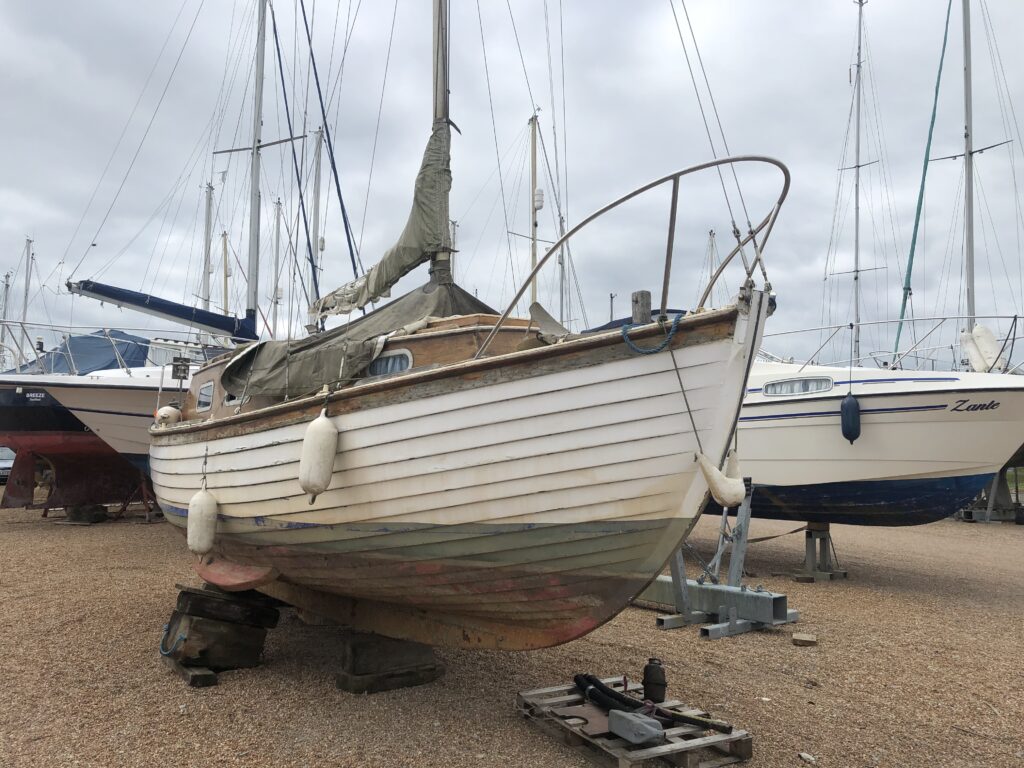
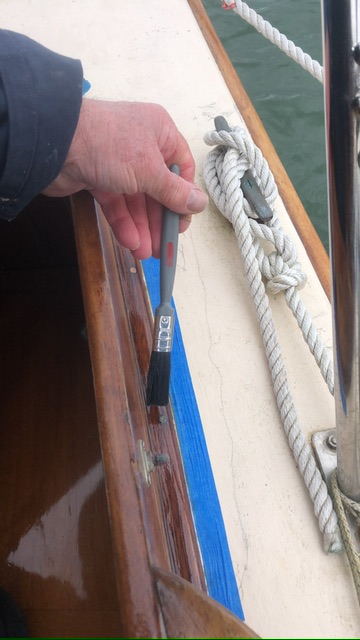
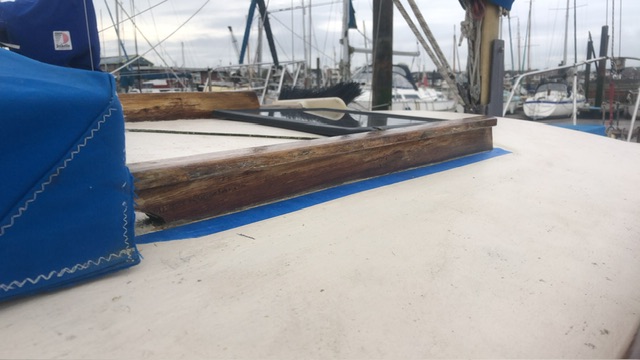
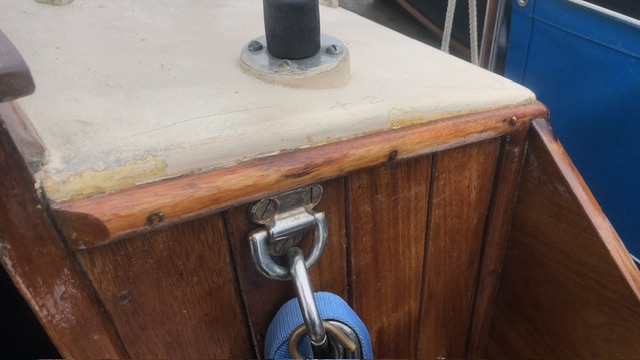
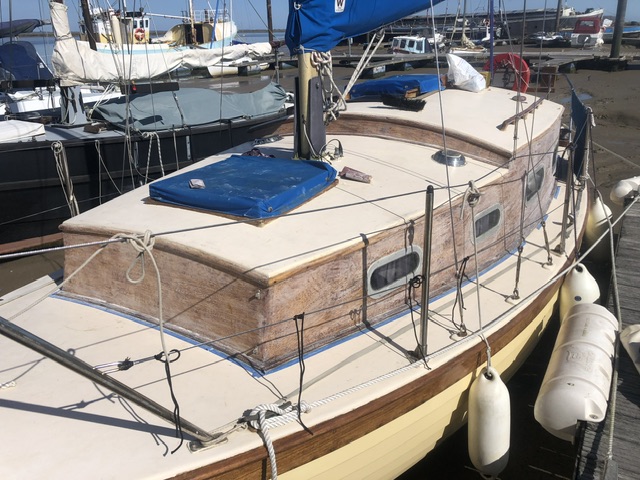
With the fair weather experienced in Essex at least, I was able to begin dealing with repairs to Whimbrel’s varnish work. Repairs were only needed to areas of cabin side beadings.
The flat surfaces have stood up to the winter very well and continue to look good. So, overall, I have been happy with my new coatings of Le Tonkinois varnish, first applied after our complete stripping off of forty years of coatings of urethane.
Applying one of eight repair coats.
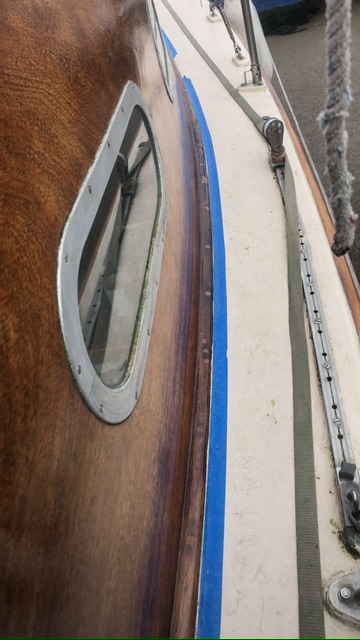
Although the autumn and winter in the Essex area has not been as wet as elsewhere, it has been damp with many overcast days, this is damaging to varnish and areas suffered.
Beading repairs along port cabin sides.
The dry weather allowed day after day coats and visit by visit sections were nearing completion as final repair areas were hit.
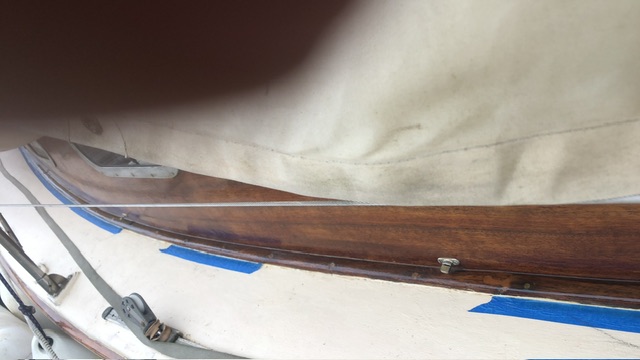
A lengthy section of cabin side to deck beading coating under repair.
Before I started I had ordered a batch of varnish from a different source from my usual supplier (UK distributor), but for unknown reasons I could not elicit a reply.
When the batch arrived it looked different. But that is another story. I ultimately obtained a batch from the normal UK supplier. The batch looked normal.
Hatch runner repairs.Section of cabin top edge beading under repair.
The cockpit is being over coated this season but beforehand a few areas of repairs were needed. I had done some of this way back last September and have already recoated the cockpit seats. If the weather continues along a fair path, I’ll have this done too.
The mate hard at it coming round with fine grade…
On the final day of March we got ourselves over to the boat and got cracking, sanding, wiping and varnishing.
Sanded ready for a fresh water wipe.
We sanded with 180 followed by 260 grade before brushing down and water wiping with a touch of degreasing gloop (sugar soap) in it.
Looks good!
Christobel had a break during the varnishing process for she ‘cannot’ do it!
We can’t remember getting this far ahead with full overcoating of the cabin sides.
We need a new red ensign my mate told me a while ago. The fly had been sewn up and the colour is badly faded. It’s quality is dubious!
‘It looked piddly…’ she said.
I had got a small 3/4 yard size last time…
So, I looked around the web. Most had no information regarding how made and details of material.
Jimmy Green did give some detail, but like many outlets had a high price…
On the Jimmy Green site.
Amazon had plenty of choice … some cheap printed types and others fully stitched and not so cheap. I went to web sites of outlets and finally began to get proper information. Some stated that they were made to UK Ministry of Defence standard.
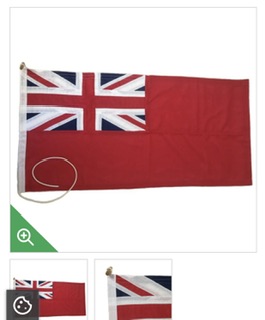
Finally I alighted on Alpha Flags, see: https://www.alphaflags.co.uk/
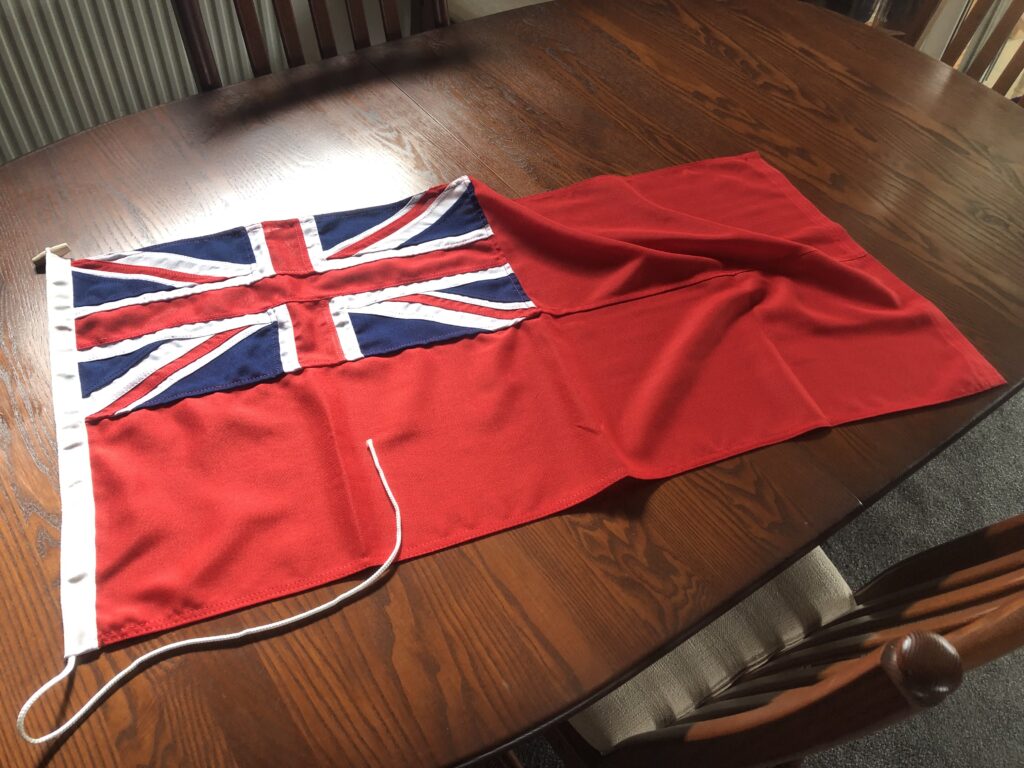
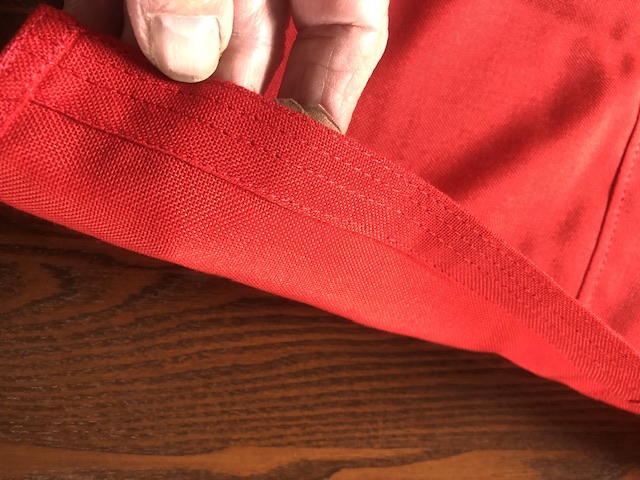
The flag was described as robustly made in the appliqué style – all sewn panels – with a larger fly turn over (hem) with several rows of stitching…
It was described as being of good colour fastness too.
The flag – a larger yard size.
It was ordered on Sunday afternoon. Monday, I answered a question and placed the order, making payment. It arrived on Tuesday’s post…
A cracking service, without a chandlery mark up.
Note the turn over and four rows of stitching.
The mate said it was lovely and bright, as I pointed to the stitching…
Although we only fly the red during the ‘winter’ … only time will tell.
Recently news broke that Fairline Yachts was in trouble again. This was after a fall in sales from around £48M to around £42M. Another group had taken over the concern in between times.
The ins and outs of the pain being felt by investors is far above my head, but they know the risks… It looked like the company was heading for a winding up if funding or new owner could not be found.
They are described as ‘historic’ in terms of British Yachts. Really, when the company dates from only 1963!
However, although initially it looked like the company was going to move onwards. This would have been good news for UK boating and leisure industry, but are their products really what the boating public needs: the craft advertised are bordering on ‘super-yachts’ and far outside the yachting norms.
And, what does £42M actually buy? How many boats does it represent?
Well, it adds up to very few craft: they are all big and damned expensive – up to a little under £4M.
Moving into 2025, within two months, the new owner enacted a winding up order and an administrator is now in charge…
If you look at the company’s history, they began with small run-about weekenders before gradually climbing the length ladder, until anything less than 40′ (other than a 33′ sports-weekender) was not catered for.
In a news briefing it was announced that currently apart from a hand full of staff released before Christmas 2024, no one further had been laid off and work on orders was to continue whilst a future was looked for.
Meanwhile way down the line, the UK’s Caravan, Camping & Motorhome show is to reintroduce ‘starter boating’ in its format.
Now, there is a market in this sector. One only has to look around the creeks and small ports that abound in our rivers to witness the phenomenal growth of canoeing, kayaking, paddle-boarding. In my own locale, large groups of ‘canoeists’ are oft seen whilst out sailing.
A group of ‘canoeists’ on Mundon Stone Point – Lawling Creek.
One of the sailing clubs in Maylandsea has actively encouraged new memberships from this fraternity. It was something that developed in a big way during Covid pandemic.
Too little attention is paid to the small craft market. Whatever happened to the builders of boats of 18′ to 30′ that used to proliferate our waters? Some got just too damned expensive, like Cornish Crabbers, niche yes. £130K for a open plan 24-footer – madness!
The 1960s onwards into early 1980s was a time of huge increase in leisure boating and designers and builders ran with it. Many were poorly produced whilst others were heavy but there were also some great boats form Westerly, in particular…
My own came from this period, but of wood, starting at 21′ growing to 24′ and finally to 28′.
Then, I believe, the ‘big is beautiful’ ethos in marketing circles encouraged larger and larger craft. This destroyed that ‘starter’ buzz of working up through size with family and age.
However, there becomes a point when a large craft becomes a deterrent to actually going boating and one only has to look around yards and marinas to see this.
In my own patch, there are a couple of large yachts which are unused. One is coated in green verdigris – fresh water algae.
The yard and moorings are also filled with far smaller under-used or unused vessels – something else that is a common sight.
One wonders how many more craft are actually needed? What of those many thousands of unused vessels?
There are things, as all boaters know, that can be dealt with during the darker and colder time of the year. All that is needed is the ‘will’ and a place to do it.
I had no constraints for washboards and the locker door. but for the cockpit locker seat tops, an approaching week of ebb tides at the dark ends of the day was going to give me a window, so, I cracked on with the first items as they would not stop me using the boat.
A bit of dry and sunshine allows outside preparation like stripping and sanding and a shed or garage used as such is great for touching up, however, being ‘allowed’ to fetch bits into a conservatory is a boon for final coatings…
Temporary wash boards fitted.
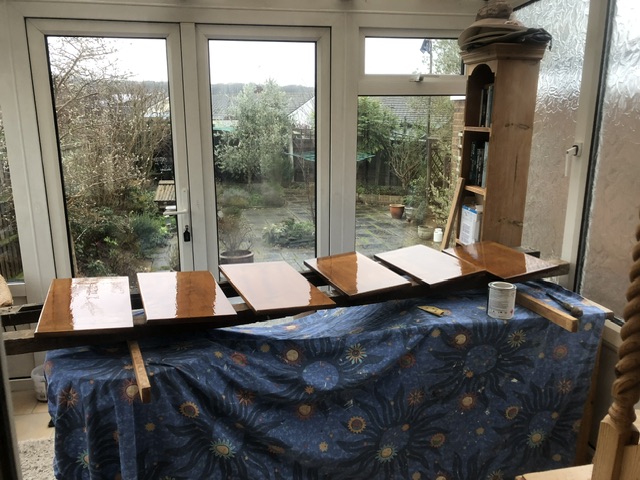
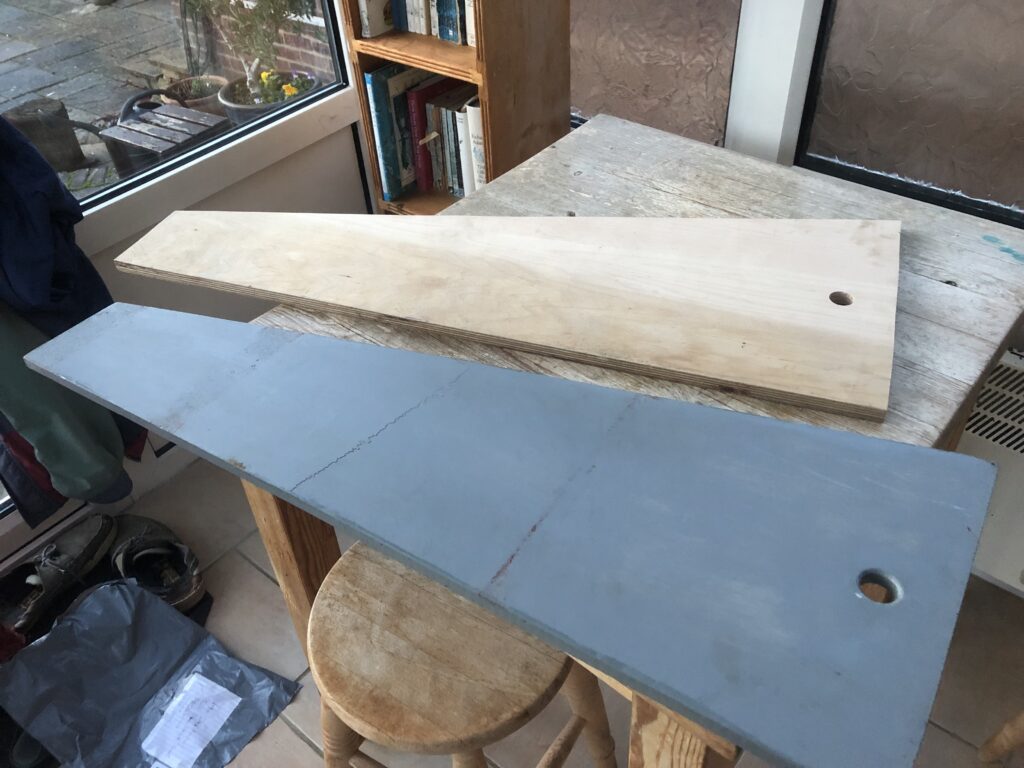
The cockpit aboard Whimbrel is due to be varnished this coming spring, so, the cockpit seat lids, wash boards and poop locker door have all been brought home and refurbished in advance.
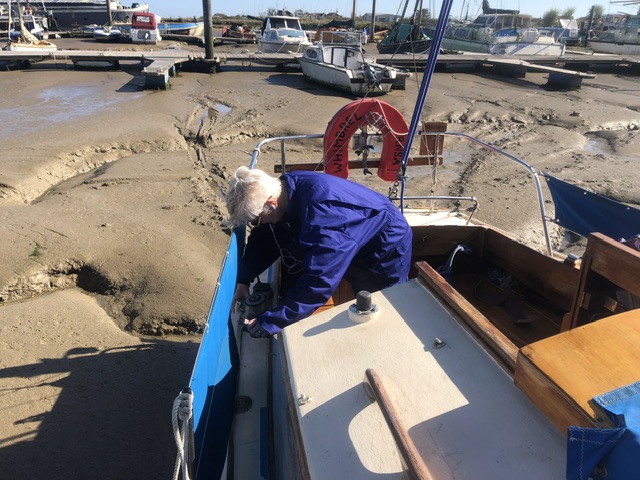
The wooden bar I fitted across the aft uprights of the pushpit to support the lifebelt holder was also removed. Its coatings had degraded and it has suffered water attack. A complete strip and hard sand got rid of all stains.
View aft – note the wooden bar across pushpit: it supports the lifebelt holder.
It took a little while for the bar to dry out properly before it had a final sanding. Meanwhile, touching up several coats to bared areas on the boards was completed.
Wash board and cockpit poop locker door – final coats.
When the boards and hatch door were completed they were returned aboard Whimbrel and the locker seat lids came home – I had a week of ebb morning/evening tides to get done.
In between adding touch-up coats to the cockpit seat tops, the bar was given several coatings of epoxy.
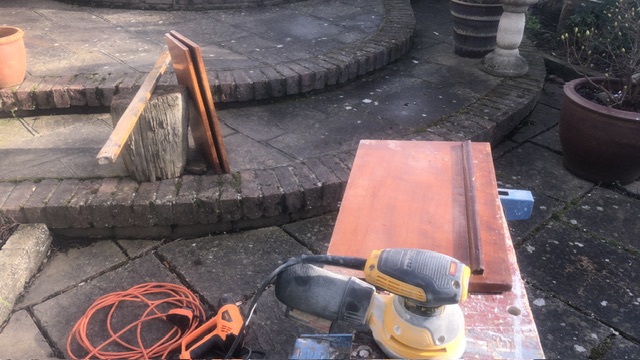
Sanding preparations – the wooden bar (sitting on log) was heat stripped too.
The seat lids were in relatively good condition as I’d done some prep work back in the autumn.
Wood bar being epoxy coated.
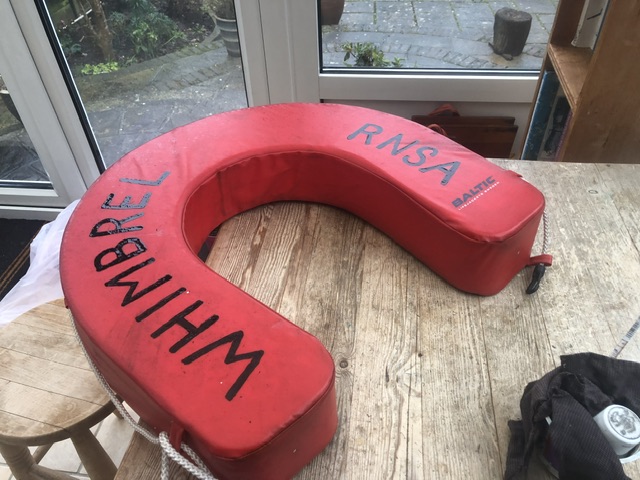
The lettering on the lifebelt had degraded too. A simple job to redo…
Repainting the lettering on the lifebelt.Job done!
Many, if not most boats do not have a name and a port if wished marked on the lifebelt carried aboard. I used to have ‘IYC’ but that lifebelt went into a skip upon leaving that place. I could mark it with ‘Blackwater Marina’ but it is a bit of a mouthful! On Classed vessels marking is a requirement and is something advised for smaller vessels. It is usual for the lifebelt to float free, eventually, thus providing a clue to a vessels loss, however…
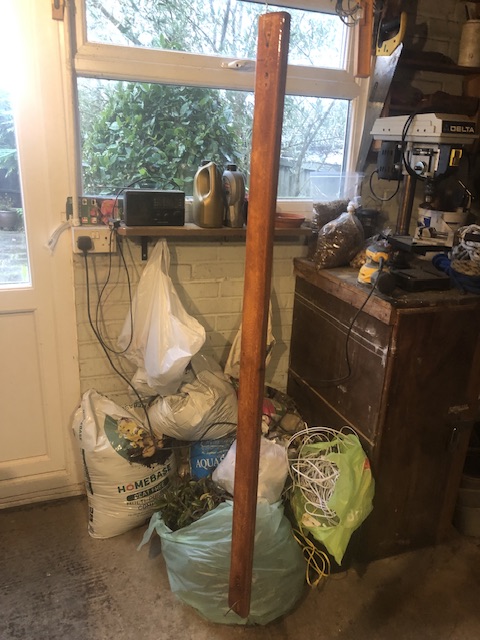
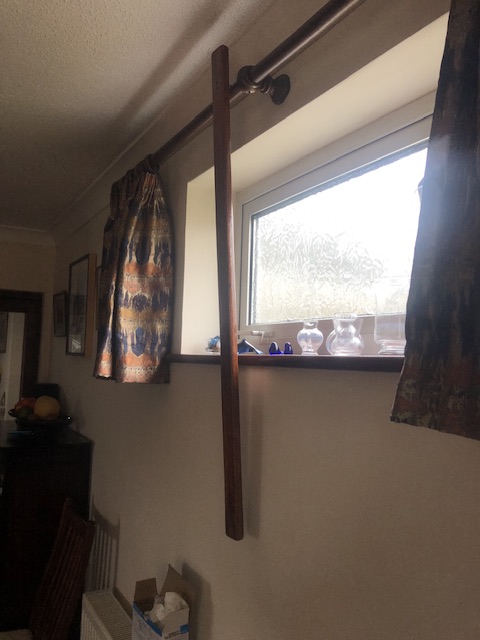
As the locker tops were dished up, the bar received its last of three coats of epoxy. It generally took two days to harden sufficiently to abrade and then add another coat. I hung it from a curtain pole above a radiator finally! NB: a nail fitted into a drilled fastening hole nicely, giving a convenient hook…
Epoxy hardening above a radiator!
The locker lids came ‘indoors’ for their final finish coat.
Cockpit seat covers – final coat…
The wooden bar has now had three coats of varnish over the epoxy and tomorrow it will be returned to boat and fitted back.
Roll on some spring warmth to get at the rest of the cockpit, although some preps are already in hand.
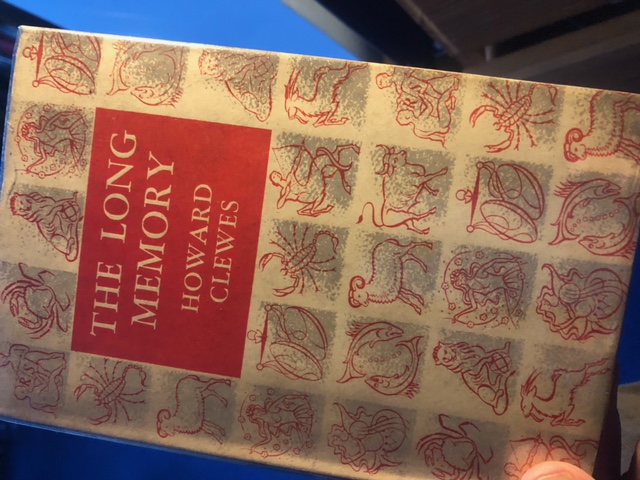
I was alerted to the film, ‘The Long Memory’ by a fellow sailor during last autumn. I quickly discovered that it was based on a book by Howard Clewes, author and film script writer.
Howard Clewes was born in 1912 and died in 1988. His early life was in York – far from the silty Thames. He was a BAFTA award recipient during his career. As far as I can ascertain, The Long Memory was his only book to feature spritsail barges and the R. Thames.
The film was good, however, at the time the hacks tore into the ‘wooden’ characters depicted… The book is a fabulous yarn.
Cover of The Long Memory by Howard Clewes, Reprint Society, 1953.
It is a story of a chap’s release from prison for murder. It was a murder he did not commit. The chap finds a home on a hulk amongst others in a graveyard The back story comes out as the book progresses with the character searching for the two people who’s untruths put him behind bars.
The untruths, wrongful corroborative statements that a deceased person was not who he was. As you will find, the deceased is later found alive and well in Shad Thames running a tug business and a racket besides.
The synopsis of the book is in a link within the link below:
The so-called murderer was heir to a tug business based at Gravesend but he fell in with the daughter of a barge owner (once of a small fleet) who drank all the profits. The owner agrees to transport a bank robber on the run to a ship out in the estuary … and the tale unfolds…
For me, the main story was enthralling. It is a clever tale with the London River’s reaches weaving through it. Anyone whether or not they have sailed this waterway will be carried along on the flowing tides…
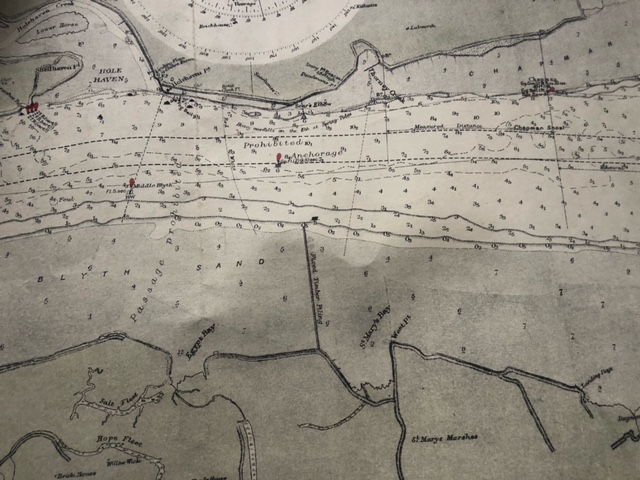
The book and film both open with the released prisoner (on licence) taking up residence aboard an abandoned barge (lighter) with a hut on its deck in ‘Morocco Bay’ on the Grain peninsular along the Blyth Sands…
There are evocative views purporting to be in either Egypt of St Mary’s Bay that were filmed in Bedlams Bottom where lighters and a few other barge types and the odd spritty or two were laid up against the sea wall.
I think St Mary’s is the place for a track runs out from a road across the low grazing marsh from High Halstow. It was extended at start of WW2 to a set of buildings housing men protecting a river barrier built here.
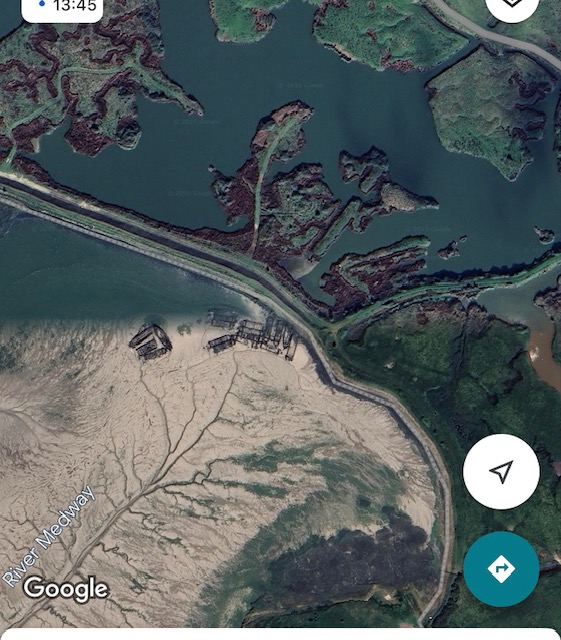
Having sailed those delightful waters at the foot of Stangate for most of my life and investigated the wreckage, now containing the remains of the famous racer Veronica, it was fascinating to see how it all was several decades before my own wanderings. Google earth clearly shows these vessel remains.
Sea Reach Chart 1931, corrected to 1942 showing the boom across Blyth Sand.
In the book, towards its conclusion (film differs), the main character is set down on the boom end from a river boat and he walked ashore into danger…
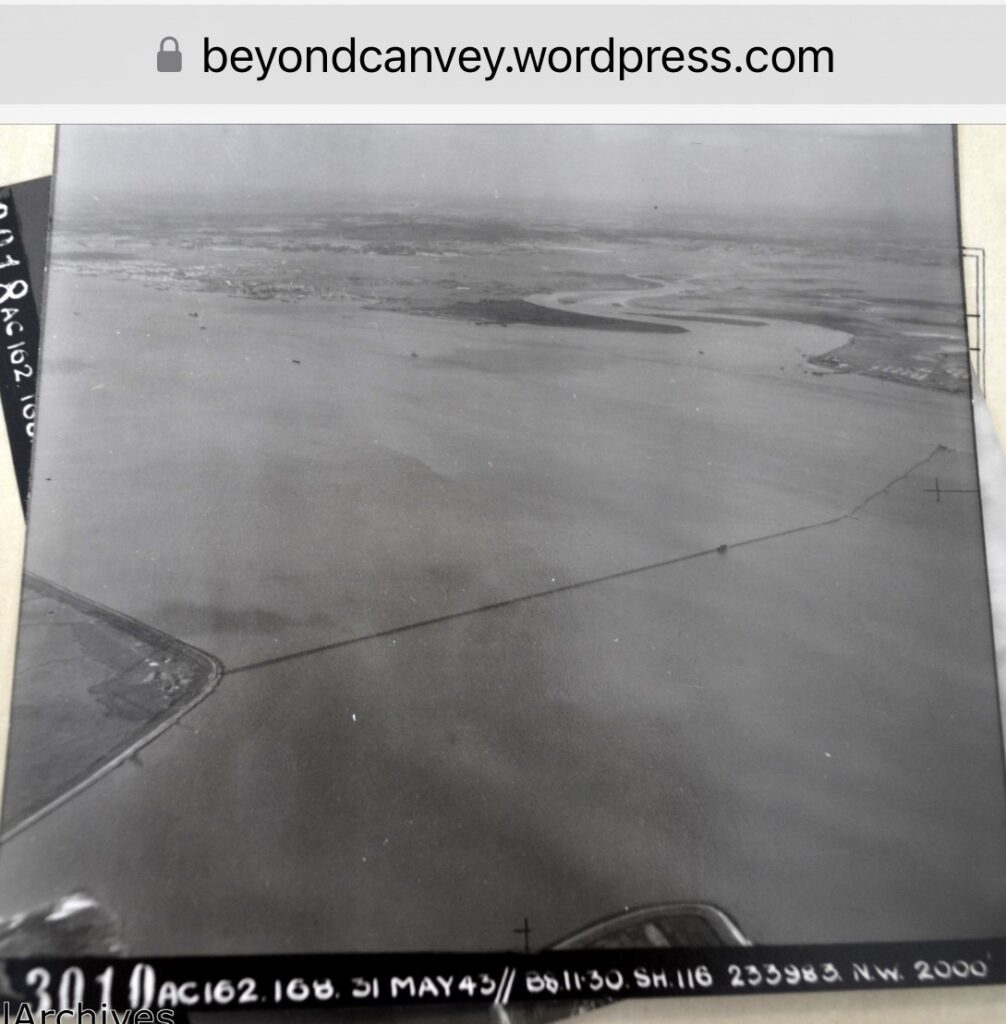
An arial photograph I found on a web site ‘beyondcanvey.wordpress.com’ which has come from archives clearly shows a building of some sort at the outer end at edge of the Blyth. The deep channel floating boom was tended by naval-ised fish-trawler types manned by probably men of the ‘way navy’…
Arial view of boom – from ‘Beyondcanvey.wordpress.com‘
The web page was interesting for the archive photographs (not referenced) and is worth a look.
Very few of the places are now as described by Clewes and used for filming. The eastern end of Gravesend has changed dramatically, as has Shad Thames and the area immediately upriver of Tower Bridge. The only areas that are still hauntingly wild and lonely are St Mary’s Bay and Bedlams Bottom where filming took place. The remains of wrecks are still there too…
Bedlams Bottom – courtesy of Google Earth. The inshore row will be instantly recognisable as the film site. For interest, Veronica is uppermost western vessel with another across her stern end. The Sirdar is at foot of view near a ‘sandy’ do, on the southern shore.
Copies of the book are available on line, but check your local library as it may well be held in a reserve stock.
I have not tracked down which spritsail barge was used, but it was a yacht-barge, and no, it was not destroyed in the film!
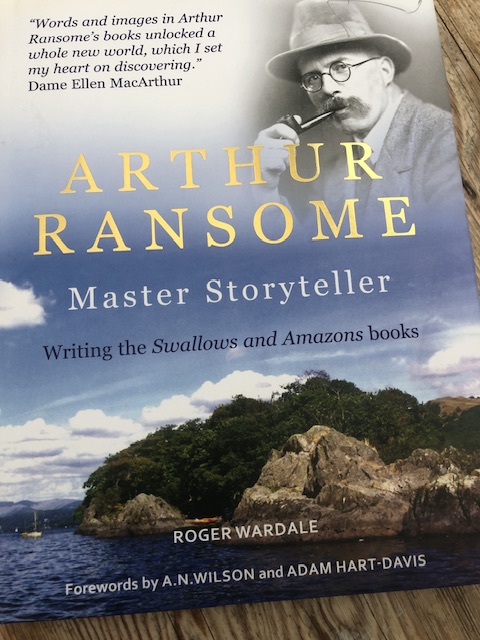
A bit of a delight was found under our Christmas tree, a present from my dear mate, a book.
The book, Arthur Ransome Master Storyteller, By Roger Wardale, has been around for some while, however, it’s title hadn’t fell my way. Christobel said that she found it while we were away on holiday in Norfolk – I suspect it was at the Museum of The Broads…
The cover of the book.
Of course, like many sailing adults, Ransome’s books have been enjoyed many times. I have read most of the books about Ransome’s books, but not this one.
The book covers the works of Arthur Ransome, more specifically, the twelve about ‘his’ children and their exploits. It was published in 2010 by Great Northern Books and is still available on line.
There have been a number of Ransome inspired books. Christina Hardyment’s Arthur Ransome and Captain Flint’s Trunk looked at the supposed and most likely places the stories were based. Hugh Brogan wrote a biography of Arthur Ransome and also Coots in the North & other Stories, which has sections of unfinished or abandoned yarns. Arthur Ransome also wrote an autobiography too. Taqui Altouayan’s In Allepo Once details a time Arthur and Evginia spent with the Altouayan’s where the family lived for some years.
There was of course, The Racundra First Cruise book by AR himself, which many say cemented ideas for the Swallows & Amazon series. The old seaman who sailed with AR is remembered as Peter Duck…
Don’t expect to find much about Authur Ransome’s own boats – they do get a mention, especially Nancy Blackett (Goblin) as she actually featured in two of the tales. His second cruiser, Lottie Blossom, completed just before WW2 was hardly sailed by Ransome, whilst Peter Duck was built, sailed, sold and promptly repurchased – his boats are told about elsewhere.
Was the book worth a read? Yes.
Do I recommend this volume to anyone who has an interest in Arthur Ransome’s books? Yes, certainly.
The start of the year was punctuated for us by the failure of our propeller key making it imperative for a lift out. This was our first at The Blackwater Marina.
It all went swimmingly well and the team listened to my ‘foiballs’ about chocking up… Beccs, the manager, kindly gave me a telephone number for a metal fabricator up the road in Latchingdon and I had a new key made (milled) up by the elderly owner that evening, on our way home from the yard. See blog for the story!
Whimbrel ready for relaunching just a week after lift out.
At the time we had not yet completed our first year in the yard, nor have we yet carried out the antifouling and other annual jobs on the slipway yet. These were all completed (early) whilst out end February to early March.
Sailing out.
We have found sailing from our berth and returning simplicity in itself – no traumas or difficulty has been experienced. Only a hard easterly would cause, or likely to cause, any problems.
On many Saturdays in the early part of the year, we walked local to the boat, or just Christobel, while maintenance was carried out – often the second, third or fourth varnish coat etc.
During the autumn especially, we have enjoyed morning sailing with a delicious soup lunch at the bistro bar. The quality of the fare offered here has radically advanced since a change of proprietorship. I am even considering it a venue for the 2025 Finesse rally!
It has been an entertaining year all in all.
All my siblings have enjoyed the boat from the mooring including a cousin and extended family. All have commented on what a delightful place we are now based. For one thing, there is absolutely no bloody ‘club initiated stress’ to cope with!
Crew at ready to slip, sailing off at Brightlingsea.
The year has brought warnings from the authorities on boat safety, especially on the inland waterways where accident, fires and death have occurred. The RNLI has had a rise in rescues inshore caused in the main by paddle boarders and canoeists. Both past times grew during the pandemic exponentially. Large numbers of both are oft seen in Lawling Creek.
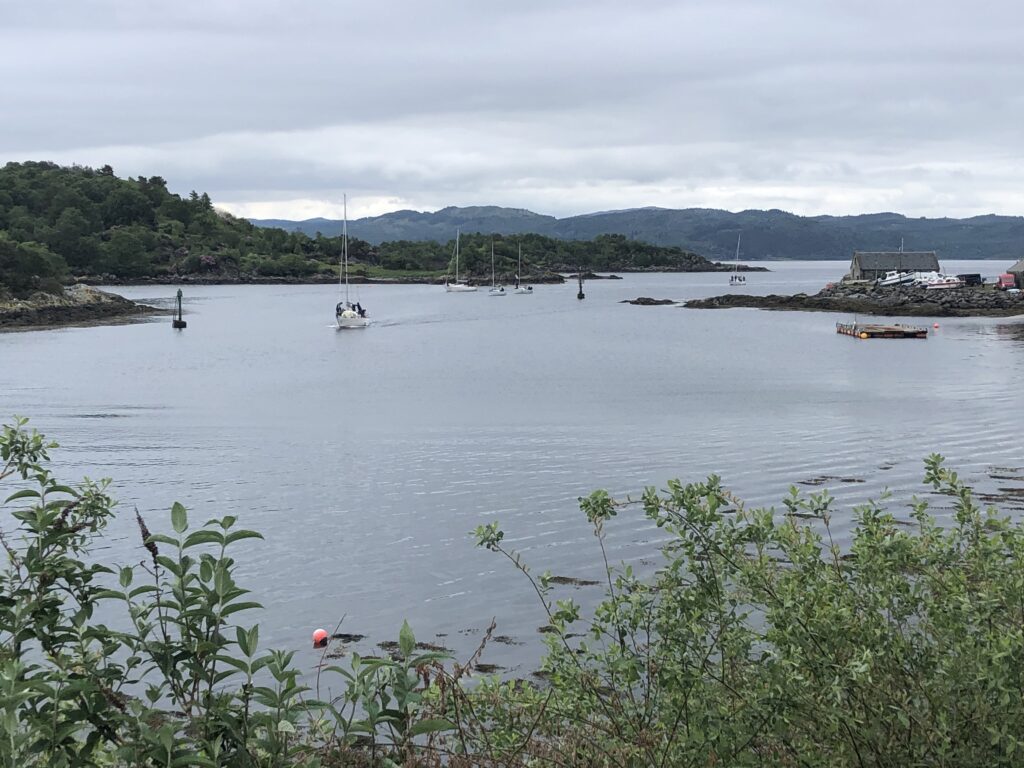
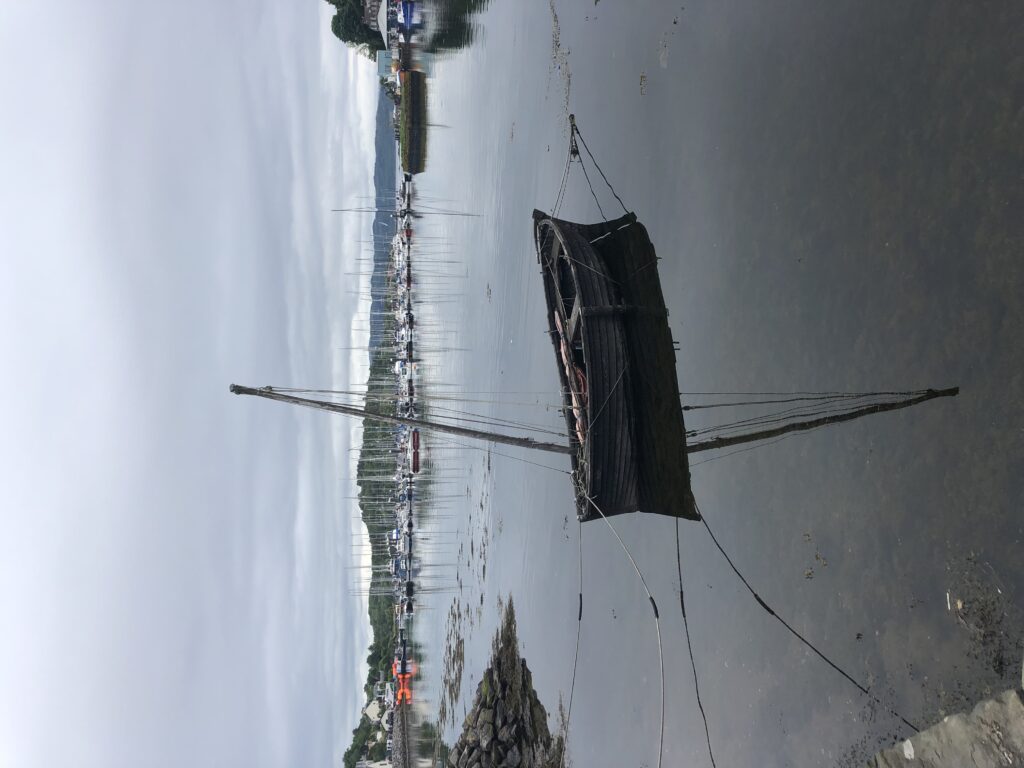
Craft leaving Tarbert Harbour for another racing day in Late May.
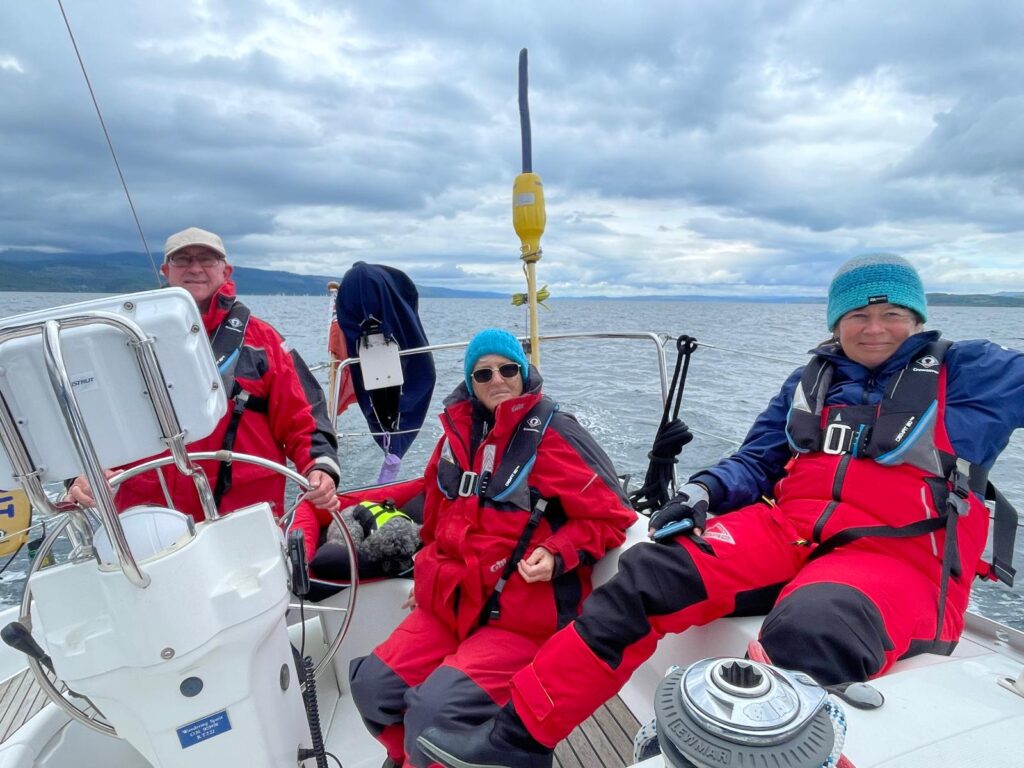
Yachting (sailing?) seems to have taken a dive around the east coast, although when visiting a cousin in Tarbert, Argyll, during Clyde Tarbert Weekend, the number of craft participating puts the ‘south’ to shame, I thought. I sailed aboard my cousin’s yacht on a dreek day, but boy it was enjoyable. water depth was in excess of 110 metres – unheard of in my locale!
The Olympics took place in France this summer too. The much heralded and grossly over funded Royal Yachting Association’s Team GB did crushingly poorly… It was disastrous. The RYA should get back to what its core membership used to be – cruising sailors and get a grip.
Me helming a bit of GRP in Loch Fyne off Tarbert, Argyll…
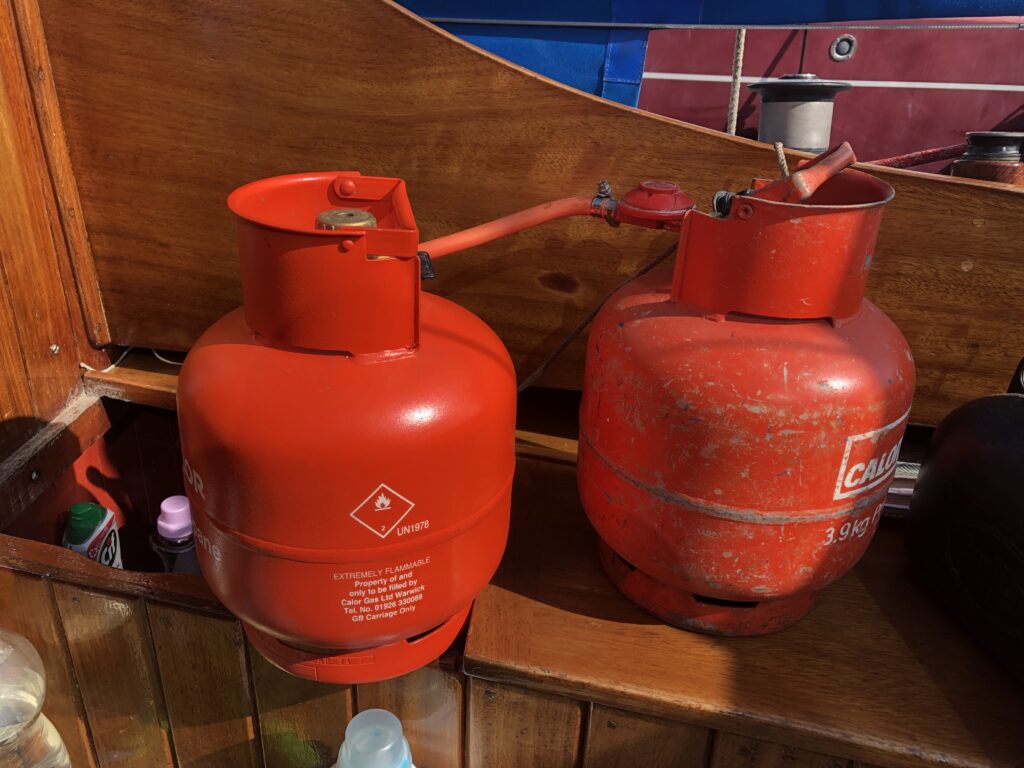
My membership was terminated over the Calor Gas bottle saga: the RYA were outstandingly useless. Calor themselves saw the light eventually, announcing purchase of new bottle stock and a continuation of supply of both propane and butane in the ‘small’ cylinder. That was a definite positive outcome for the year.
A brand new gas cylinder…
The numbers of empty moorings – buoys and marina berths – has seemingly continued to rise, with a resultant increase in craft laid up ashore. The laid up fleet is huge.
Active boats seem crewed by ‘older and older’ crews. To many this is worrying, but I believe is symptomatic of the way modern life has evolved. The youngsters of today, on the whole, do not want the hassle of maintenance and the trouble of running – looking after – a vessel. The growth in companies offering boats for short term use – essentially hired – is spreading to UK waters. It is a bit like going to the gym: there is no commitment to the equipment or premises. It is a case of use and go…
Be interesting to see how this develops.
One thing is for certain, many yards cannot cope with much more in the way of laid up craft being parked up and leave space for maintenance of regularly owned craft.
Norfolk boat rescue centre – new build nearing completion..
Whilst on holiday in Norfolk, we visited the Broads Museum where craft are being preserved, and, on another day visited the Norfolk Boat Rescue Centre where craft are being repaired and there was actually a new build nearing completion.
Sadly, a few weeks before the end of the year it was announced that the internationally famous Lowestoft Boat Building Centre is closing. This is a huge blow to the training of new specialists in wood. There are yards specialising in wooden construction and repair, but the numbers of trainees any one yard can support cannot be a substitute: the number of yards themselves is not high.
New gaff being shaped up for the tender, Twitch.
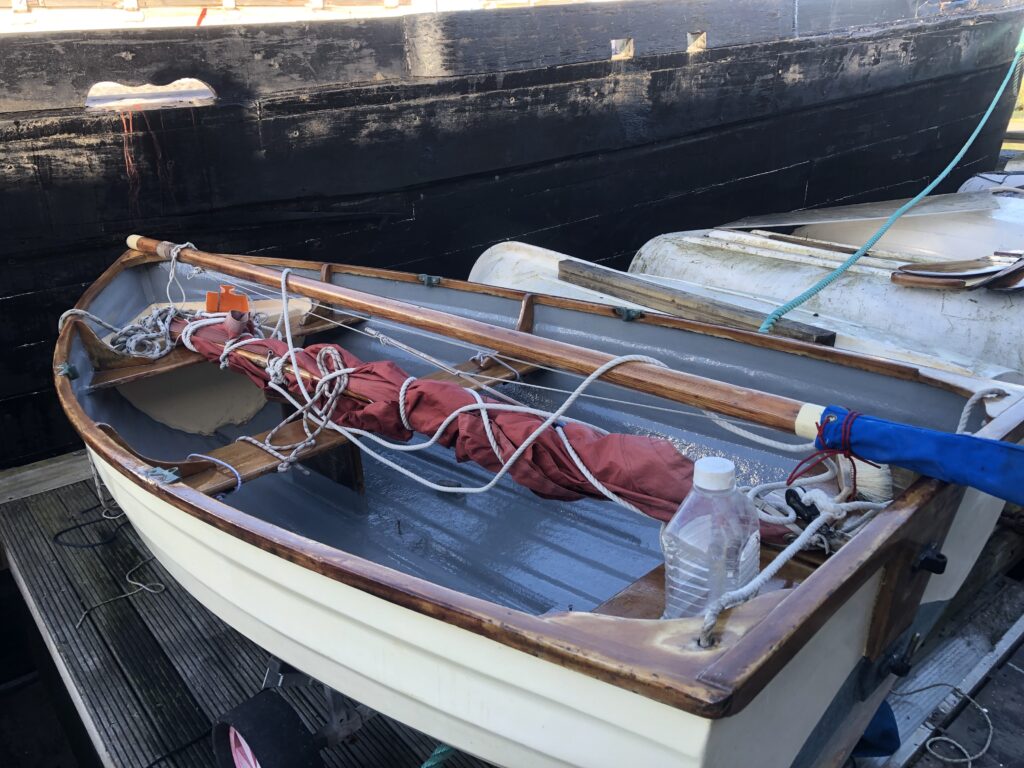
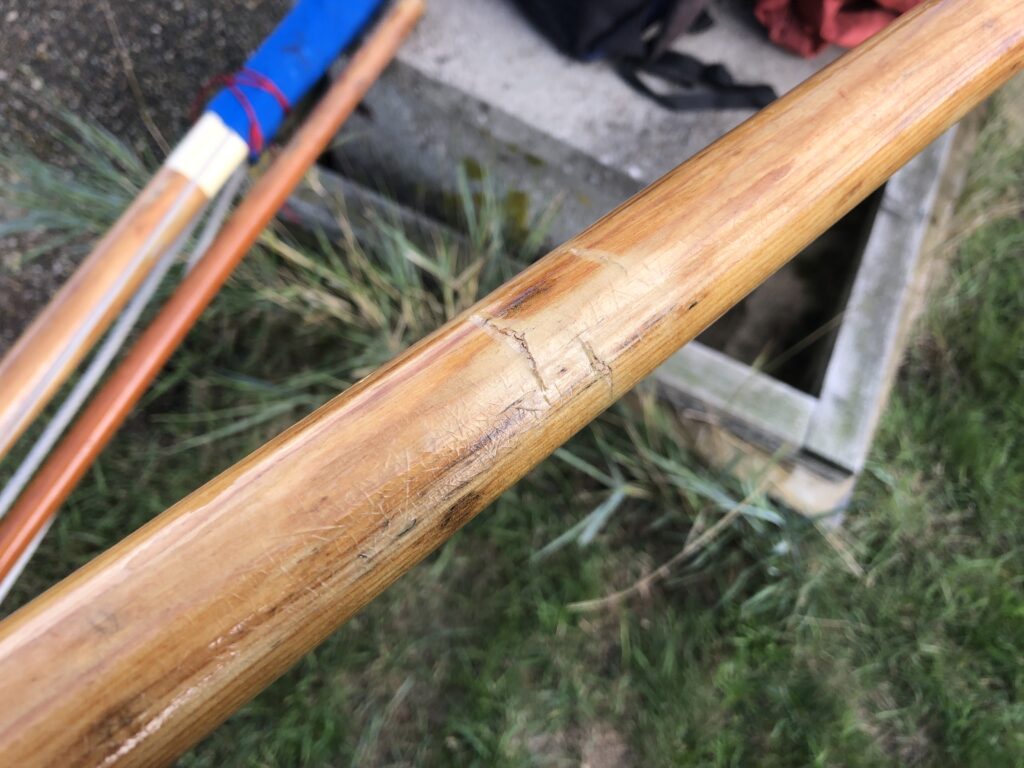
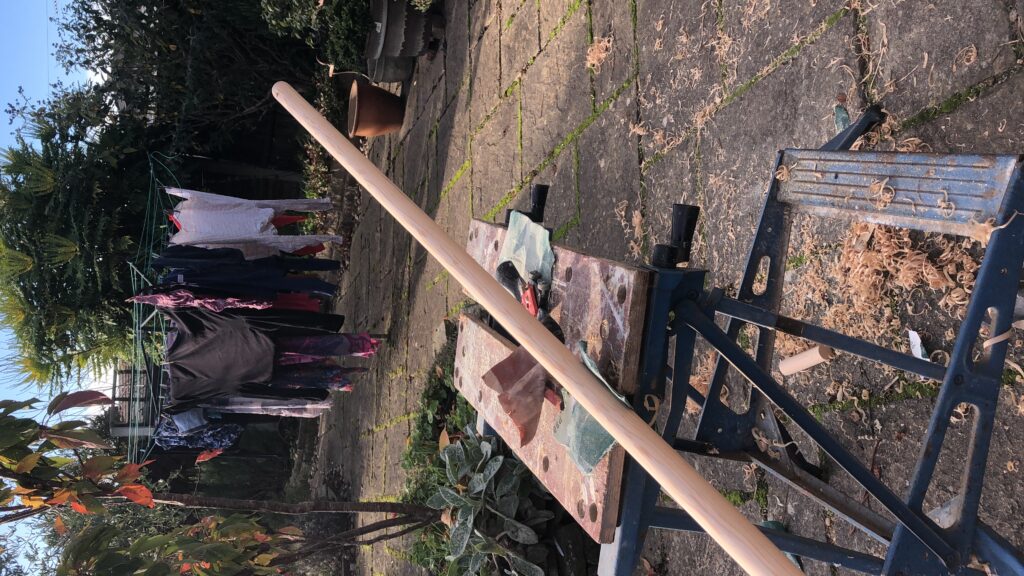
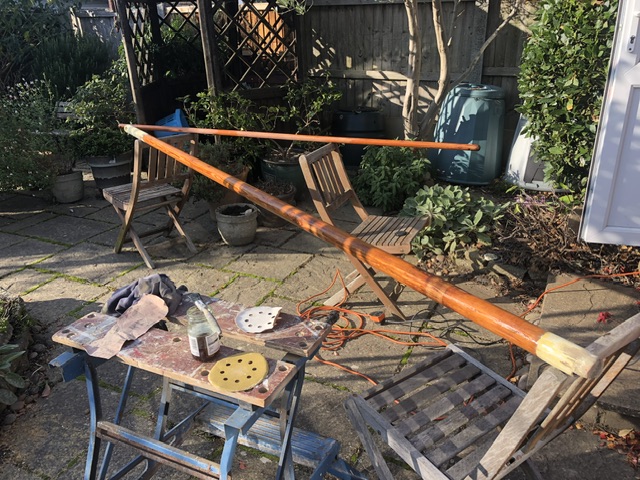
This last autumn I have had to make a new main section to my Genoa whisker pole – made from laminations of spruce. Also, a new gaff for Twitch’e lug sail. Both were jobs well within my capacity.
So, we are moving into 2025. For me it will be a a bit of a year: I reach the young age of seventy in June…
Last sail of 2024 – Skippy feeling happy!
And, we would both like to wish all readers of this blog a very happy 2025, whether sailors or not, be happy and content with life and live it as it should be. Go…
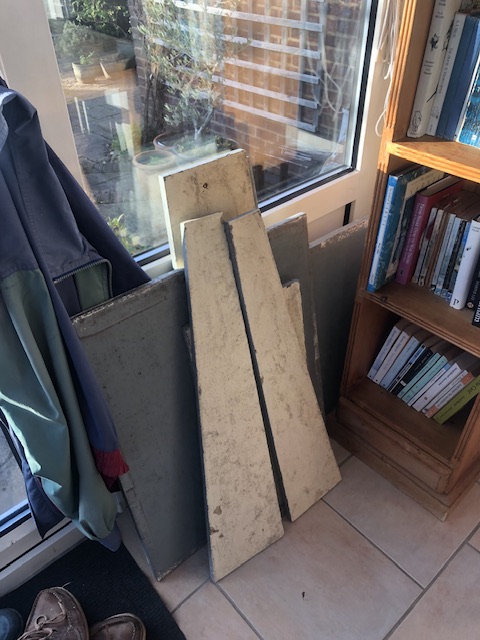
The cockpit sole boards aboard Whimbrel have needed to be stripped back for a couple of seasons. The paint layer thickness was becoming excessive (notoriously tough resistance to sanding!) and in places adherence was breaking down.
As an experiment, I had applied a single coat of a different non-slip paint from Teamac as I was increasingly unimpressed with either Hempel or International products. Quite frankly neither of them gave a respectable non-slip finish, even with added ‘sand’ in the mix.
The 2024 festive tree aloft!
So, after enjoying a sail on the day the festive tree was set aloft and considering ongoing forecasts we transported them all home.
Running east back to Lawling Creek.
It was an excellent pre-Christmas sail, with a kindly breeze allowing us to break away from Lawling Creek and beat up to Heybridge Basin before running back downriver.
Over Christmas the tides are all ‘wrong’ that is they’re early and late. The New Year period brings middle of the day tides … so, just enough time for the job!
The sole boards sitting in the warmth.
In many respects getting the boards home ‘early’ was more than helpful: it took longer to complete the project – I’m not one for shortcuts!
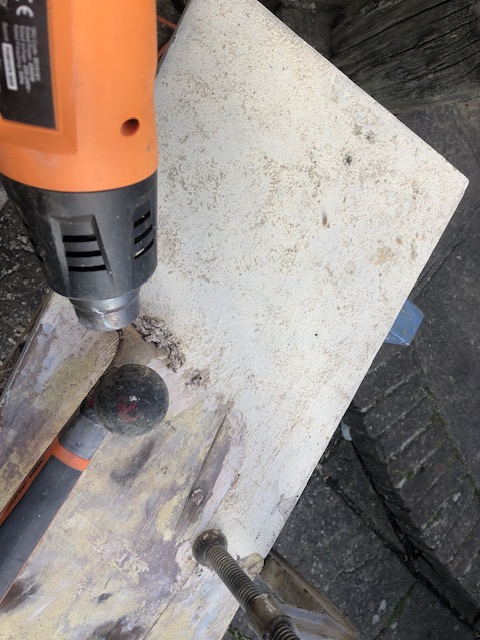
Stripping off with a heat gun.
A heat gun and orbital sander came into their own as paint removal and preparation progressed nicely outside on two windy yet sunny days.
The smaller sections stripped, sanded and primed.
One of the things I have not done is to use a middle under coat between the silver primer/undercoat and non slip for we have found that deck paint does not adhere to coatings such as ‘oneup’ primer undercoat (made by International Paints).
I wonder if others have had similar problems.
I also wonder if the apparent incompatibility is due in part to the different make up of the paints. The aluminium primer/undercoat and non slip use a solvent thinners, whilst ‘oneup’ uses white spirit…
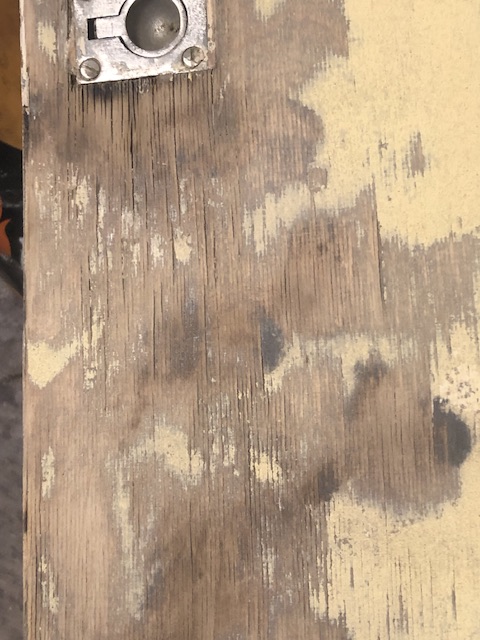
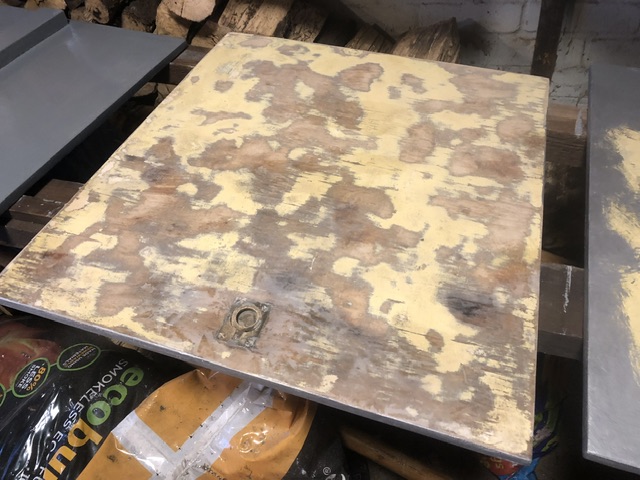
Areas on the two larger area boards had some outer ply layer damage.
Some epoxy and filler repairs were needed to two of the boards as the ply surface had been torn by the heating and scraping off of the paint.
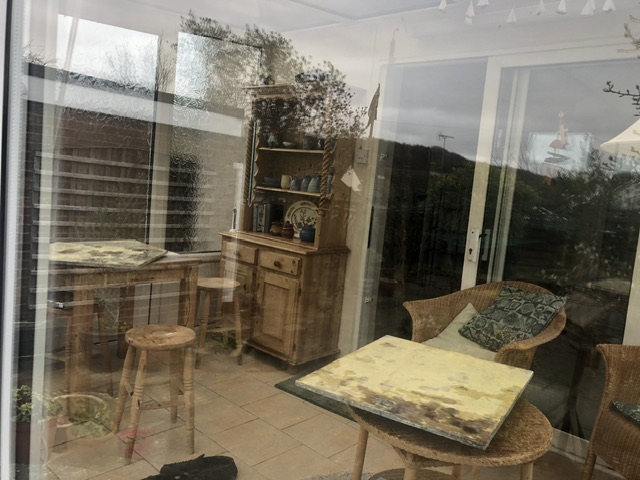
Both were thoroughly stripped bare locally and epoxy coated.
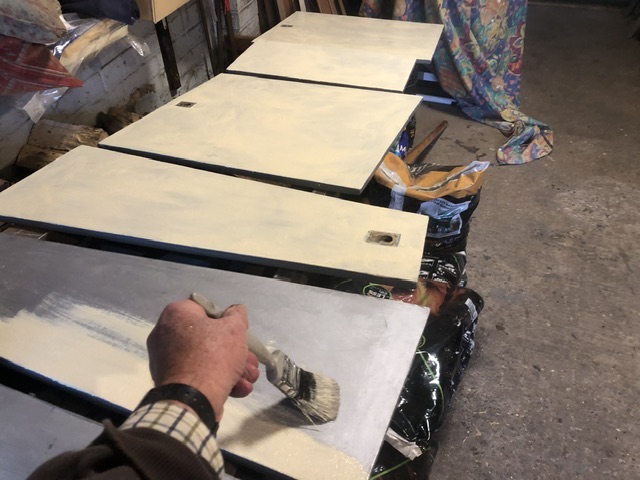
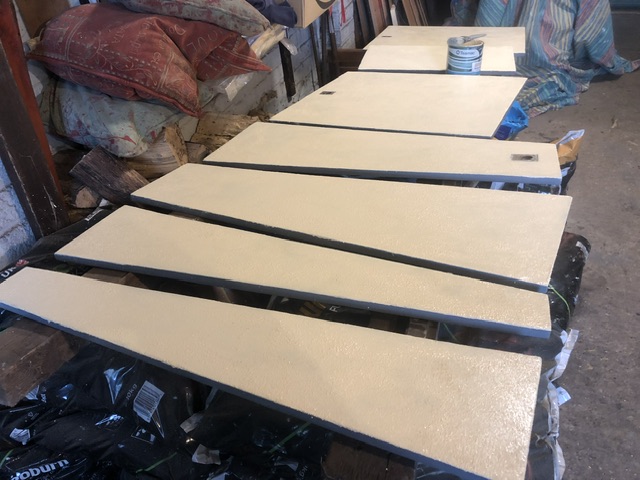
Words aren’t really needed as the pictorial flow tells the story, but not of the time and effort made!
Primer and two coats of gloss was given to undersides.The worst of the damaged boards sanded and ready for priming.First coat of non slip paint.
Progress prior to Christmas was on course to allow shipping sole boards back aboard Whimbrel for a sail as soon as tide times allow.
Once the initial preparations were completed, it was a case of essentially a coat each day. The aluminium primer being quick drying allowed two coats on a day, which made life easier…
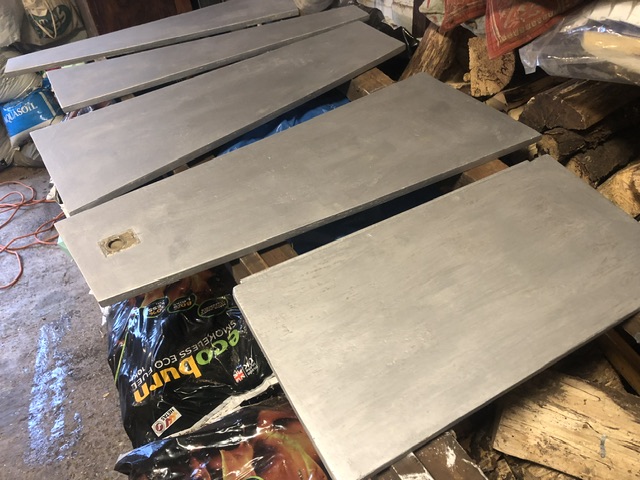
The paint coatings completed.
In the coatings completed view the course or roughness, if you like, texture of the deck coating can be seen. It is certainly effective when sailing and Whimbrel has some heel on her. With a single test coat previously applied, I did not slip on any subsequent occasion…
There are many areas where a conservancy fee is ‘normal’ such as the Broads, inland waterways and river areas above the tidal limits such as the Thames and Medway in the south, but this news in the link below of what Peel Ports Clydeport wish to do is a bit of a shocker, or is it?
The area ‘given’ to the Clyde Authority as it was instituted was very large indeed. It encompasses all waters from Kintyre peninsular to the Ayrshire coast, including the yachting centre at Troon. The private port owning company, Peel Ports, own this now and they have come up with a proposal to make a charge on all boaters within their domain.
It is the size of this domain with its far reaching tentacles that is infuriating boaters and others.
The proposed charges are within those levied down in England, on the River Medway in Kent. Circa £80-£100 for pleasure craft, annually. Note furor over the 2025 increases outlined below!
Tarbert Harbour on Loch Fyne, Kintyre.
Something amongst the ‘stink’ of complaint seeped into my consciousness: there are conservancy fees around the United Kingdom.
Many coastal and river harbours are either privately owned, run by trusts or are instituted authorities. Some moorings are charged for, some not and anchoring is free. Fees are paid for marina style berthing and within that charge is generally an amount that is ‘a licenced fee’ which goes to whoever.
Down on the Thames estuary area of the eastern coast of England there are river fees in some areas, not however on the lower Thames waters below tidal limits.
On the rivers, Blackwater, Colne, Stour, Orwell, Deben and Alde, there is no conservancy fee or similar.
Brightlingsea charges for moorings within their harbour, but nowhere else within their remit up to Colchester.
The River Medway as a ‘harbour’ is owned by Peel Ports and an annual licence fee is levied on privately owned craft moored within their jurisdiction.
Peelports Medway conservancy licences are increasing by a whopping 15% as stated by association webmaster’s post :
‘Peel Ports have acknowledged the need to make these changes and have today announced that dates that the conservancy fee covers will be changed to align with the typical boating season, i.e. 1st April to 31st March.
The letter from the Richard Goffin, Port Director, is shown below along with the new schedule of fees. The conservancy charge from 1st April 2023 will be £105.23 and the fee for yacht club moorings from 1st January will be £125.18. This is an increase of 14.2% (RPI to October) and 15% respectively.’
Interesting!
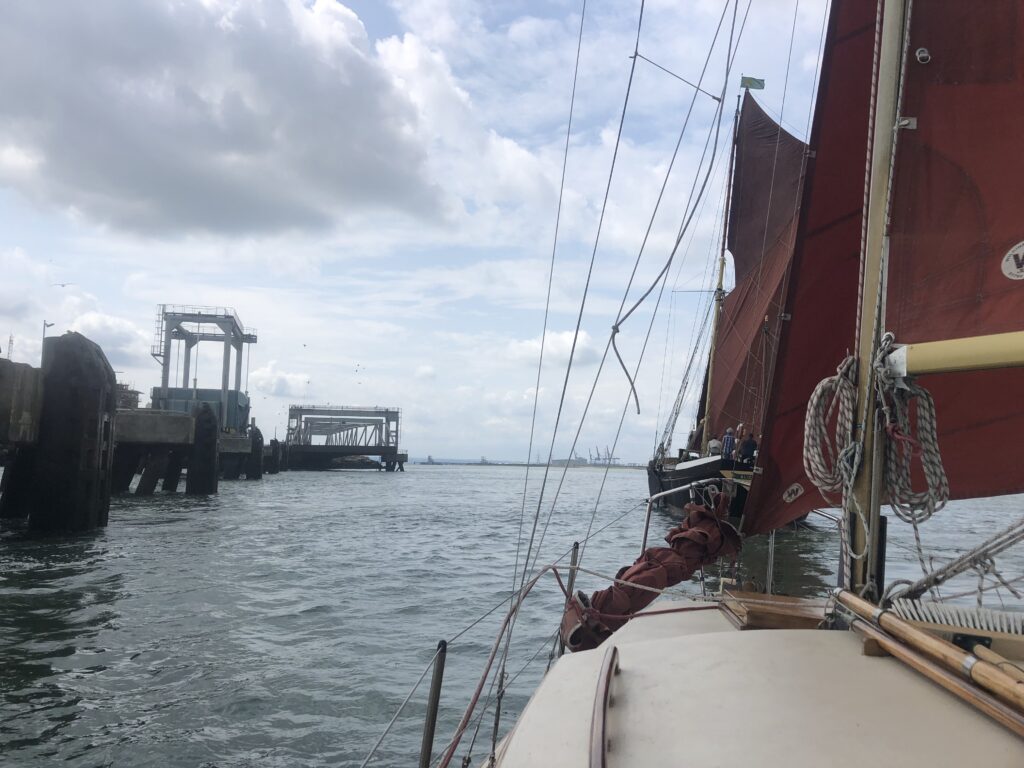
Sailing into the River Medway past RoRo facility.
On the upper River Medway above Allington Lock the river is operated by the Medway Conservancy and private leisure craft are charged.
Expanding on what previously stated, although there is currently no conservancy fee for the Lower Thames, there was a charge made to the yacht club on Canvey Island I once belonged to for forty years, for moorings.
The PLA levied a charge of approximately £110 for each mooring laid in the river or on the foreshore. Aligning with that club with drying moorings are levied also. The club I once belonged was charged a hefty amount for the club’s moorings and it equated to a similar amount per vessel.
The upper Thames beyond the Port of London Authority limit to Teddington Lock and beyond is run by an authority and a fee is levied.
Both these southern conservancies (although the Thames runs from the mid-west) charge by a vessel’s waterplane area – as does the Broads Authority, I believe.
This is all very interesting and it is something not often talked about: people just pay, mutter into a foaming pint or a fizzing gin, grin and bear it…
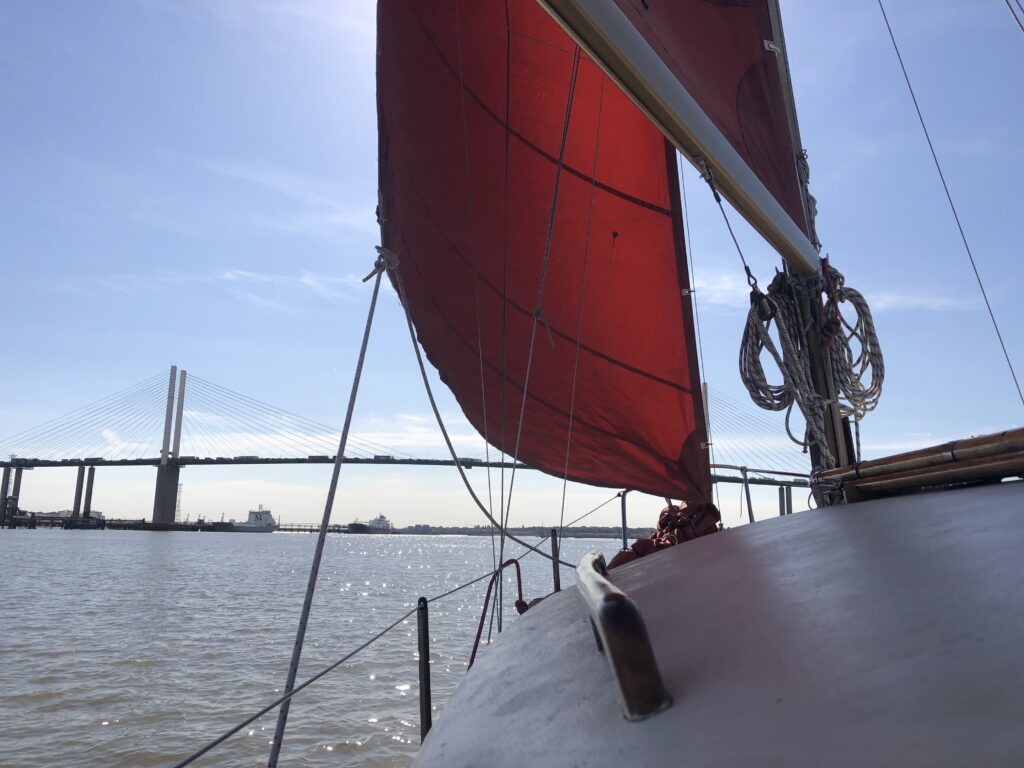
Whimbrel in Long Reach, R. Thames, outbound, August 2024.
Around the Thames estuary there is one river that does charge and that is on the River Crouch which is run by the Crouch Harbour Authority.
Visitors to the Crouch Harbour Authority area do face charges, although I myself have never been charged…
See here: ‘ Visiting Vessels (Only applies to vessels coming in from seaward) All visiting leisure vessels are entitled to one visit in any Dues year of up to 14 consecutive days free of charge before being charged for Harbour Dues. If you are remaining in the river for longer than 14 consecutive days and do not intend to remain permanently, Short Visit Dues will apply. Please see charges below.’
Short Visit Dues
Vessel Length
Feet
Metres
Dues
8.00 – 15.50
2.44 – 4.73
£9.00
15.51 – 21.50
4.74 – 6.55
£11.25
21.51 – 26.50
6.56 – 8.07
£14.00
26.51 – 32.50
8.08 – 9.90
£17.45
32.51 +
9.91 +
£21.95
These are the 2025 rates recently published.
Don’t stay around for more than two weeks…
So, for the Rivers, Blackwater, Colne, Stour, Orwell, Ore and Alde, this is something we currently are not saddled with, but for how long?
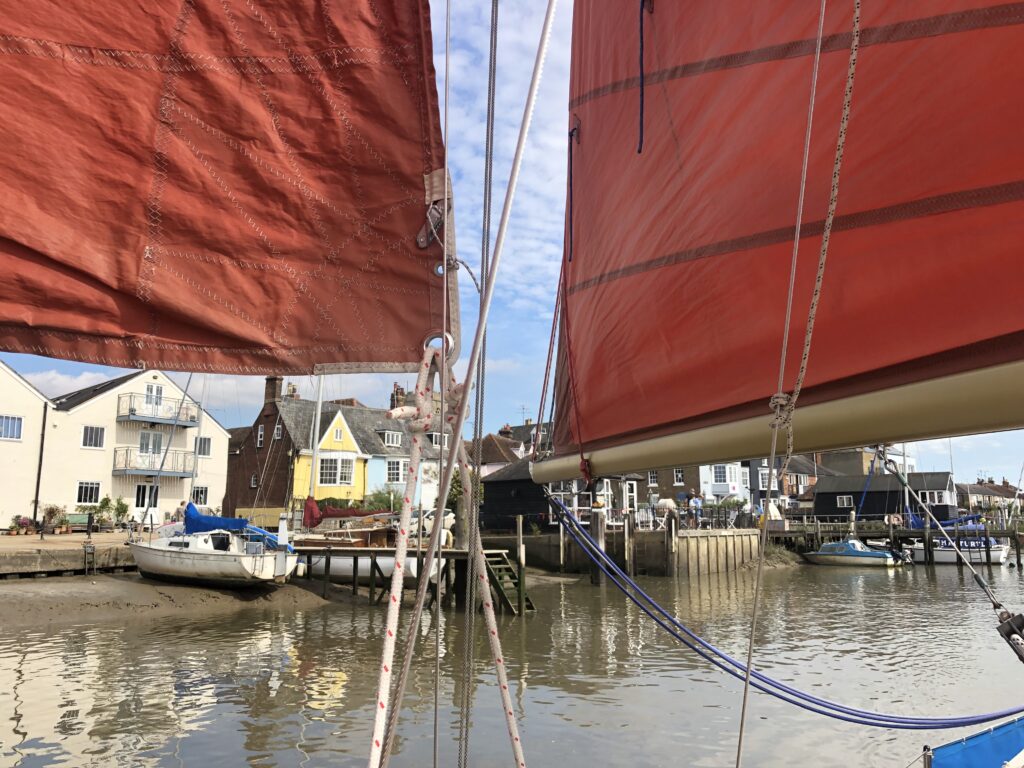
Whimbrel sailing past Wivenhoe, September 2024.
Back to the beginning of this post: googling the various rivers, it was clear that the issue is hot for the key words ‘Conservancy and fees’ brings up Clyde Ports…
Clearly, there can be no real gripe about being levied a charge within an area where efficient buoyage is laid and maintained by an authority. The entrance to the wider River Blackwater has been well buoyed by the West Mersea group of clubs and businesses – those yellow buoys with a black flags, local sailors know so well.
I have always assumed that Maldon District Council pays for the upkeep of buoyage in the upper reaches of the River Blackwater, from Thirslet Spit inbound. Whether or not this is spread over mooring charges, or licences, I do not know.
I will try to find out…
30 Jan 25.
Well, from owner of Blackwater Marina, the PLA pays for upkeep of buoyage to Colne Bar and Bench Head, the navigation marks to Maldon are maintained by Blackwater Conservancy (Maldon District Authority in effect). I got the impression that this could change…
Reading the article below reminded me of a ‘man overboard’ incident from Whimbrel with my good mate, Christobel, being the victim. We were berthing in Limehouse Marina during Easter week, April 2017.
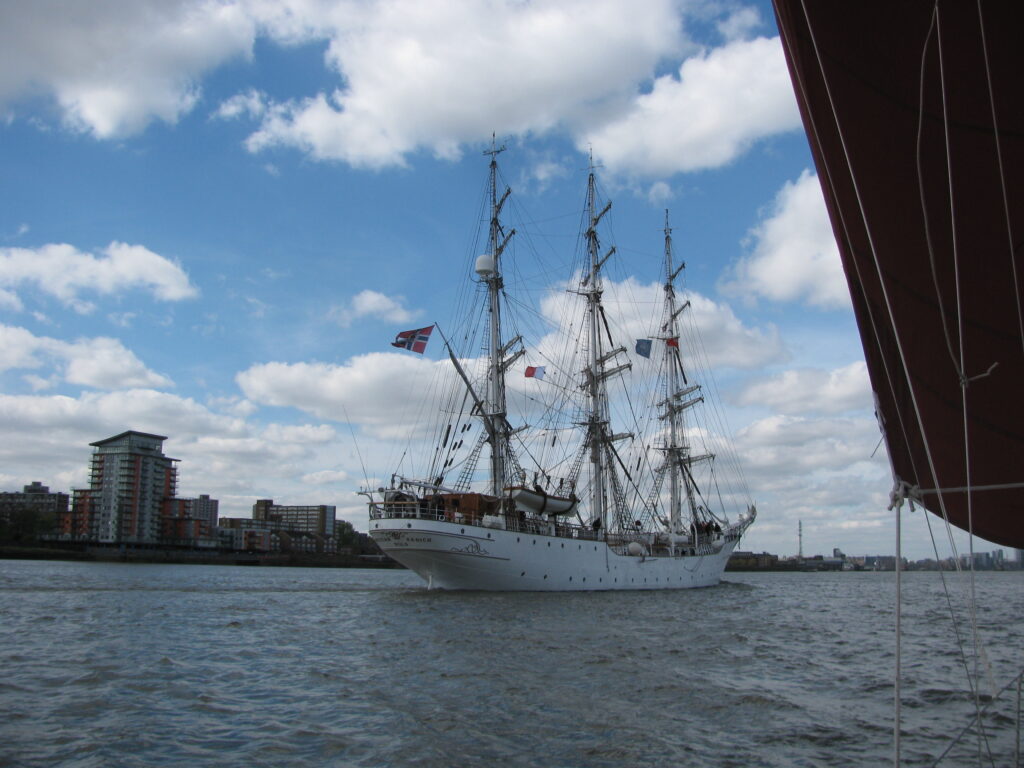
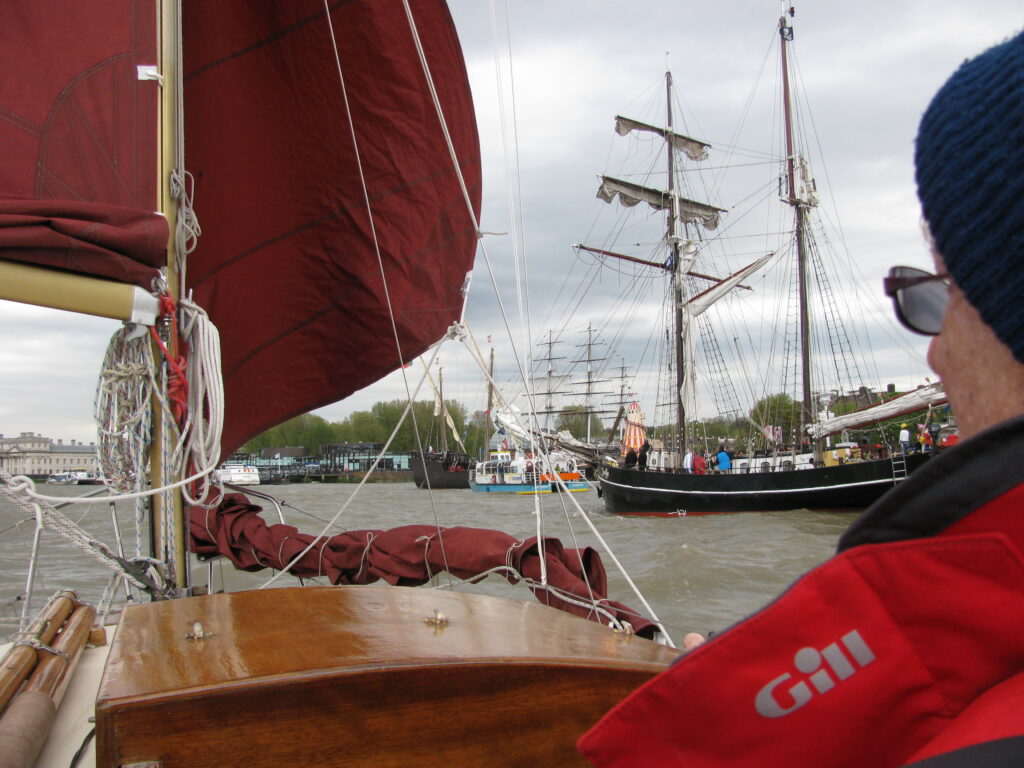
We had gone up for two reasons – to see a Passion Play at Trafalgar Square and see the tall ships which congregated off Greenwich for start of race to Canada.
The Christian Raddich passing as we tacked upriver nearing the barrier.
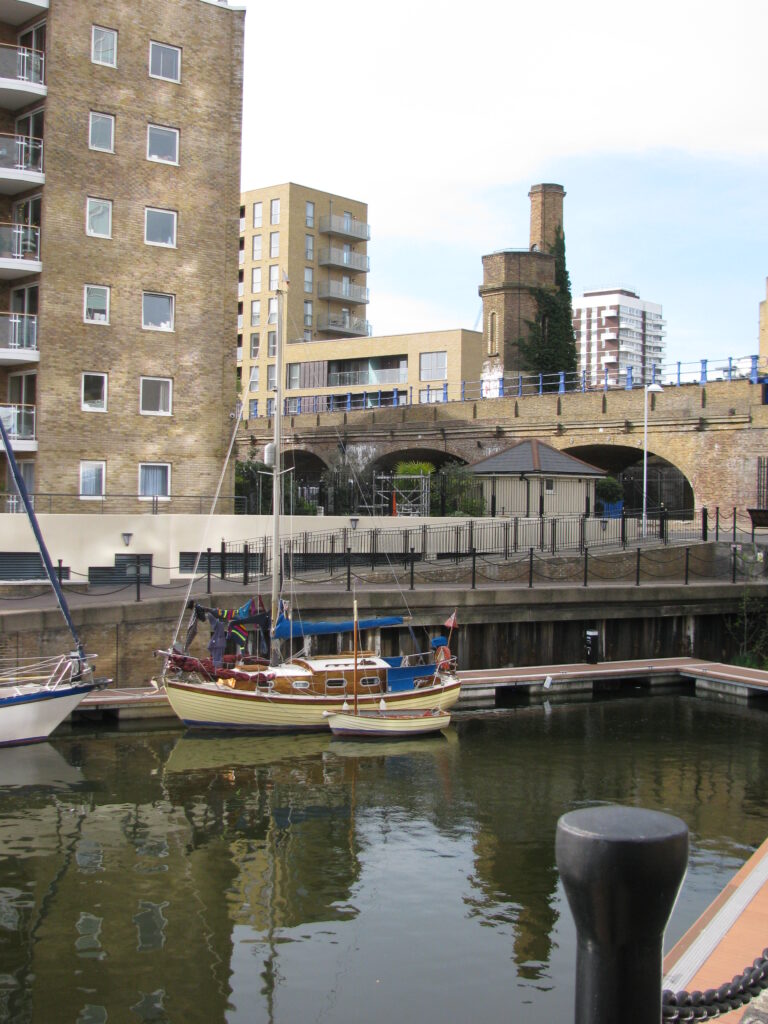
Our assigned berth was in a far corner used at the time for visitors. A large yacht meant a tight turn to berth with our bow pointing out as it were.
Christobel got herself ready, however, I failed to spot that she was standing forward of the shrouds. The turn was a cinch … as we glided towards the pontoon, I bent to give a thrust astern to stop the boat…
As I looked up Christobel made to step onto pontoon and promptly ‘disappeared’ from sight. There was a great sploosh as she plunged into the freezing water then a loud hiss as her life jacket exploded into life.
I leapt ashore with a stern line taking it round a cleat and back to boat – the guard rail I seem to remember. Boat was secured.
Next, to rescue Christobel!
A group of adults with a few young ones saw it all happen. A lady called from the quayside, ‘Do you want a coffee…’
I called back, ‘Got that aboard … I need to get her out…’ None of the chaps offered to help me.
I got Christobel to hold onto jetty while I looked for a ladder. There was one, but the big boat ahead and a ‘Dutchman’ were in the way!
I had to drag Christobel up little by little until her chest was on pontoon, allowing water to drain. Once water drained from her upper clothing layers, I managed to complete the job.
Her life jacket made it difficult to pull her over the pontoon edge!
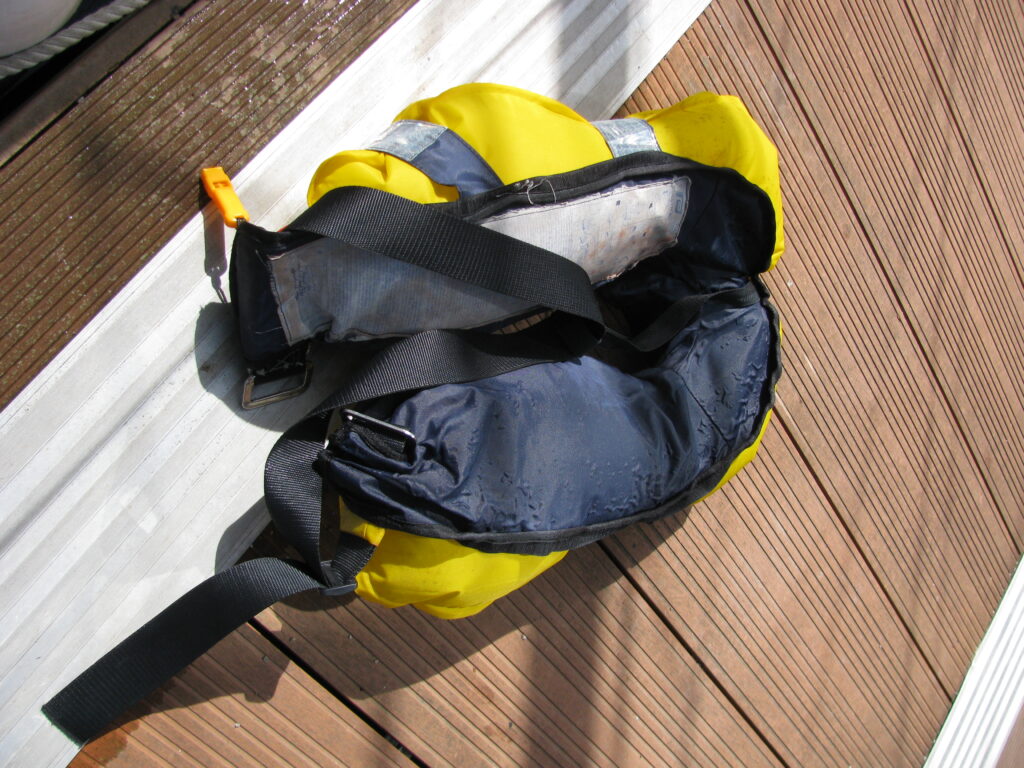
The inflated life jacket after removal.
At that point our watchers sauntered off.
I gathered a bag of clothing and wash tackle and Christobel hot footed to the shower unit…
The article makes interesting reading – a tragedy and a major point regarding pontoon ladders.
I have noticed that ladders are often difficult to reach due to berthing arrangements. Most though seem to be logically placed at the head of berths along the main walkways.
I haven’t (yet) had to use one in the emergency situation, nor do I really know how deep they go below the surface.
The transom ladder fitted to Whimbrel has two submerged steps which makes getting out far easier.
The report homed in on the ‘depth below’ aspect and has recommended a review by Marina operators…
Whilst on holiday with the Mate based in a cottage in Holt, N. Norfolk recently we came across by complete accident a lovely museum dealing with boats of the Norfolk coast.
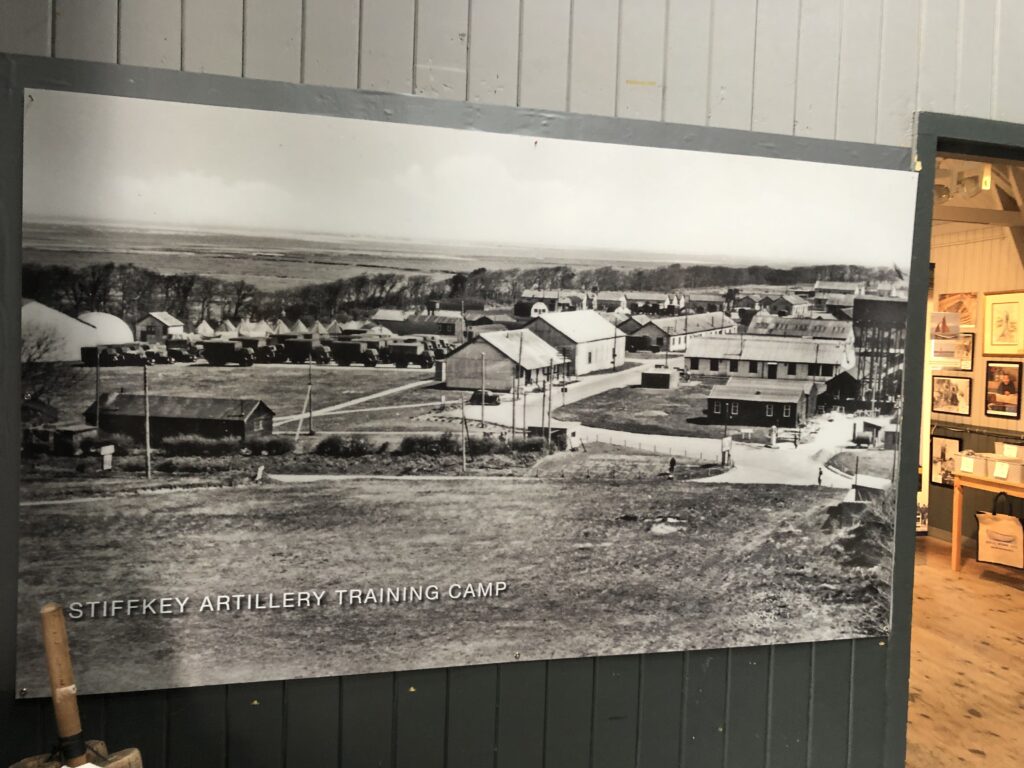
The museum, a working boatyard as well, is based at the former artillery training ground at Stiffkey. The site has all sorts within its bounds as well as caravan and holiday parks.
The old working boats of the coast are unique to the local coast with its open beaches to the south on the curve from Sherringham to Great Yarmouth/Lowestoft and the shallow creeks that riddle the saltings on the more northern facing coast, running round to Kings Lynn.
The museum has a bent for lifeboats but has film footage of craftsmen (people) at work, artefacts and a spritsail barge model even, but it was the boat shed that lit my eyes. I think we got invited to view it as we (mate on the whole) got talking to staff about our own clinker sloop…
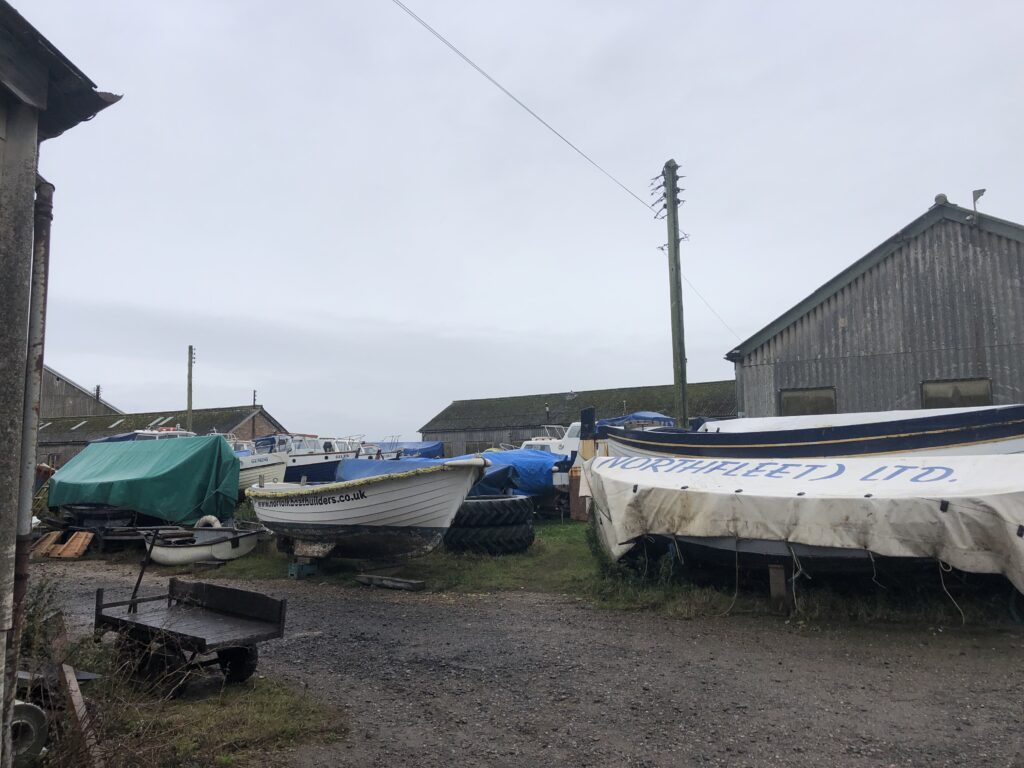
The boatyard.
It was a howler dank sort of day, not really conducive to pottering, but we are hardy folk!
Inside the shed we met the resident boat builder and restorer, David Hewitt. He was actually star of one of the film clips in the main display shed. Chatting, I mentioned we owned a Finesse 24. His eyebrows raised as he said, fine boats … pity about the nailed decks! Indeed…
He had worked on two 24s locally and knew of a F21 along the coast which he had also done work on.
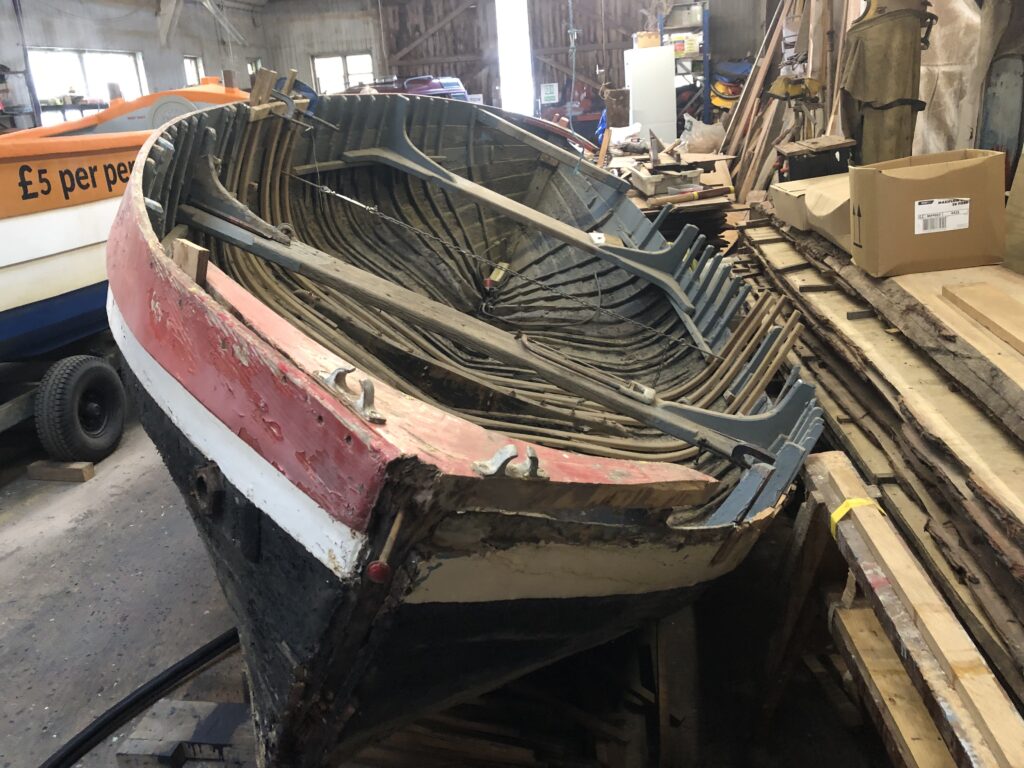
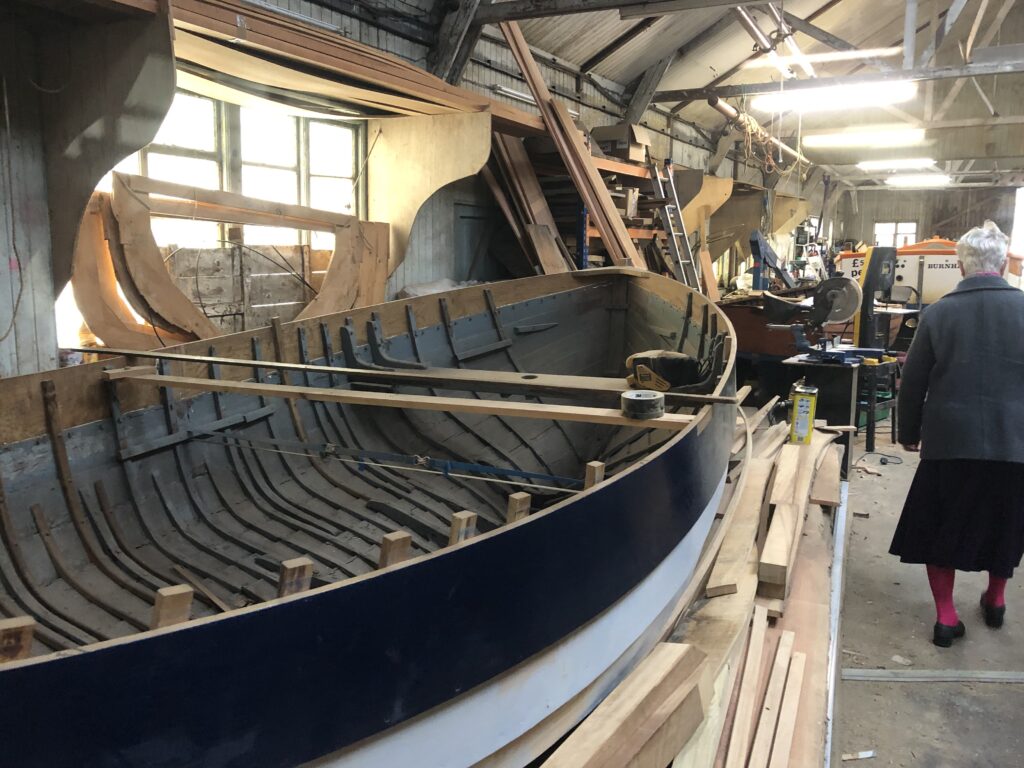
An old beach boat – inside view.
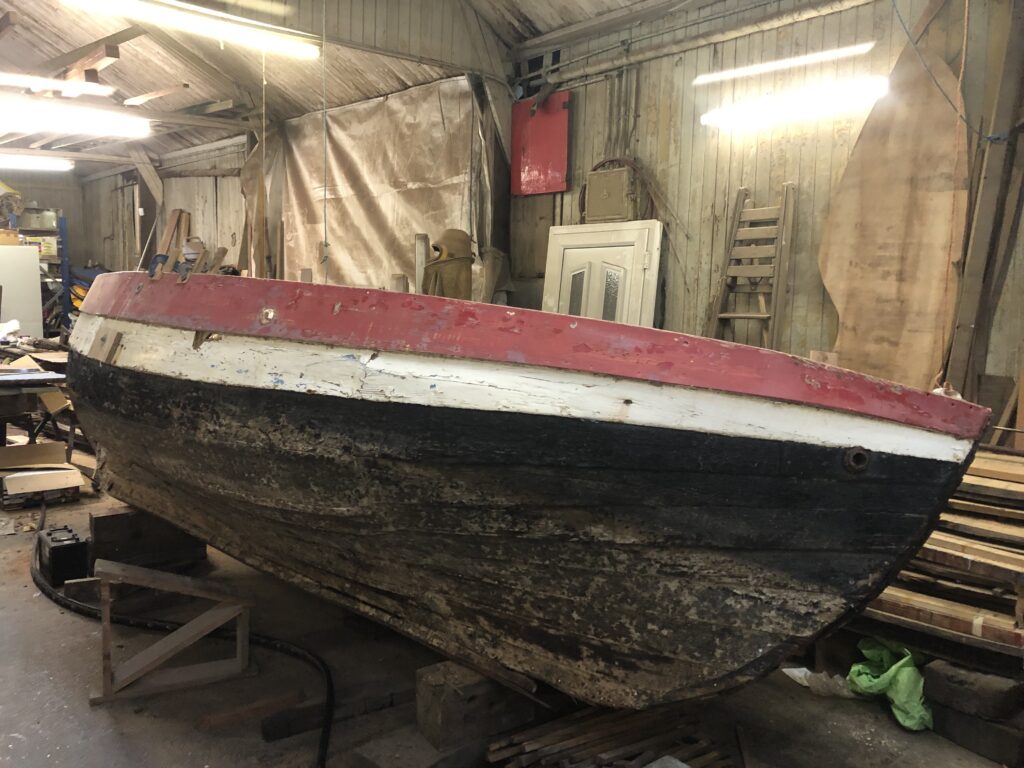
The boat builder told us a little about an old craft in the shed – in for some conservation as she was not on the radar for much else unless funding could be magicked up…
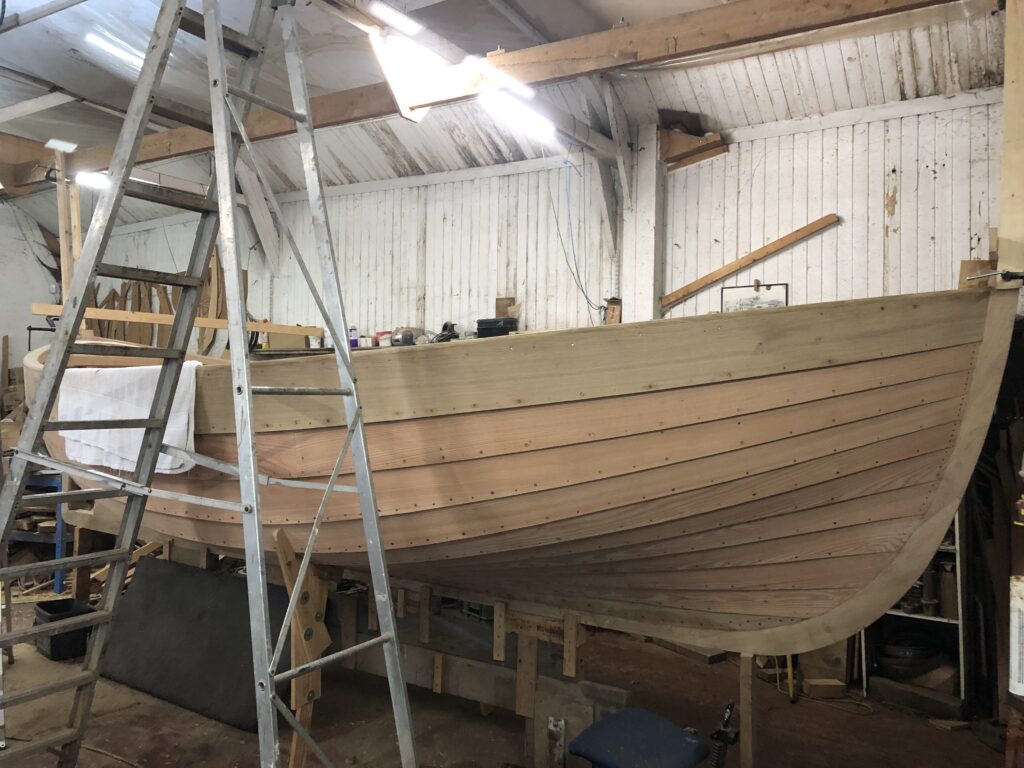
I was a little surprised at a lack of gunnel timbers at the top of the hull planking, but that was the way she was built.
Old beach boat.
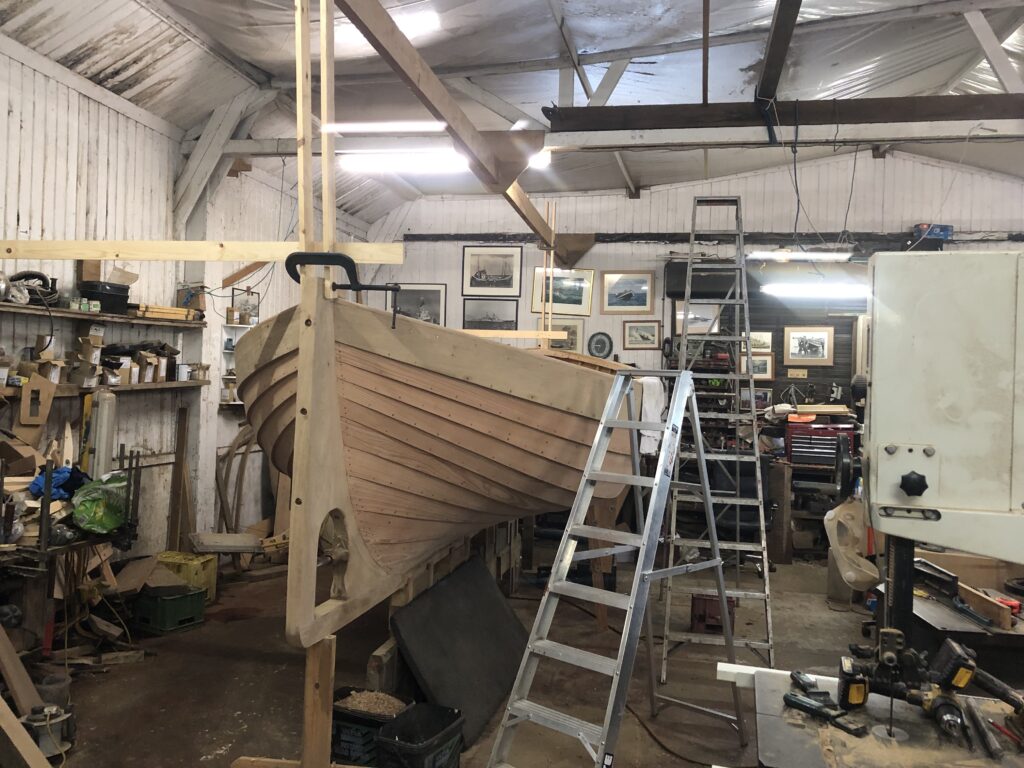
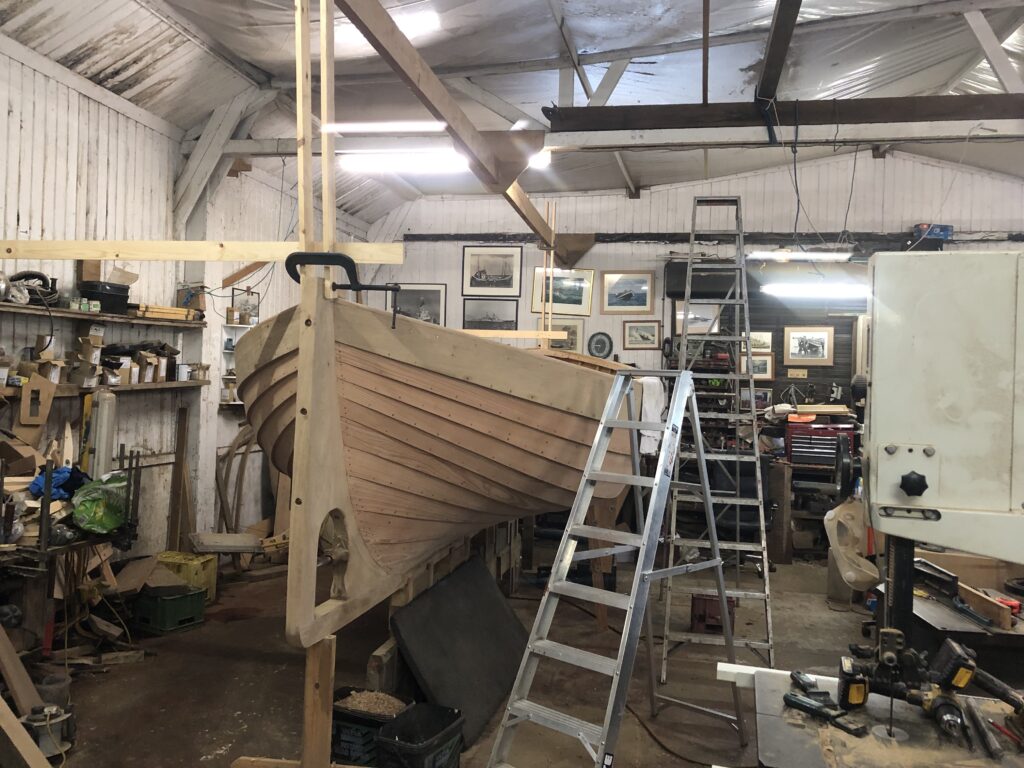
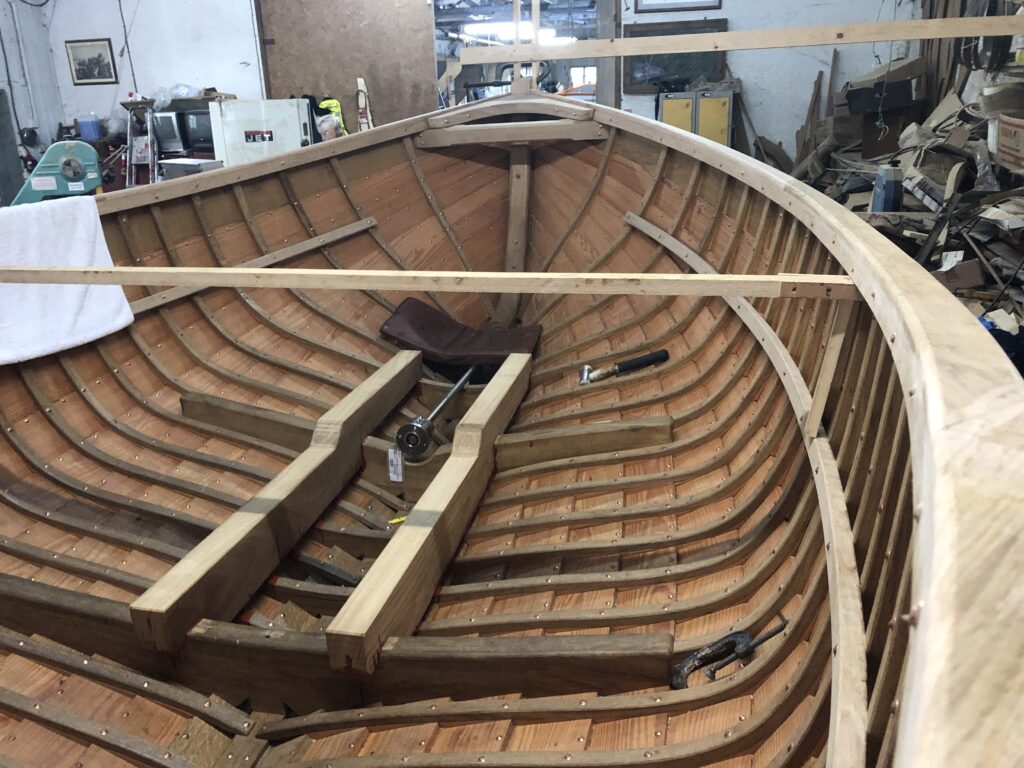
A new vessel along similar lines was under construction with her hull all planked up ready for finishing.
A modern reincarnation under construction.
Note the very deep sheerstrake plank also the wide gunnel,almost like a very narrow side deck.
Stern view with propeller aperture – very reminiscent of a wooden ships’ lifeboat.
Her propeller shaft was in and her engine beds were being set up ready to set up a small diesel engine.
Internal and external painting was not far off.
Internal view.Boat under repair.
Within the shed too were a couple of boats receiving repair attention. One, seen above, had a large number of new ribs being fitted.
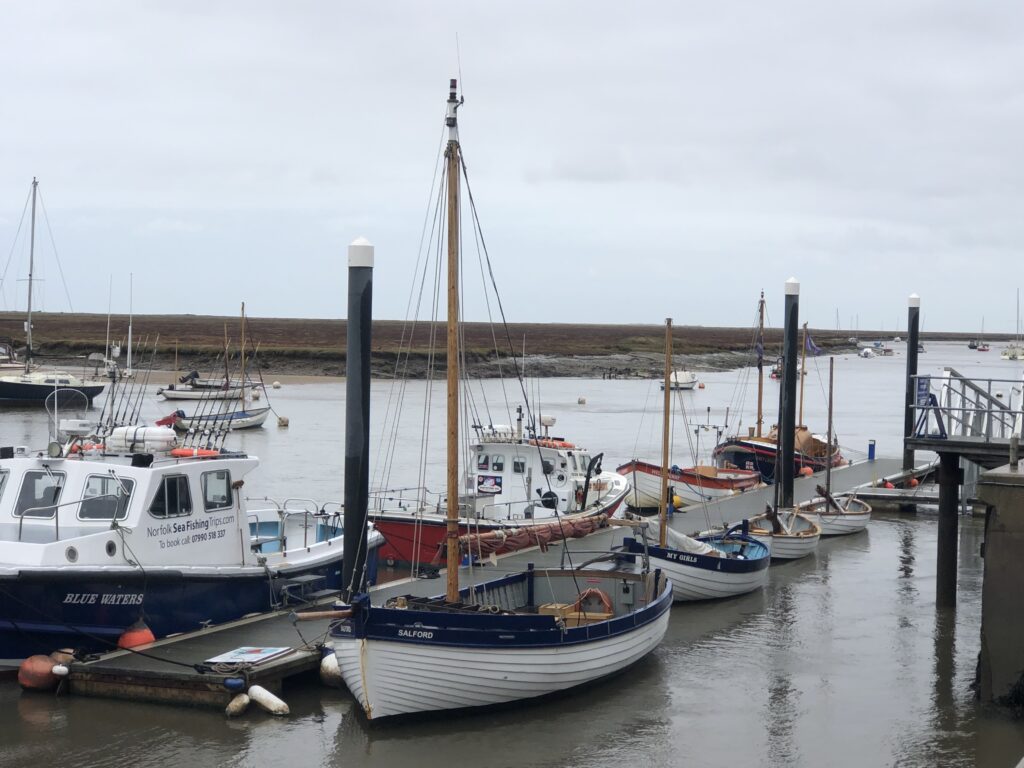
Boats under the museum’s umbrella in Well’s Harbour.
Further along the coast in Wells Harbour is a pontoon where a number of craft associated with the Boat Rescue Project are berthed. During summer months excursion outings can be booked…
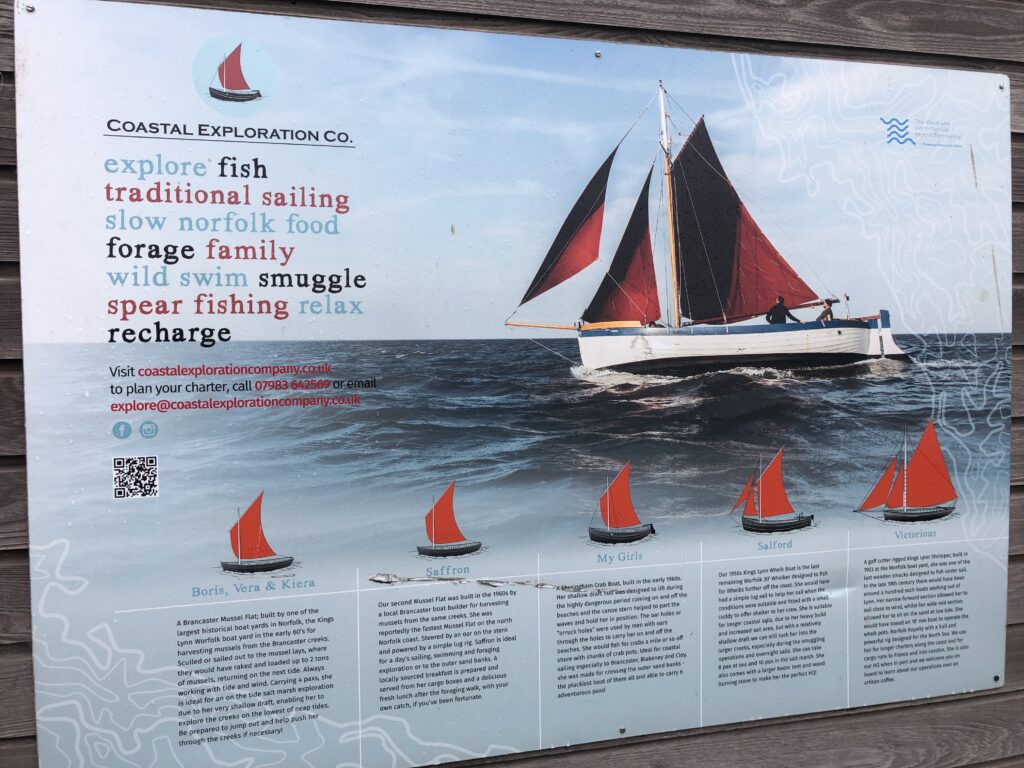
Explore the web site and its sister site of the Coastal Exploration Company – fascinating stuff.
Boat type information board by pontoonin Well’s Harbour.
If you happen along that coastline in your travels, the museum and workshops are a worthwhile stop point. There is a cafe to quench thirst and post breakfast pangs too!
The first tender to Whimbrel was a little 8′ Tepco GRP moulded dinghy. It was a great carrier with a full bilge, but sweet she wasn’t being a bit of a tub.
In time after the demise of our Mirror dinghy, the tender was refitted with a dagger board and rudder made from the Mirror’s bits. The dinghy was rigged with a simple spritsail set on a mast made from the Mirror’s gunter gaff.
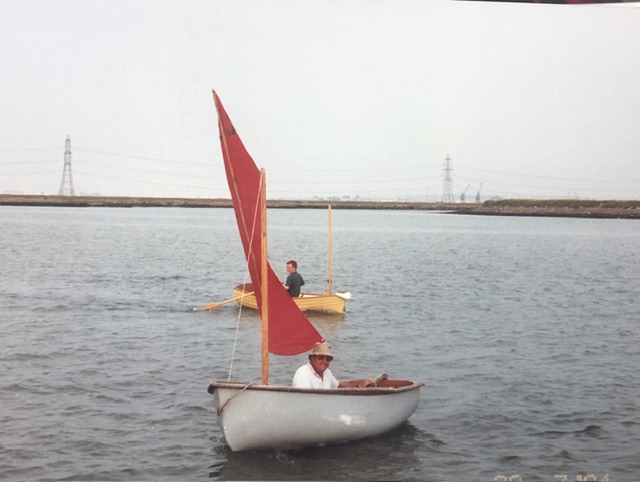
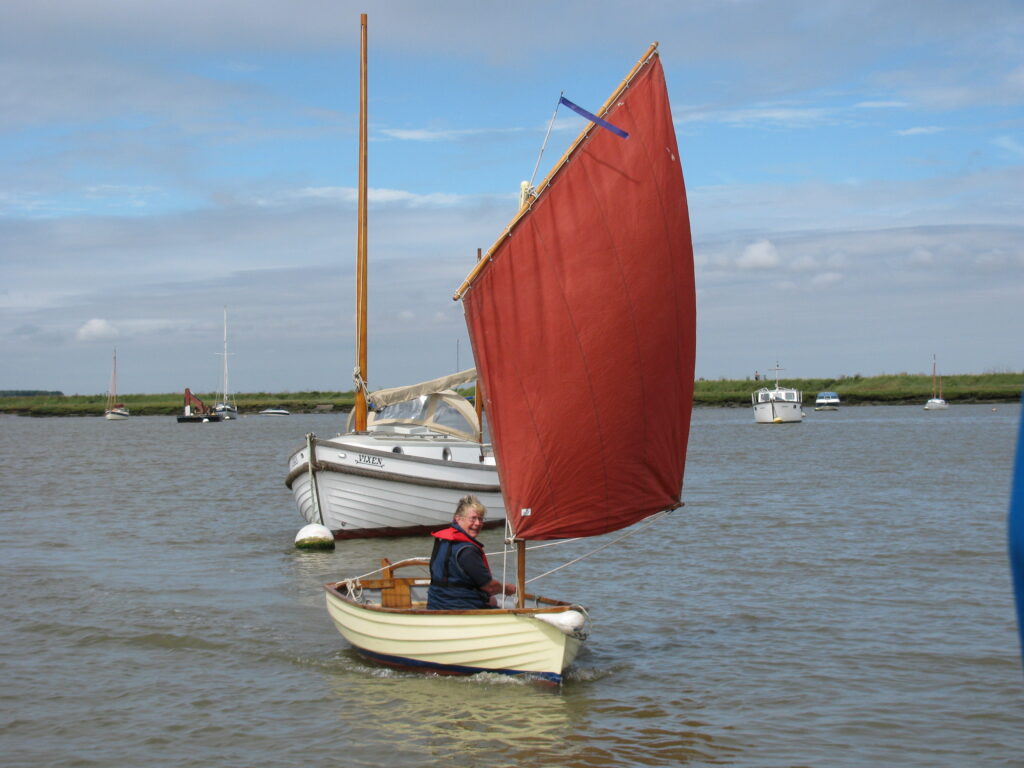
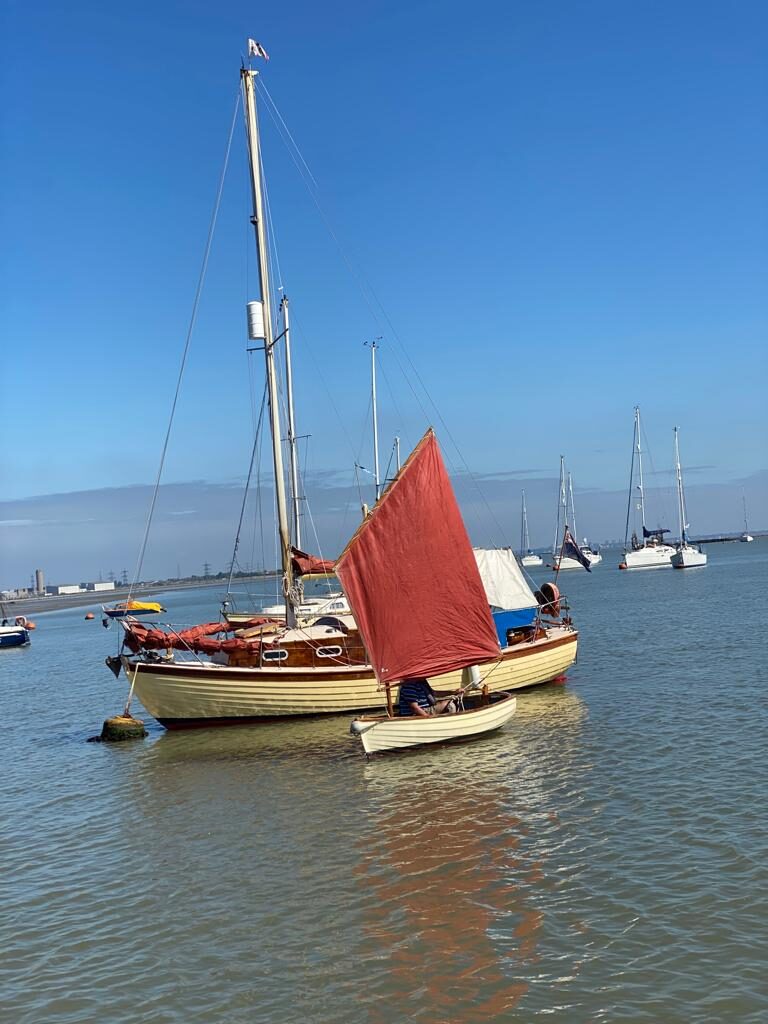
Our Tepco rigged with a little spritsail. Behind is the little barrow boat built by with son’s help…
It was all rather rudimentary, but it worked!
As our boy grew up he expressed a desire for his own little boat. We looked a various, but he fancied a little Barrow-boat Sailer. This came in kit form and we all had fun building it. At the time I had looked at a 9′ ply-clinker dinghy seen at the Colne YC – she sparked and stuck in my mind.
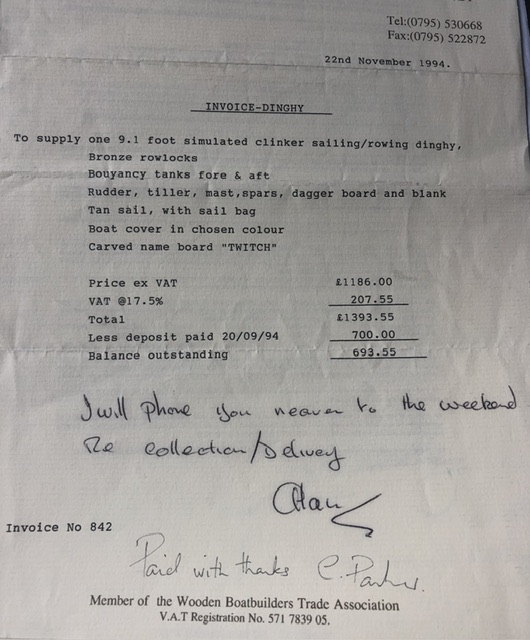
At some point in 1994, I decided that I would like a proper tender built to sail, row and power with an outboard. A visit to Alan Staley’s yard on a jaunt up the creek into Faversham showed what was eminently suitable.
Alan fitted out a series of clinker tender GRP shells moulded by a friend. Alan kindly drove us over to his own boat’s moorings in Oare Creek to view a completed 9-footer., which he’d had for a few years.
So, that was that.
The invoice! Best twelve-hundred quid I have ever spent…
In the early autumn of 1994 I was posted to a shore based job for a two year stint (It became nearly five after being appointed to a project) and the order was placed before the days in September had travelled far.
I was based at my company’s ship refitting headquarters then located in Bath, travelling down for the week with weekends at home. The dinghy was collected from Faversham by car on a Saturday. I remember it being strapped down on a set of oars lashed to a roof rack, all tied trough the rear door window openings and to ‘bumpers’ front and back!
She arrived home safely…
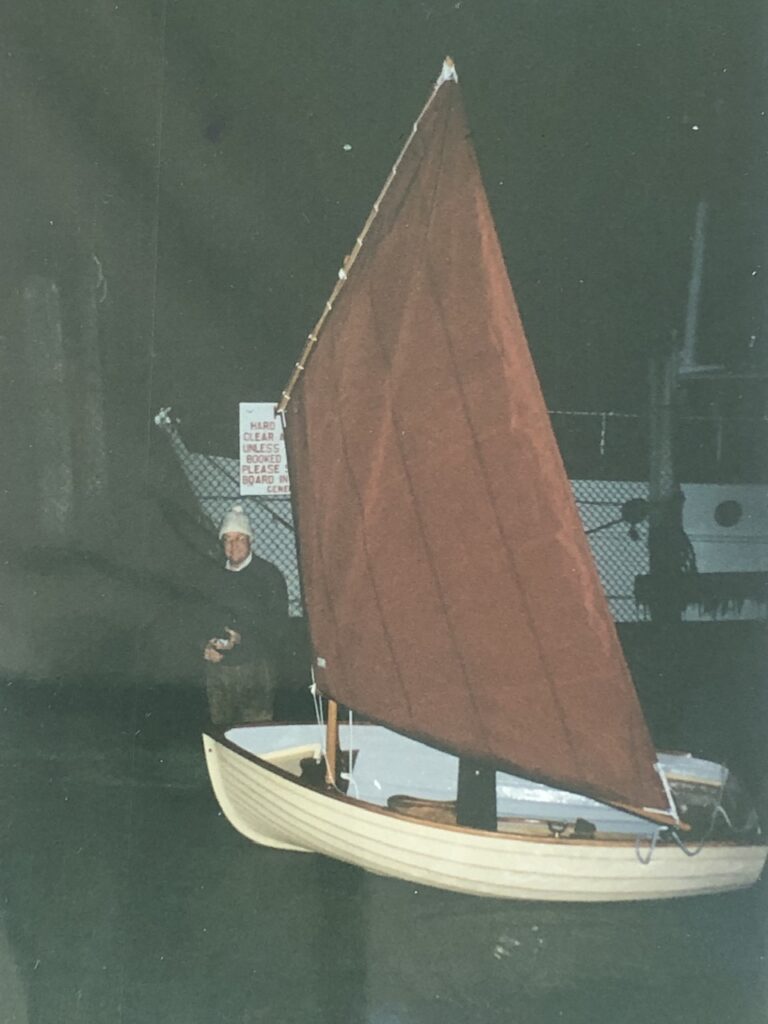
New dinghy – Twitch – rigged and ready to launch.
The dinghy, without my knowledge, had been named Twitch by Christobel – don’t ask! The name has stuck: it is carved on a name plate inside the dinghy.
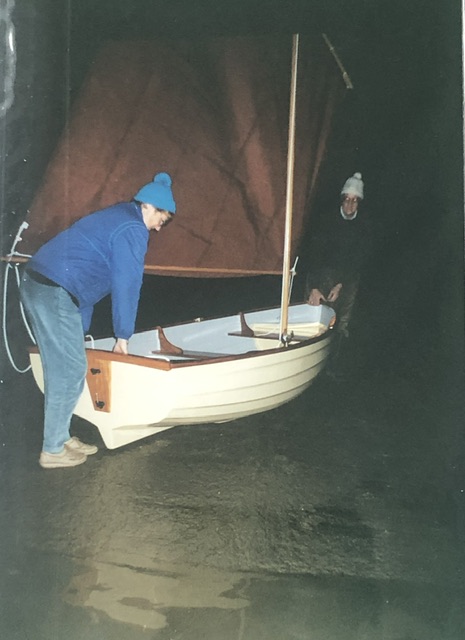
It was a late tide that particular weekend – no matter. She was rigged up to await her wetting. It was essentially dark by the time the tide made enough to get her in.
On the way to the water.
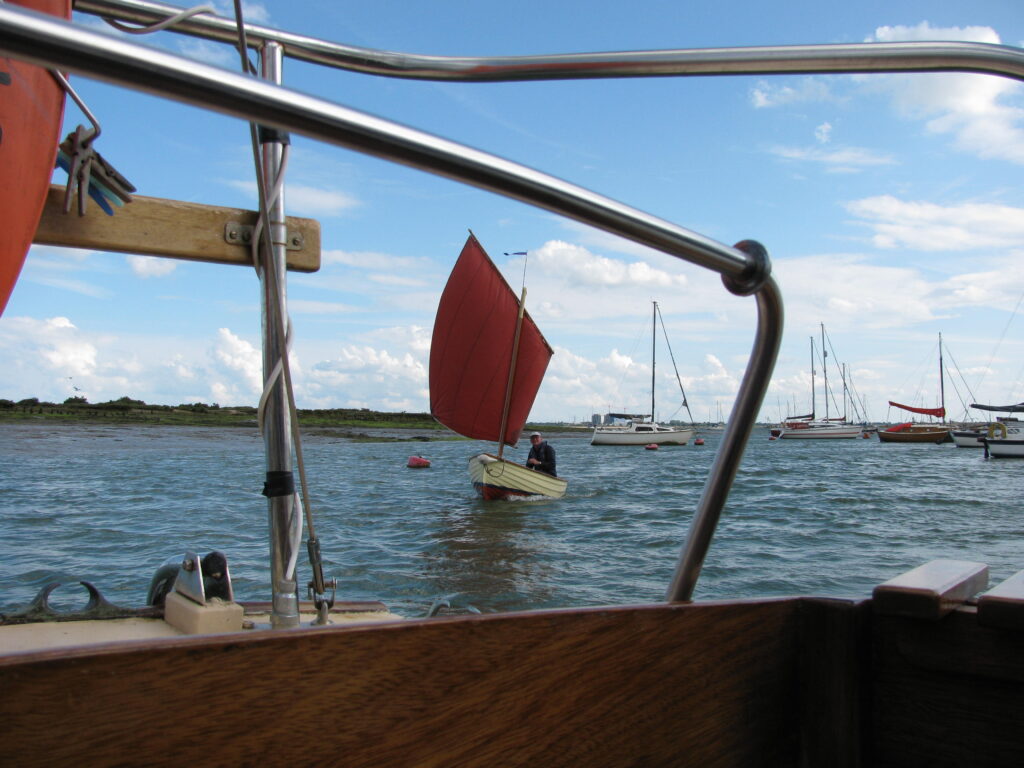
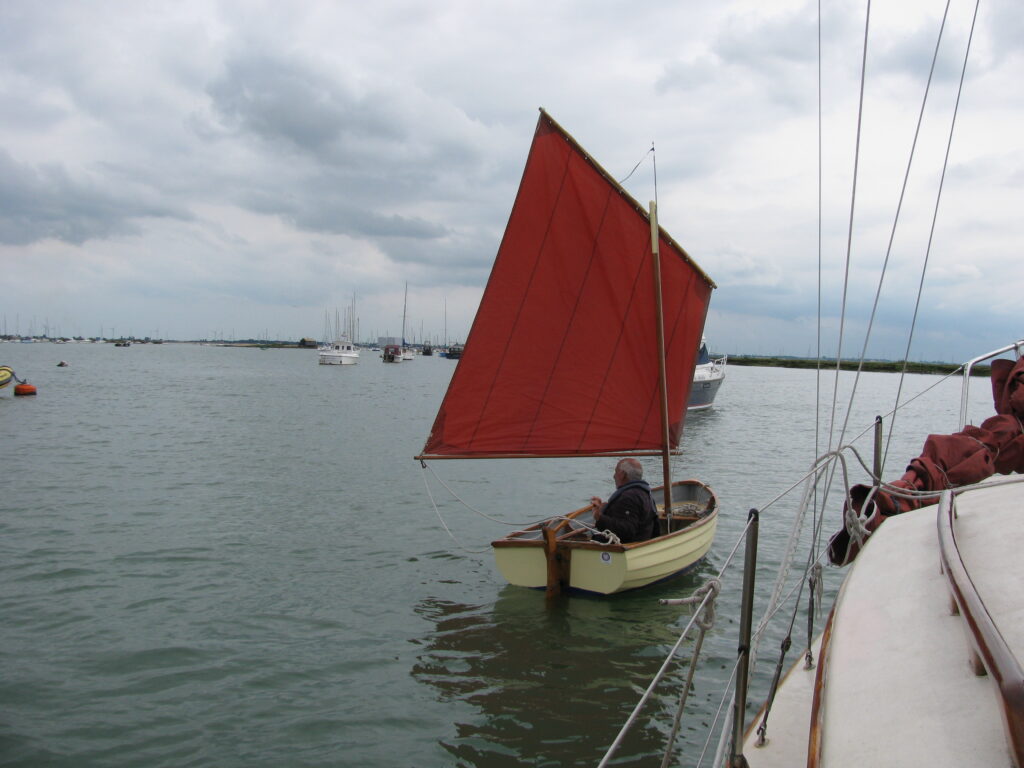
The dinghy is lugsail rigged with an un-stayed mast. She has a lift of rudder and a simple dagger board. Simplicity in itself. The same sail has seen her through too. It receives the occasional wash at home, other than that it is always on the spars, ready to hoist.
A very short sail followed, then it was time to pack her up. Me at the helm!
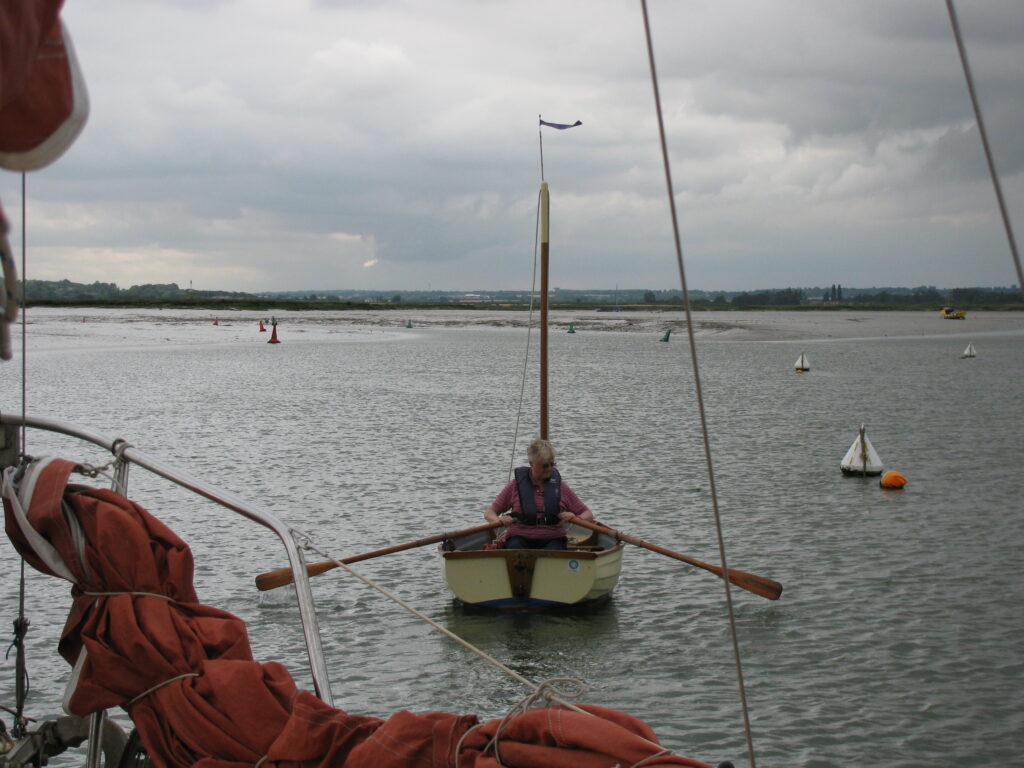
The dinghy has proved to be versatile. She is a little tender with minimal flat bilge but has great stability with four adults aboard when being rowed or propelled by the outboard engine.
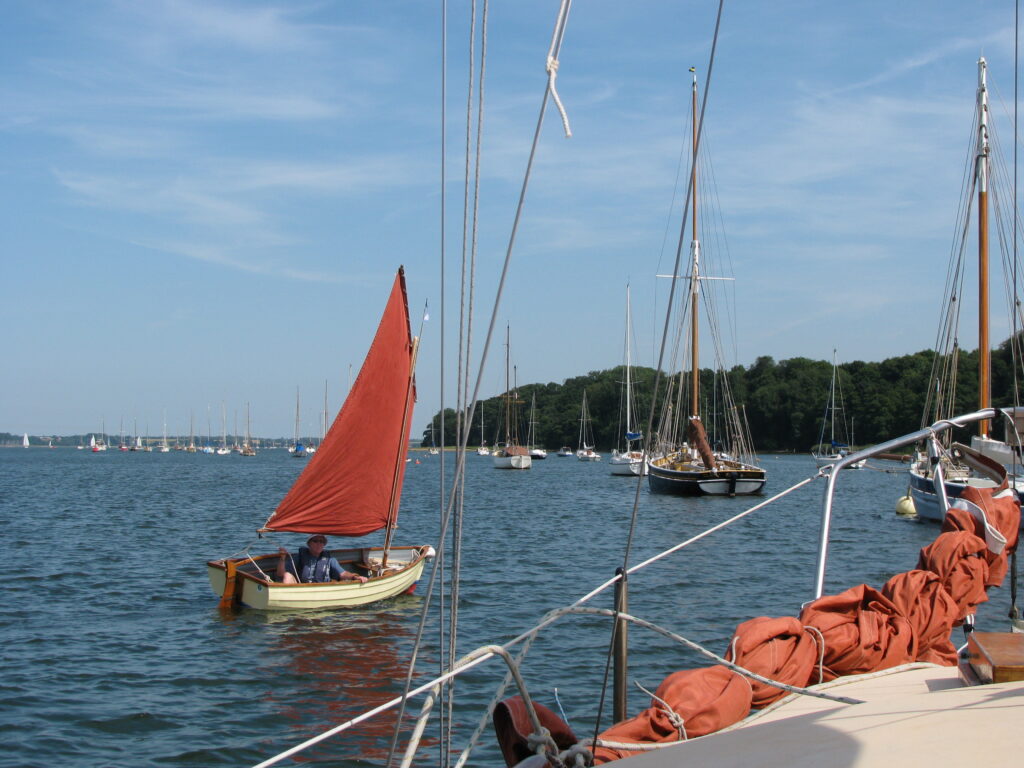
With one aboard, she is an absolute joy to sail. Tacks easily and is very forgiving.
The one early lesson I learnt was to stow the mast on anything of a coastal passage. The tall mast makes her unstable in a sea. On one occasion the boat has slid down the side of a roller and capsized. Our boy was aboard once on a short passage (in a breeze) from Suffolk Yacht Harbour to Walton. Rollers were met outside Harwich Harbour. Yes. The dinghy capsized: I’d taken a risk!
Andrew Ardley in in planing mode…
Virtually all who have sailed aboard Whimbrel have enjoyed little jaunts around the harbours and creeks visited. They include, Theresa, Andrew (& Claire), Graham, Paul, Hannah and Christobel (rowing only).
I have appended a few pictures for posterity.
Theresa Ardley captaining her little ship!The Mate goes for a bit of rowing exercise…Twitch under the command of Paul Mullings who hails from near Auckland, New Zealand.
At the end of each season the dinghy is given ‘the once over’ to tidy up and repair varnish work. Every now and then the spars and oars get the home treatment.
Graham Ardley sailing around Pin Mill’s moorings in 2013.
Last year during the autumn, Twitch received a big refit.
Many years ago, not so long after we purchased her, I fitted a stainless steel runner on the underside of the keel for concrete slipways and hard ground were taking their toll, chipping and wearing away the grp fell coat. It was a good move as it has surely lengthened the girl’s life.
Around fifteen years ago the hull was hard sanded and coated with a two-pot paint. These have been discontinued and current coatings are made with straight urethane paints. I’ve yet to do this.
Twitch after a refit in the autumn of 2023.
The odd ‘disaster’ has sailed by over the years – I lost the rudder when beached on the sand bar at West Mersea – we were ashore for a BBQ. I didn’t unship the rudder! Alan Staley made up a new one after Christobel sent him the tiller…
I had to make a new tiller after the failure of the original some years ago. Other than that, little has been done.
However, stripping the sail off the spars this autumn to re-varnish them, I found several stress fractures in the sail’s gaff. Two were old with a new one sitting opposite an old which meant a repair was not available.
The new fracture – lucky it didn’t break completely!
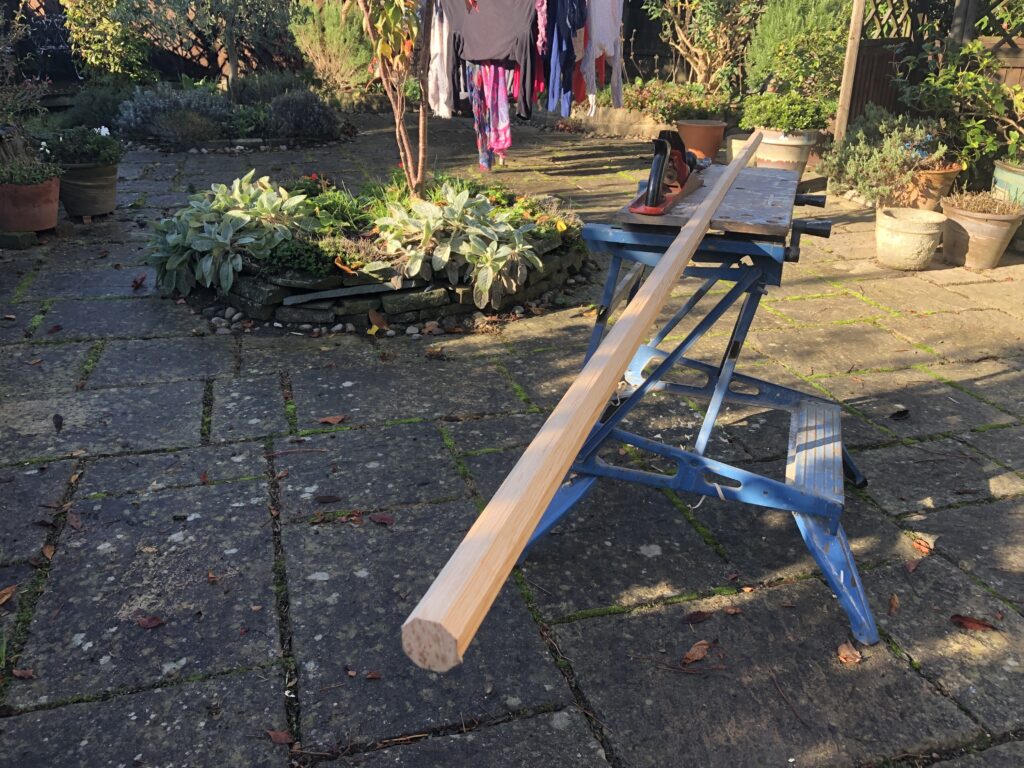
Alan Staley has come to my rescue and has provided a length of timber – Douglas Fir – for me to make a new one. I’d ordered a square section but he kindly made an eight-sided blank for me to finish off.
Sanding of new spar completed.Spars being recoated.
The mast was stripped to bare wood with all varnishing nearing completion as I write, the gear is almost ready to go back aboard Twitch.
The sail drying after a gentle wash.
Over the years, Twitch has taken me into rills that riddle the estuary’s rivers and creeks where old wharves or industries sit decaying and forgotten.
Slumbering barge remains have often been reached across shallow mud flats out of reach of land exploration. These have been recorded for soon many of these will meld into the environment and disappear.
So, bless the little ship and may she continue to serve for many more years to come!
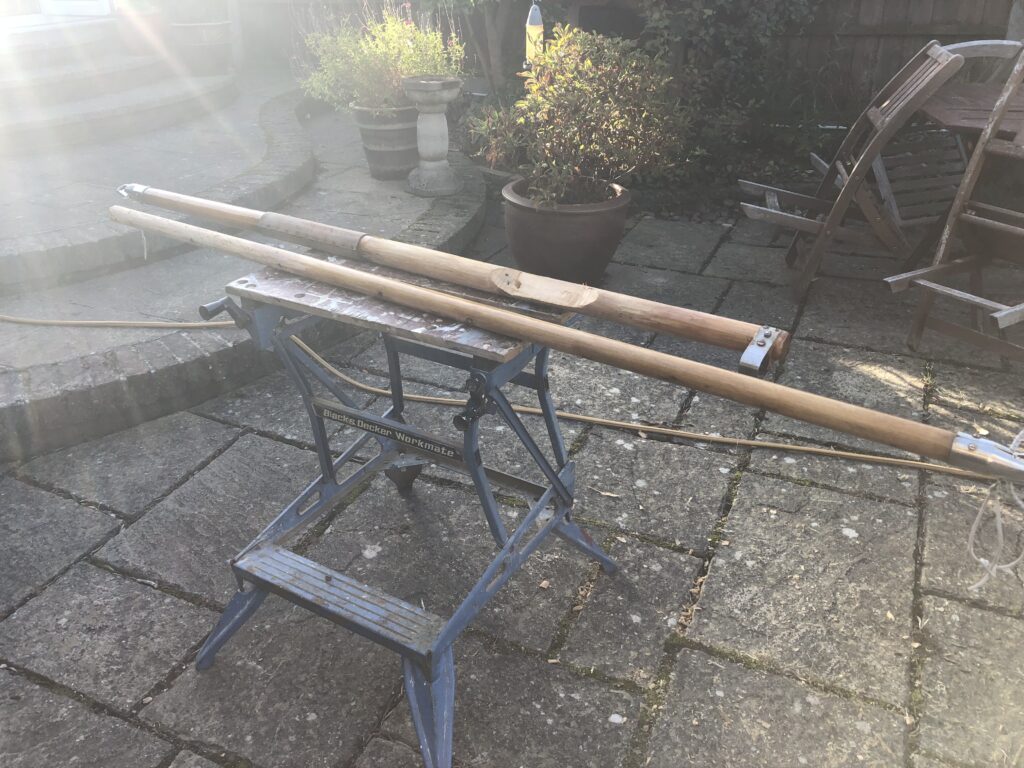
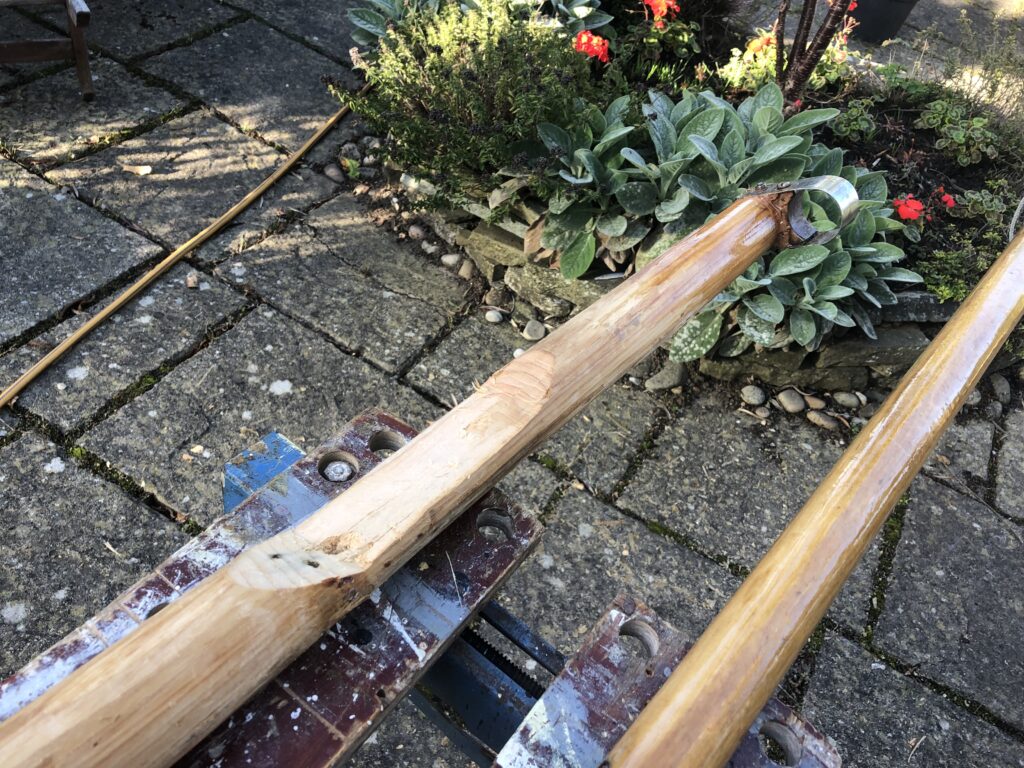
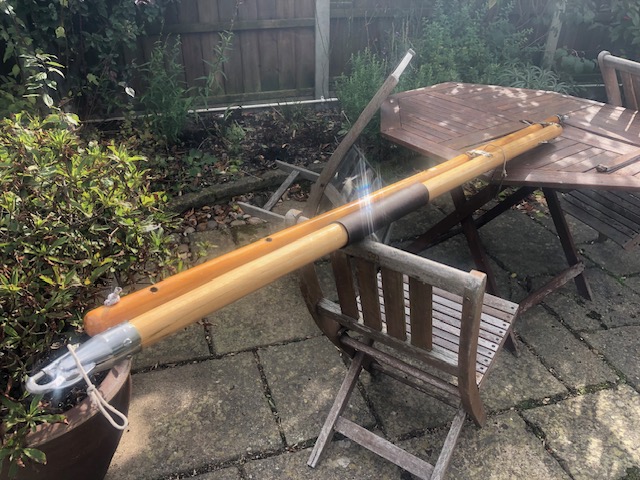
I had taken the two part pole for booming out the Whimbrel’s headsails home for refurbishment as the ‘main’ part looked distinctly crabby.
Once dismantled I set too with a heat gun to strip the main pole of varnish. I quickly discovered the dreaded rot. The pole had to have a section cut off its outer end a few seasons back due to the very same. It had ‘collapsed’ whilst sailing with my youngest sibling as crew. At the time the wood looked good beyond the cutback.
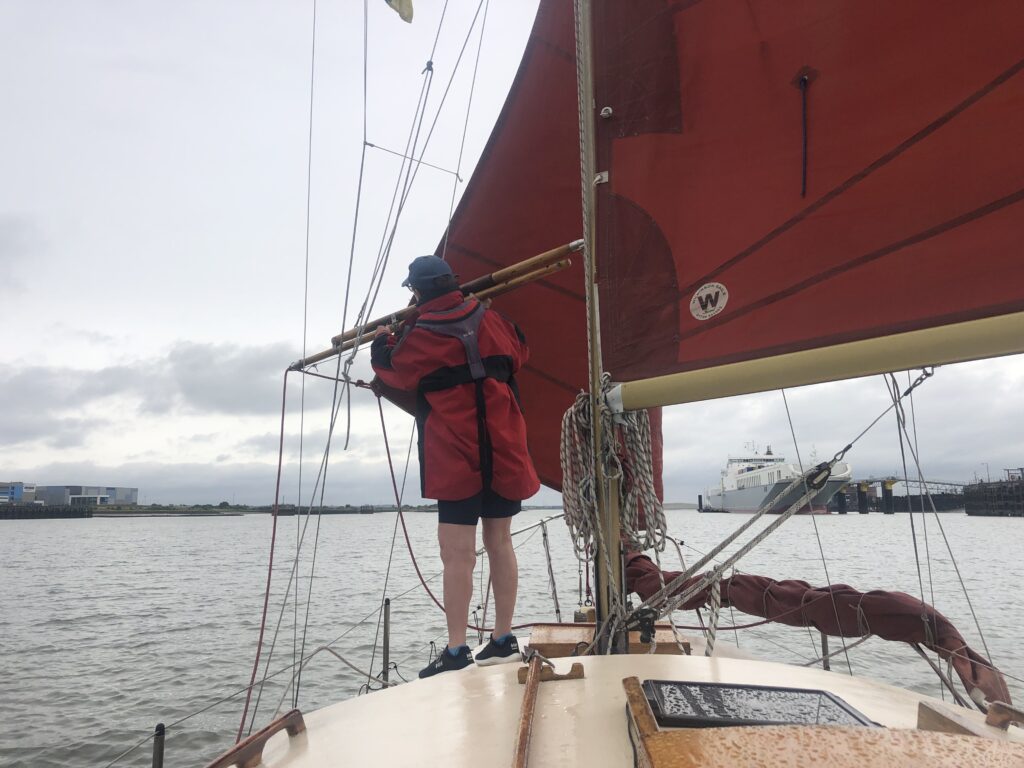
The two-part pole being rigged by a Whimbrel crew member (Theresa) during last summer.
This time it was terminal: the rot was in the middle area and along its length to outer end. It seemed to run down the centre of the original tree.
Pole disassembled and initial area of rot removed.Further investigations showed it went right through. Note end housing for outer sliding pole.
The main pole was initially made from a piece of Sitka Spruce I obtained from a long closed wood merchant in South Benfleet – they were general builders merchants but had other stuff in small quantities.
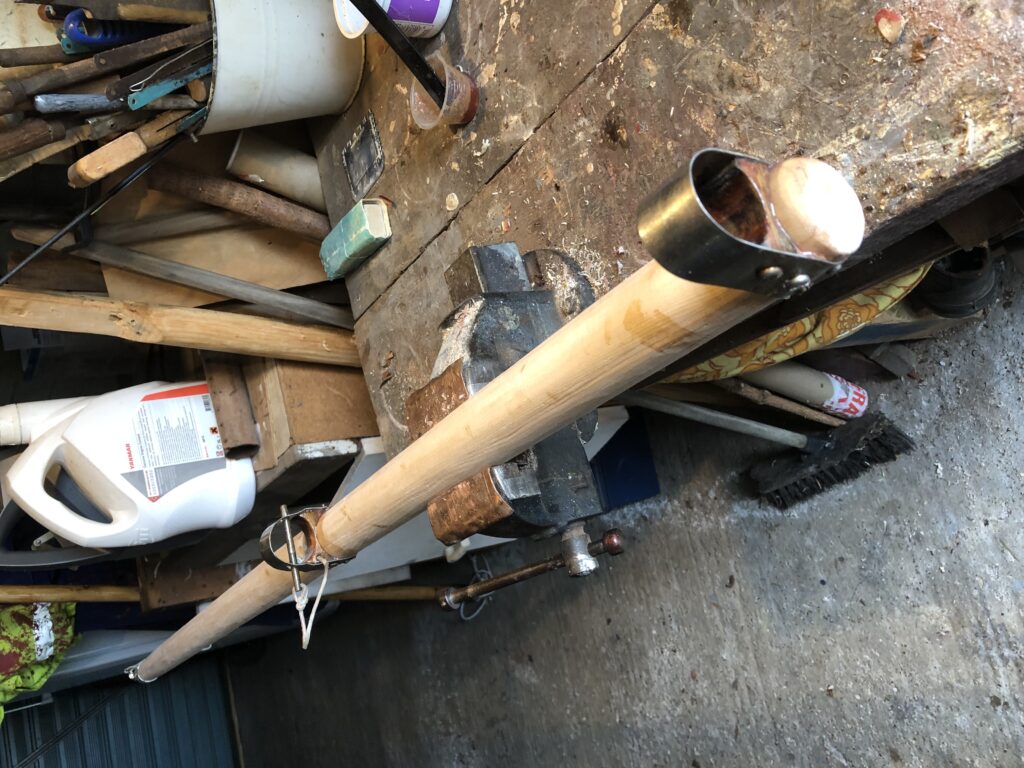
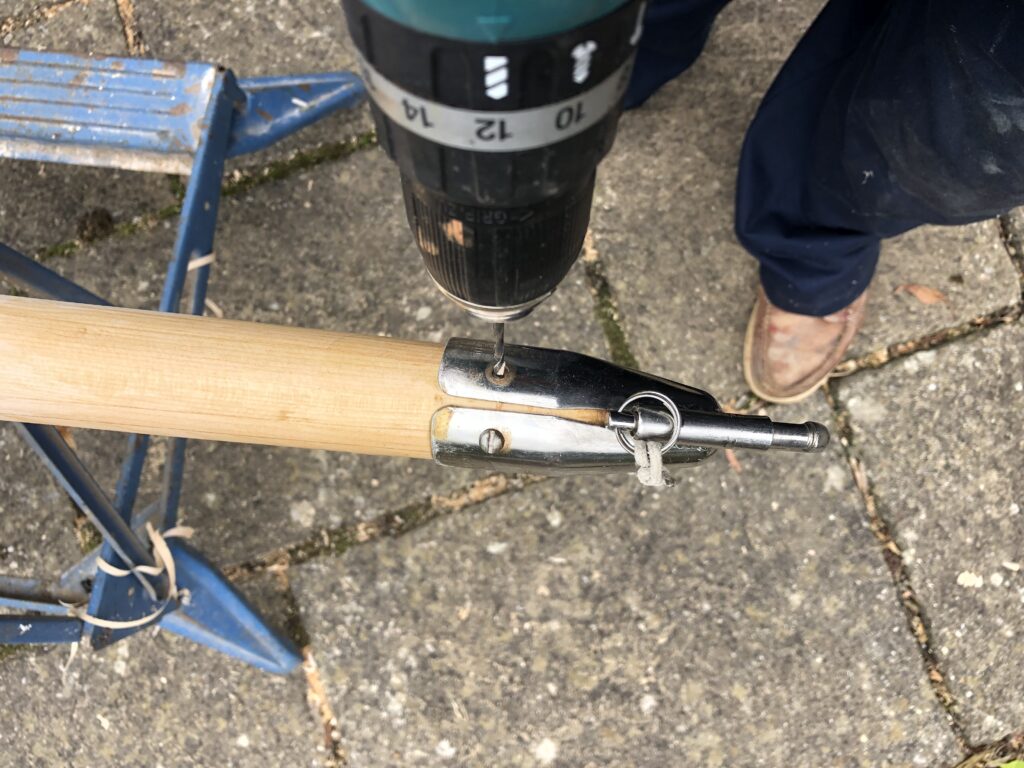
The outer pole is designed to run in housings I made from stainless steel and is secured by a pin.
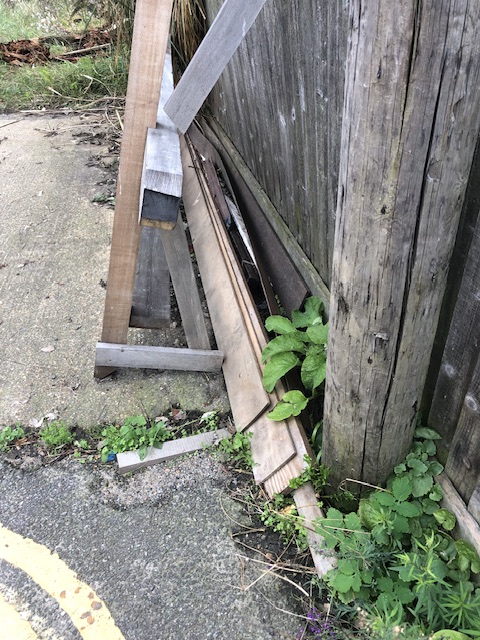
I researched on line for suitable timber – it could be ordered at great expense. So, thinking that a couple of the Maldon boatyards might have some, I had a wander. Jim at Downs Road Yard had some pieces of Douglass Fir from a mast project but they were not of sufficient length, when section was good! So, onto the next yard. Scouting round the Shipways Yard by Marine Store, I spotted some suitable timber – the yard asked me to come back in a a couple of days and Adrian (manager – and boat builder/repairer) would sort me out…
A little pile of Spruce…
Returning to the Shipways Yard, Adrian remembered me (and the mate) from a couple of visits over recent years staying at the yards visitor berth. We had a natter about ‘the Finesse’ – it transpired that he had been the man who converted F24, No.5, Mariette to gaff rig some fifteen years ago. Adrian was saddened to hear that the boat, as far as I knew, has been languishing in a rill at the Benfleet YC. Hey Ho!
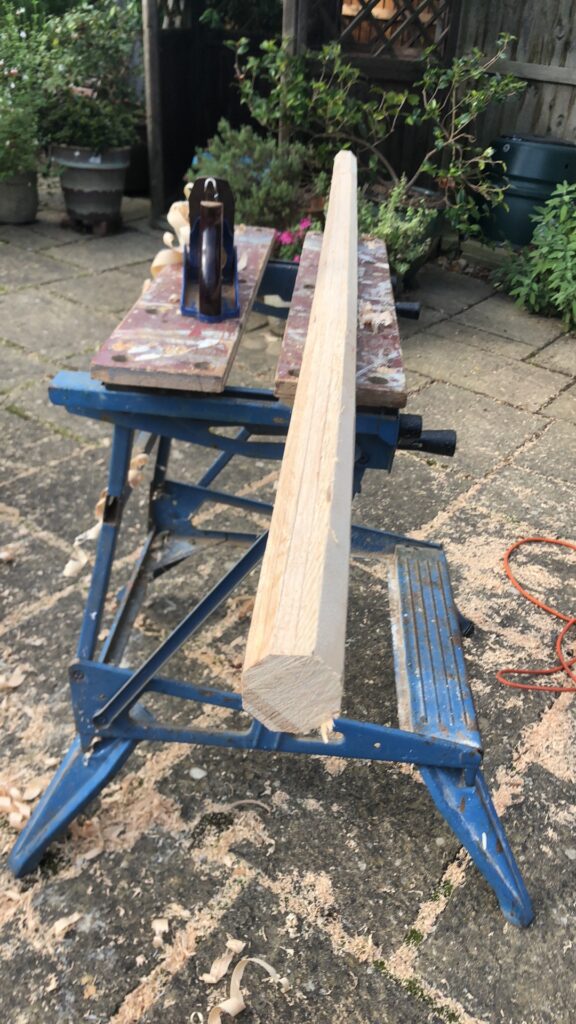
Anyway, Adrian grabbed a couple of planks from a little pile of spruce planking and after ascertaining that I had neither a band saw or planer he proceeded to reduce the ‘grey’ boards of spruce to a number of battens making up a little over the finished size of the pole… Thirty quid!
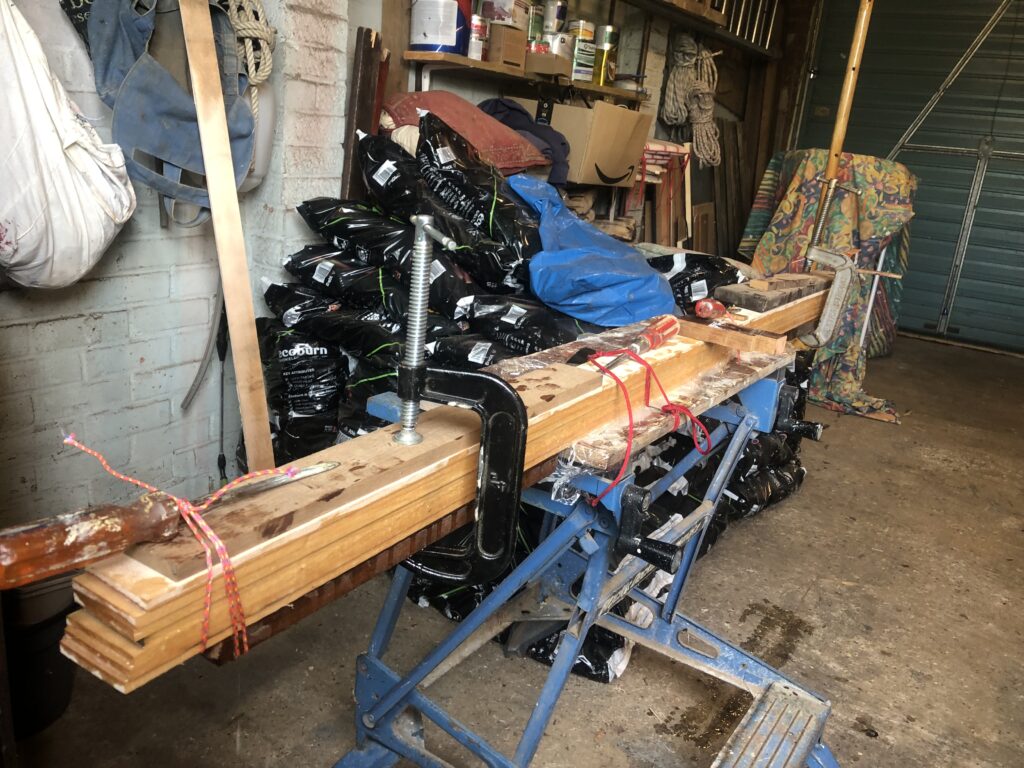
Sufficient battens being glued up…
I had to order up a West epoxy kit and as soon as it was delivered the battens were set up on a bench then glued and clamped.
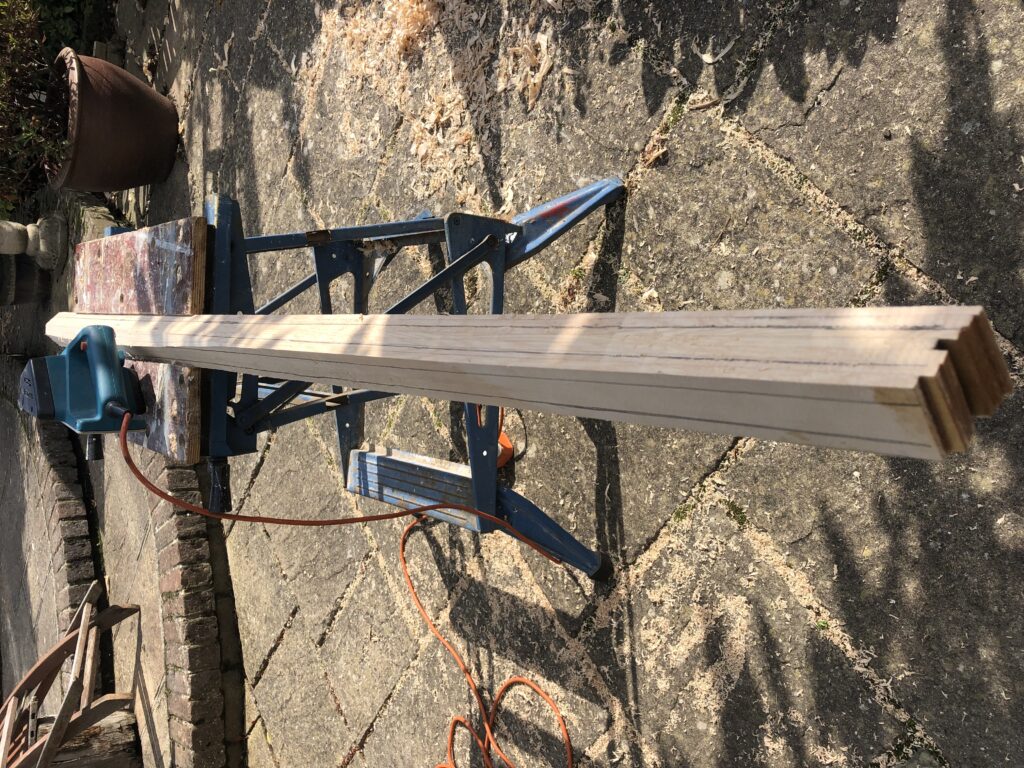
The glued assemblage was left to cure for a couple of days before I set to and began squaring off. Our ‘boy’ who was fortunately working from his home popped over with his rudimentary but effective planer which saved some graft!
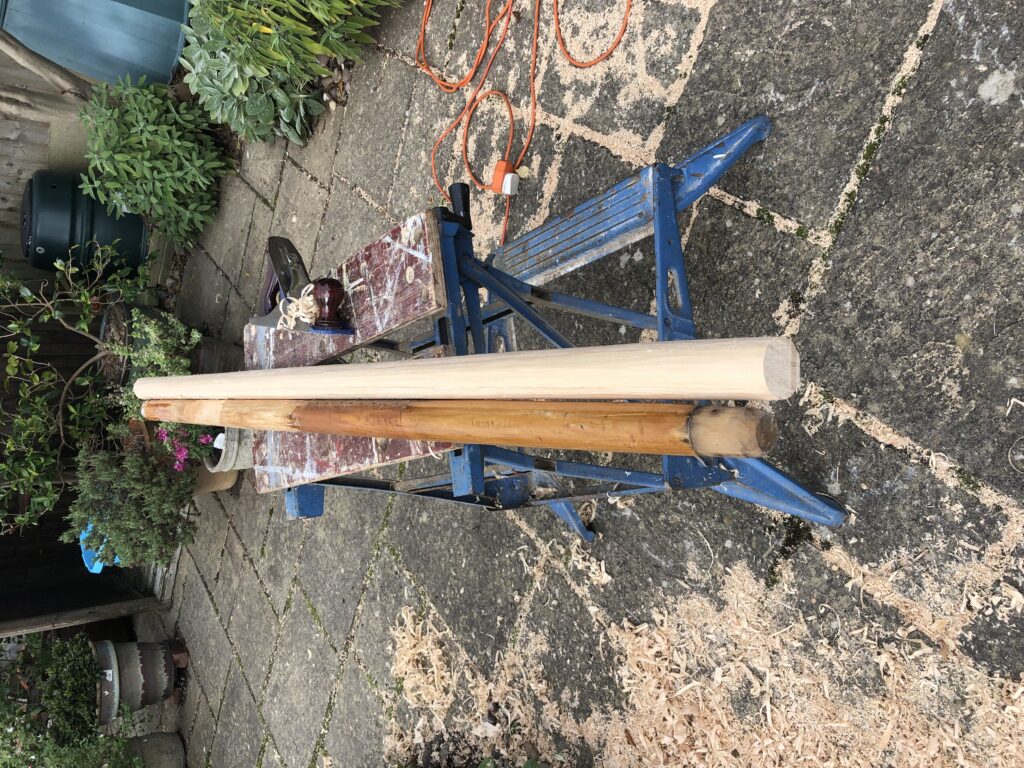
Squared and all set for shaping the eight sides.The pole eight sided and ready for rounding.Rounded pole next to the duff one.
Once all the shaping with plane and then a spoke-shave was done, the pole was sanded until I was satisfied it looked and felt right.
The next job was to reassemble the housings for the outer sliding pole. Fortunately, I had been able to remove these without damaging them and a quick sand to remove old epoxy glue and they were ready.
Fitting the housings.
The inner end where the mast fitting was to be fitted was given several coats of varnish prior to its final securing. That done, it was over to the varnish brush and a steady daily build up of eight coats of urethane varnish.
Securing the mast attachment fitting.
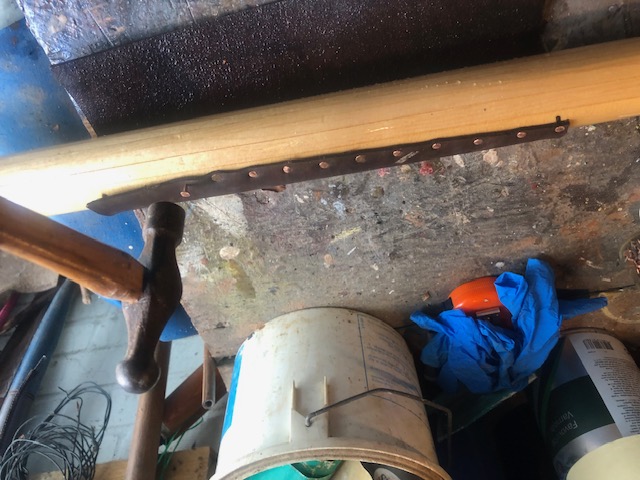
Once the varnishing was completed the new pole was re-leathered where the pole can come up against the forward mast stays.
Securing the leather with copper tacks. Note the lamination lines…
The set up was originally a single pole made from the boom of Mirror dinghy 959 dating back to 1963, which I had played with for many years of childhood, as had my siblings too. The dinghy ultimately came my way and even Christobel ‘enjoyed’ a few jaunts out in it…
The reassembled completed pole ready to go back aboard Whimbrel.
Within a short time, I decided that an extending booming out pole was required but did not want to go for the typical aluminium poles seen aboard cruisers. It was a kind of ‘magic moment’ when I contrived the idea of a sliding assembly in housings similar to the system in use on spritsail barges for housing and lowering of topmasts.
Oft referred to as, ‘You Play with Your Toy, I’ll steer…’ by the mate, it has worked extremely well with its adjustment ability to suit set of both the working jib and Genoa.
It was an interesting project. The laminations of the new pole are visible after varnishing and it all looks very strong: ready for the next thirty years, or so…
Now, if you had said to me eighteen months ago: ‘You’re going to sail to a new home soon…’ I’d have laughed outright. The mate would agree for she too, with reservations, was enjoying the camaraderie of the part of the Island Yacht Club we inhabited.
Whimbrel with sails set awaiting sufficient water to depart. Note the pontoon fenders, at bow, amidships and on outer end/corner. I had a cabin side cover made to protect from nigh on all day sun!
Weekend work party was a time to meet people and enjoy dong a myriad of maintenance and repair works.
I have wondered since how close that camaraderie actually was for the support we actually got with our prevails with the mean and bullying club hierarchy was pretty scant – no one really wanted to know. A mind set of keep heads down or I’ll be next attitude always prevails. However, that is all history now…
I wrote a post about reflecting on a ‘year of change’ on the last day of 2023.
The post lays out the facts behind our decision to break with a place we had loved. A place I wrote about, revered in words which will persist until the world crashes. It was sad, but necessary.
But, for me the sadness was almost fleeting as I busied myself into sorting out our new mooring and making it safe to come into a fixed fender protected pontoon.
Sailing out from between berthing pontoons in early January 2024.
We have now enjoyed a little over a year in our new home.
The yard has been very helpful. Yes, any services have to be paid for, but that was the case at the club. They are though a little more expensive. The mooring more so, but, as our son said, ‘you can’t take it (the money) with you dad…’ Indeed not!
The manager, Beccs, made us up a new floor board to replace one that got a stress fracture after Christobel crashed down onto it – a story to tell! I only asked if there was a piece of scrap offcut in the yard … there wasn’t a charge!
New floor board cut to shape – it only needed sanding and painting. Crack in old can be seen…
As always, I remain proactive though and if a fault is seen, I report it: staff do not always see things, and if deficiencies aren’t reported one cannot complain about them not being fixed!
At the end of February the propeller key failed as I was leaving the berth to go out. It wasn’t until clear that I fully realised as the pop rattled and knocked beneath the transom as the boat picked up speed under sail. With ideal conditions to turn back, I did, berthing under sail. Whimbrel required to be lifted out. This was achieved the day after the event. The problem was resolved the same day with a new key made by a local engineering concern – used by the yard.
We were out for exactly two weeks, however the charges were for a lift, wash and return at a weekend rate…
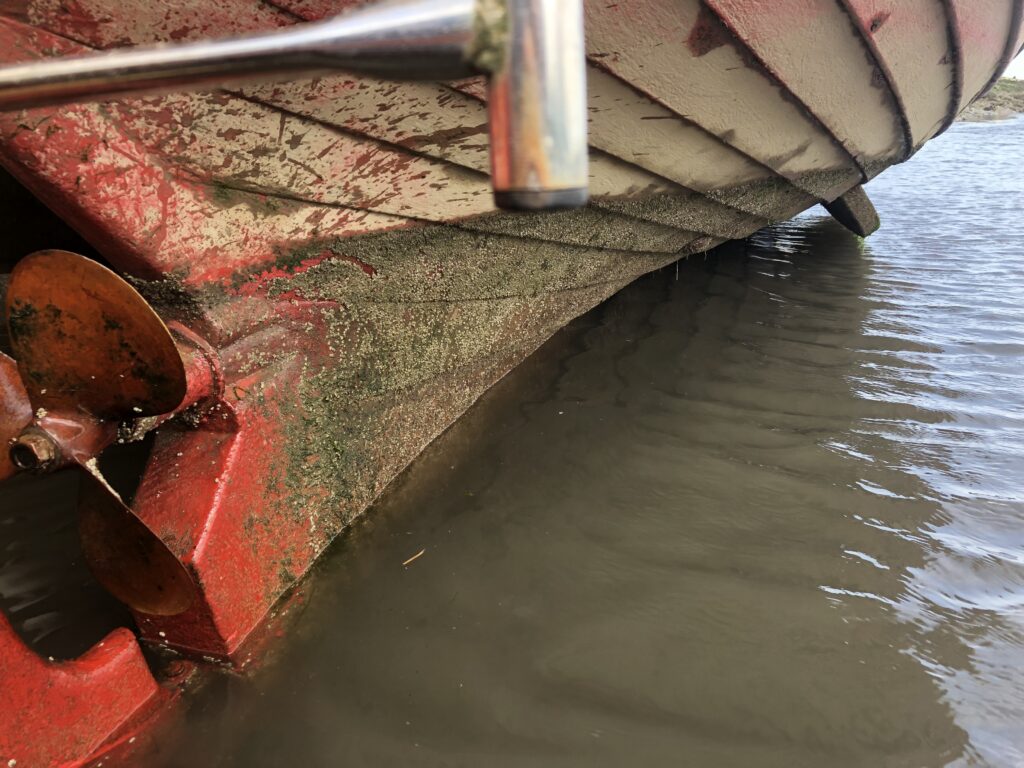
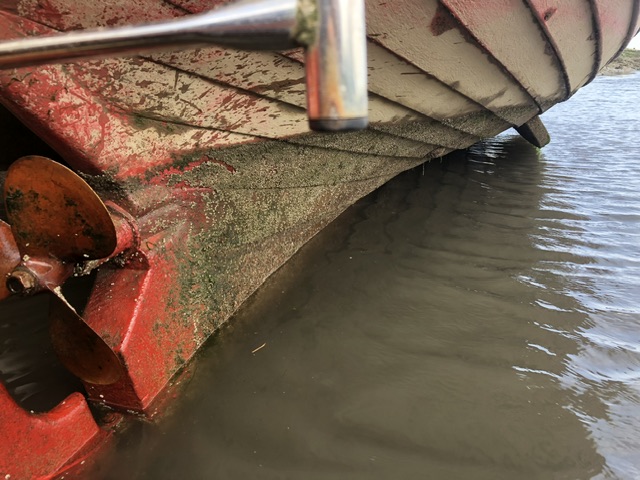
We both felt it was far to early to antifoul, but it held up well. During the summer, while sitting in Lower Halstow Dock in early August, I went over for the side for a look. It was not as bad as expected, but it needed to be scrubbed off. I set to and got to most of it apart from the middle body to port against the wall.
I scrubbed (and scraped) off most of the bottom alongside in Lower Halstow Dock in August. We finished the job on the Ray Sands on way back down from London couple weeks later!
Coming back from an overnight sail on my own in May exemplified the friendliness of the mooring holders around us. I was early by probably ten to fifteen minutes and slid to a halt short of the berth. Going ahead, the long keel prevented boat from turning.
One of the chaps ashore called for me to toss a line … two of them then pulled as I went ahead and the bow came nicely round. They didn’t need to do that, but did, for a few minutes more the tide would have allowed…
We have often gone over to the boat and enjoyed a rural walk before completing jobs on a Saturday, also, we have gone sailing when the conditions down in Sea Reach of the Thames would have kept us ashore. The wind is not really felt until well out in the river beyond Stansgate Point, when in the northeasterly to southeasterly quarter.
With the boat moored into the face of the prevailing winds, leaving is easy and returning under sail is cool, calm and collected!
Sailing in, under full sail. Conditions were ideal!
There are little differences, the Brent geese arrive a little later than down on the Thames, but they seep our way as the food sources get gobbled up and their shear numbers force a natural spreading. The terns ‘disappear’ at the same time as elsewhere, but waders, in general, are present throughout the seasons. I always look forward to the winter breeds which eventually smother the mud flats. Overwintering duck like the widgeon with their whistling call can be seen close up as they feed along the mud edges close by the boat.
Throughout the year we have a seal colony in the entrance to Lawling Creek and our regular anchorage spot when overnighting for whatever reason is almost in casting distance.
Seals in the entrance to Lawling Creek.
So, on reflection, it has all been rather refreshing. There are some regrets, there always are, but we have suffered from absolutely no stresses. I have gradually ‘washed’ off the hurt. Perhaps one day I shall write about it, but maybe not…
Oh, I mustn’t forget, cake. Yes, for we used to provide the work party regularly. Now, after our around six-weekly stints doing coffee morning at our church, a plate of spare cake goes to the yard. Boy do they appreciate it!
And on that note, before leaving the Thames, Medway and Swale at the end of August (2024), a cake, specially made by Christobel, was given to the helpful staff at Queenborough Harbour Trust.
Apparently, no one else has presented them with homemade cake since we left the area…
Tacking up River Blackwater towards Lawling Creek mid September 2024.
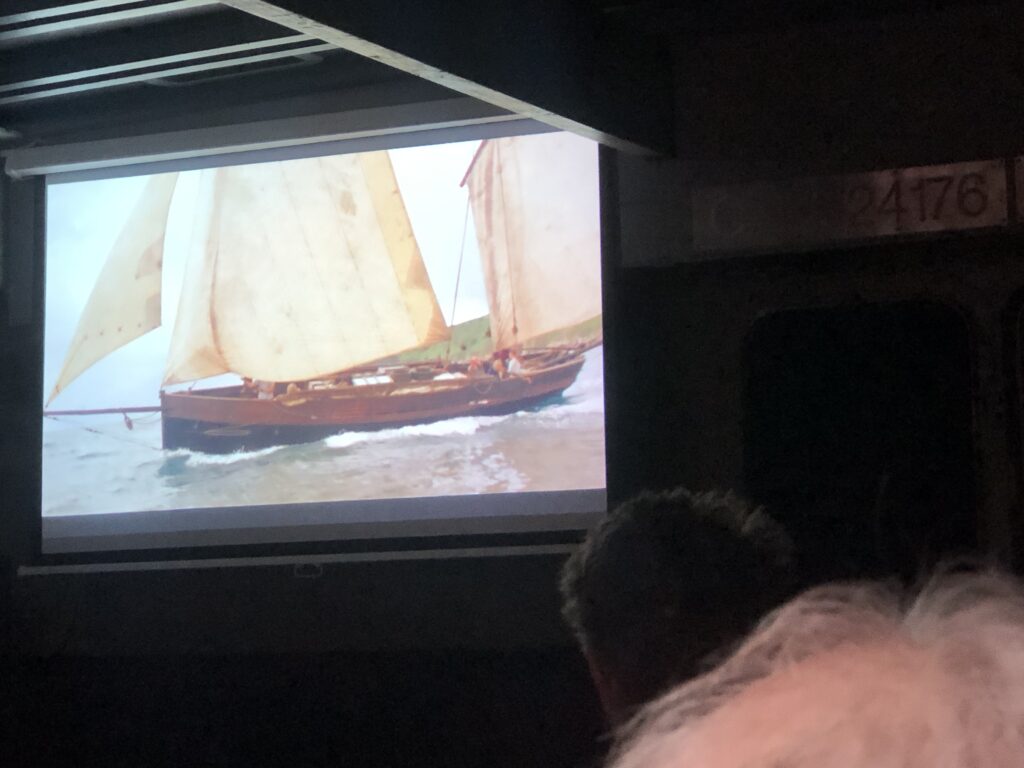
During the early summer a film was released about ‘Wind, Tide and Oar’ by a film maker and ‘ardent’ supporters of the non use of propulsive power in the boat’s belly.
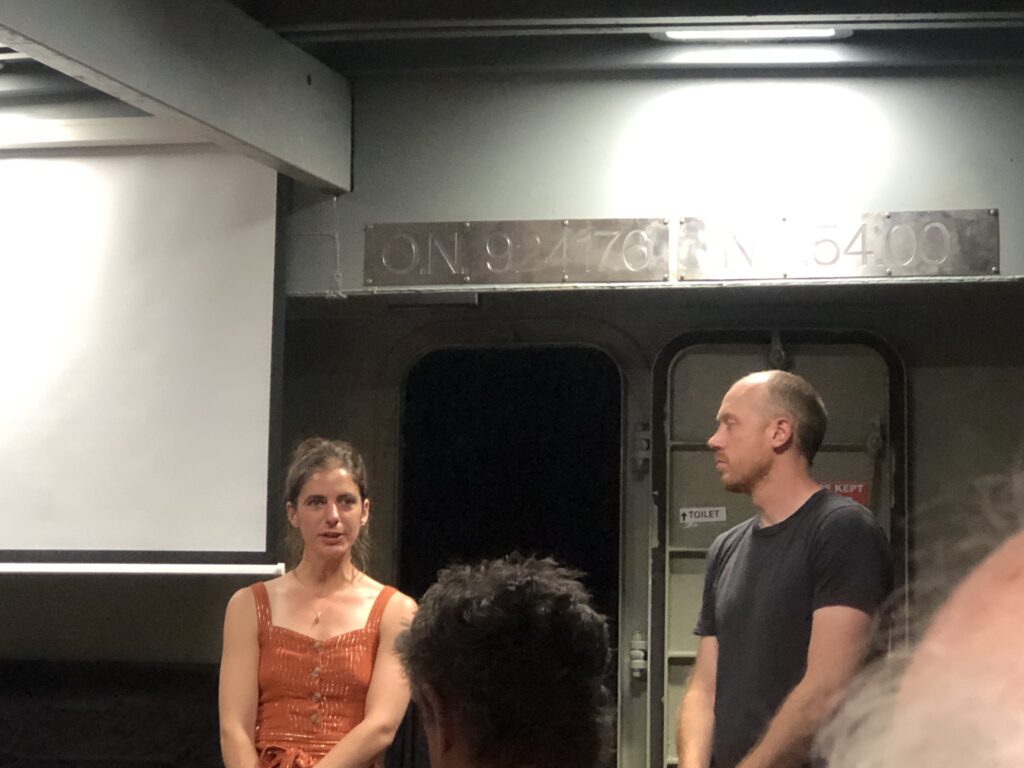
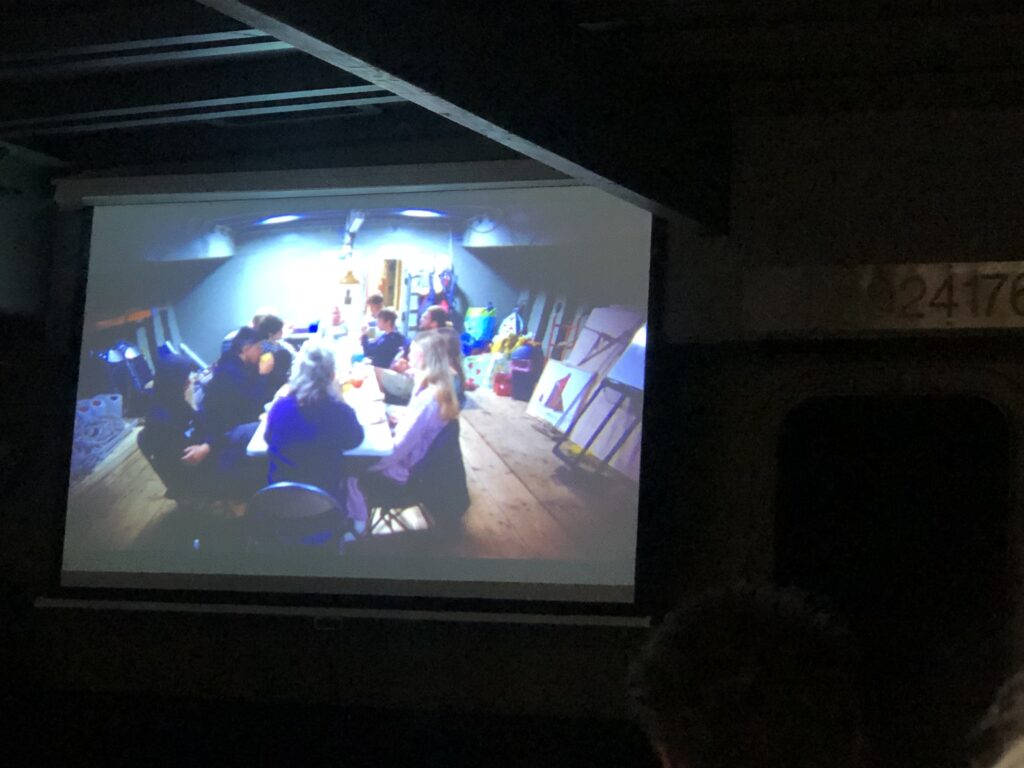
The mate and I attended one of numerous showings of the film aboard the Sea-change Sailing Trust’s barge, Blue Mermaid, which had received a grant to take the film to a host of east coast ports for public screening. The ports ranged from Lowestoft to Ramsgate, the allowable trading limits of the Blue Mermaid.
On Brightlingsea’s Heritage Pontoon, sails set, singled up fore and aft on slip lines.
The Blue Mermaid is a new spritsail barge which has gained a 110 tonne cargo carriage certificate. Unfortunately, finding such loads has proved difficult but numerous smaller cargoes gave been carried, using wind and tide alone.
Slipped, bearing away as crew clears fenders on way aft.
Now, as many will know, the diesel under Whimbrel’s cockpit floor is used as little as possible. If a passage can be safely made under sail alone, that is way it is done. During the summer period, we covered 700 nautical miles and I purchased a mere 30 litres of fuel. We traversed the Thames to St Katharine Docks twice, sailing most of those miles. Unfortunately, there were a couple of long passage trips where the engine was called into use.
The engine-less spritsail barge EDME sails off her anchorage in Pyefleet Creek.
It is the same too for departures. From an anchorage and mooring buoys especially, and a marina berth too if it is feasible without causing a hazard to others. The same is true for arrivals.
During last year a meet took place between vessels and people who followed the principle of engine-less sailing. The event was based around Pin Mill with sailing at the heart. Among a group of traditional yachts and one in particular more modern, two spritsail barges took part, EDME and Blue Mermaid. The film has footage of the goings on.
Film makers.
The film discusses the pros and cons of engine-less sailing, but something is missing, I thought, because the basics of the process of getting under way from say a buoy/anchor wasn’t covered, neither was a Marina entry/departure – the be all mooring for many ‘normal’ sailors.
Larger craft are more likely to anchor off than a ‘family boat’ but film did cover a chap with a ‘forty-footer’ moored in Ipswich where apparently sailing is not allowed in the dock. Really: I have twice in recent times sailed towards the lock!
The film had far too much time aboard a West Country Lugger to my mind – there were some good moments, nice, but what was the film time for?
The lugger Guide Me…
The Co-producers are a half brother and sister and I wondered as it progressed if this was ‘their’ film?
There seemed to be a lot of ‘cosy cabin talk’ about environment and achievements. The lady removed an engine from her boat, yet is filmed getting away from her Maldon berth with aid of motor boat … not really in the spirit!
Christobel wanted to ask her whether or not she would sail with a young baby aboard without back up propulsion – would she feel different?
Christobel ready to drop headsail…
Over the forty plus years of owning Whimbrel, the mate and I have developed well honed routines, well practiced and regularly accomplished: reliance on one’s engine with a sailing vessel is unsatisfactory seamanship.
Knowing you have learnt how to get your boat to do what you want strangles the ‘fear’ of having to carry out such manoeuvres when a need comes along, as it surely will with a mechanical device tucked away under the floorboards…
Headsail dumped…
It is fun too to achieve what you want – Whimbrel tracks far better under sail or momentum than under power. A gentle touch of helm is instantly answered. Note below: she is gliding towards the mooring pontoon, speed slowing allowing time to step over, pick up the forward spring, drop it onto cleat to arrest her.
Slipping into berth with boat’s momentum driving her.
I do it alone too, using a short line onto the outer pontoon cleat. Sometimes a boat hook is called for, but no one has been hit or any damage done to ourselves.
Back to the film – cargo sail is discussed. As a retired Marine Engineer Officer, I am fully aware that the maritime world is working on ‘sail’ assist, but a general reversion to sail is not credible.
Whimbrel in Lower Halstow Dock – ashore is a stack of timber delivered by spritsail barge Blue Mermaid for works needed aboard the Ardwina, astern of us, inboard of the Tollesbury.
Yes, there are cargoes very suited to sail transit, but these are limited in scale. There are sail cargo operations in various areas of the world – to take on containerisation, not a very likely prospect!
I thought the film was somewhat naive in this respect, as was forcibly put by the ‘chap on sitting on my left’ – Michael Everard. Michael is a member of the British Shipping Council, and ex director/owner of Everard Shipping. (Interestingly, but outwith this post, we had a bit of a chat about ‘history’ back to the last trading matches and the destruction of the Everard vessels… I also talked about my RFA life and ships in general.)
Afterwards, talking to the ‘story teller’ at the event we attended aboard the Blue Mermaid in St Katharine Docks – we travelled up from Faversham by train – I suggested, tongue in cheek, that she read my books about the changing coast and environment: there are others like me out here who espouse similar feelings and have been at it for a long time… Not a new fad to fit the climate change warnings.
The film was worthwhile viewing and it contained food for thought. The total reliance on wind, tide and oar is a pipe dream though: as Richard Titchener of the Sea-change Sailing Trust said, even the Blue Mermaid needs a pluck by a motty boat at times, and, they and other engine-less spritsail barges use the barge’s boat with an outboard in windless conditions when the need arises…
Filming aboard the Blue Mermaid – note lamp ‘swinging’ above the table – from May Flower…
For me, the film is far too long – forty minutes could be cut to deliver same message, I thought. I hope some radical editing takes place if it goes further.
The book: https://www.waterstones.com/book/wind-tide-and-oar/huw-wahl/artur-jaschke/9789083384122?sv1=affiliate&sv_campaign_id=626889&awc=3787_1726593924_014433b8788178fa393cc2f988760242&utm_source=626889&utm_medium=affiliate&utm_campaign=Preisvergleich
The film web site: https://www.windtideandoar.com/
The mate had expressly asked for a visit into Tollesbury – it would only be an overnighter: tomorrow will be our penultimate day.
Besides, I wanted to ‘raid’ the local butcher’s shop for a proper pork chop, cut to order!m. Our ‘last supper’ tomorrow night.
We were only moored in West Mersea, so it was not a long passage!
Sun came up as we departed!
We left under sail and crept away down Thornfleet against the flood before crossing towards the Nass Spit. It was then a run towards Tollesbury Fleet.
The sun behind us…
Entering the Fleet in mid channel close to line of moored vessels, a ‘day fisher’ roared directly at us, the mate made a course adjustment, he kept coming. After a swing to starboard by us, he swept past at full chat – he had acres of water and depth to his starboard side. But he was a day trip fisher – an absolute buffoon!
It didn’t spoil our magic for long though as we crept along nicely with the last of the flood.
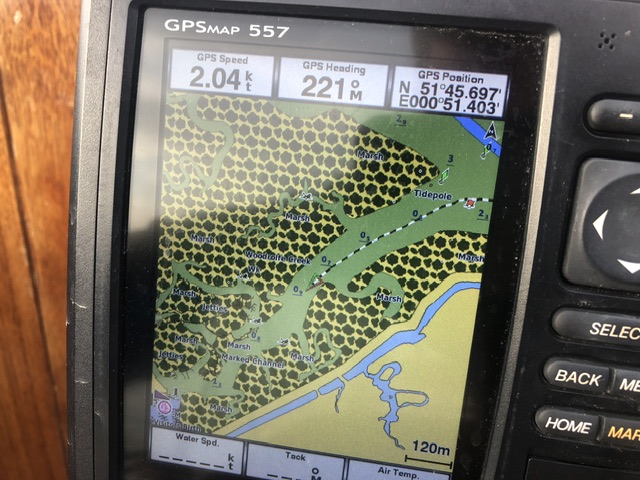
Entering Woodrolfe Creek.
Coming to Woodrolfe Creek I spotted a couple more vessels motoring out, both slowed on approach, waved and went on.
‘Thank you..,’ we both mouthed! What a difference a bit of acceptance makes.
The eastern saltings has a sprinkling of moorings – some with ‘abandoned’ craft …
The creek has saltings moorings on both sides, the predominant clusters are to the west, where the HQ of Fellowship Afloat is based on an old light vessel.
I nodded as we passed the two creeks holding the rotting remains of the Saltcote Belle and Memory – spritsail barges long abandoned.
The saltings was lush with growth but I felt it won’t be long before a late summer and autumnal hue pervades for it isn’t long to the change of seasons.
Sailing through a no man’s land…
Off the Lightship, our mainsail was stowed and we slowly crept on under jib: the flood was nearly done.
Little did we know that we were being watched: later the Marina manager wanted to know about boat and dinghy!
Jib down and pushed out of way under Genoa … mate at ready.
Finally, on the approach to the marina’s cill, the fickle breeze died. The water had the look of a glassy millpond. It was no good – the iron torps’l was called into action.
We berthed a few minutes past eight, in time for a quiet breakfast!
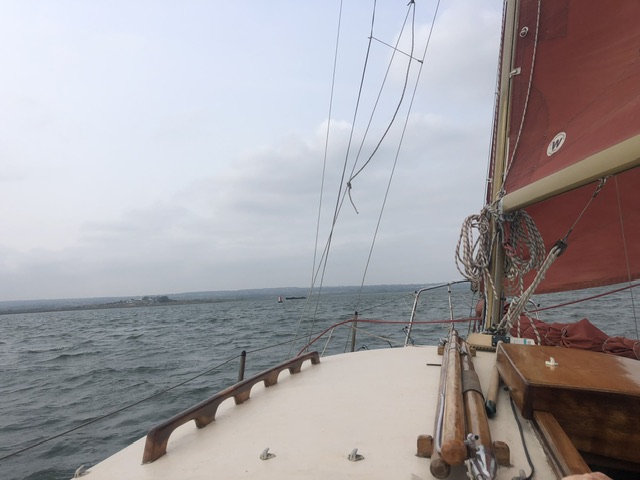
We were bound up the River Medway from Queenborough to Upnor. It was a calm start with just enough puff to fill main and Genoa. We crept slowly away from our buoy, gradually slanting across tide towards the shallows.
Soon after beginning to reach up Saltpan, a rapid increase in the wind strength persuaded me to change headsails: short tacking was going to be the order, with my proposed plan.
Creeping away. The mate held the Genoa out with the boathook.
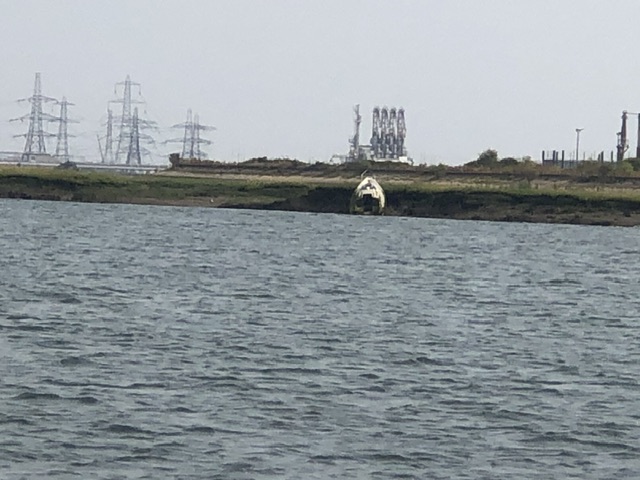
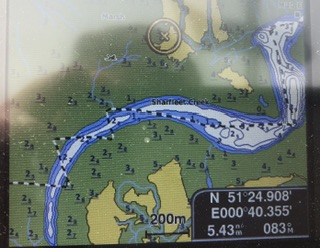
Entering Stangate Creek, a couple of tacks were needed to reach Sharfleet Creek. On the way I gazed upon two abandoned GRP boats languishing along the east bank of Tailness. One was abandoned after a grounding then sinking after firing off the saltings edge, the other is clearly a ‘break away’.
My belief is that these craft should be removed by the harbour authority before they become a hazard or begin to break up: the GRP content in sea water is something scientists are currently worried about across the world (see my post on the USA solution..).
One of the abandoned craft. This one stranded and was abandoned. Another sits a little south perched on the side of the sea wall.
Entering Sharfleet we got round in the natural tacks allowed by the wind.
We have not been into Sharfleet for two years and I was flabbergasted by the break up of the tounge of saltings running out south that was once part of Burntwick Island. Marsh loss has been huge judging by the remains island’s size – there were many visible tidal cuts into the soft clay.
A cruiser motored through the tide scoured channel that appeared a decade or so ago: perhaps it could become the main run of Sharfleet in time as what is left is rapidly being eaten away!
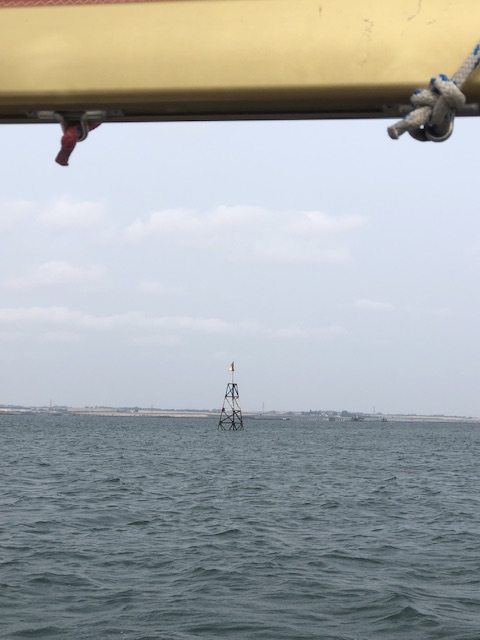
The beacon that once stood by Captain’s Creek. The various ‘Medway’ beacons are a throw-back to the river’s naval days. Some have remained useful to us hiatuses!
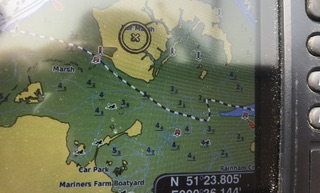
We tacked round the banana curve of the invisible western end of Sharfleet west of Slayhills Marsh using echo sounder and satnav before crossing the ‘Upchurch Saltings’ (mudflats now) into Half Acre Creek.
Route… round Sharfleet.
Upon Slayhills Marsh, a large vessel has been washed up. I know nothing about it, but will endeavour to find out! She sits at an angle of early forty-five degrees and is so far in she is very likely to be in her final berth.
Approaching the Otterham Creek buoy. Note the wreck in distance of Motney Hill – an old dry dock caisson.
The breeze was too strong to allow any saline scented wafts from the sea drenched saltings to reach us and boat speed was varying between 3.5 to 5 knots. My memory placed those senses for me though…
Way out in the main river, several largish yachts were motoring upstream (Why?) with the tide. One of these was astern of us as we later swept into the juncture of Pinup and Gillingham reaches!
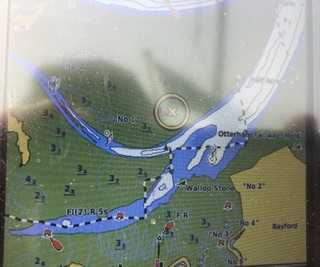
Route… Half Acre into Bartlet Creek.
It was a rapid beat southward to the Otterham Creek buoy which also marks the juncture with Bartley Creek and the South Yantlet. Our course was along the former towards Horrid Hill, on an isthmus running north out of the shore – all now a designated country park.
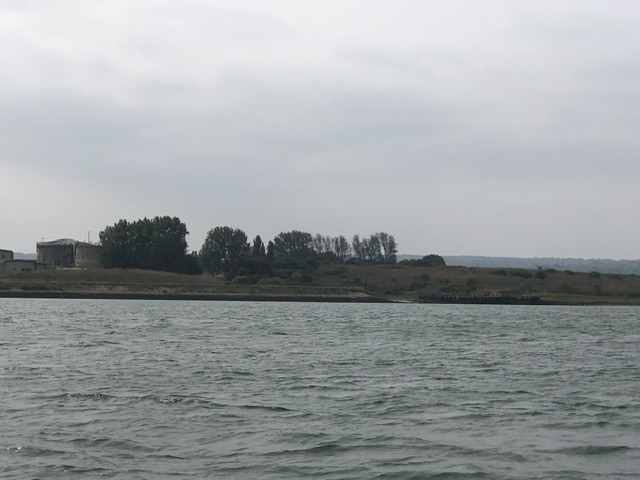
Passing Motney Hill first, I looked into the old dock on the end of this tail of land to the west of Otterham Creek. It’s an old brick and cement dock, still in a remarkably good condition. Motney is home to a huge sewage treatment works and it’s ping wafted over us!
The old Dock under Motney Hill.
As we reached up Bartlett, I gazed back at the spire of Upchurch Church, where my mother designed a millennium window. The building’s body was shrouded by trees.
Spire of Upchurch Church. It was long used as a navigational point.
Over to the north of us we were passing by the tide soaked saltings of Nor Marsh Island which once boasted a farmstead and hundreds of sheep. More GRP craft could be seen washed ashore…
Underside of Nor Marsh Island. Note the ‘white’ GRP hulk.
A short tack was needed into Rainham Creek which runs to a boatyard at Marina’s Farm, a place used for winter layup locally. Horrid Hill was passed with its strategically placed ‘lovers’ benches shielded from each other by natural scrub.
Horrid Hill for many years was home to a cement making complex, it’s old wharves and building debris remain.
Our way under Nor Marsh.
The scrub wilderness seems to suit Horrid Hill – a horrid name, for sure for it is a habitat for bird life etc.
Horrid Hill.
Our inside route passage rapidly came to an end as we shot past a red buoy marking the channel across an old causeway, across the mud flats bordering the south side of Pinup Reach.
Aiming for the mudflats beacon that seems to mark nothing!
And, we left the beacon close to port for a clear reach past Hoo Ness at the western end of Hoo Island. We caught up with and overtook one of the ‘dawdling’ yachts motoring home. Another remained astern of us, not pass until we’d picked up a buoy under Upnor Castle.
Wind over tide choppiness was avoided and, yes, it was fun for sure.
It is not likely that I’ll have the opportunity to do it again for a while, or, as I wryly said to the mate, ‘if ever…’
P.S. this passage has been written about in various of my books – ‘Salt Marsh & Mud…’ is one.
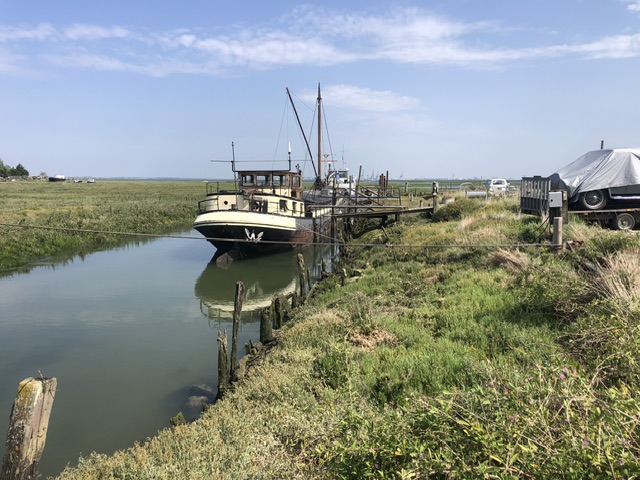
It has been a very long time since we last had a night’s stop-over in Lower Halstow Dock, back to before Edith May’s days.
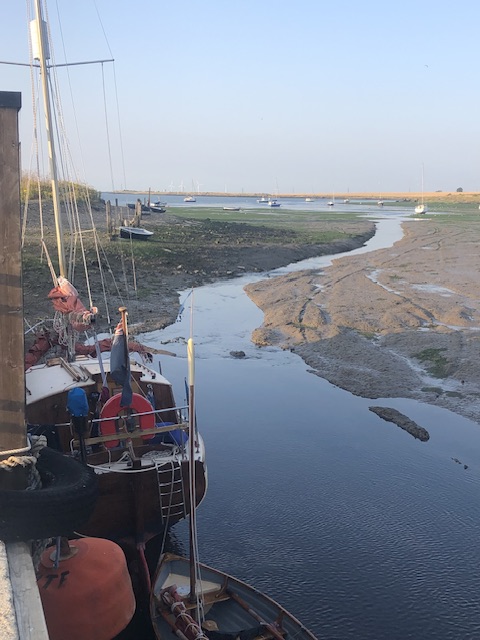
Approaching the dock under sail.
I’d contacted Geoffrey Gransden to clear our visit: the Edith May was away sailing up the East Ciast.
Christobel ready to drop headsail…
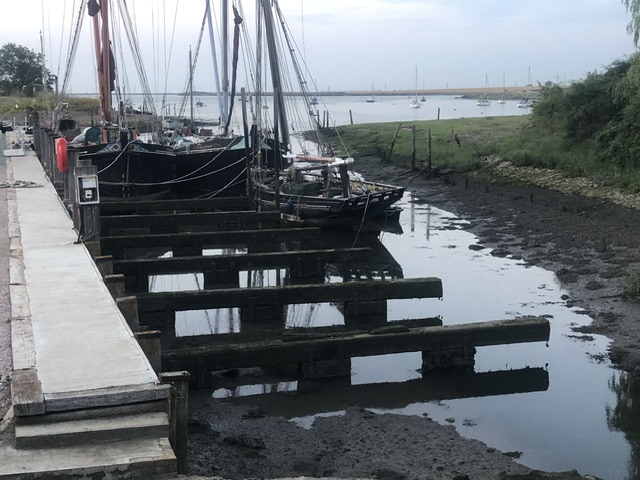
As we came abreast of the chosen mooring position astern if the TSBs Ardwina and Tollesbury, I rounded to fall back onto the wall – a touch of engine was needed, unfortunately…
After mooring, stowing sail and a coffee we were off on a gentle walk around the boundaries of L. Halstow and Upchurch. This is the land of my youth – from 1966.
Whimbrel snuggled into Edith May’s berth! The stack of timber was brought into the dock by the engine-less spritsail barge, Blue Mermaid.
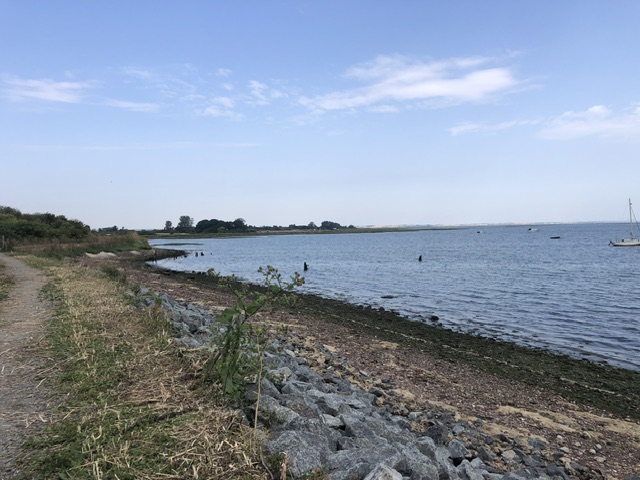
We traversed the well worn path around the top of Glass Bottle Beach where rocks have been placed along the top to waylay coastal erosion – the problem is that the land is made from landfill and is ‘soft’ – easy pickings for the sea!
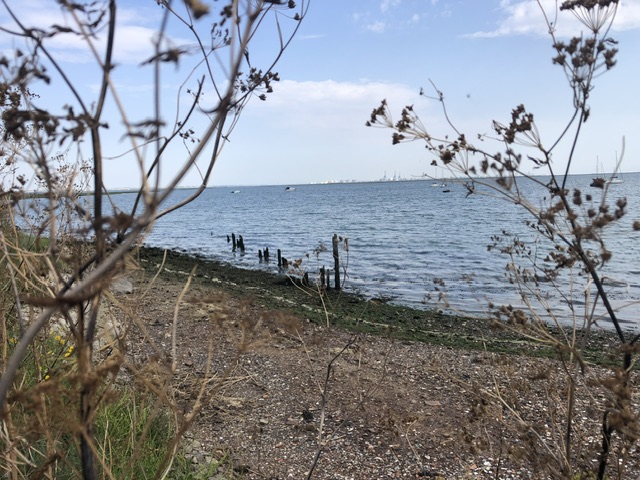
We passed by the stem and stern posts of the brickie barge Surrey poking above the tide. She was abandoned on the beach in late 1930s. Along from her sits the remains of Nile Wharf – used in bygone days by a farmer in the main.
Glass Bottle Beach with stem and stern posts of the Surrey…Remains of Nile Wharf where once bricked and farm barges called.
Along the outside of the sea wall golden banks of samphire and it’s edible cousin glasswort, lower down closer to the mud line, grew in profusion.
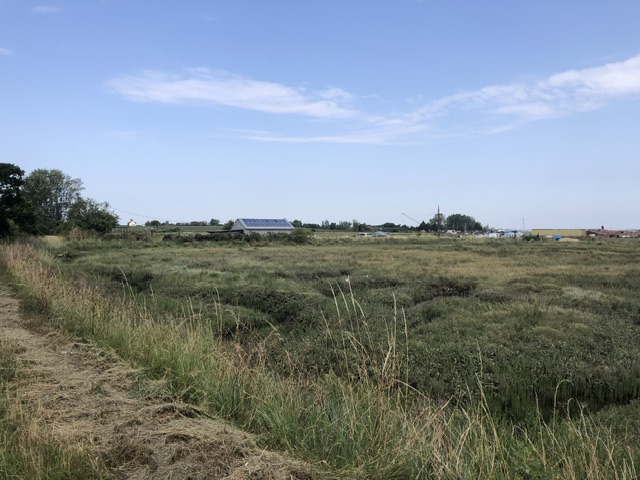
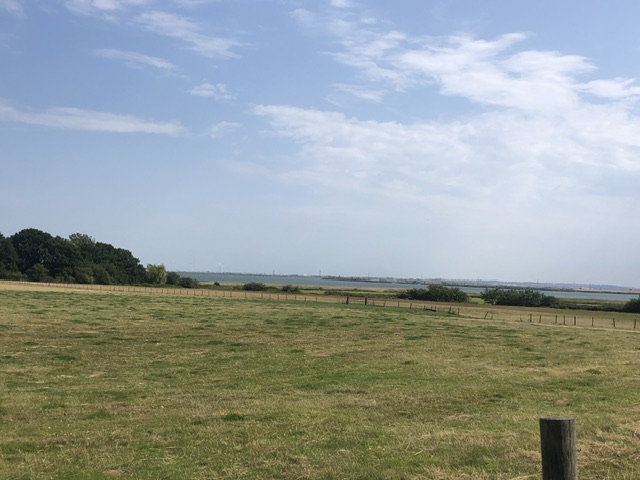
View over Twinney Saltings to Twinney Dock.
On the inside of the wall immediately after leaving the old brickwork boundary is low land, wet with reeds growing thickly. This is the dammed off grad of Twinney Creek and marks the parish boundary here. Closer to Lower Halstow’s Dock than many appreciate.
The dock served a brickworks on the seaward edge of Upchurch and a myriad of tramlines interconnected, Dock, works and brick earth sites…
Across the saltings, belonging to Twinney, sits Twinney Dock. This was the home for the May Flower chosen by my parents chose after Whitewall Creek was left behind.
The family with the owners of the Henry resurrected the dock. The dock and land was bought over the heads of my parents by our joint tenants, thus we became, unknowingly the Henry’s tenant. My father ‘went ballistic’ on getting the quarterly rent demand…
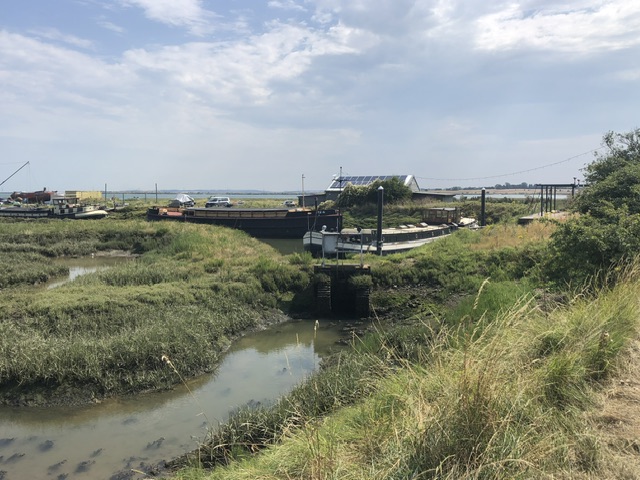
Twinney Dock from by flushing sluice.
Allotment style gardens were situated in a top corner above the ‘salt line’ – it is just grass now. The dock was purchased by current owner from those (that) owner and much gas been done to maintain a flush system, although cord grass threatens to choke the creek’s passage.
Apparently, a wedding venue is being established … stabling is already well bedded in.
May Fliwer berthed in the ‘vacant’ spot 1966-68.
My parents took a lease on Callows Wharf – long defunct but bits were still visible – where the barge was better able to come and go. A huge amount of work was needed, all family done, to make it ‘home’. That wharf too remains in use in amongst banks of cord grass towards the head of Milfordhope Creek.
View over the Lower Halstow and Upchurch creeks from Susan’s Lane
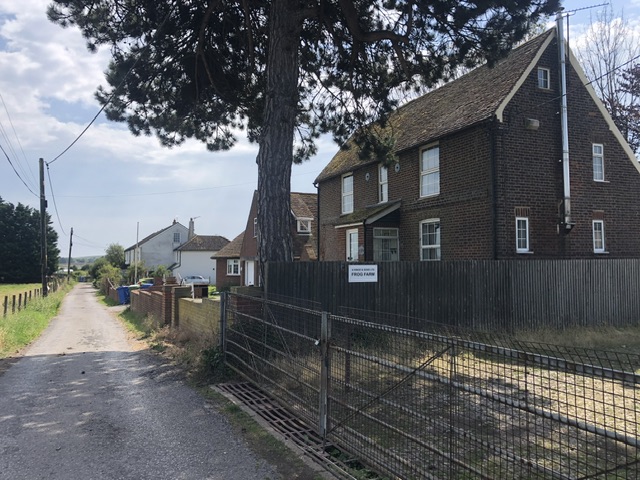
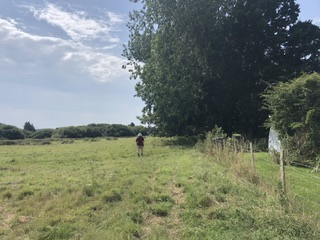
The ordnance survey map showed a path running close to the dock access lane – we used the lane! It took us to Susan’s Lane where a short walk took us to a farm house (now not a farm house) and a row of cottages – Susan’s Cottages.
Susan’s Cottages and farm house.
Turning into a field we were soon ‘lost’ for no way ahead seemed possible. Banks if nettle and thistle seemed to block the way until an oblique sort of passage was seen. It lead to a buried kissing gate (we had a kiss!).
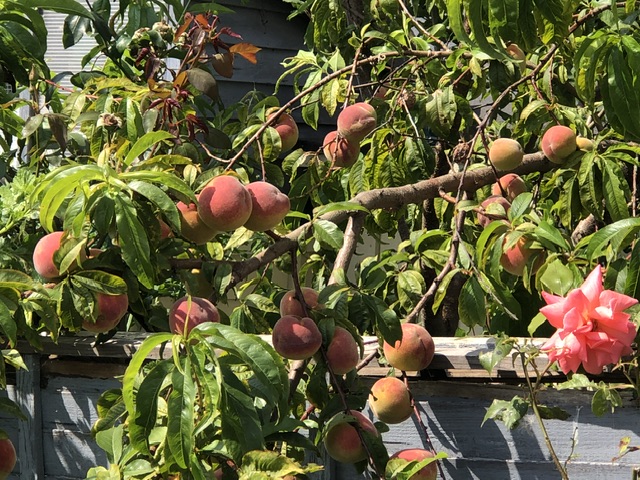
Peaches in Upchurch…Wait for me… Along a section of poorly marked pathway and barbed wire blockages!
After the kissing fate, the Lower Halstow road should have been easily accessible, however, barbed wire enclosures for ponies lay in front of us like a chequerboard.
We made our own way out, meeting a loud speaking (into a phone) young chap who wanted to know what we were about!
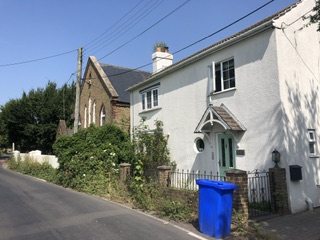
We made it to the road by the old Methodist Chapel…
Up on the low hill sits Lower Halstow old village where hundreds and thousands of bricks were made, fired and sailed to London to be used in the late Victorian building boom.
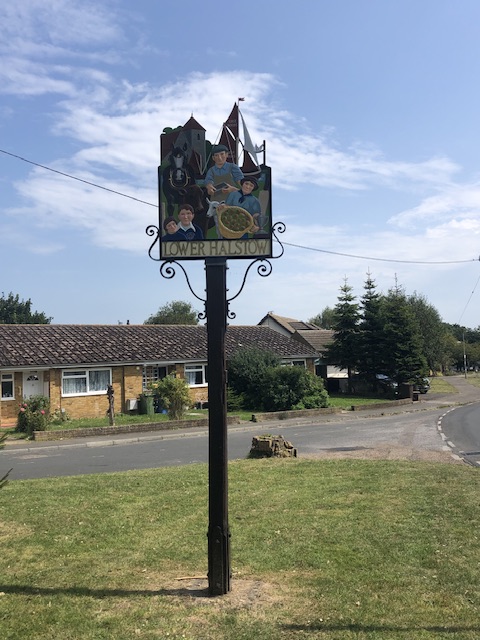
The Lower Halstow village sign – designed by my mother.
On the green, and along the manicured roads within the old brick field, sits a clinkered clump of overcooked bricks.
Following the stream leading to the dock I was again wandering down memory lane…
Back to the dock – tide has gone!
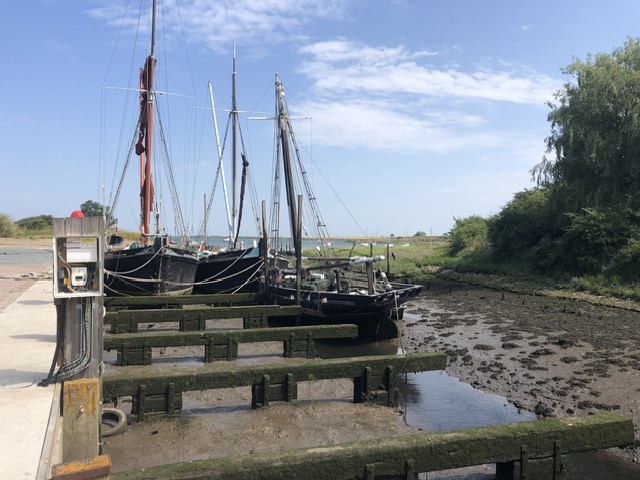
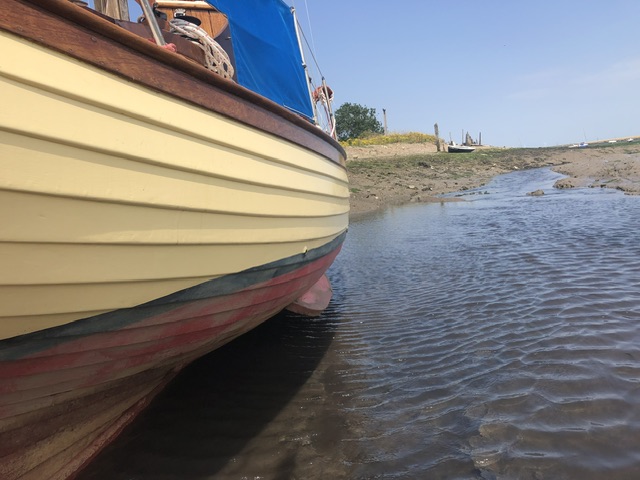
Reaching the creek we found the tide had gone. Whimbrel was leaning nicely against the wall, so thoughtfully renovated by the parish council. Twenty years ago it was far from comfortable: posts were old spars and shuttering bits of barge planking, leeboards and rudders!
Back aboard Whimbrel I looked overboard and a weed infested sight net my eyes!
Knowing that Whimbrel’s bottom was fouled, I climbed overboard, wielding scraper and broom!
Once in the creek bed, a goodly crop of barnacles met my eyes too.
I set too, scraping and scrubbing.
I did a pretty good job!
The better part of Whimbrel’s starboard side was reached as well as the port side aft quarter and fore end – the Mate can do the rest another day!
The tide returning – shows creek run.
After our evening meal, a glass at the Three Tubs beckoned…
Evening reflections…
Yes, it was a very pleasant interlude in our touring around. So interesting to see the changes at close hand, and too, to enjoy the rather lovely peaceful countryside around the watery edges of these two parishes…
In the morning we sailed away…
The next morning, with just a favourable slant we sailed off the wharf and beat away from the dock…